The post The Ultimate Skinny Guy’s Guide to Bulking Up Fast: How to Bulk like the Hulk first appeared on Nerd Fitness.
]]>
Want to go from a skinny guy to building muscle quickly? I got you.
I’ve spent my entire life trying to pack on muscle, and after years and years of trial and error, I finally cracked the code.
Today, I share that code with you! Up, up, down down, left, right…
Wait, wrong code.
This is a topic that is near and dear to me because I’ve spent my life devoted to this stuff:

These are the exact tactics I’ve used and the same strategies we use with our Online Coaching Clients.
This free guide is gonna get you started off on the right foot!
Here are the 4 parts we’ll cover in this ultimate guide:
#1) INTRO:
#2) NUTRITION:
- The most important thing for putting on muscle (your diet).
- What foods should I eat to bulk up?
- What supplements should I take to bulk up and build muscle?
#3) STRENGTH TRAINING:
- How to grow bigger muscles (get stronger).
- Skinny Guy Workout Plans for bulking up.
- Can bodyweight training help you bulk up?
- I am skinny fat: should I gain weight or lose weight first?
#4) RECOVERY, TIPS AND TRICKS, NEXT STEP:
- Proper sleep and rest for putting on muscle.
- FAQ for skinny guys trying to bulk up.
- More resources for skinny guys looking to bulk up.
We also have nutrition guides, shopping lists, and workouts you can download for FREE when you sign up for our newsletter.
Alright, let’s get to it!
How I Bulked up After Years of Struggling as a Skinny Guy

Growing up, I was always the scrawny, skinny weak kid.
There was a reason I dressed up like Superman every other day for the first six years of my life:
Superman was strong, big, and powerful…and I wasn’t.
To this day, it’s still a big challenge for me to gain weight or build muscle.
When I was cut from the high school basketball team (for being bad at basketball, mostly), I decided I needed to get bigger and stronger, so I signed up for a gym membership to get big and strong.
Within five minutes, I had almost killed myself when loading up way too much weight for a set of bench presses.
Fortunately, I survived and thus began my love affair with strength training.
I spent the next six years training in a gym, reading every muscle and fitness magazine I could find, drinking protein shakes religiously…and had about 3 pounds of muscle gain to show for it.
I just assumed “I’m one of those people who can’t gain weight.”
It turns out, I was doing it all wrong.

After graduating college, I moved to California, signed up for a gym membership, and received a few free personal trainer sessions.
Although I thought I had known it all (I had been training for 6 years in a gym! I read the muscle mags! I was in good shape already!), I still took the free sessions for the hell of it.
I’m so glad I did!
The trainer drastically simplified my workout and DOUBLED the amount of food I was eating.
I thought he was crazy at first, but I stuck with it.
In 30 days, I had put on 18 pounds (pictured below), increased the strength for ALL of my lifts, and felt more confident than I ever had before in my life.
That’s when the lightbulb went off in my head: turns out I had been telling myself a lie.

Thus began a radical redefinition of how I thought the human body worked, how muscle was built, and where I needed to put my priorities.
Since then, I’ve spent over 15 years learning everything I can about how muscle is built.
A few years back, I took an epic 35,000-mile trip around the world, and despite not having access to a gym for 6 months, I managed to pack on even more muscle and get myself in great shape without once picking up a weight (pictured below):

Again, my world was turned upside down.
I learned that gyms are not a requirement for building muscle and getting stronger, though a great gym workout can certainly speed up the process.
And after a few more years of up and down challenges, I had finally – jokingly – changed from Steve Rogers to Captain America (there’s a story behind this):
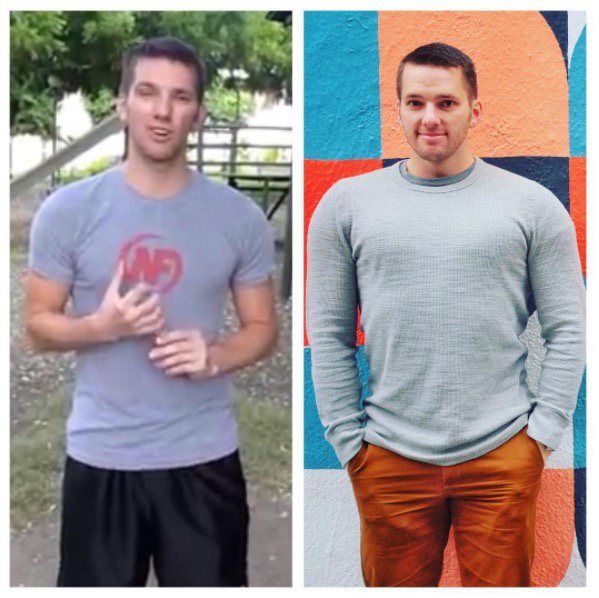
I’m still not the biggest guy in the world, nor will I ever be. I’m okay with that!
I’ve learned that anyone can pack on muscle, even skinny nerds like me.
If you’re skinny and want to get bigger, you’ll be fighting genetics the whole way, but do not let that deter you.
Today’s article outlines everything I’ve learned over the past 15+ years of mistakes, successes, failures, and adventures.
The Most Important Thing for Putting on Muscle: Eat More Food.

As they say, muscle isn’t made in the gym, but in the kitchen:
If you want to bulk up, you’d be better off working out twice a week for 30 minutes and eating enough calories/protein, than working out 6 days a week and not eating enough.
I learned this the hard way.
I spent four years of college working out five days a week for 90 minutes a day trying to get bigger.
I drank protein shakes like I thought I was supposed to. I got a little stronger but never bigger.
Why?
BECAUSE I DIDN’T EAT ENOUGH CALORIES.

When I get emails from people who lament the fact that they can’t gain weight, I always first ask about the person’s diet.
More often than not, that person thinks they are eating enough, but are definitely not.
Here’s the truth:
If you are not getting bigger, you are not eating enough.
Your body can burn 2000+ calories every day just existing (and then factor in exercise and, gulp, cardio – I’ll get to that in a minute), and you need to overload your system with calories in order for it to have enough fuel for the muscle-building process.
Want to know how many calories you burn every day just existing?
Plug your stats into our TDEE (Total daily energy expenditure) calculator:
Nerd Fitness Total Daily Energy Expenditure Calculator
Basal Metabolic Rate (BMR)
0
Your BMR is an estimate of the total calories burned a day, while in a state of rest.
TDEE
0
Your TDEE is an estimate of the total calories burned during a single day, when exercise is factored in.
Note: we have used The Mifflin-St Jeor Equation to create this calculator! [1]
For every person, the number of required calories for bulking up daily is different. You need to factor in your age, your height, your current weight, how much you move and fidget throughout the day, and how much weight you want to gain:
- For some people, it might be 2,000 calories a day.
- For others, it might be 3,000 calories a day.
- For others, it might be 4,000 calories a day.
While calorie counting isn’t required to put on mass, I think for a newbie starting out tracking calories for a few days is a great place to begin. It gives you a snapshot of your current eating patterns and helps you avoid a lot of heartache later on. No one wants to spend months trying to gain muscle only to realize they vastly overestimated how much they were eating!
(Of course, this doesn’t mean you need to track calories forever. In our coaching program, we use a combination of calorie tracking and a “Balanced Plate” approach to find what works best for each client.)
So, track your calories using something like MyFitnessPal over a few days and get an average.
I bet you’ll discover you’re eating significantly less than you thought you were.
Once you’ve learned how many calories your body burns daily…
Eat MORE than that!

How much more, you may ask? Time to do a little math.
Step 1: Calculate your TDEE (total daily energy expenditure.)
Step 2: Calculate how many additional calories you need to eat to gain weight.
- We recommend you aim to gain 0.25-0.5% of your body weight per week.
- If you weigh 150lbs, that would be 0/3-0.75 lbs per week
- Multiply that increase in weight by 3500 calories (3500 calories = 1 pound)
- In the above example, you would need to eat an extra 200-400 calories per day.
Step 3: Track your progress for 2-3 weeks and reassess.
- Spend the next two weeks eating those additional calories and see how your weight adjusts and how you look in progress photos!
- If you are not getting bigger, add 250 additional calories per day and repeat the process.
Some people will bulk up much faster by overeating more calories than this, but we don’t recommend it. Your body has a limit to how much muscle it can naturally build each week.
Everybody’s results will vary (thanks, genetics!):
- Under optimal conditions, some say you can expect to gain 1 pound (.5 kg) of muscle per week.
- My results have shown that 2 lbs (1kg) per month is more realistic.
- A 2016 study[2]revealed that strength training produced a 2.2 lb increase (1kg) increase in lean mass in 8 weeks.
When you exceed your muscle-building capacity, those extra calories are stored as body fat, not as muscle – which isn’t necessarily a bad thing. There will likely always be SOME fat put on while you bulk – it won’t be 100% muscle even for people like professional bodybuilders with great genetics.
Here are things to consider if you overeat WHILE strength training: extra glycogen, some fat, and water stored in your body can be a good thing for your confidence and get you headed down the right path.
So, don’t listen to the sites or programs that say “gain 40 pounds of muscle in two months!”
It’s going to be a slow, long process.
Yes, it is possible to have incredible transformations in a short amount of time, like when I gained 18 pounds (8.1kg) in 30 days
This was due to strength training, overeating, protein, and extra water weight (from supplementing with creatine):

My advice: Rather than massive weight gain over a month, you’d be much better off gaining .5-1.5 lbs. (.25-.75 kg) a week, every week, for several months at a time…and keeping the weight on!
Now, I know this isn’t easy.
There’s nothing worse than spending 6+ months in a gym and doing what you think you SHOULD be doing, only to step on the scale and realize that you haven’t made any progress!
If you’re somebody who’s worried about wasting time, or you want to have an expert guide your nutrition based on your current situation, consider checking out our Online Training Program!
What Food Should I Eat to Bulk Up?

Let’s go through how you should be prioritizing your nutrition, nutrient by nutrient:
- Protein: rebuilds muscle after you break it down.
- Carbohydrates: provide your muscles with fuel and your body with energy
- Fat: helps your bodily functions and can also be burned as fuel in the absence of carbs.
Let’s look at each of these individually:
PRIORITY #1: PROTEIN
Protein can come from any number of sources, including:
- Meat (steak, bison, pork).
- Fowl (chicken, turkey, duck).
- Eggs![3]
- Cheese and dairy.
- Fish and shellfish (salmon, tuna, shrimp).
- Legumes (black beans, chickpeas).
- Other vegetarian protein sources here.
As we cover in our “How much Protein do I need?”, claims for the amount of protein needed vary wildly from source to source (and athlete to athlete).
Here is our recommendation for protein consumption:
If you’re of healthy weight, active, and wish to build muscle, aim for 0.8g/lb (1.6g/kg). [16]
If you get all of your protein from plant-based sources, you may want to aim slightly higher at around 1.0g/lb (2.2g/kg). This covers for plant-based sources that don’t have as complete an amino acid profile as meat and dairy.
If you want to keep it simple, target ~1 gram of protein per pound of body weight (2.2 grams per kg).
If you’re curious, this is what a portion of protein looks like from our healthy eating article:
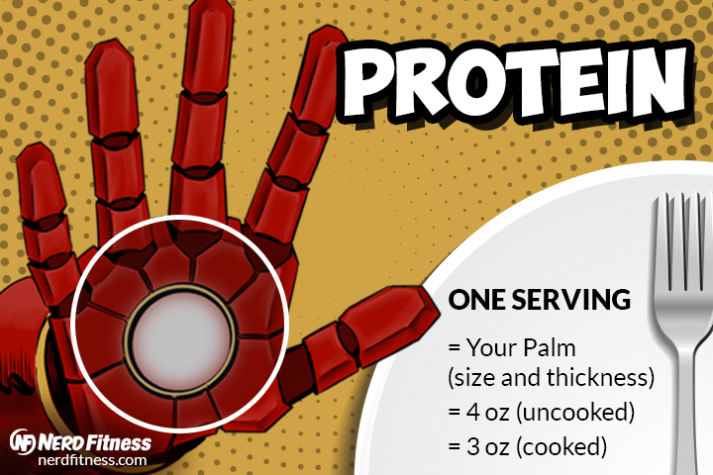
Also, here’s how much protein is in a serving of food:
- 4 oz (113 g) of chicken has around 30 g of protein.
- 4 oz (113 g) of salmon has 23 g of protein
- 4 oz (113 g) of steak has 28 g of protein.
Want to get more protein? Consider protein shakes, like so:

PRIORITY #2: CARBS
After protein, to get bigger, you need to eat enough calories, and those calories should come from sources composed of carbs and/or fats.
Making sure your muscle’s glycogen stores (which primarily comes from consuming carbohydrates) is full also helps prevent the breakdown of protein into energy (i.e. breaking down muscle tissue for energy!) That’s a pretty big deal when we are trying to bulk up!
Here are foods full of carbohydrates you can prioritize for bulking up:
- Rice
- Quinoa
- Oats
- Legumes and lentils
- Sweet potatoes
- Yams
- Regular potatoes
- Whole grain pasta
- Whole grain bread
To help you get better at eyeballing serving sizes:
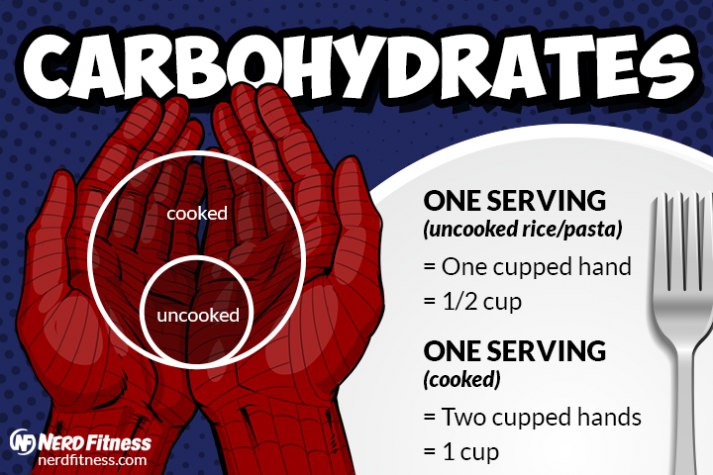
1 serving of a starchy carbohydrate is 1 cupped hand (uncooked), or your two hands forming a cup (cooked).
Here are some images to help you learn proper portion sizes (thanks to SafeFood):

In addition to consuming carbohydrates from these sources, there are tons of other great options like fruit, starchy tubers like potatoes or yams, and more.
PRIORITY #3: FAT!
Fat is a macronutrient that can help you reach your goals in the right quantity. It’s higher in calories, so a little bit can go a long way. Especially if you struggle to eat enough calories, adding more fat to your diet can help you increase your calories without feeling too full.
Healthy fat can be found in foods like:
- Avocado
- Almonds
- Walnuts
- Macadamia nuts
- Olive oil
- Almond butter
- Peanut butter
What about saturated fat? Is that OK to eat when I’m bulking up? In moderation, saturated fats can absolutely be a part of your diet! [4]. We recommend keeping saturated fats to 10-20% of your total fat intake.
Saturated fats can come from things like:
- Whole milk
- Full-fat dairy
- Coconut oil
- Grass-fed butter
- Fatty cuts of meat
- Lard
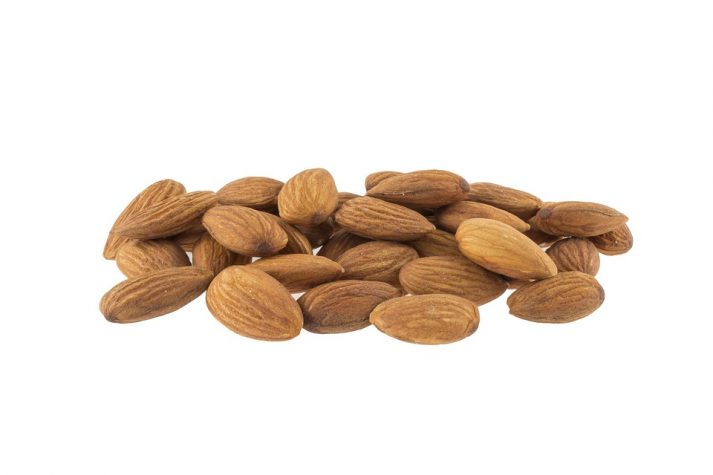
To help you gauge: a serving size of fat is roughly the size of your thumb!
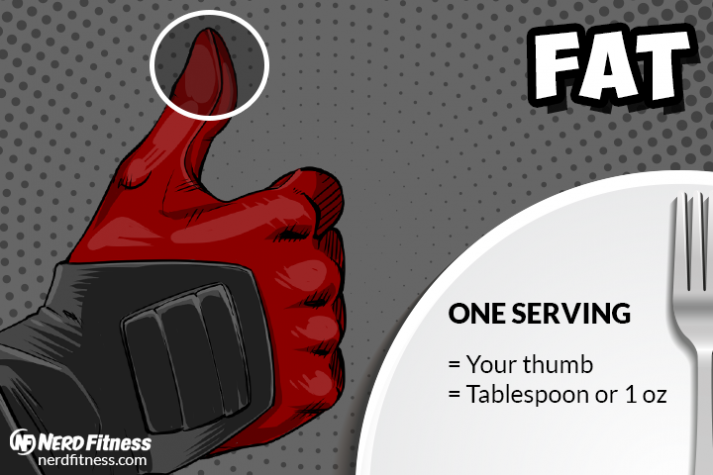
For reference, this is a single serving of almonds (162 calories):
THIS is a serving of olive oil (119 calories):
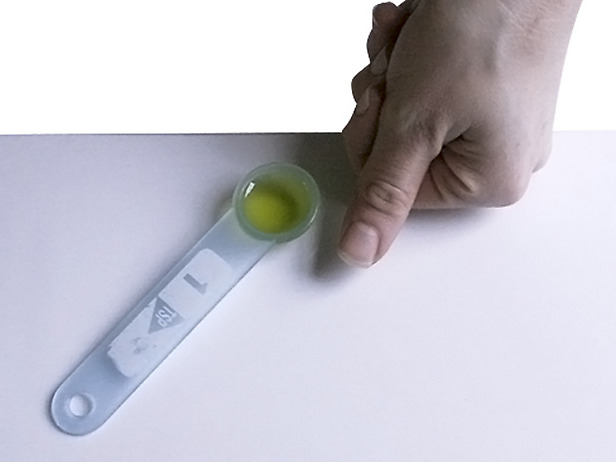
As you can see, you can eat an extra 500 calories of “healthy fats” by eating lots of “heart-healthy” fats like nuts or adding more olive oil to your meals.
PRIORITY #4: VEGETABLES!
Last but not least, fruit and vegetables.
If you start to eat a lot more food, your “indoor plumbing” is going to really benefit from eating some high-fiber veggies with each meal:
A serving of veggies is about the size of your fist.
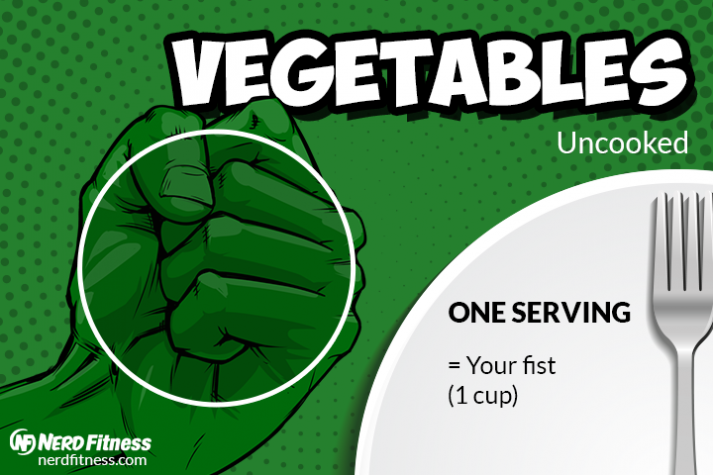
Here’s a quick, non-complete list of veggies that can fill your plate:
- Broccoli
- Broccolini
- Cauliflower
- Spinach
- Kale
- Spaghetti squash
- Brussels sprouts
- Zucchini
- Cucumber
- Carrots
- Onion
- Asparagus
BRINGING IT ALL TOGETHER:

This plate and serving size stuff above is just to help you get started thinking about healthy food differently and in proper portion sizes.
To recap:
HERE’S HOW TO EAT TO BULK UP:
- Calculate your (Total daily energy expenditure) and add enough calories to increase 0.25-0.5% of your body weight per week.
- Consume 0.8-1g per pound (1.6-2.2g per kg) of body weight in protein every day.
- Consume the rest of your calories from foods composed of carbs and fats.
- Eat vegetables to keep up your fiber and micronutrient content for your general health.
- If you are not gaining weight, add more carbs and/or fats to your meal.
It really does come down to the following:
If you are not gaining weight fast enough, you are not eating enough. Increase your portions of carbohydrates and fats!
Whenever we work with coaching clients who struggle to bulk up, this is the area we target: adding more carbs and fats to each meal.
What Supplements Should I take to Bulk up? How to eat more calories.

If you are struggling to consume enough food every day, then here are some tips to help you reach your caloric goals to bulk up:
“WHAT SUPPLEMENTS SHOULD I TAKE TO BULK UP FAST?”
Most supplements are garbage.

HOWEVER, if you are interested in bulking quickly, there are two I would recommend:
- Protein Powder. A great solution for getting extra protein and calories in your diet and building muscle.[5] As we point out in our article on protein and protein shakes, mix and match your own ingredients and see how many calories you can get into a smoothie without breaking your blender.
- Creatine supplement. It helps your muscles retain more water, and have more energy and power to push your workouts hard (which will be another key component of bulking up, adding muscle!) [6], and has been shown to increase the hormone IGF-1, which is needed for muscle growth[7].
Outside of these two supplements, you really don’t need to prioritize supplementation, despite what the muscle magazines tell you!

I’ll leave you with a couple more suggestions on how to bulk up in this section:
#1) Liquid calories are your friend. Liquid calories can give us lots of calories without ‘filling us up,’ which is an easier way to consume enough calories every day without feeling overly full.
I personally get a huge chunk of my calories every day from making my own ‘Powerbomb Shake – from our Protein Guide:
- Water: 16 oz.
- Quaker Oats: 3 servings (120g)
- Frozen spinach: 1.5 servings (120g)
- Frozen mixed berries: 1.5 servings (120g)
- Protein powder: 2 scoops of Optimum Nutrition Vanilla Whey
And here is the macronutrient breakdown:
- Calories: 815 cal
- Protein: 70g
- Carbs: 107g
- Fats: 12g
If you need even more calories consider adding whole milk, coconut milk, or almond milk instead of water.
I like to buy Frozen berries and Frozen Spinach from Trader Joes, but you can buy in any grocery store!
You can also add a shot of olive oil to add calories/fats to a shake in the quest for MOAR MUSCLE!
#2) Keep your protein intake to the lower end of the 0.8-1g/lb range.
Wait, Steve, are you actually telling me to eat LESS protein? In this case, yes! If you’re struggling to get enough calories in, I recommend you keep protein at the optimal range of 0.8g/lb of body weight, and not any higher.
You’ve already maximized muscle synthesis, so any additional protein is just going to fill you up more (since protein is the most satiating macronutrient.)
#3) Use food palatability to your advantage.
Highly palatable foods (like those containing lots of flavor, carbs, and fats) are less filling and tend to make you want to eat more of them. This is essentially the opposite advice of someone on a fat loss diet, but can be helpful if you struggle to get enough calories to bulk!
#4) Continue to slowly increase your portion sizes or add more meals throughout the day
If you’re someone who’s struggled to put on weight your whole life, a lot of that could be because you just don’t feel all that good when you try to eat more food!
There’s really no way around the fact that we’re going to have to increase the amount of food you eat, even if it’s not always the most comfortable.
If you are cooking rice, each week try adding in an extra quarter cup when you cook it.
You may have to eat at times when you don’t feel all that hungry.
This is not enjoyable. You can try to increase the number of times you eat throughout the day to help combat this a bit.
However, just like it’s necessary to force your muscles outside of your comfort zone to get bigger, you need to force your stomach outside of its comfort zone until it adapts to accepting more calories.
How to Grow Bigger Muscles: Get Stronger

When you strength train, your muscles are broken down and then get rebuilt stronger to adapt to the stress you have applied to it.
So every time you pick up a slightly heavier weight, you are increasing the challenge and forcing your muscles to adapt and get more resilient.
Specifically, what I’m trying to say is:
If you want to get bigger, focus on getting stronger.

As long as you are continually increasing the weights or increasing the sets and reps you are lifting, your muscles will continually adapt to get stronger.
This is called “progressive overload” and it. is. everything.
NF Coach Jim walks you through the ins and outs of progressive overload in this video:
If you want to dive in more, check out our guide “What is Progressive Overload?“
Follow a progressive overload strategy and eat enough calories, and you will get bigger.
Let’s dive into more specifics with programming and exercises so you can maximize your muscle growth potential:
VOLUME
Volume refers to the total number of sets and reps you challenge your muscles with each week.
For most people, we recommend starting with 10-20 working sets per muscle group per week. Getting more volume (more sets of exercises) per week resulted in more mass compared to less volume (fewer sets of exercises), in this study[9]
That might look like:
- 6 sets for your quads on Tuesday, and then another 6 sets on Friday
- 4 sets for your chest on Monday, Wednesday, and Friday
- Or 3 sets for your back on Tuesday, Thursday, Saturday, and Sunday
How you break it up will really depend on your schedule (which we’ll get to in a minute.)
What about repetitions per set? While recent studies show that any rep range from 5-30 reps per set stimulates an equal amount of muscle growth as long as the set was brought close to failure, practically, we’ve found that most of our clients do really well in the 6-15 rep range, with 2-3 working sets per exercise. [17]
INTENSITY
Remember when we talked about progressive overload? That comes into play right here.
You want to come within 1-3 reps of failure for your working sets. That means you pick a weight and do enough reps that you can only do 1 to 3 more before you can no longer perform the exercise with proper technique. [10][11]
Don’t risk an injury by trying to lift too much weight too soon, but make sure you regularly test whether you can lift a few more pounds in your lifts.
TEMPO
Maintaining tension in the muscle for longer helps stimulate muscle growth. Controlling an exercise’s eccentric phase (the lengthening portion) also helps reduce injury risk. (Though strength training is one of the safest sports in the world.)
Our recommended tempo for your lifts is this:
- 2-4 seconds slow and controlled as you lower the weight
- A brief pause in the bottom position
- Athletically move the weight back up (no need to go slower than normal here)
- Repeat
SCHEDULE
You want to train each major muscle group at least 2x/week. You can divide this up in several ways:
- 2-4 full body workouts per week – hitting major muscle groups in each session
- 2-3 upper body days, combined with 2-3 lower body days each week
- 2 days each of a “push” focus, a “pull” focus, and a lower body focus each week
For most people, we recommend starting with a full-body program. It’s more efficient (only 2-4 days per week instead of 5-6), and your body doesn’t NEED more workouts at this point to grow plenty of muscle.
As you progress, you can experiment with upper/lower and push/pull/lower splits if they work for your schedule and you hit a plateau in your training – though before adding more days, we recommend you double-check that your volume, intensity, and tempo are all dialed in first.
You can use movements like these in your full-body workouts:
- Squats
- Deadlifts
- Overhead Presses
- Bench presses
- Body rows
- Dips (assisted)
- Push-ups
- Pull-ups (assisted)
If you can focus on getting stronger with the above exercises and eat enough calories, you will also get bigger in all the right places.

Just. Keep. Eating. And. Lifting.
Skinny Guy Workout Plans for Bulking Up

As we cover in our “How to build muscle” article, here’s a sample routine you can follow NOW to start bulking up.
After you do your dynamic warm-up, do the following workout:
MONDAY BULK-UP WORKOUT:
- Squats: 3 sets of 6 to 8 reps
- Bench press: 3 sets of 8 to 10 reps
- Wide Grip Pull-Ups: 3 sets of 8 to 10 reps
- Dumbbell Lateral Raises: 3 sets of 10 to 12 reps
WEDNESDAY BULK-UP WORKOUT:
- Deadlift: 3 sets of 6 to 8 reps
- Dumbbell Incline Bench Press: 3 sets of 12 to 15 reps
- Inverted Bodyweight Rows: 3 sets of 10 to 12 reps
- Cable Tricep Pushdowns: 3 sets of 12 to 15 reps
FRIDAY BULK-UP WORKOUT:
- Front Squats: 3 sets of 6 to 8 reps
- Dips: 3 sets of 8 to 10 reps
- Pull-Ups: 3 sets of 6 to 8 reps
- Dumbbell Bicep Curls: 3 sets of 12 to 15 reps
Get stronger, and the rest will take care of itself.

NERD FITNESS RECOMMENDATION: Feel free to pick WHATEVER workout program you want from wherever. If you don’t want to follow the workout above, consider these sources:
- Beginner Dumbbell Workout
- 5 Beginner Strength Training Routines you can follow.
- Follow our 6-level gym workout routine.
- You can build your own workout routine.
- You can follow any workout from any muscle magazine.
If you’re curious, here are some commonly accepted strategies based on your goals for how many sets and reps you should do:
- Strength and power: 1-5 reps
- Strength and some size: 5-8 reps[8]
- Size and some strength: 8-12 reps
- Muscular endurance: 12+ reps
As we pointed out above, as long as you get close to failure, recent research shows that anything between 5-30 reps is about equal for muscle growth. So don’t worry too much about which path is best.
Nutrition plays the most important role in bulking up, and any strength training plan will help you get bigger.
What this means: Don’t overthink it.
- Pick up heavy stuff for 2-3 sets of 6-15 reps. Pick up a weight that is heavy enough that you could only complete 1-3 more reps with good technique.
- And then do a little bit more next time.
What’s important is that you pick a plan and follow through with it while focusing on eating enough.
After a few months, you can reevaluate and then adjust based on how your body has changed. [18]
And as we showed, feel free mix in bicep curls or tricep extensions or calf raises at the END of your workouts.
Focus on the big lifts first and get stronger with them.
How much weight should you lift? For every one of the barbell movements above, it’s okay to start with just the bar, and then add weight in 5 lb (2.2kg) increments each week.
It’s important to get the form right and get your body used to the movement for when you start to lift heavy weights.
How long should you wait between sets? Again, don’t overthink it.

Waiting 60-90 seconds puts more of an emphasis on muscular size and endurance (as you’re resting for a shorter period). Waiting 2-3 minutes allows you lift heavier weight, and thus can make you stronger.
..but don’t overthink it. Do the next set when you’re ready.
A piece of advice from 8-time Mr. Olympia, Lee Haney: “stimulate, don’t annihilate.”
Don’t destroy yourself for the sake of destroying yourself; stopping one or two reps short of maximum effort can save you from overtraining and potential injury – remember that muscles are built in the kitchen!
Can Bodyweight Training Help Me Bulk Up?

Yes, you can get bigger and stronger by doing exclusively bodyweight exercises.
Take a look at any Olympic gymnast: he is jacked, with giant muscles, all built with bodyweight exercises:

It all depends on the same rules we laid out above.
Can you target the muscle groups you are trying to grow with exercises that create a high amount of tension and take you close to failure after doing 6-15 reps?
If your answer is “yes”, then that bodyweight exercise is a great option for you! In fact, things like inverted rows, chin-ups, pull-ups, dips, push-ups, lunges, etc. are all fantastic exercises to help you put on muscle.
However, some people may find it difficult to get that right level of “challenge” with certain bodyweight movements.
Maybe you have a hard time finding upper body or bicep movements that feel good without using weights.
Maybe you can do countertop push-ups for more than 15 reps, but when you try to progress to a harder variation you don’t have any surface in your house that quite works so you feel stuck.
And that’s the crux of the issue:
Like with weight training above, you need to increase the difficulty in order to challenge your muscles to adapt.
Because it’s often more challenging to add a few pounds to a bodyweight exercise to make it tougher – compared to putting a weight on a bar, you need to increase the difficulty of the bodyweight movement itself.
You may need to experiment with higher rep ranges (15-30 reps) to push your muscles closer to failure.
- If you can do 4 sets of 15 push-ups, consider making them harder to progress. Do 4 sets of 15 push-ups with your feet on a bench.

- Bodyweight squats too easy? Work your way up to pistol squats (one-legged squats).

4 sets of 12 pull-ups not a challenge anymore? Great. Make them tougher. Try a different grip or weighted pull-ups.

I highly recommend that beginners take a serious look at strength training with free weights; it’s much easier to record one’s progress, easy to add more difficulty (just add more weight!), and very structured.
You can ALSO mix in bodyweight training! Really, it’s just about finding the group of exercises that works best for you, regardless of whether their bodyweight, barbell, dumbbell, machine, or anything else!
What it really comes down to is this: no matter what you have access to (a gym, barbell, dumbbells, or just a pull-up bar), you can find a way to build strength and muscle if you follow a plan and eat enough calories.
If you’re trying to bulk with just bodyweight, it might be worth enlisting the help of a coach to help you scale your bodyweight exercises correctly and in the proper sequence!
I am Skinny Fat: Should I gain or lose weight first?

If you are skinny fat (you have skinny arms and legs but have a gut), there are three paths available to you:
- Bulk up and build muscle, then lean out.
- Lean out, then build muscle.
- Build muscle and lean out at the same time.
We all want Door #3, right?
Here is how to accomplish both goals at the same:
- Heavy strength training…
- While following a healthy diet and slight calorie restriction…
- To decrease your body fat percentage.
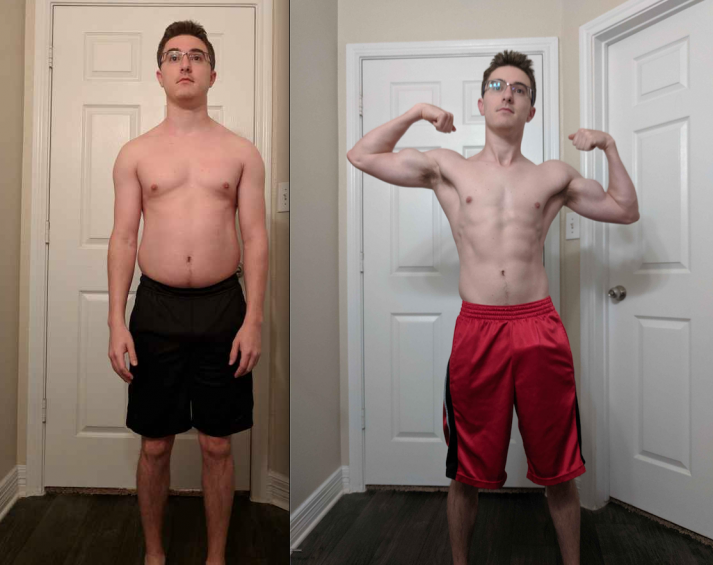
If you follow a program with the right calories and strength training, you can both lose weight AND build muscle at the same time.

It’s how we helped NF Coaching Client Jimmy (these photos are 5 months apart):
NF Coach Matt recommends the following strategy, as long as you also know there are tradeoffs!
Get strong and eat a SLIGHT caloric deficit while consuming enough protein every day.
Get yourself down to roughly 15% body fat (~25% for women), and then start to increase the size.
By slimming down first, while building muscle, you don’t have to worry about buying BIGGER clothes first, only to then need smaller clothes once you start cutting the fat.
Then, once you decide to eat more and get bigger, if you notice your body fat percentage start to creep up, you can simply adjust until your body fat gets back in the acceptable range. Then keep building!
What about those tradeoffs Coach Matt mentioned?
Anytime you focus on two different goals at once (losing weight AND building muscle), neither of those will be done optimally. You can build muscle more quickly if you focus on that as your main goal, eat more calories, and continue to challenge yourself in your workouts. You can also lose weight faster if you go into a slightly larger caloric deficit than recommended above.
Balancing these two goals isn’t necessarily a bad thing. You’ll be able to get plenty strong and lean out a bit without having to manage bigger changes in your diet, which can be easier to sustain.
If you get stuck in the future, focus on one thing at a time.
To recap, here’s what to do if you are skinny-fat:
- Eat a caloric deficit while heavy strength training to build muscle while leaning out.
- Prioritize protein intake: 0.8g per pound (1.6g per kg) of body weight.
- Get strong as hell with compound lifts and a moderate rep range (this will build muscle even in a deficit).
Once you reach a certain body fat percentage you’re happy with, then you can increase your caloric intake to build more size.
Proper Sleep and Rest for Building Muscle

Last but not least, the other important piece to this Triforce of muscle building:
Strength training, eating enough, and RECOVERY.
Your body builds and rebuilds its muscles during RECOVERY.
Our muscles generally need 48 hours or so to recover from their previous workout, so I do not recommend you do any serious strength training of the same muscle group on back-to-back days . [20]
Feel free to do dynamic warm-ups or fun exercises as active recovery on off days, but I tend to take my off days OFF.
I might go for a walk (to Mordor!), but that’s about it.
A word about cardio: if you are serious about getting bigger and stronger, lots of long-distance cardio will work against you.
It’s something Coach Jim brings up in the video “7 things I learned adding on 50 lbs of muscle”:
As Coach Matt says, when you do a ton of long-distance cardio, it’s hard to eat enough calories to grow bigger. You’re also training for efficiency rather than size, which stimulates a different type of adaptation in your muscles.

If you love to run/bike, that’s cool, as long as you know it’s slowing (or halting) your progress.
So, cut back on the running or cut it out completely.
Try mixing insprints and interval training, or even just upping your step count, if you want to keep the cardio up without having to do all of the crazy distances. You can always add it back in once you accomplish your weight gain goals.
A few words on SLEEP: You need more of it when you are building muscle.
It’s that simple.

Don’t be surprised if after a heavy deadlift day you find yourself wanting to sleep for 10 hours.
It might mean less TV or less video games.
Again, if you are serious about getting bigger and stronger, don’t neglect sleep.
FAQ for Skinny Guys Trying to Bulk Up

QUESTION #1: “But I just want to get toned, I don’t want to get too bulky.”
That’s not a question, but I hear it all the time. Do NOT worry about getting too bulky. I’ve been trying to get “too bulky” my entire life – it takes years of concerted effort to pull that off.
I’m gonna guess you have 30+ pounds to gain before you’d ever even be considered “bulky.”
That means that if you struggle with weight gain, getting to the point where you are TOO bulky would actually be a good problem to solve.

As you start to put on weight if you ever find yourself getting a tiny bit too chubby, simply eat less at that point!
So, when in doubt, always err on the side of too many calories than not enough. If you’re not sure if you should eat or not, etc.
QUESTION #2: “But I don’t want to do that stuff, so I’m gonna do _____ instead.”
Hey, go for it. Give it a month, and see how your body reacts. If you’re getting bigger, stronger, and healthier, keep doing it.

If not, come back to this article and apply the lessons here!
QUESTION #3: “I’m a vegetarian/vegan, can I bulk up?”
Absolutely. You just need to make sure you’re getting enough calories and enough protein in your system to promote muscle growth.
In order to optimize muscle protein synthesis, plant-based eaters may actually need MORE grams of protein per day (~1.0g/lb of body weight).
Beans and nuts have lots of protein; if you’re vegetarian you can still use dairy to your advantage (whey protein, whole milk, cheese, etc.).
If you’re vegan, then it’s slightly more of a challenge to get enough protein, but it can be done!
Check out our plant-based protein suggestions.
QUESTION #4: “Should I do ___ reps and sets or _____ reps and sets?“
Either plan will get you there. As long as you have your diet dialed in, either will work.
What’s important is that you pick a plan, you progress, you keep track of your results, and you consistently progressively increase the load that you are moving (be it your body’s weight or an actual weight).
QUESTION #5: “I want to get bigger and faster and have more endurance and flexibility ALL at the same time, can I do that?”
I hate to say it, but building endurance and getting bigger simultaneously is brutally difficult.

As I point out in “How to build any physique,” compare a marathon runner’s body with that of a sprinter or gymnast. Put the running on hold for a while, and focus on getting bigger: you’ll get there faster.
That being said, low-intensity cardio like 20 minutes of bike riding, walking, etc. isn’t likely to dent your gains all that much and can be good for heart health and enjoyment all around.
When you decide to mix longer distance endurance training back in, keep your calorie consumption high, and don’t forget to keep strength training!
QUESTION #6: “Do I need to eat every three hours?”
Nope, you don’t have to:
- The TOTAL number of calories you consume over the course of a day is more important than the timing of the meals.[14]
- The same is true with protein intake: studies show it doesn’t matter WHEN you eat your protein. HOW MUCH you consume in a day is more important.[15]
But eating more frequently might help…
If you struggle to get enough calories in your system, spacing out your meals might help you feel less full, or give you more opportunities to reach your calorie goal for the day.
QUESTION #7: “But what about this other article? And this other thing I read? Which workout is the best workout?“
Don’t overwhelm yourself. Keep it simple. Get stronger, eat more food, sleep. Break this down into simple steps and goals that aren’t scary, and get started.
The best advice I can give you is to start and make adjustments along the way.
Track your progress, track your calories, and track your workouts.
If you are getting bigger and stronger, keep it up!
I know this stuff can be overwhelming, as I struggled with this stuff for YEARS before getting results.
It’s why after I started Nerd Fitness, I eventually launched a coaching program: to help people skip the years of mistakes I made!
More Resources for Skinny Guys Looking to Bulk Up

This is a monster of an article, and your head probably hurts at this point.
If I can narrow it down to three main points:
- Get stronger by picking up heavy stuff or doing more challenging bodyweight movements.
- Get bigger by eating enough.
- Recover faster by sleeping enough and giving your muscles days off to rebuild.

If you made it this far, and you want more specific instruction and guidance, we have a few options for you:
1) If you are somebody who wants to follow a tailor-made program that’s designed around their life and goals, check out our popular 1-on-1 Online Coaching Program.
You’ll work with our certified NF instructors who will get to know you better than you know yourself, check your form, and program your workouts and nutrition for you.

2) Download our free Bulk Up Guide, which you can get when you sign up in the box below:
May you achieve ALL THE GAINZ!
-Steve
PS: Make sure you check out the rest of our Bulk Up guides:
- How to build muscle quickly
- How fast can I build muscle?
- 9 Mistakes People Make Trying to Get Bigger
- 13 Tips for Guaranteed Weight Gain.
###
photo source: Not Happy, Marina Pissarova © 123RF.com, magone © 123RF.com, Ekaterina Minaeva © 123RF.com, Morning run with the Fitbit, Inna Vlasova © 123RF.com, Viktor Hladchenko © 123RF.com; Olga Yastremska © 123RF.com; famveldman © 123RF.com; 167/366, LEGO bench
The post The Ultimate Skinny Guy’s Guide to Bulking Up Fast: How to Bulk like the Hulk first appeared on Nerd Fitness.
]]>The post Get Your First Pull-up Or Chin-up! 30-Day Pull up Progression Plan first appeared on Nerd Fitness.
]]>
Pull-ups are my favorite exercise of all time.
But what if you can’t do a pull-up yet?
The answer: read this ultimate guide on getting your first pull–up ASAP!
We have helped hundreds of Online Coaching Clients get their first pull-up, and we’ll cover our exact strategies below!
As part of our Strength Training 101 series, we give you an exact plan to follow leading you to your very first full pull-up:
- Tips on how to start doing pull-ups.
- Level 1 Pull-up Workout: Bent Over Dumbbell Rows
- Level 2 Pull-up Workout: Inverted Bodyweight Rows
- Level 3 Pull-up Workout: Assisted Pull-ups
- Level 4 Pull-up Workout: Top Holds and Bar Hangs
- Level 5 Pull-up Workout: Negative Pull-ups
- Level 6: Doing Your First Pull-up or Chin-Up
- Level 7: Advanced Pull-up Moves
If you can already do a pull-up (woot!), you might want to check out our article on proper pull-up form, although we’ll cover a lot of the same material here.
Let’s do this thang.
(Oh, and if you want a free downloadable version of how to get your first pull-up, which includes details on each of the levels we cover here as well as sample workouts, just tell us where to send it!)
Tips on How to Start Doing Pull-Ups
In the video above, Coach Jim walks you through the exact progression system we use with our coaching clients who want to get their first pull-up (or chin-up).
Before we get into exercises to progress into a pull-up, let’s chat about some general strategies.
Consider the following three points when attempting to get your first chin-up or pull-up:
#1) This should hopefully be obvious, but the more you weigh, the more you have to lift in order to complete a pull-up.
If you’re truly serious about completing a pull-up, start by getting your diet under control.
As we say here at Nerd Fitness, 80-90% of weight loss comes down to what you eat.
Here are some resources to help you with weight loss:
- Tried to lose weight in the past without success? I hear you, weight loss is super tough. Learn why in our article “Why Can’t I Lose Weight?” for a deep dive into the subject. We also have the 5 Rules of Weight Loss to help you get going.
- Not sure what a proper diet looks like? Check out our Guide on Healthy Eating for a full lesson on nutrition.
- Wondering if Paleo, Keto, or Veganism can help you with weight loss? They might. Read our guide on determining the perfect diet (for you).
- In the above guides, you’ll find me stating that losing weight comes down to eating fewer calories than you burn. Not sure how many calories you need? Check out our guide on calculating your daily caloric requirements.
#2) MAKE YOUR “PULL” EXERCISES A PRIORITY. A lot of people do every other exercise before doing any back-related exercises, if they do any at all.
After warming up properly, your first exercise should always be the stuff that you want to work on the most – in this case, it’ll be your back muscles.
Until you get your first pull-up done, focus on the back exercises detailed in the levels and workouts in this guide.
#3) The progression we outline is a path that works for most people, but does NOT need to be followed to a T.
We give sample sets and reps and when to move up, but if you feel like you can progress sooner or want to try doing full pull-ups sooner than we recommend, that’s OKAY.
This is the slower progression method, where some people will want to do fewer reps and progress to the next levels sooner – that’s okay.
We recommend moving up to the next level when you can do 3 sets of 8 reps of a particular exercise. If you want the accelerated path, move on up as faster as you can do 3 sets of 5 reps. You do you boo.

Want someone to build you a custom-made progression plan for doing your first pull-up? Our 1-on-1 Online Coaching Program will do just that, plus your coach can review your movements through our app so you’ll know your training correctly and safely.
Level 1 Pull-up Workout: Bent Over Dumbbell Rows

We’re going to start with bent-over dumbbell rows, the most basic of back exercises, in case you’re starting from ABSOLUTELY square one.
Level 1 Pull-up Workout:
- Bent-over dumbbell rows: 8 reps for each arm (or as many as you can do)
- Rest for a 2-minute break
- Do another set
- Repeat until you hit 3 sets
What weight should you start out with initially?
Whatever allows you to get to at least 5 reps a set.
Once you can do 3 sets of 8 reps (each arm), it’s time to pick up a heavier dumbbell.
This will allow you to get stronger and stronger.
Make sure you give yourself at least 48 hours until you do the Level 1 Dumbbell Rows again, so you can include these dumbbell rows for your workouts on:
- Monday
- Wednesday
- Friday
As soon as you can do 3 sets of 8 reps, it’s time to move up to a heavier dumbbell.
- Once you can lift a 25-pound (10kg) dumbbell or heavier, consider moving up to the next level.
- If you are a little bit bigger than the average bear, you might want to stick with this step until you lose a little bit more weight and get stronger – maybe go to 35 or 40-pound (18kg) dumbbells.
Level 2 Pull-Up Workout: Inverted Bodyweight Rows

Bodyweight rows are the PERFECT precursor to pull-ups – they work the same muscles, and have you lifting your own bodyweight, just at a different angle.
For this level, we’ll provide you with two options: You can also make adjustments.
OPTION A: IF YOU HAVE ACCESS TO A GYM OR WANT TO JOIN A GYM:
You can follow the rest of this workout as part of our 6-Level Gym workout guide, which will help you go from total gym newbie to pull-up progressing badass!
At your gym, find your Smith Machine and set the bar at about chest height.
A higher bar makes the exercise easier to start:

And as you get stronger, you can set the bar lower:

Here’s a whole post I did on inverted bodyweight rows.
Here’s how to do an inverted bodyweight row:
- Set the bar at a height where it’s challenging for you to complete 3 sets of 8 reps with two minutes of rest between sets.
- Clench your butt and keep your abs tight and body straight throughout the exercise.
- Pull your shoulder blades down and back towards each other (like you’re trying to pinch a pencil between them behind your back).
- Focus your mind on PULLING with your arms.
- Pull until your chest touches the bar (not your neck).
- As soon as you can complete all 3 sets of 8 reps, set the bar height lower to make the exercise more difficult.
If it helps, here is a video demonstration with gymnastic rings, but you can start with a bar as displayed in the images below.
If you need to make the exercise less challenging, bend your knees and put your feet flat on the ground:

Level 2 sample workout routine:
- Monday – 3 sets of 8 reps of overhand bodyweight rows

- Wednesday – 3 sets of 8 reps of underhand bodyweight rows (hands reversed)

- Friday – 3 sets of 8 reps of overhand bodyweight rows
(And then go underhand, overhand, underhand the following week)
As soon as you’re doing bodyweight rows where your body is at a 45-degree angle or lower, you can progress to Level 3.
OPTION B: IF YOU DON’T HAVE ACCESS TO A GYM FOR INVERTED ROWS:
You have 4 paths here:
1) Purchase a door frame pull-up bar, hang a pair of gymnastic rings from them. And then follow the same advice as above!
2) Use your kitchen table for rows (BE CAREFUL):
3) Do inverted rows between a couple of chairs, as we walk you through in How to Do Pull-ups Without a Bar:

4) Move up to Level 3 and progress with caution there.
If you are struggling with rows, you’re not sure you’re doing them correctly, or you’re not sure how to progress to the next level, check out our 1-on-1 coaching program.
It’s the type of program that helped single mom Leslie lose 100+ pounds and start training with gymnastic rings and handstands!

Level 3 Pull-Up Workout: Assisted Pull-Ups

Okay! It’s time to get to ACTUAL pull-ups here!
Here are a couple of different options to start doing assisted variations of the pull-up:
#1) Assisted Pull-ups with a chair

Either one foot or two on the chair, depending on your needs. Your feet are ONLY there for support, use your upper body as much as possible.
You can also use a box or similar-sized object for the same result:

#2)Assisted Pull-ups with exercise band:

You can get different types of exercise bands with different levels of strength, or a variety pack for easy progression.
Put your foot in the exercise band and pull yourself up.
Here’s a video on How to Tie the Resistance Band for Your Pull-up:
#3) Assisted pull-ups with a partner:

Have a friend hold your feet behind you and help you complete each rep. Have them use the least amount of help possible to get you through your workouts.
#4) Assisted Pull-ups on a Machine

These are a great option as you can keep the assistance at a specific level throughout the entire movement (whereas a band will be easier at the bottom and harder at the top of the movement.)
HERE’S HOW TO DO AN ASSISTED PULL-UP:
- Clench your butt and keep your abs tight throughout the exercise – try not to swing like crazy.
- Keep your shoulder blades pinched behind you throughout the movement and focus on PULLING the bar down with your arms.
- Use the least amount of assistance that you can handle – as soon as you can do multiple pull-ups with both feet on the chair, switch to just one foot.
- If you’re using an exercise band, try to get a few bands of varying tension so you can decrease the resistance as you get stronger.
- As soon as you can do 3 sets of 8 with assistance, it’s time to move on to Level 4.
For another reference, Coach Jim and Staci show you how to do a variation of assisted chin-up right here:
Finally, a workout that includes Level 3 pull-up exercises
- Monday – Assisted Pull-ups – 3 sets of 8 reps
- Wednesday – Inverted Bodyweight Rows – 3 sets of 8 reps
- Friday – Assisted Chin Ups – 3 sets of 8 reps
This is probably the TOUGHEST level before getting your pull-ups. If you get stuck on “assisted pull-ups” and “assisted chin-ups”, you’re not alone. This is where most people get stuck.
Which is why we’ll add in our next two progression sequences to get you over that plateau.
Level 4 Pull-Up Workout: Top holds and Bar Hangs

Alright, so we’ve started off great! We’re working those pulling muscles and assisted variations – but an actual chin-up might feel miles (or kilometers) away.
Heck, just holding onto the bar may be a challenge without some assistance.
What should we do now?
How about we work on holding onto the bar!?!

Before we work on doing full range, unassisted chin-ups or pull-ups, it’s really helpful to be strong and confident in holding unassisted parts of the movement.
This is where Top Holds and Bar Hangs come in!
#1) A Top Hold is exactly what it sounds like – we hold the top position of the chin-up or pull-up for several seconds (5 to 10). You’ll likely find holding the top of the chin-up (palms facing you) easier than the pull-up.

This is definitely something that you want to first do assisted. We’ll then work to transfer more weight – bit by bit over several workouts – off our feet and onto our arms until we’re holding ourselves unassisted at the top.
Using a band is a good option for assisted chin-ups, but using a box, bench, or another sturdy object will be a better option here.
It will allow you to shift that weight onto your arms a little easier.

That said, if all you have is a band for this exercise then that’s ok! Look to use thinner and thinner bands, while lifting the feet and knees up a bit to further reduce assistance (as the band won’t be stretched as far).
#2) On the other side of the movement, we have the Bar Hang…which is pretty much what it sounds like too!

To perform a bar hang:
- Grab the bar with palms facing towards you or away from you. You’ll likely find hanging with palms facing away from you to be a bit more comfortable. Either direction will help strengthen up your grip.
- Just like with the top hold, you’ll want to start assisted then work to shift your weight from your feet onto your arms until you’re hanging unassisted.

To further supercharge this exercise: once you are hanging unassisted, work on retracting your shoulders down away from your ears.
Like so:

And so:

This small movement is TOUGH (and you can even practice it assisted) but getting strong here will set your shoulders in an even better position for your first chin-up/pull-up.
We’ll look to hang from the bar (assisted or unassisted) for a total time of 30 seconds to 1 minute. At first this time may be broken up into several sets (e.g., 10 seconds, 10 seconds, 10 seconds), but you should eventually work up to one full set.
So how should we integrate either of these into our training?
#1) For the Top Holds, do this at the start of your workout (after your warm-up) for 3 sets of 5 seconds. Make sure you give it your all! Really squeeze the muscles tight and put as much weight on the arms as possible!

With all that effort, you’ll want to give yourself 30 seconds to a minute rest in-between. I know that sounds like a lot for just 5 seconds of work – but if you were working hard enough, you’ll need it!
#2) For the Bar Hang, do this at the end of your workout for 30 seconds to a minute. Again, look to complete this in as few sets as possible, while making the exercise as challenging as possible. Move from assisted to unassisted, with the shoulders retracted downwards.

If you have to take a break during the bar hang time, then take enough rest so that the next hold is productive.
Here Are the Exercises You Can Include for Your Level 4 Workout Routine:
Monday:
- Top Hold (Assisted or Unassisted) – 4 sets of 5 seconds
- Assisted Pull-ups – 3 sets of 8 repetitions
- Bar Hang (Assisted or Unassisted) – 30 seconds total time
Wednesday:
- Top hold (Assisted or Unassisted) – 4 sets of 5-10 seconds
- Bodyweight Rows – 3 sets of 8 reps
- Bar Hang (Assisted or Unassisted) – 30 to 60 seconds total time
Friday –
- Top Hold (Assisted or Unassisted) – 4 sets of 5 seconds
- Assisted Chin-ups – 3 sets of 8 reps
- Bar Hang (Assisted or Unassisted) – 30 seconds total time
When you’re able to perform the Top Holds and Bar Hangs unassisted, then it’s time to move to the next level!!!
LEVEL 4.5 PULL-UP WORKOUT: (THE HIDDEN LEVEL)

What’s this??? Secret hidden exercises?
I just wanted to bring your attention to a great addition to any of these workouts – especially as things really ramp up.
Ready for it?
It’s . . . the front plank!

The front plank (or any of your favorite midsection stabilization exercises) is a great exercise to do, should holding a Top Hold or a Bar Hang prove tough.
If you haven’t already felt it during the previous pull-up workouts – your middle needs to be involved too!
During a pull-up or chin-up, if we squeeze through the midsection and glutes, the nearby muscles are able to contract stronger through a phenomenon known as muscle irradiation.
Besides sounding like something the Fantastic Four encountered in space, this cool “trick” can help engaged nearby muscles in the midsection, including those big back muscles that pull us up!

You can see muscle irradiation for yourself if you’ve ever been asked to flex your biceps for someone. You’ll instinctually squeeze your hand tight, because it helps the biceps engage stronger!
If needed, throw in some front planks work near the end of your workout.
You can even start on your knees:

Look to hold 30 seconds to one minute of total time.
Alright, back to our regular scheduled programming!
Level 5 Pull-Up Workout: Negative Pull-Ups

Okay! We are now DANGEROUSLY close to getting our first pull-up!
The big step at this level is doing a negative pull-up:
- Grab onto the bar with an overhand grip
- Jump so your chest is touching
- Slowly lower yourself under control until you’re at the bottom of the movement.
WARNING: This can be very dangerous if you’re very overweight, which is why I’d recommend moving slowly through steps 1-3 first.
However, once you have a decent amount of back strength (which you got from Levels 1, 2, and 3), doing negatives is a great way to build arm and back strength.
You have two options for negative pull-ups:
- Hop up on a chair to get above the bar and then lower yourself back down. The name of the game is “in control.”
- Jump above the pull-up bar, and then begin to lower yourself back down IN CONTROL.
You don’t need to lower yourself so slowly that one repetition destroys you…lower yourself at a controlled speed – Counting to “three Mississippi” during the movement is a good tempo.
Here are the exercises you can include for your Level 5 Workout Routine:
Monday:
- Negative Pull-ups – 4 sets of 1 rep
- Assisted Pull-ups – 3 sets of 8 reps
- Bar Hang (Unassisted) – 30 seconds total time
Wednesday:
- Top Hold (Unassisted) – 4 sets of 5-10 seconds
- Bodyweight Rows – 3 sets of 8 reps
- Bar Hang (Unassisted) – 60 seconds total time
Friday:
- Negative Chin-ups – 4 sets of 1 rep
- Assisted Chin-ups – 3 sets of 8 reps
- Bar Hang (Unassisted) – 30 seconds total time
Once you’re doing all of the negative repetitions in each exercise…you’re ready to do a pull-up.
As you’ll see above, we’re giving you the “pull” exercises if you are building your own workout. If you want a good beginner gym workout program, these movements will fit in perfectly.
Alternatively, we can do all of the heavy lifting for you (well, not ALL the heavy lifting) – we’ll create a specific workout so all you have to do is log into your NF Coaching App each morning and do the workout your coach prescribed!
Level 6 – Doing Your First Pull-up or Chin-up
OH BOY! My dear Rebel, it’s time for a…

At this point you have two options:
A chin-up is when you grab the bar with an underhand grip with your palms facing towards you.

Many find chin-ups slightly easier than…
A pull-up is when you grab the bar with your palms facing away from you. Seeing as this is a pull-up guide…
HOW TO DO A PULL-UP, STEP-BY-STEP:
- Grab the bar with a grip slightly wider than shoulder-width, with your hands facing away from you.
- Start from a dead hang.
- Engage your shoulders, pull them down and back towards each other (like you are pinching a pencil between your shoulder blades!)
- Flex your stomach, pull your body until your chest touches the bar.
- Slight pause, yell out “I’m a champion!”
- Lower yourself all the way back down to a dead hang.
We cover all of this and more in our post “How to Do a Proper Pull-Up,” but the above will get you started
Depending on your weight, your level of fitness and strength, and how far along you are in these progressions, you might be able to start with even more than one pull-up.
At this point, you can be a full Gym Class Hero by following a Gym Workout with these movements in there for your “pull” exercises:
Level 6 routine weekly schedule:
Monday:
- Pull-ups – 4 sets of 1-2 reps (move onto the next exercise if you can’t perform a rep)
- Assisted Pull-ups – 3 sets of 8 reps
- Bar Hang (Unassisted) – 60 seconds total time
Wednesday:
- Negative Chin-ups – 4 sets of 1 rep
- Bodyweight Rows – 3 sets of 8 reps
- Bar Hang (Unassisted) – 60 seconds total time
Friday:
- Chin-ups – 4 sets of 1-2 reps (move on to the next exercise if you can’t perform a rep)
- Assisted Chin-ups – 3 sets of 8 reps
- Bar Hang (Unassisted) – 60 seconds total time
Congratulations! You’re now doing pull-ups. Make sure you watch the video above to make sure you’re doing pull-ups with proper form. Nearly everybody does them incorrectly, with bad form.
But what if you’re feeling stuck between Level 5 and achieving your first full pull-up? Don’t worry, we got you covered.
Here’s a couple of additional tips to help you break through that plateau:
- Add more reps/sets – if you feel stuck and like you can’t get to your full pull-ups still, try adding more reps or an additional set to your workouts. More work = stronger muscles = more
- Slow the movement down – more time under tension = more control through the full range of motion! You can use this not only on your negative reps but on your assisted pull-up and inverted row progressions too. Think 3 seconds on the way up and down.
- Make sure you pull your shoulders down away from your ears – it may sound like a small thing, but many people get “stuck” here because they don’t set their shoulders in a good pulling position! Practice this by hanging from a bar, relaxing your shoulders so they cover your ears, and then strongly pulling your shoulders down and back so they end up away from your ears.
Add these additional tricks in, and you’ll be on your way to a full pull-up in no time!
Level 7 – Advanced Pull-up Moves
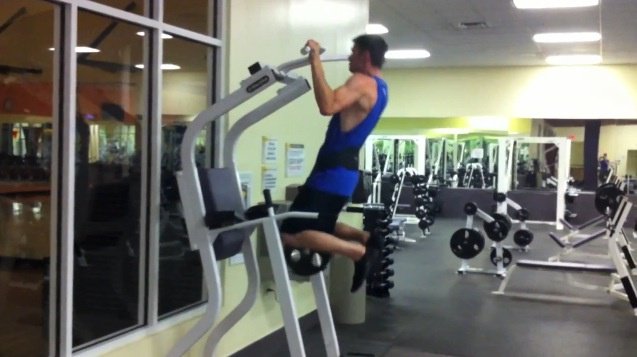
Once you’re able to do 3 sets of 10 pull-ups or chin-ups, you have a few options:
OPTION #A: Continue to get better at doing more reps – 3 sets of 12, 3 sets of 15, 4 sets of 20, etc.
OPTION #B: Start doing other types of pull-ups.
Here are some advanced pull-ups you can try:
#1) WIDE GRIP PULL-UPS (grab the bar WAY out with both hands):
#3) SIDE TO SIDE PULL-UPS

#4) RING PULL-UPS

#5) TOWEL PULL-UPS (Great for grip strength)
OPTION #C) Add weight with a weight belt and do weighted pull-ups or weighted chin-ups:

Personally, my favorite thing to do in a gym is weighted pull-ups; if you’re at this level and interested in doing so, here’s what you need to do:
- Get a weight belt. I bought this one on Amazon and it’s worked out incredibly well for me. I’ve tried doing the whole “put weights in a backpack” and it certainly works, but the angle of the weights hanging off your back is weird. With a weight belt, the weight hangs down between your legs (not a euphemism) so it feels more natural.
- Add small amounts at a time. Most gyms will have 2.5 lb (roughly 1kg) weights; you might feel stupid putting on a big weight belt and only hanging a tiny weight off it, but you need to start somewhere.
- Consistently add more weight. I’ll warm up with two sets of 5 pull-ups with no extra weight, and then do 3 sets of 5 weighted pull-ups. If I can complete all 3 sets of 5 reps (with my chin over the bar for every rep), I’ll make a note to add 2.5 or 5lbs (1 or 2kg) to my weight belt for the next time.
Here’s how to incorporate these Level 6 exercises into your gym workout routine:
- Monday – Weighted Chin Ups – 3 sets of 5 reps
- Wednesday – Elevated Feet Body Weight Rows – 3 sets of max repetitions
- Friday – Wide Grip Pull-ups – 3 sets of maximum repetition
- (The following week, I’d alternate by doing the chin-ups without weight, and then doing weighted pull-ups
Where do you go from here? How about working towards one of the most impressive exercises of all time? The MUSCLE UP (warning: uber advanced)!
Lift Yourself Up (A Life With Pull-Ups)

No matter your starting point, you CAN do pull-ups.
And you WILL do pull-ups with this guide.
You don’t need to follow the progression above exactly – it’s merely one path that you can take in order to reach the promised land…where the pull-ups flow like wine and the women instinctively flock like the Salmon of Capistrano.

Just ask Christina, who can now do multiple sets of pull-ups – her story is incredible:

Or Bronwyn, who lost 50+ lbs and now does chin-ups with her daughter on her back!
For people looking for the next step, we’ve built 2 options that might float your boat:
1) If you are somebody who wants to get results like the women above and follow a tailor-made pull-up strength program designed around their life and goals, check out our popular 1-on-1 Online Coaching Program.
You’ll work with our certified NF instructors who will get to know you better than you know yourself, check your form, and program your workouts and nutrition for you.
2) Join our free community, the Nerd Fitness Rebellion, and we’ll send you our free Strength 101 Guide, which you can get when you sign up in the box below:
Follow the path that works for your schedule, your experience, and your level of comfort with this movement – there’s no shame in going slowly and progressing safely.
And if you’re gung ho about pull-ups, ready for negatives and trying to squirm for that first rep, feel free to go for it. Just be safe.
When you DO finally do a pull-up, I want to be the first to know – email me at [email protected] and tell me about it!
For the Rebellion,
-Steve
PS: Check out our other three articles on pull-ups:
- How to Do a Proper Pull-up (Correct Form)
- 5 Common Pull-Up Mistakes
- How to Do Pull-ups Without a Bar
PPS: Want to learn more? Read the rest of the Strength Training 101 series:
- Strength Training 101: Beginner Strength Workouts
- 6 Gym Workouts for Beginners
- How to Find a Good Personal Trainer
- Strength Training 101: Inverted Rows
- Strength Training 101: How to Squat
- Strength Training 101: The Press
- Strength Training 101: The Deadlift
###
Photo Souce: Muscles that Move the Humerus
The post Get Your First Pull-up Or Chin-up! 30-Day Pull up Progression Plan first appeared on Nerd Fitness.
]]>The post How to Build Muscle Fast (Training, Diet, and Workouts) first appeared on Nerd Fitness.
]]>
Want to build muscle like this guy?
(Leopard print unitard optional but encouraged)
In this guide, we’ll provide step-by-step instructions that will help you start building muscle immediately. Like, today.
We’ll explore:
- How do you build muscle?
- What’s a sample routine for muscle training?
- How many sets and reps should I do?
- Muscle training weightlifting tips.
- How many calories to eat to build muscle? (and which supplements)
- Will I get too bulky lifting weights?
- Can you lose weight and gain muscle at the same time?
- Rest days for building muscle and strength.
That may seem like a lot of topics to cover. DON’T PANIC!
If you want to build muscle, get bigger, and become stronger, it comes down to three things done consistently:
I realize doing those three things is much easier said than done. Doing hard stuff consistently for months and years requires a great strategy!
In fact, we even helped our friend Ali Abdaal put together a video on exactly how important these three things are.
If you want some help implementing these strategies in your own life, we provide a free bodyweight routine, and a comprehensive gym training routine to get you started with strength training in our free guide, Strength Training 101: Everything You Need to Know. Grab your guide when you sign up in the box below:
How Do You Build Muscle and Strength?

If you are going to build strength and muscle, you need to lift heavy things to force your muscles to rebuild themselves stronger.
But what the heck does ‘heavy’ mean in this context? I’m so glad you asked!
Muscle-building is optimized when performing strength-training exercises in the 5 to 30 rep range (bodyweight or weightlifting), working to within 1 to 3 reps of failure while maintaining good technique.
(i.e. You could do 1 or 2 or 3 more repetitions of the exercise using a specific weight, but not more.) Usually, you’ll repeat this effort for multiple sets targeting multiple muscles in a workout.
That’s what I mean by ‘lift heavy’: you picked the right amount of weight to challenge yourself for the desired number of reps. By forcing your muscles to really tax themselves by picking up heavy things, you are participating in the Holy Grail of muscle building: progressive overload!
Progressive overload: forcing your muscles to rebuild themselves stronger by increasing the challenge they face with each workout. Examples include: lifting heavier weight, doing more reps, frequency, etc.
For example, from one week to the next, progressive overload would look like:
- Week 1 Barbell Squat: 4 sets of 6 reps at 150 lbs.
- Week 2 Barbell Squat: 4 sets of 6 reps at 155 lbs.
If you do that, you’ve gotten stronger! Then, repeat next week. Consume enough calories and protein, and you’ll gain muscle mass too.
“Got it, Steve. I need to pick up heavy things. Can we talk about which exercises I should do to build muscle?”
Great question, you good-looking person. I’ll cover specific exercises in the following section, but let’s start with a broader point:
Free weights, machines, and bodyweight exercises are ALL good options as long as you can adhere to the guidelines we laid out above. [4]
While you can grow muscle using any type of strength-training exercise, having access to a gym with free weights and weight machines makes leveling up your muscle-building game all the easier.
Check out our Beginner’s Guide to the Gym for everything you need to know and getting started in a gym with sample workouts.
So let’s start building muscle!
We’ll want a routine with compound exercises that train multiple muscle groups at once. They’re efficient and they can create solid growth and stimulation.[5]
To create our full-body routine, each workout will make sure it has a big compound leg exercise, push exercise, and pull exercise:
- Leg Exercises (Quad Dominant or Hip Dominant): Squats, Deadlifts, or Lunges
- Push Exercises: Bench Press, Deficit Pushups, or Dips
- Pull Exercises: Inverted Rows, Pull-Ups/Chin Ups, or Dumbbell Rows
Learn these few exercises, get really good at them, and your entire body will get stronger and bigger. Focus each week on adding more weight to each exercise.[8]
Bottom line: if you want to get bigger muscles, you need to challenge them regularly with exercises that bring the muscle close to failure (1 to 3 reps). To start, we recommend picking big, compound movements that work multiple muscles at a time.
“Steve, what about isolation exercises like bicep curls, tricep extensions, calf raises, etc.?”
Absolutely add these in whenever you want to, though we recommend starting with the workout we laid out above FIRST and getting consistent with that. Muscle-building isn’t just about picking the right exercises and the right weights, it’s about building the habit of working out!
If you try to do ALL THE THINGS at the very beginning, you’re increasing the risk that you won’t be able to make the habit stick.
Start with compound exercises that give you the biggest bang for your buck, THEN sprinkle in isolation exercises that target your specific areas of need. [6]
“What about machines versus free weights? I’ve heard free weights are better…”
Not true! If a machine exercise feels safer, is more easily accessible to you, and targets the same muscles – go for it. The important thing is that you are challenging your muscles to get stronger, that’s it. [7]
What’s a Sample Routine for Building Muscle?

Using the principles I’ve laid out in my “how to build a workout routine” article, here’s a beginner three-day routine:
- Monday: Squats, Benchpress, Wide Grip Pull-Ups
- Wednesday: Deadlift, Overhead Press, Inverted Rows
- Friday: Weighted Lunges, Weighted Dips, Weighted Chin-Ups
Each day has a leg exercise, push exercise, and a pull exercise.
Besides having rest and recovery days in between MWF, adequate rest intervals have been established in the workout itself!
By following the leg exercise, push exercise, and a pull exercise routine you will maximize rest in-between each exercise, therefore, limiting muscular fatigue and allowing you to perform each strength training exercise to its fullest extent.[9]
Now, this is just a basic, 3-day, Full-Body workout routine. We have a whole guide on how to build your own workout, but there are infinite ways to build a strength training routine.
4-Day Push-Pull split[32]:
- Monday: Push exercises
- Wednesday: Pull exercises
- Friday: Push exercises
- Saturday: Pull exercises
4-Day Upper Lower Split:
- Monday: Lower Body
- Wednesday: Upper Body
- Friday: Lower Body
- Saturday: Upper Body
Bodybuilders often prefer to follow a 5-day “each day gets one body part” workout. While this is a popular split, we recommend hitting each muscle group 2x/week for more efficient gains.
- Monday: Legs (quad dominant)
- Tuesday: Chest
- Wednesday: Back
- Thursday: Legs (hip dominant)
- Friday: Arms
Yes, there’s even a 6-day split! (We muscle-building nerds can come up with endless ways of organizing our training.
- Monday: Legs
- Tuesday: Upper Body Push
- Wenesday: Upper Body Pull
- Thursday: Legs
- Friday: Upper Body Push
- Saturday: Upper Body Pull
- Sunday: Rest
Each routine has positives and negatives, is dependent on how often you can work out, and is based on your preference! As long as your muscles are being forced to rebuild themselves stronger, and are able to recover before you work them out again, it’s the right workout for you.
While it’s possible to build out the perfect routine on your own, many of our Rebels end up spending hours and hours building something custom – only to realize it isn’t what they need (or isn’t effective) weeks and months later for their goals.
For people who want to avoid that altogether, we built the solution – our uber-popular 1-on-1 coaching program pairs you with your own Nerd Fitness Coach who will get to know you, your goals, and your lifestyle, and handcraft a workout plan that’s specific to your body, your schedule, and your life.
Click the image below to schedule a call with our team to see if we’re a good fit for each other!

How Many Sets and Reps Should I Do?
We have a MASSIVE guide on the exact number of sets and reps (it’s where the video above comes from), but you can follow the basics here.
- For beginners, we recommend starting in the 5 – 15 reps range to increase both size and strength. (If you want to focus on more strength than size, stick to the lower end of that range.)
- As you get more advanced, you may find that it’s beneficial to do up to 30 reps of an exercise. (Though 90% of your work will still be in that 5 – 15 rep range.) The biggest drawback to higher rep ranges like this is it can be hard to target specifically that “1 to 3 reps before failure” when the rep count is so high. [10] [11]
The good news is that no matter which path you take (pure strength, size, or a mix of both), as long as you are adding weight each week – and eating enough – you WILL be getting stronger.[12]
ANY path will work, provided you are progressively overloading your muscles with an increased challenge!
Coach Jim explains it all for you right here:
Progressive overload involves exerting slightly more effort than last time (lift a heavier weight or do 1 more rep) consistently.
Your muscles will have to adapt and rebuild themselves to get stronger. So in order to see improvements, your training must gradually and constantly increase.
We just have to make sure we get the right pace!
According to Mike Rebold, PHD, a professor from from Hiram College:
Keep in mind that if the overload increases too quickly, poor technique and injury may result. And if the overload progresses too slowly, improvements will be minimal or non-existent.
Slowly but gradually increasing your challenge could look like:
- If you do 5 sets of 5 squats at 140 pounds this week, aim for 5 sets of 5 of 145 pounds next week.
- Or if you’re doing 3 sets of 10 at 100 pounds, then next week try for 3 sets of 12 at 100 pounds.
Get stronger, which is 20% of the puzzle. The other 80% is nutrition (which I cover later)!
As I said before, if you want even more info, you can head to our article “Determining the Correct Number of Reps and Sets” for a deep dive into the subject.
7 Muscle Building and Weight-Lifting Tips

#1) Warm-up before exercising – don’t walk into a gym, slap 45-pound plates on the bar, and then start your routine.
Get your heart rate up and muscles warm first by doing a dynamic warm-up of jumping jacks, lunges, bodyweight squats, hip raises, push-ups, leg swings, jumps, etc, for a couple of minutes.
After that, always start with doing a set or two of lifting a much lighter weight than your planned heavy sets, gradually increasing your weight each warm up set until you are ready to start your workout proper. [13] Only then should you start adding weight for some warm-up sets before moving into your work sets.
#2) Have a focused form – if you’re doing a bodyweight squat incorrectly, you might develop bad habits.
However, if you do a barbell squat incorrectly with 405 pounds on your shoulders, you could do some serious damage. If you’re just starting out, check your ego at the door: start with a VERY light weight and make sure you are doing the exercise properly.
There is NO SHAME in starting with just the bar. You can always add more weight next week if this week is too easy.
#3) Stimulate, don’t annihilate – I try to always have one more rep left when I finish a set.
While it can be helpful to occasionally go to failure in order to gauge how many “reps in the tank” you have left, this isn’t something we would do all the time.
Your muscles get built while resting, not in the gym, so don’t worry about destroying them completely each day you step in the gym – it’s not worth it.[14]
#4) Adjust your rest time accordingly – some muscles take longer to recover than others. For example, your quads may need more rest time before they feel ready to do another set, while your shoulders may only take half the time.
You know you are ready to start the next set when:
- You’re not so out of breath that it’s limiting your ability to perform the lift
- You’re muscles are recovered enough to do at least 5 high quality repetitions (the bottom end of the 5 to 30 target rep range for muscle building)
- You’re supporting muscles aren’t a limiting factor (for example, your biceps aren’t the muscle that is limiting your ability to do a back exercise)
For most people, this is going to be 30-90 seconds between warm-up sets and 2-3 minutes between working sets.
Just be consistent between sets and when doing the same workout between weeks to track your progress.[15]
Bottom line: The most important thing is to rest long enough that you can give near the same level of effort as you did in the previous set.
For more, learn all about sets and rep ranges.
#5) Don’t overdo it – More does not mean better in weightlifting. You don’t need to spend two hours in the gym, you don’t need to do 15 different kinds of chest exercises.
My routines last no longer than 45 minutes, I only do three or four sets (after warm-up sets) for each exercise, and it’s enough to stimulate muscle growth. I only need to add more if my growth plateaus or stops, and before I do that I make sure my intensity, diet, and recovery are dialed in FIRST. [16]
Three workouts a week is a great place for most to start – we’ve had clients build muscle on anywhere from 2 days a week to 4 days a week using a full-body routine like this! You need to give your muscles time to regrow bigger – remember muscles are made in the kitchen![17]
Less is often more – just make your routines really intense and exhausting.[18]
#6) Write down everything – Keep a training journal, and write down exactly how many sets and reps you did for every exercise.
That way, you can compare how you did this time with how you did last time. You’ll know how much more you need to lift this week to make sure you’re stronger than last week.
#7) Follow a routine, have a plan and stick with it for months and months. We are training our muscles to get stronger and stronger, so you’ll get the best results if you can fall in love with the boring process of doing the same workout – but lifting heavier weight for months and years. [19]
I’ve been doing squats, pull-ups, deadlifts, and presses once a week, every week for 24 years. The sets, reps, and weights have changed, but the workout is largely the same. I don’t need to be entertained by the workout, I’m excited about, “how much weight can I lift?!”
How Many Calories Should I Eat To Gain Muscle (and Which Supplements)

If you’re skinny and trying to bulk up, this will be 90% of the battle.
If you’ve been lifting weights for a while “but can’t seem to gain weight,” then you are not eating enough. To gain weight, you’re going to need to seek a calorie surplus (i.e., hypercaloric diet). This usually consuming an additional 250-500 kcal/day or 10-20% above your typical diet. [20]
I thought I was one of those people who just could never gain weight, even after training hard for 6 years…and then I learned it was all diet, started eating 3500+ calories a day (lots more liquid calories, rice, bread, oats, and potatoes!), and I put on 18 pounds in 30 days.

After 6 years of exercising without putting on any weight, it was great to see so much progress in such a short period of time.
I’ve since changed my strategies and have become more calculated in my approach. It’s how I (jokingly) went from Steve Rogers to Captain America.
So, as a former super skinny nerd who finally realized “it’s the calories, dummy,” here’s the 3-step process for nutrition when it comes to building muscle:
PART #1: Eat More – To gain weight, you’re going to need to seek a calorie surplus (i.e., hypercaloric diet). This can be achieved by consuming an additional 250-500 kcal/day or 10-20% above your typical diet.
You can get an estimate of how much you need to eat to just MAINTAIN your weight in our free calculator here.
I’m not clairvoyant (yet), so I’m not sure how you’re currently eating. But if you’re looking to add more calories, there are 3 key places to look:
- Adding more carbs: rice, bread, pasta, oatmeal, cereal, potatoes, and any other calorically dense food!
- Adding more fats: avocado, olive oil, nuts, seeds, cheeses, nut butters.
- Drinking more liquid calories: protein shakes (covered below), juice, milk, weight-gain shakes, etc.
Besides just seeking a calorie surplus, it can also be beneficial to pay attention to your macronutrient ratio (e.g., carbohydrates, fats, and protein).
For more specific information on what foods to eat and how to structure your diet for bulking, check out our ‘Bulk like the Hulk’ guide!
PART #2: Eat enough protein – With all the hard training you’re doing, you want to not only gain weight but make sure your body has the resources to turn as much of that weight as possible into muscle.
That’s why we put together this handy protein calculator for you – so you can maximize your gains! For most people, targeting between 0.7-1.0g/lb of bodyweight gets you in the optimal muscle-building range.
In our Protein 101 Guide, we discuss sources of protein and provide simple ways to incorporate more into your diet. If you’re not used to eating a lot of protein, that can be a struggle!
“Which Supplements Should I Take to Build Muscle Quickly?”
As we lay out in our Nerd Fitness Supplement Guide, most supplements are a waste of money and completely unnecessary for building muscle.
However, there are two supplements that CAN BE helpful in building muscle quickly:
- Protein Shakes: If you are struggling to hit your protein and calorie intake goals for the day, adding in a high-calorie protein shake can be a game-changer.[23]
- Creatine Supplements: Creatine helps your muscles retain water and can improve your performance, allowing you to push harder, for longer, in the gym.[24]
Are you vegan and trying to build muscle? Read our full article on how to go plant-based properly![25]
Bottom line: If you don’t see any change, then you need to eat more.
- Yes, it will feel excessive.
- Yes, you will feel full all the time.
- Yes, it’s a pain in the ass and expensive.
But if you really want to be bigger, then you are going to need to really dedicate yourself in the kitchen.
Unless you’re a genetic mutant, it’s incredibly tough to build muscle and strength without overloading your system with calories and nutrients.
Just keep eating.
Won’t All of This Eating Make Me Fat? I Don’t Want to Get Bulky.

I have amazing news: as somebody who has been trying to get “too bulky” for 20 years, it’s unbelievably difficult for a naturally skinny person to suddenly get too bulky.
Yes, you will put on SOME fat along with the muscle you’re building if you’re running a calorie surplus.
This is why picking the right amount of calories per day is important:
- If you can build muscle at 3,000 calories, but you’re eating 4,000 calories, you’ll put on a pound or two of fat per week along with your muscle.
- However, if you need to eat 3,000 calories to build muscle and you’re only eating 2,500, you won’t see any changes.
Everybody is different, so you need to experiment and find out what works best for you.[27]
Once you get to your desired weight (actually, aim for about 10-15 pounds heavier than your goal weight), you can scale back the calories, increase your step count, and keep lifting heavy – the muscle will remain, the fat will disappear, and you’ll be left with the body you want.
I’m not skinny, I need to LOSE weight – what’s different for me?
As Coach Matt explains above, you can actually build muscle and lose body fat at the same time.
You just have to be careful about how you do it.
We cover the subject in depth in the post, “Can You Lose Fat and Gain Muscle at the Same Time?”:
If you are eating enough protein, and have decent fat stores to pull from for energy needs, you can build muscle even while in a caloric deficit.
As long as you are resting (next section) and strength training (previous section), you can shed body fat while still putting on muscle.
Now, this only works if you have plenty of fat stores to pull from. Once you start to lean out a little, you’ll likely have to increase your calories to start putting on more muscle.

I recently added some strength (and muscle) while losing 22 pounds in 6 months.
Just remember, you can build muscle while losing weight if you:[28]
- Sustain a caloric deficit
- Lift heavy
- Prioritize protein
- Rest
Let’s talk about that last one for a bit.
Rest Days for Building Muscle and Strength
As Coach Jim mentions in the video above, if you’re skinny and trying to bulk up and build muscle, avoid cardio like the plague (also avoid the plague).
Why?
Take a look at the best marathon runners in the world, and compare their physique to somebody like Usain Bolt, the best sprinter in the world – tons of muscle, power, and a body to envy.

There’s nothing wrong with EITHER body – we’re all awesome and are special and blah blah blah.
But you’re reading an article about how to build muscle fast, right? So focus all of your effort on building muscle![29]
You want all the calories you’re consuming to go towards “building muscle,” and not “fuel my run.”

I will admit that I’m biased against chronic cardio, but mostly because it bores me!
You can be far more effective when you focus on getting stronger and only do ‘cardio’ on things you enjoy – after all, your success will largely depend on your nutrition, NOT your cardio!
If you’re lifting heavy, and eating enough, make sure you’re also getting enough sleep! 5-6 hours a night isn’t going to cut it – you need to get at least 8-9 hours of sleep per night for optimal muscle-building. Take naps too if you have the opportunity.
Sleep needs to become a priority, because while we’re asleep, growth hormone, a hormone responsible for regulating muscle growth is released.[30]
If you’re a big guy/girl trying to slim down, a little extra cardio might speed up your fat loss but if you’re not eating correctly, it might result in losing some of the muscle you already have.
Don’t worry about going for 10-mile runs on your off days – do 20-30 minutes of intervals or go run hill sprints in your park. The weight will come off more slowly, but you’ll be losing predominantly fat, not fat AND muscle.
Once you hit your goal weight and the target amount of muscle mass, I’d recommend adding back in some cardio for your overall conditioning and cardiovascular health.
If you love going for long runs and aren’t going to give that up, I’m not gonna stop you. Just know that the long hours of cardio will severely inhibit your progress on building strength and size.[31]
Get Started Building Muscle Today

This is a basic overview to get ya started. It really boils down to a few major things:
- Lift heavy
- Eat lots of good food
- Rest
Simple to understand, tough to implement.
Trust me, I know – I’ve been battling this for the past decade.
If you made it this far, and you want more specific instruction, here’s how Nerd Fitness can help!
If you are somebody that wants to follow a tailor-made program designed to build muscle and grow strong, check out our popular 1-on-1 Online Coaching Program.
You’ll work with our certified NF instructors who will get to know you better than you know yourself, check your form, and program your workouts and nutrition for you.
-Steve
PS: Be sure to check out the rest of our Strength Training 101 series:
- Strength Training 101
- Strength Training 101: Equipment
- Strength Training 101: Finding the Right Gym
- Strength Training 101: Where do I start?
- Strength Training 101: How much weight should I be lifting?
- Strength Training 101: Inverted Rows
- Strength Training 101: How to Squat Properly
- Strength Training 101: The Overhead Press
- Strength Training 101: The Deadlift
###
All Photo Sources are found right here.[32]
The post How to Build Muscle Fast (Training, Diet, and Workouts) first appeared on Nerd Fitness.
]]>The post 5 Best Strength Training Workout Routines For Beginners (Home & Gym) first appeared on Nerd Fitness.
]]>
Want to get strong like these LEGO lifters but don’t how to start?
In this Beginner’s Guide to Strength Training (part of our Strength 101 series), you’ll have both the confidence to start getting strong with resistance training AND a plan to follow.
These are the exact strategies we use with our Online Coaching Clients to help them start strength training, and I’m excited to cover everything you need.
We’ll be digging into the following:
- How do I start strength training or resistance training?
- What are some examples of strength training?
- Which strength training program is right for me?
- 5 best strength training workouts for beginners.
- How much weight should I lift?
- The 9 best strength training exercises.
- How to know you’re doing an exercise properly (form checks)
- Strength training for weight loss.
- “Just TELL ME what strength program I should do.”
By the way, we’ve combined this article along with the rest of our strength articles into a “Strength Training 101: Everything You Need to Know” guide.
Grab it free when you join the Rebellion by putting your email in the box below.
How Do I Start Strength Training?

Welcome to the first day of the rest of your life.
You’ll look back years from now and thank “Past You” for starting strength training today.
And I promise, you WILL start strength training today.
After all, strength training or resistance training doesn’t need to be scary or overcomplicated!
Strength training really comes down to two things:
#1) Movement of any weight against “resistance”(including your body weight) – Doing ANY exercise that pushes your muscles outside of their comfort zone, forcing them to rebuild stronger to prepare for the next challenge.
#2) Progressive overload: doing slightly more than last time (lift heavier weight or do 1 more rep) consistently. Your muscles will break down slightly during your workout, and then rebuild themselves as you rest and recover to be stronger and able to handle more the next time.{1}}[[1]]Powers SK, Howley ET. (2011). Exercise physiology: Theory and application to fitness and performance. New York: McGraw-Hill Humanities/Social Sciences/Languages.[[1]]
Coach Jim explains the ins and outs of progressive overload in this video:
That’s all there is to it: do some resistance training and attempt to make it more and more challenging, and you’ll grow stronger.[2]
- This means if you do ONE push-up off of a countertop right now, technically you’ve done a strength training workout.
- It also means if you then do TWO countertop push-ups tomorrow, then you are officially following a strength training routine.
In other words…

Now, it’s SCIENCE TIME!
While learning the strength training exercises, you are allowing for proper communication to develop between your neuromuscular systems.

More efficient communication between your neuromuscular systems will result in something known as “proper motor unit recruitment.”
You may be asking yourself: what is a motor unit?
That’s okay because I was asking myself this same question.
A motor unit is a single motor neuron and the muscle fibers it innervates.
You can think of two different types of motor units:[3]
- We all have small motor units, meaning that a single motor neuron innervates relatively few muscle fibers, and these smaller motor units are good for precise and detailed movements (e.g., moving your fingers).
- We all also have large motor units, meaning that a single motor neuron innervates hundreds of muscle fibers, and these larger motor units are good for generating a lot of force (e.g., getting larger muscle groups like the quads to generate a lot of force to help in sprinting).
When you start strength training, you really are helping your muscles communicate better together.[4]
How cool is that?
Now, there are many different “strength training” and “resistance training” paths.
Like a “skill tree” in a video game (with branching paths and progressions), you can progress up one path, and mix and match movements from others depending on the situation.
These paths depend on your goals and what equipment you have available to you.
What Are Some Examples of Strength Training?

Let’s chat about a few different types of strength training.
#1) BODYWEIGHT TRAINING
Bodyweight training is simply doing an exercise in which your own body is the “weight” you are “lifting.” For example, you might do a squat, a push-up, or an inverted row. These are all bodyweight strength training exercises.
This is the place where we start many of our 1-on-1 clients on their strength training journey.
Why? Two big reasons:
A) You always have your body with you (unless you are a ghost, in which case, this is awkward). This means you can work out ANYWHERE with bodyweight training:
- Our Beginner Bodyweight Workout Routine in your living room.
- Our Hotel Workout in a hotel (obvi).
- Our Park Workout in a…well, you get the point.
B) Using your body for resistance training is the most “human” thing ever! By learning to push and pull and hang and squat and lunge, you are doing what your body is literally designed to do.
And by building strength, you’re making yourself antifragile and less injury-prone.
For many of our clients, bodyweight exercises are right in that sweet spot of being challenging while lowering the barrier to entry to get started.
Bodyweight training isn’t as easy to ‘scale’ the difficulty as some of the other strength training methods (“put more weight on barbell”), but you can get REALLY strong with just bodyweight training.
For example, you can start with knee push-ups, then go to regular push-ups, then elevated push-ups, then even up to things like handstands and handstand push-ups.
You just have to know HOW and WHEN to scale up (we can help there too).
#2) DUMBBELL TRAINING

Dumbbells are a great first step into the world of weight training and strength training:
- Most gyms will have dumbbells, even if it’s a basic gym in your apartment complex.
- An adjustable set of dumbbells doesn’t take up a lot of room, which means you can have a pair at home without a large footprint.
- Dumbbells make it easy to add difficulty to a bodyweight movement: holding dumbbells while doing lunges, for example.
- Dumbbell exercises can be less intimidating than barbell training for some, and are a step towards barbell training.
- Dumbbells have an added stabilization challenge,[4] and will point out muscle imbalances pretty easily (“oh my right arm is stronger than my left arm.”).
- Dumbbells allow for single-arm and single-leg exercises to be performed. This can allow you to strengthen any muscle imbalances and can come in handy, especially after an injury.
- You can scale easily. Once the 10-pound weights become too easy, pick up the 15-pound ones!
#3) KETTLEBELL TRAINING

A kettlebell is essentially a cannonball with a handle on it. They come in any weight imaginable, don’t take up a lot of room, and can be used in dozens of ways for a great compact workout.
Our 20-minute kettlebell workout has 8 simple exercises you can do with just one weight.
Although there are “adjustable kettlebells,” you’ll most likely be working with a single kettlebell, and then adjusting your movements for “progressive overload” (making the workout slightly more difficult each time).
If you are a member of a gym, they’ll probably have multiple kettlebells that you can use to level up.
#4) BARBELL TRAINING
Regardless of sex or gender age, if your goal is to get strong quickly, use 20 seconds of courage and get comfortable training with a barbell (I’ll help you, I promise):
- “Progressive overload” is easy – you simply add weights to either side of the bar, allowing you to progressively lift more and more weight each week.
- It’s much easier to go heavy safely – especially for lower body movements like the squat and the deadlift.
The biggest downside to barbell training is that to train at home, you need to have purchased a squat rack, a barbell, a bench, and enough weights for your house or garage (which can be an expensive investment, especially when starting out!).
If you want to try it before you buy it, you definitely will need to join a gym.
#5) MACHINE TRAINING
Although they’ve gotten a bad rap in previous years, machines are another excellent entry point into strength training! These are going to be one of the most common options at gym franchises like Planet Fitness or Anytime Fitness, and usually come with instructions on the side for how to set up and perform the exercise. They have the benefit of being able to add weight quickly to scale, and usually require less stability to perform. (I.e. you’re not trying to balance and coordinate the movement at the same time as lifting it as much.)
While we still encourage our clients to do free-weights to build stability, when you’re first getting started having the extra guidance from a machine can be helpful!
WHICH RESISTANCE TRAINING PATH IS RIGHT FOR YOU?
Not sure which path to pick? You’re not alone – this stuff can be overwhelming. The truth is that you’ll probably mix and match a variety of these different options as you go. However, if you’re unsure, we recommend starting with bodyweight exercises. Then you can add in one dumbbell or machine movement at a time to introduce more variety and options for yourself!
Want to take the thinking off of your plate and have a program designed with your specific needs and equipment in mind? Check out our 1-on-1 Coaching Program. We get to know you and your goals, check your form via video, and make adjustments based on your progress!
Which Strength Training Program is Right for Me?

So, what’s the best workout program to start as a beginner?
Realistically, it’s the one that you will ACTUALLY do.
We have a saying that we love around here: “Start where you are. Use what you have. Do what you can.”
Barbell training might be optimal in terms of building pure strength quickly, but if you don’t see yourself getting to the gym regularly – or you’re too self-conscious to enter the free weight section (for now) – no problem!
Start with bodyweight training.[5]
Conversely, bodyweight training might seem convenient and easy to start now, but if you can’t motivate yourself to work out at home, you might be better off joining a gym.[6]
So let’s get you a workout program!
As we cover in our “How to Find the Perfect Workout Plan (for you)”: MOST beginners will be best served by following a “full-body” or “total body” routine, 2 to 3 times per week, with a day of rest in between each workout.[7]
This full-body workout will have 4-5 big compound movements.
A compound movement is an exercise that recruits LOTS of muscles simultaneously and forces your body to work in unison. These compound exercises are considered multi-joint exercises meaning that they involve more than a single muscle group.[8]
An example would be the barbell squat, which recruits every muscle in your core, butt, and legs to work together to lift the weight.

This is WAY more efficient – and effective at building pure strength – than doing 5 different isolated leg exercises.[9]
Why do 5 exercises when 1 exercise will get you better results in 20% of the time?
In order to balance our full-body workouts, we want to make sure we pick exercises that spread the work out across the entire body. One helpful way to do this is to think of exercises as fitting into one of three different ‘buckets’:
- Push Exercises – these are exercises that generally work the front of your upper body. Things like push-ups, bench press, and overhead press all fit in this category.
- Pull Exercises – these are exercises that generally work the back of your upper body. This includes rows, pull-downs, and chin-ups.
- Lower Exercises – these are exercises that work your legs. Squats, deadlifts and lunges are some of the biggest bang for your buck exercises here.
By balancing your workouts across all three of these buckets, you get a well-rounded full-body strength program!
I can already tell what you’re next question will be: but how many sets and reps of each of these exercises should I do as a beginner?
As we explain in our “How Many Sets and Reps” guide:
- Reps in the 1-5 range build super dense muscle and strength.
- Reps in the 6-12 range build equal amounts of muscular power, strength, and size.
- Reps in the 12+ range primarily build muscular endurance and size and also cardiovascular health.[10]
If you want more, Coach Jim breaks down different set and rep ranges in this video:
Many beginner strength programs will encourage you to keep things simple, doing just 5 sets of 5 reps for each exercise.
Personally, I encourage people to aim for a weight that they can lift for 8-10 reps. This gives you a chance to really work on your form and lift safely!
The max lifts will come later, my friend. You gotta learn to walk before you can run!
To recap, our recommendations as you get started are:
- Pick a type of strength training that you have access to and are excited to try (body weight, barbell, etc.)
- Perform 2-3 full body workouts per week, with at least 1 day of rest in between each
- Pick 4-5 compound exercises that work multiple muscles at once for each workout
- Perform 8-10 moderately challenging reps of each exercise for 1-3 sets
If your main goal is general fitness and fat loss, doing these exercises in a circuit training workout will likely help you reach your goals (make sure you see our section below for “strength training for weight loss”).[11]
If your main goal is to get stronger and/or put on muscle, following a more traditional, pure-strength-style gym workout is going to get you there faster.
TRUTH BOMB: ANY strength training workout will help you reach nearly any goal provided you do two things:
- Eat correctly for your goals too. How you eat will account for 80-90% of your success or failure when it comes to weight loss or bulking up.[12]
- Increase the difficulty of your workouts. This is that “progressive overload” stuff we were talking about earlier. Doing 1 more bodyweight squat, lifting 5 more pounds, or completing your circuit 10 seconds faster than the last workout. By forcing your body to constantly adapt, your muscles will never get complacent and have to keep burning extra calories and rebuilding themselves stronger.
The 5 Best Beginner Strength Training Programs

“Alright Steve, are there any ‘out of the box’ beginner workout programs I can start following now?”
Yup! Let me share with you some of our suggestions:
Here are 5 resistance training workouts you can follow TODAY. Pick the level that you feel most comfortable with, and then level up when you feel ready:
#1) BEGINNER BODYWEIGHT WORKOUT:
Our Beginner Bodyweight Workout has a variety of rep ranges to promote endurance, strength, and cardiovascular health. We’ve added new progressions and even created a handy tracking sheet for free if you sign up for our newsletter.
Complete one set of each exercise and then move directly to the next exercise:
- 10 assisted bodyweight squats
- 10 elevated push-ups
- 10 dumbbells rows (using a gallon milk jug)
- 15 to 30-second knee plank
- 10 bodyweight good mornings
- 20 walking jacks
- Repeat for 2 rounds
Once that feels easy and you want to level up, try this sequence:
- 20 bodyweight squats
- 10 push-ups
- 20 walking lunges
- 10 dumbbell rows (using a gallon milk jug)
- 15-second plank
- 30 Jumping Jacks
- Repeat for 3 rounds
Want to stick with bodyweight training? When you’re ready to level up, check out our advanced bodyweight training circuit.[13]
Otherwise, you can move on to weight training when you feel comfortable!
#2A) BEGINNER NERD FITNESS DUMBBELL WORKOUT
If you are just getting started with dumbbells and you’re looking for a beginner workout program to follow, this is an example of a workout that includes dumbbells with your bodyweight training:
- 10 goblet squats
- 10 push-ups
- 10 dumbbell rows per side
I knew you’d ask, so here is a Goblet Squat video explanation:
And here is our video on how to do dumbbell rows:
#2B) BEGINNER NERD FITNESS KETTLEBELL WORKOUT
Our Beginner Kettlebell Routine is a workout you do anywhere you have room to swing a kettlebell.
So, probably not in a phone booth or a closet or a bathroom stall. But other than that, pretty much anywhere else.
Complete 3 Kettlebell Workout Circuits:
- 8 Halos (each side)
- 10 Goblet Squats
- 8 Overhead Presses (each side)
- 15 Kettlebell Swings
- 8 Bent Over Rows (each side)
- 6 Front Rack Reverse Lunge (per side)
#3) BARBELL TRAINING: 2-DAY WORKOUT SPLIT
As we cover in our “How to Train in a Gym” guide (where we take you from “lost sheep” to “barbell badass”), this routine is a much more focused weight training, strength-building workout that gets your feet wet with barbell training. Click on ANY exercise to learn how to do it properly.
NF BEGINNER BARBELL STRENGTH WORKOUT: DAY A
Do 3 rounds of:
- 10 barbell squats
- 10 push-ups
- 10 bodyweight rows
NF BEGINNER BARBELL STRENGTH WORKOUT: DAY B
Do 3 rounds of:
Alternate between these 2-4x per week and there’s your program!
WHAT ARE SOME OTHER POPULAR STRENGTH TRAINING PROGRAMS?
#1) “Starting Strength” is considered the gold standard beginner barbell weight training program by many. We highly recommend you pick up the actual book if you are serious about barbell training – it’s one of the most important training books you can ever read.
#2) Strong Lifts 5X5: A solid workout program that starts you out very slow, with just the barbell, and helps you master form before you get too heavy. It also keeps things VERY easy with “do 5×5.” Strong Lifts has been around for a long time and is a solid program.
#3) Jim Wendler’s 5/3/1: This program allows you a little more freedom to do exercises that you enjoy, or work on personal weaknesses, because you choose some of the assistance work.
Note: You can modify any of the barbell training programs to be done with dumbbells, if that’s what you have at home!
Lastly, you can always write your own workout plan!
We do have our own 1-on-1 Online Coaching Program where you’ll work with a coach who will build a strength training workout program for your body type and goals, check your form on each exercise via video, and even help you plan out your nutrition too.
How Much Weight Should I lift?

We have a FULL resource on how to determine your starting weight for lifting, but I’ll give you the gist here.
The simple-to-learn but tough-to-implement answer: lift enough so that you can get through the set, but not too much that you have NO fuel left in the tank at the end.
And then, try to lift sliiiightly more than last time.
Here are two common questions on strength training:
#1) How much weight should I start with?
- If you are using dumbbells or a kettlebell, always err on the side of “too light” versus “too heavy.” You want to learn the movement correctly and build correct form.
- If you are training with a barbell, ALWAYS start with JUST the bar, no matter the exercise (By the way, a standard barbell weighs 45 pounds).
#2) How fast should I add weight to the bar?
Here’s what we teach all of our coaching clients: add the minimum amount of weight each week you can, even if you THINK you can lift more. It’s better to finish a workout full of momentum and say “I can do more!” than defeated and saying “That was too much, crapola.”
Think of it this way, even if you are adding just 5 pounds per week to the bar, within a year you would be lifting 300+ pounds!
The National Strength and Conditioning Association (NSCA) recommends a similar approach:[14]
- For less trained people (i.e., beginners), it is recommended that for upper body exercises you increase the load by 2 – 5 pounds and by 5 – 10 pounds for lower body exercises.
- For more trained people (i.e., advanced), it is recommended that for upper body exercises you increase the load by 5 – 10 pounds or more and by 10 – 15 pounds or more for lower body exercises.
So go SLOW. Even slower than the NSCA recommends if needed.
I even bought little half-pound weights and increased many of my lifts by just 1 pound per week. It’s a big part of how I transformed (jokingly) from Steve Rogers to Captain America.
The 9 Best Strength Training Exercises to Learn

If you’re new to all this “strength training” stuff, hopping into a program and going from zero to sixty might be a recipe for failure.
Instead, be patient, and take the time to learn these movements first.
I’m going to share with you the 9 best strength training exercises that every beginner should master (scroll down for full video and explanations!):
- 1. Push-up: uses every push muscle in your body (chest, shoulders, triceps)
- 2. Bodyweight squat: uses every muscle in the lower body (quads, hamstrings, glutes, core)
- 3. Bodyweight row: works every “pull” muscle and helps prepare you for a pull-up!
- 4. Pull-up or chin-up: the best “pull” exercise in history! Everybody should have a goal to get their first pull-up.
- 5. Bodyweight dip: advanced “push” movement that targets your push muscles (chest, shoulders, triceps) in a different way than push-ups.
- 6. Barbell squat: the best bang for your buck on muscle building. recruits nearly every push muscle in your whole body, and a great core workout.
- 7. Barbell deadlift: the favorite exercise of every coach at Nerd Fitness. Uses every “pull,” leg, and core muscle in your body.
- 8. Barbell benchpress: as basic and powerful as they come. Uses every “push” movement in your upper body and can get you strong as heck!
- 9. Barbell press: press the bar above your head! Targets shoulders and triceps more than the chest.
All of the exercises listed above are considered functional (closed-chain) exercises. That means they relate to our everyday movements and can be used to predict our success in sports, recreational and occupational activities, and activities of daily living.[15]
When attempting all of these above-listed exercises, aim to master the movement and perform the exercise through its entire range of motion (ROM).
Why?
Because it will decrease your risk for injury, activate all of the appropriate muscle groups, and result in greater muscle hypertrophy.[16]
Let’s go over these now.
Click on any of these exercises to get a FULL explanation of the movement, step-by-step:
1) The Push-Up: The best exercise you could ever do for yourself when it comes to using your bodyweight for push muscles (your chest, shoulders, and triceps):
2) The Bodyweight Squat: This exercise serves a dual purpose: it is the foundation for building strength AND helps build proper mobility. If you are going to ever do barbell squats, you need to work on hitting proper depth with a bodyweight squat first!
3) The Inverted Bodyweight Row: Until you can get your first pull-up or chin-up, these exercises are GREAT to start building your pull-muscle strength: your back, biceps, and forearms.
4) The Pull-Up and Chin-Up: Once you can support your bodyweight above the bar, the world becomes your playground. No strength training routine should be without pull-up or chin-up work! (Click here if you can’t do a pull-up or chin-up yet?)
5) The Bodyweight Dip: As you start to get stronger with push-ups and need to find a way to increase the challenge, consider doing dips – warning: these are very advanced, but incredible strength-building exercises.
And now we’re into the best weight training exercises:
6) The Barbell Squat: Probably the best exercise when it comes to building strength and muscle throughout your whole body. It also burns crazy calories and makes life better. This is a MUST:
7) The Barbell Deadlift: Maybe the best exercise of all time. Actually no, it IS the best exercise of all time. It’s certainly the most primal: “pick the weight up off the ground. Done.”
This is a very technical lift, so make sure you read our article on how to do it with proper form:
8) The Barbell Press: Press a barbell above your head. This recruits all of the muscles in your chest, shoulders, and arms in order for you to lift the weight over your head.
As a bonus, you need to really flex and brace your core, which gets those muscles working too.
9) The Barbell Bench Press. Lie on a bench, and lower a barbell until it almost touches your chest. Pause, and press it back up towards the sky. Repeat! And get strong.
NOTE: All exercises were explained according to the guidelines that have been established by the NSCA.[17]
Your mission, should you choose to accept it: commit to trying ONE of these movements in the next week. Use 20 seconds of courage, recruit a friend who has lifted or trained before, and try your best.
How to Know You’re Doing a Strength Training Movement Properly (Form Checks)

Always start out with just your body’s weight and make sure your movement is correct!
- If it’s a barbell movement, use a broomstick (or PVC Pipe).
- If it’s a dumbbell movement, use two sections of PVC or something else that is