The post Intermittent Fasting Guide: Myths, Facts, & Strategies first appeared on Nerd Fitness.
]]>
“…Tony the Tiger tells us that breakfast is the most important meal of the day! It’s grrrrrreat!”
This adage about breakfast has become commonplace that it’s readily and unquestionably accepted as fact.
Well then, what’s with the growing popularity of Intermittent Fasting and SKIPPING breakfast?
(Tony just audibly gasped.)
In this Ultimate Guide to Intermitting Fasting, I’ll teach you everything about the science of fasting and what results you can expect:
- What is Intermittent Fasting?
- How does Intermittent Fasting work?
- Should I eat 6 small meals a day?
- Should I try Intermittent Fasting? (6 Things to Consider)
- What are the negative effects of Intermittent Fasting?
- Can I build muscle and gain weight while Intermittent Fasting?
- Should I do Intermittent Fasting and the Keto Diet?
- Does Intermittent Fasting have different effects on men and women?
- Top 5 questions about Intermittent Fasting.
- 5 tips and tricks for fasting.
- Intermittent Fasting: next steps.
- Download our Intermittent Fasting Plan.
Let’s dig in!
What is Intermittent Fasting?

Intermittent fasting is not a diet, but rather a dieting pattern:
Intermittent Fasting: making a conscious decision to skip certain meals, or avoid consuming food for a specific time period.
Let’s talk about why it’s become so popular: because it can work incredibly well for weight maintenance!
When you skip meals or only eat during certain hours, you’re more likely to eat fewer calories overall, which can result in a lower number on the scale!
(We dive deeper into the science on this in the next section.)
Let’s now talk about some popular Intermittent Fasting Strategies:
#1) INTERMITTENT FASTING 16/8 PLAN
What it is: Fasting for 16 hours and then eating within a specific 8-hour window. For example, only eating from noon-8 PM, essentially skipping breakfast.
Some people only eat in a 6-hour window, or even a 4-hour window. This is the “feasting” and “fasting” parts of your days and the most common form of Intermittent Fasting. It’s also my preferred method (5 years running).
Two examples: The top means you are skipping breakfast, the bottom means you are skipping dinner each day:
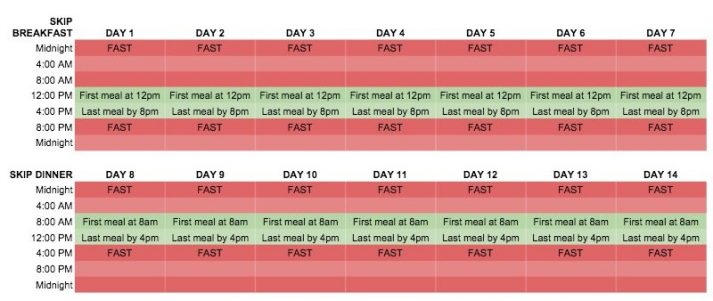
Adjust this window to make it work for your life:
- If you start eating at: 7AM, stop eating and start fasting at 3pm.
- If you start eating at: 11AM, stop eating and start fasting at 7pm.
- If you start eating at: 2PM, stop eating and start fasting at 10pm.
- If you start eating at: 6PM, stop eating and start fasting at 2AM.
#2) INTERMITTENT FASTING 24-HOUR PLAN
With this plan, you eat your normal 3 meals per day, and then occasionally pick a day to skip breakfast and lunch the next day.
Eat on a normal schedule (finishing dinner at 8PM) and then don’t eat until 8PM the following day.
If you can only do an 18 hour fast, or a 20 hour fast, or a 22 hour fast – that’s okay! Adjust with different time frames and see how your body responds.
Two examples: skipping breakfast and lunch one day of the week, and then another where you skip lunch and dinner one day, two days in a week.

These are just two popular strategies, though there are many variations of both that you can modify for yourself:
- Some people eat in a 4-hour window, others do 6 or 8.
- Some people do 20-hour fasts or 24-hour fasts.
- Another strategy is to eat only one meal a day (OMAD).
You’ll need to experiment, adjust to work for your lifestyle and goals, and see how your body responds. If there’s one thing we’ve learned after Coaching over 15,000 1-on-1 clients: there is no “one-size-fits-all” approach to exercise and nutrition that works for everyone, all of the time.
Let’s first get into the science here behind Intermittent Fasting and if you should consider it!
How Does Intermittent Fasting Work?

Now, you might be thinking: “okay, so by skipping a meal, I will eat less than I normally eat on average (2 meals instead of 3), and thus I will lose weight, right?”
All things being equal, yes.
By cutting out an entire meal each day, you are consuming fewer calories per week – even if your two meals per day are slightly bigger than before. Overall, you’re still consuming fewer calories per day.

In this example, you’re eating LARGER lunches and dinners than you normally do, but by skipping breakfast you’ll consume 500 less calories per day.
And thus, weight loss!
However, that doesn’t mean this works 100% of the time, for everyone. By understanding the underlying mechanism of weight loss (i.e. calorie deficit), we can better understand how our dieting strategy is affecting our behavior. Then we know if this strategy will work for us or not.
In the case of intermittent fasting, by condensing the eating window, many people feel more full and naturally eat less (like in the example above.)
However, it’s also totally possible for somebody to be so hungry as a result of fasting that they overconsume calories during that same period, which would result in weight gain instead of weight loss.
If you were reliant on the idea that “Intermittent Fasting works for weight loss” – full stop – you could be easily discouraged if it didn’t work.
You might think: “Is my metabolism broken?” But because we know that intermittent fasting is one dieting strategy that CAN work for weight loss if it helps you stick to a caloric deficit more easily, you’re empowered to decide if this is a good fit for you. Eureka!
This is highlighted in a recent JAMA study[2] in which both calorie-restricted dieters and intermittent fasters lost similar amounts of weight over a year period.
You might be thinking: “Ok, ok, I get it. Caloric deficit. But what about the timing of meals – can’t that also influence how your body reacts?”
Yes, your body operates differently when “feasting” compared to when “fasting”. But it’s important to understand how this fits into the big picture.
When you eat a meal, your body spends a few hours processing that food, burning what it can from what you just consumed.
Because it has all of this readily available, easy-to-burn energy (thanks to the food you ate), your body will choose to use that as energy rather than the fat you have stored.
During the “fasted state” (the hours in which your body is not consuming or digesting any food) your body doesn’t have a recently consumed meal to use as energy.
Thus, it is more likely to pull from the fat stored in your body as it’s the only energy source readily available.
However, when we compare the differences in energy used from body fat over an entire day, that’s entirely dependent on the total calories consumed. So while your body is more likely to pull energy from a recent meal, and will rely on fat stores once that energy runs out, if you eat the same amount of calories throughout the day, the result is the same amount of energy pulled from fat. It all balances out in the end.
The same goes for working out in a “fasted” state.
Without a ready supply of glucose and glycogen to pull from (which has been depleted throughout your fasted state, and hasn’t yet been replenished with a pre-workout meal), your body is forced to adapt and pull from a source of energy that it does have available: the fat stored in your cells.
While many of us get excited about the idea of being in a “fat-burning mode”, the same principle holds. If we burn an equal amount of calories, whether fasted or not, the result is less total energy stored in our fat cells at the end of the day. (There’s even an argument for athletes whose sports require glycogen to be readily available to meet their energy demands – making sure these stores are never depleted is important so an athlete doesn’t ‘bonk’ in the middle of their competition.)
Hopefully, you can see how easy it is to take a true fact of our biology (we burn more fat from fat stores when in a fasted state) and extrapolate it to seem more than it is. The same goes for six meals a day!
The truth is, there isn’t a magic pill or solution that’s going to overcome the basics. The best reason to do Intermittent Fasting is because you like it and it fits within your lifestyle.
TL/DR: Fasting can help promote weight loss and muscle building when done properly ~ though it isn’t the ONLY method that works.
Should I Eat 6 Small Meals a Day?

There are a few main reasons why diet books recommend six small meals:
1) When you eat a meal, your body does have to burn extra calories [9] just to process that meal. So, the theory is that if you eat all day long with small meals, your body is constantly burning extra calories and your metabolism is firing at optimal capacity, right? Well, that’s not true.
Whether you eat 2000 calories spread out throughout the day, or 2000 calories in a small window, your body will burn the same number of calories processing the food [10].
So, the whole “keep your metabolism firing at optimum capacity by always eating” sounds good in principle, but reality tells a different story.
2) When you eat smaller meals, you might be less likely to overeat during your regular meals. I can definitely see some truth here, especially for people who struggle with portion control or don’t know how much food they should be eating.
However, once you educate yourself and take control of your eating, some might find that eating six times a day is very prohibitive and requires a lot of effort. I know I do.
Also, because you’re eating six small meals, I’d argue that you probably never feel “full,” and you might be MORE likely to eat extra calories during each snack.
This is why personal preference is so important when picking a diet strategy that works for you.
Although grounded in seemingly logical principles, the “six meals a day” doesn’t work for the reason you think it would (#1), and may feel prohibitive to prepare and eat 6 times a day (#2). Other people may find that 6 meals a day fits them perfectly. If you find what works for you, that rules!
If we think back to caveman days, we’d have been in serious trouble as a species if we had to eat every three hours. Do you think Joe Caveman pulled out his pocket sundial six times a day to consume his equally portioned meals?
Hell no! He ate when he could, endured and dealt with long periods of NOT eating (no refrigeration or food storage) and his body adapted to still function optimally enough to still go out and catch new food.
A recent study (written about in the NYT, highlighted by LeanGains) has done a great job of challenging the “six-meals-a-day” technique for weight loss [11]:
There were [no statistical] differences between the low- and high- [meal frequency] groups for adiposity indices, appetite measurements or gut peptides (peptide YY and ghrelin) either before or after the intervention. We conclude that increasing meal frequency does not promote greater body weight loss under the conditions described in the present study.
That’s why we made this:

Should I Try intermittent fasting? (4 Big Benefits)
Now that we’re through a lot of the science stuff, let’s get into the reality of the situation: why should you consider Intermittent Fasting?
#1) Because it can work for your goals. Although we know that not all calories are created equal, caloric restriction plays a central role in weight loss.
When you fast, you are potentially making it easier to restrict your total caloric intake over the course of the week, which can lead to consistent weight loss and maintenance.
#2) Because it simplifies your day. Rather than having to prepare, pack, eat, and time your meals every 2-3 hours, you simply skip a meal or two and only worry about eating food in your eating window.
It’s one less decision you have to make every day.
It could allow you to enjoy bigger portioned meals (thus making your tastebuds and stomach satiated) and STILL eat fewer calories on average.
It’s a point that Coach Matt makes in this video on intermittent fasting:
#3) It requires less time (and potentially less money). Rather than having to prepare or purchase three to six meals a day, you only need to prepare two meals.
Instead of stopping what you’re doing six times a day to eat, you simply only have to stop to eat twice. Rather than having to do the dishes six times, you only have to do them twice.
Rather than having to purchase six meals a day, you only need to purchase two.
#4) Plus, Wolverine does it:
If adamantium-clawed superheroes do Intermittent Fasting, it can probably work for you too, if you can make it work for your particular lifestyle and situation!
What Are the Negative Effects of intermittent fasting?

It’s important to understand Intermittent Fasting is NOT a cure-all panacea.
Let’s talk about some of the potential drawbacks of Intermittent Fasting:
#1) If you skip breakfast, you might be so hungry from this that you OVEREAT your other meals, which can lead to weight gain. The important thing here is that with an intermittent fasting plan, you’re eating fewer calories than normal because you’re skipping a meal every day (if your goal is weight loss.)
In other words, don’t delude yourself into thinking that if you skip breakfast and then eat 4,000 calories of candy bars for lunch and dinner that you will lose weight.
This is simply a math and behavior strategy for giving yourself fewer chances to overeat and put your body into a caloric surplus.
(If you struggle with portion control, figure out your calorie goals and track your calorie intake in your meals to make sure you’re not overeating.)
#2) Skipping meals can result in feelings of lethargy, hunger, and “hangriness”!
If you eat breakfast every morning, your body expects to wake up and eat food.
Once you retrain your body to NOT expect food all day every day (or first thing in the morning), it’s possible that these side effects become less of an issue. In addition, ghrelin (a hormone that makes you hungry [13]), is actually lowest in the mornings and decreases after a few hours of not eating.
#3) Intermittent Fasting can be more complex for people who have issues with blood sugar regulation, suffer from hypoglycemia, have diabetes, etc. If you fit into this category, check with your doctor or dietitian before adjusting your eating schedule.
#4) Intermittent Fasting can affect women differently: there’s a whole section dedicated to that here.
Can I Build Muscle and Gain Weight While Intermittent Fasting? (Pros and Cons)

It is possible to build muscle and strength while Intermittent Fasting, though it’s not inherently superior to building muscle and strength while following a traditional eating pattern.
(We have our big “how to build muscle” guide, in addition to a whole “Strength 101” series – and I’d recommend you read those if you’re looking for a place to start strength training.)
Personally, I did intermittent fasting from 2015 to 2020 while building muscle and strength:
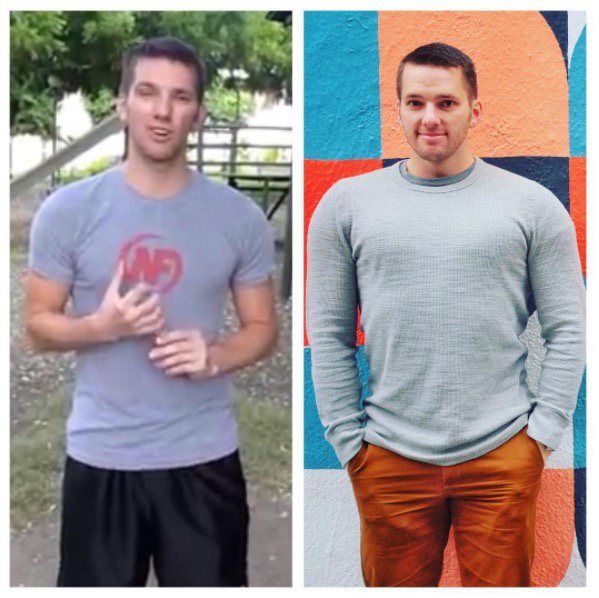
Let’s talk first about the nutritional strategy first, and then we’ll get into the exercise portion.
Here’s how I built muscle while simultaneously fasting: In order to gain weight and build muscle, I had to be in a caloric surplus.
And because I was not eating for 16 hours, that meant I was cramming 3000 nutritious calories into an 8 hour window, which often left me feeling bloated and overly full.
- 11 AM Work out with heavy strength training in a fasted state.
- 12 PM Immediately consume 1/2 of my calories for the day (a regular whole-food meal, followed by a calorie-dense homemade protein shake).
- 7 PM Consume the second portion of my calories for the day in a big dinner.
- 8 PM – 12 PM the next day: Fast for 16 hours.
After following this strategy for a number of years, I gave up fasting in 2019, and instead consumed my calories throughout the day.
Here’s a different strategy for Fasted Muscle Building: my friend Nate Green packed on a crazy amount of muscle while fasting for a full 24 hours on Sundays. [15]
Let’s now talk about strength training!
If you want to build muscle while fasting, you need to work out. Specifically, by lifting heavy, so here are a few workout options!
#1) “Build Your Own Workout Routine” and get your hands dirty. Our guide will walk you through building a full-body exercise program in 10 simple steps.
#2) Follow our Strength Building Guide and start training today. You’ll want to do lots of heavy compounds lifts:
How to tie it all together: pick up heavy things, eat enough protein, and consume enough calories, and you’ll build muscle and strength.
Should You Do Intermittent Fasting and the Keto Diet?

We have a crazy extensive guide on the Keto Diet in case you’re not familiar with it, so here it is in a nutshell:
By only eating fat and protein, your body must adapt to run on fat for fuel instead of carbohydrates. In the absence of carbs/glucose, your body converts fats to ketones and uses them for fuel.
This process is called “ketosis,” and there are two ways for a body to enter ketosis:
- Eating in a way that induces ketosis (very low carb, high fat).
- Fasting…Hey, that’s what you’re reading about right now!
We actually have an amazing success story here on Nerd Fitness, Larry, who followed our strategies, went Keto and start intermittent fasting. He ended up losing weight, getting stronger, AND overcame the challenges of rheumatoid arthritis (click on the image for his story)!

Why Keto and Fasting can work: eating Keto can be really challenging. And every time you eat, it’s an opportunity to do it wrong and accidentally eat foods that knock you out of ketosis.
You’re also tempted to overeat.
So, by skipping a meal, you’re eliminating one meal, one decision, one chance to screw up.
Note: if you’re thinking “Steve, am I losing weight because I’m skipping 1/3rd of my meals for the day, AND eliminating an entire macronutrient?”, then you’d be right.
Both Keto and IF have secondary effects that could also be factoring in – physiological benefits which I explain in both articles.
Your value may vary!
You need to decide what works for you.
You probably won’t become “keto-adapted” (your body running on ketones) just skipping breakfast every day – your body will still have enough glucose stored from your carb-focused meals for lunch and dinner the day before.
In order to use fasting to enter ketosis, the fast needs to be long enough to deplete your carb/glucose stores, or you need to severely restrict carbohydrates from your meals in addition to IF in order to enter ketosis.
MORAL OF THE STORY: Experiment and try different strategies that will work for you.
By skipping a meal or minimizing carbohydrate intake, you’re more likely than not to lose weight:
- You can do intermittent fasting without eating a Keto Diet and lose weight.
- You can do a Keto Diet without intermittent Fasting and lose weight.
- You can combine them and lose weight.
- You can do neither and lose weight.
Sticking with Keto is BRUTALLY difficult, and probably not the right diet for 98% of the planet. Those people would be better off following our “Start Eating Healthy” guide with small changes.
Does Intermittent Fasting Have Different Effects on Men and Women?

The quick answer is: “yes, Intermittent Fasting can affect men and women differently.”
Anecdotally, we have many women in our online coaching program that swear by Intermittent Fasting, while others have had adverse effects.
Let’s dig into the science and studies.
A recent PubMed summary concluded that “fasting can be prescribed as a safe medical intervention as well as a lifestyle regimen which can improve women’s health in many folds [18].
Now, in that extract, many of the studies cited are focused on specifically calorie restriction (and not just fasting), and they also say that “future studies should address this gap by designing medically supervised fasting techniques to extract better evidence.”
Digging into the PubMed Archives brought me to the following conclusions [19]:
One small study (with 8 men and 8 women, all non-obese) resulted in the following: “Glucose response to a meal was slightly impaired in women after 3 weeks of treatment, but insulin response was unchanged. Men had no change in glucose response and a significant reduction in insulin response.”[20]
Another small study (8 women) studied the effects on their menstrual cycles after a 72-hour fast – which is significantly longer than any fast recommended in this article: “in spite of profound metabolic changes, a 72-hour fast during the follicular phase does not affect the menstrual cycle of normal cycling women.” [21].
Yet another study tracked 11 women with 72-hour fasts (again, longer than we’d recommend) and it found that “Fasting in women elicited expected metabolic responses – included increased cortisol (a stress hormone) – and apparently advanced the central circadian clock (which can throw off sleeping patterns). [22]
Those studies above, in working with small sample sizes, and different types of fasting than recommended here, would lead me to believe that fasting affects men and women differently, and that many of the weight loss benefits associated with intermittent fasting (that affect insulin and glucose responses) work positively for men and negatively for women.
There are also a series of articles[23] out there that dig into the potential reproductive health issues, stress challenges, induction of early-menopause [24] associated with fasting (and calorie restriction) for women.
Precision Nutrition – a great resource – recommends not attempting Intermittent Fasting as a woman if:
- you’re pregnant
- you have a history of disordered eating
- you are chronically stressed
- you don’t sleep well
- you’re new to diet and exercise
The challenge associated with all of this is that there aren’t enough long-term studies, with large enough sample sizes, specifically targeting female humans, with relation to the different types of Intermittent Fasting.
It does appear that men and women will have different experiences with intermittent fasting; we’re all unique snowflakes (yep, especially you), and your body will be affected by intermittent fasting differently than the person next to you.
There is enough evidence as cited in the articles and studies above that would give me pause to recommend Intermittent Fasting for women, especially if you are considering getting pregnant in the near term.
If you are looking to attempt fasting for weight loss reasons, my research has shown me that Intermittent Fasting could be less effective for women than men with regards to weight loss, and thus you would be wise to keep your efforts elsewhere:
- Focusing on the total calories and quality of your food (here’s how to eat better).
- Start exercising regularly!
- Make sure you are getting enough sleep.
Now, if you’ve read the above warnings, you are still curious about Intermittent Fasting, and you want to give it a try as a female, that is your choice!
You know your body best.
So, get blood work done, speak with your doctor and get a check-up.
Give intermittent fasting a shot, track your results, and see how your body/blood work changes as a result of Intermittent Fasting and decide if it’s right for you.
Your mileage may vary, so speak with a doctor or find a doctor versed in intermittent fasting plans and treat it like an experiment on yourself!
Top 5 Questions about Intermittent Fasting

1) “Won’t I get really hungry if I start skipping meals?”
As explained above, this can be a result of the habits you have built for your body. If you are constantly eating or always eat the same time of day, your body can actually learn to prepare itself for food by beginning the process of insulin production and preparation for food.
After a brief adjustment period, your body can adapt to the fact that it’s only eating a few times a day. The more overweight you are, and the more often you eat, the more of an initial struggle this might be.
Remember, your body’s physical and cognitive abilities most likely won’t be diminished as a result of short-term fasting.[25]
2) “Where will I get my energy for my workouts? Won’t I be exhausted and not be able to complete my workouts if fasting?”
This was a major concern of mine as well, but the research shows this might not be the case: “Training with limited carbohydrate availability can stimulate adaptations in muscle cells to facilitate energy production via fat oxidation.”[26]
In other words, when you train in a fasted state, your body can get better at burning fat for energy when there are no carbs to pull from!
The caveat to this is that pulling energy from fat oxidation is a slower process than breaking down carbohydrates. If your workout is super intense (high-intensity interval training, MMA, even bodybuilding) – you’ll likely benefit from having more readily available energy to fuel your workouts for better performance.
3) “I like the idea of fasted training, but I work a regular 9-5 or a night shift and can’t train at 11AM as you do. What am I supposed to do?”
Depending on your training schedule, lifestyle, and goals, go back to the portion above where I talk about the 16/8 protocol and simply adjust your hours of fasting and feasting.
LeanGains digs into various options here, but here is really what you need to know:
- Don’t overthink this. If you can’t train until 5pm, that’s okay. Consume a small meal for lunch, or shift your Intermittent Fasting window to eat all of your meals in the 8 hours post-workout. Better to do that than abandon it as a lost cause and have 0% compliance.
- If you are an elite athlete, speak with a coach or nutritionist about your specific concerns and expectations. Otherwise, make intermittent fasting work for you Consider trying the 24-hour protocol below instead of the 16/8 protocol.
- If you train later in the day (say, 7pm) but break your fast before training (aka Lunch), make it a smaller meal focused around fats and protein – which should be a solid goal even if you aren’t Intermittent Fasting! Try to time your carb and big meal consumption to happen AFTER your workout.
- If you exercise BEFORE work, but then don’t eat until lunchtime: consider a protein supplement immediately after your workout, or simply wait until lunch to start eating. See how your body responds and adjust accordingly.
Do what you can, and don’t psyche yourself out! Get started and adjust along the way.
4) Will Intermittent Fasting cause muscle loss?
Good news: Our bodies are quite adept at preserving muscle even when fasting [27], and it turns out that protein absorption by our body can take place over many many many hours.
Not only that, but you can even burn fat AND build muscle at the same time if you have the right system in place!
Protein consumed in a shorter period of time has no difference on the body compared to protein spread throughout the day.
5) How much should I eat while intermittent fasting?
Simple: Eat for your goals! You do know how many calories you should eat every day, right?
If your goal is weight loss, you still need to consume fewer calories than you burn every day to lose weight, full stop. If your goal is bulking up, you’ll need to consume more calories than you burn every day. Intermittent Fasting isn’t a cure-all, it’s a PART of the puzzle.
To start, begin intermittent fasting and eat your normal-sized meals and track your weight and performance. If you are losing weight and happy with the progress, keep doing what you’re doing! If you are NOT losing weight, you could be eating too much. It’s a message I really strike home in our guide “Why Can’t I Lose Weight?”
That’s why you should track your calories for a week, and then target a 10% reduction in calories and continue. Here’s a calculator for you to determine the amount of calories you need daily.
6 Tips and Tricks about Fasting

#1) Don’t freak out! Stop wondering: “can I fast 15 hours instead of 16?” or “what if I eat an apple during my fasted period, will that ruin everything?” Relax. Your body is a complex piece of machinery and learns to adapt. Everything is not as cut and dry as you think.
If you want to eat breakfast one day but not another, that’s okay. If you are going for optimal aesthetic or athletic performance, I can see the need to be more rigid in your discipline, but otherwise…freaking chill out and don’t stress over minutiae!
Don’t let perfect be the enemy of good when it comes to your intermittent fasting plan. It’s just one tool in your toolkit.
#2) Listen to your body during your strength training workouts. If you get lightheaded, make sure you are consuming enough water.
If you notice a significant drop in performance, make sure you are eating enough calories (especially fats and protein) during your feasting window.
And if you feel severely “off,” pause your workout. Give yourself permission to EASE into intermittent fasting and fasted workouts. This is especially true if you are an endurance athlete.
#3) Stay busy. If you are just sitting around thinking about how hungry you are, you’ll be more likely to struggle with this. For that reason, I time my fasting periods for maximum efficiency and minimal discomfort:
- My first few hours of fasting come after consuming a MONSTER dinner, where the last thing I want to think about is eating.
- When I’m sleeping: 8 of my 16 hours are occupied by sleeping. Tough to feel hungry when I’m dreaming about becoming a Jedi.
- When I’m busy: After waking up, 12 hours of my fasting is already done. I spend three hours doing my best work (while drinking a cup of black coffee), and then comes my final hour of fasting: training.
#4) Zero-calorie beverages are okay. I drink green tea in the morning for my caffeine kick while writing. If you want to drink water, black coffee, or tea during your fasted period, that’s okay. Remember, don’t overthink it – keep things simple! Although be aware that Dr. Rhonda Patrick over at FoundMyFitness believes that a fast should stop at the first consumption of anything other than water, so experiment yourself and see how your body responds.
If you want to put milk in your coffee, or drink diet soda occasionally while fasting, I’m not going to stop you. Remember, we’re going for consistency and habit-building here – if milk or cream in your coffee makes life worth living, don’t deprive yourself.
There are MUCH bigger fish to fry with regards to getting healthy than a few calories here and there during a fast.
80% adherence that you stick with for a year is better than 100% adherence that you abandon after a month because it was too restrictive.
If you’re trying to get to a minimum bodyfat percentage, you’ll need to be more strict with overall calories – until then, however, do what allows you to stay compliant!
#5) Track your results, listen to your body:
- Concerned about losing muscle mass? Keep track of your strength training routines and see if you are getting stronger.
- Buy a cheap set of body fat calipers and keep track of your body fat composition.
- Track your calories, and see how your body changes when eating the same amount of food, but condensed into a certain window.
#6) Don’t expect miracles. Yes, Intermittent Fasting can potentially help you lose weight, increase insulin sensitivity and growth hormone secretion (all good things), but it is only ONE factor in hundreds that will determine your body composition and overall health. Don’t expect to drop to 8% body fat and get ripped just by skipping breakfast.
You need to focus on building healthy habits, eating better foods, and getting stronger.
This is just one tool that can contribute to your success.
Getting Started with Intermittent Fasting: Next Steps

Intermittent fasting can potentially have some very positive benefits for somebody trying to lose weight or gain lean body mass.
Men and women will tend to have different results, just like each individual person will have different results. The ONLY way to find out is through a conversation with your doctor and self-experimentation.
There are multiple ways to “do” an Intermittent Fasting Plan:
- Fast and feast regularly: Fast for a certain number of hours, then consume all calories within a certain number of hours.
- Eat normally, then fast 1-2x a week: Consume your normal meals every day, then pick one or two days a week where you fast for 24 hours. Eat your last meal Sunday night, and then don’t eat again until dinner the following day.
- Fast occasionally: probably the easiest method for the person who wants to do the least amount of work. Simply skip a meal whenever it’s convenient. On the road? Skip breakfast. Busy day at work? Skip lunch. Eat poorly all day Saturday? Make your first meal of the day dinner on Sunday.
After that, get started! Take photos, step on the scale, and track your progress for the next month.
See how your body responds.
See how your physique changes. See how your workouts change.
And then decide if it’s something you want to keep doing!
4 years later, I have no plans on going back to eating breakfast. Sorry General Mills and Dr. Kellogg!
Thanks for reading, and I hope we gave you ALL the information you wanted about Intermittent Fasting, it’s underlying mechanisms for success, and reasons it may (or may not) work for you!
-Steve
PS: Before you take off, grab our Intermittent Fasting Worksheet to help you start your fasting practice:
PPS: Make sure you check out the rest of our guides on losing weight:
- The 5 Rules of Weight Loss
- How to Start Eating Healthy (Without Being Miserable)
- 9 Strategies for Losing Weight Quickly
###
Photo Source:[29]
The post Intermittent Fasting Guide: Myths, Facts, & Strategies first appeared on Nerd Fitness.
]]>The post Strength Training For Women: 7 Things You Should Know First! first appeared on Nerd Fitness.
]]>Well you’ve come to the right place!
We help women just like you grow strong, and today we’ll get you started on your strength training journey.
Here’s what we’ll cover in our strength training guide for women:
- Should women lift weights? (Why you should start strength training)
- Is strength training different for women?
- Strength Training Level 1: Bodyweight Workouts
- Strength Training Level 2: Dumbbell Workouts
- Strength Training Level 3: The Wide World of Barbells
- How much weight should women lift?
- Can strength training help with weight loss?
- The best strength training exercises for women
- A meal plan for strength training (Healthy Eating 101)
- The top frequently asked strength training questions for women
- How to begin lifting weights as a woman (Next Steps)
After today’s guide, you’ll know exactly how to transform yourself into a superhero!
What makes me so confident? How do I know so much about women growing strong?
Allow me to introduce myself: My name is Staci Ardison.
This is me deadlifting 455 pounds:

I’m currently the Senior Coach here in the Nerd Fitness Coaching Program.
And no, I wasn’t born this strong (that would be strangely awesome). It’s only after discovering a love of strength training that I learned how to handle weight like this.
Obviously, we won’t start you out lifting that much at first. But we will set you up on a path that if you want to, one day you’ll be able to.
Before we get to it, if you’re in a hurry, I want you to know we’ve compiled all our strength training material into a friendly guide so you can read it at your leisure (I’m picturing you reading the guide poolside, sipping a lemonade).
Download Strength Training 101: Everything You Need to Know when you enlist in the Rebellion (that’s us!) below:
Alright, let’s do this!
Should Women Lift Weights? (Why You Should Start Strength Training)

Everyone should start strength training: people of every sex and gender, the young, the old…everyone.[1]
We discuss the benefits heavily in our introduction to strength training, but I’ll highlight some examples now.[2]
Here’s why every woman should strength train:
#1) When you’re stronger – life is easier. No need to call for help to get that 50lb bag of dog food off the top shelf, or carrying an air conditioner unit up a flight of stairs. LIFE is easier when you’re stronger.
#2) Less injury risk – when you build strong muscles, you’re also building stronger bones, ligaments, and tendons, making you less prone to injury doing things you love (like playing in a quidditch league).[3]
#3) Helps combat age-related muscle loss,[4] allowing us to remain independent longer as we age:
#4) Muscle is harder to maintain, which means you need to eat more just to hold on to it.[5]
#5) Reduce pain – having a strong body makes living easier on your joints, as well as allows you to hold a better posture and reduce back / hip pain.[6]
#6) Appearance – this is a personal preference! Some women like to have a lot of muscle, and some don’t. While you can’t spot reduce fat, you can choose to build more muscle in specific areas, changing your body shape. Growing up, I was an extreme pear shape, but due to strength training, I now have more of an hourglass shape.

#7) Live longer – want to spend more time on Earth? Strength training and growing muscle will help you do just that.[7]
Boom!
Although strength training is one of the best things you can do for your health, it’s estimated that only about 20% of women do it, far below that of our male counterparts.[8]
That sucks.
It’s part of my life’s work to reverse this trend and to do so, I’m going to need your help.
You in?

Perfect!
Is Strength Training Different for Women?

Here’s something that may shock you: there’s no reason everybody – of any gender or sex – shouldn’t strength train the same way!
Yep, you don’t need 3-pound pink dumbbells, unless you like 3-pound pink dumbbells! You can train with free weights and barbells just like everybody else at the gym.
Sure, there are biological differences between the sexes. For example when strength training, people with typical male anatomy will produce more type IIa fibers than people with typical female anatomy, who will in turn produce more type I fibers than men.[9]
Don’t worry about any of this though.

We don’t need to get you lost in the weeds.[10]
The American College of Sports Medicine doesn’t differentiate between sexes in their strength training recommendation.[11] So neither shall we.
So what exactly is strength training, you may be asking?
“Strength training” of any kind can be explained by two things:
#1) Movement of any weight (including your body weight) – Doing ANY exercise that pushes your muscles outside of their comfort zone, forcing them to rebuild stronger to prepare for the next challenge.
#2) Progressive overload: exerting slightly more effort than last time (lift a heavier weight or do 1 more rep) consistently. Your muscles will constantly have to adapt and will constantly be rebuilding themselves to get stronger.
Coach Jim walks you through different strategies for progressive overload in this video:
Before we get into the ins and outs of strength training, I need to address a question we get over and over from the women in our coaching clients:
Will I get bulky if I lift weights?
If you see a woman who is incredibly muscular and at an extremely low body fat percentage, I guarantee she has been working her butt off for a very long time with the very specific goal of building muscle and looking that way.
It’s not something that happens overnight, or by mistake.
We simply don’t have the same amount of testosterone as people with male anatomy to get there easily.[12] It’s something we cover in great detail in our guide on How to Build Muscle as a Woman.
If you’d like to build muscle, but not as much as a professional bodybuilder – don’t worry, it’s not something that happens by accident.
It’s something Rebel Leader Steve brings up in the video below:
So strike “I don’t want to get bulky” from your vernacular.
Alright, let’s talk about how to actually get started strength training.
Strength Training Level 1: Bodyweight Workouts

If you’re just starting your strength training journey, our first stop will be a bodyweight workout.
Bodyweight training is simply doing an exercise in which your own body is the “weight” you are “lifting.”
Duh.
This is the BEST place for anybody – regardless of weight or age – to start their strength training journey.
Why is this the best place to start?
Here are two big reasons to do bodyweight training:
#1) You always have your body with you (unless you are a ghost, in which case, this is awkward). This means you can work out ANYWHERE with bodyweight training:
- Our Beginner Bodyweight Workout Routine in your living room.
- Our Hotel Workout in a hotel (obvi).
- Our Park Workout in a…well, you get the point.
#2) Using your body for resistance training is the most “human” thing ever! By learning to push and pull and hang and squat and lunge, you are doing what your body is literally designed to do.
By getting strong with bodyweight movements, you’re making yourself antifragile and less injury-prone.
Bodyweight training isn’t as easy to ‘scale’ the difficulty as some of the other strength training methods (“put more weight on barbell”), but you can get REALLY strong with just bodyweight training.
For example…
You can start with knee push-ups:

Then go to regular push-ups:

Then elevated push-ups:

Then even up to things like handstands:

And even handstand push-ups:

You just have to know HOW and WHEN to scale up (we can help there too).
Want a sample bodyweight workout you can try? You got it:
This is the Beginner Bodyweight Workout (3 Circuits):
- 20 Bodyweight squats.
- 10 Push-ups.
- 10 Walking lunges (each leg).
- 10 Dumbbell rows (use a milk jug or other weight).
- 15 Second plank.
- 30 Jumping jacks.
Want some variety? Try 8 other “at-home workouts.”
You can also create your own “no equipment workout” by reading the 42 Best Bodyweight Exercises.
Strength Training Level 2: Dumbbell Workouts

The next stop on our strength training journey includes lifting some actual weights!
Woot.
Dumbbells are a great first step into the world of weight training and strength training:
- Most gyms will have dumbbells, even if it’s a basic gym in your apartment complex.
- A set of dumbbells doesn’t take up a lot of room, which means you can have a pair at home without a large footprint.
- Dumbbells make it easy to add difficulty to a bodyweight movement: holding dumbbells while doing lunges, for example.
- Dumbbell exercises can be less intimidating than barbell training for some, and are a step towards barbell training.
- Dumbbells have an added stabilization challenge, and will point out muscle imbalances pretty easily (“oh my right arm is stronger than my left arm.”).
- You can scale easily. Once the 10 pound weights become too easy, pick up the 15 pound ones!
Here’s a beginner workout that you can do, taken from our Level 4 Gym Workout “Dumbbell Division”:
- 10 goblet squats
- 10 push-ups
- 10 dumbbell rows per side
Here’s how to perform a goblet squat:

This is a push-up done in proper form (in case you skipped the last section[13]):
And here is how to do a dumbbell row:

If you’re following along at home, you just did your first full-body workout using weights!

Want a custom-built dumbbell workout? Something designed for the weights in your apartment’s gym?
Our Nerd Fitness Coaches can do just that! Plus they’ll scale your workouts as you grow stronger, turning you into a superhero!
Strength Training Level 3: The Wide World of Barbells

You made it! It’s now time to start training with barbells!
This is going to help you become ultra-powerful and strong.
It’s how I transformed myself into the person I am today.
The reason barbell training is so important is that it allows you to pick up heavy weights and do movements that recruit every muscle in your body. This is great for building powerful, strong muscles in your core, legs, glutes, and so on.
We’re talking about exercises like the Back squat:

And the Barbell Deadlift:

Show me somebody that’s strong at both of these movements, and I’ll show you somebody that’s in better shape than most of the human population.
But wait!
Even an empty barbell can be heavy (normally 45 pounds or 20Kg), so before we jump into the deep end, let’s make sure you are strong enough to proceed.
You’ll need to be able to complete a goblet squat with a 45 pound dumbbell (shown earlier) and the Romanian deadlift with 20 pound dumbbells.
Here’s how to perform the Romanian deadlift with dumbbells:
Our test to see if you can handle barbell training will be the Level 4 Gym Workout: Dumbbell Division C (taken from our Beginner’s Guide to the Gym).
You’ll need to be able to go through the following before you start training with barbells:
- 10 goblet squats – 45 lbs (20Kg dumbbell),
- 10 Romanian deadlifts with 20 lbs dumbbells (9-10 Kg)
- 10 push-ups (on knees or regular)
- 10 dumbbell rows with each arm – at least a 20 lb dumbbell
Can’t do those movements at that weight? Stick to the Level 4 Gym Workouts until you build up the strength to progress to barbells.
Once you CAN do the above, the real fun is going to start!
We’re gonna replace the goblet squat with a back squat and the RDL with a barbell deadlift.
Here’s a video demonstration on how to perform the barbell back squat:
I would also encourage you to read How to Squat Properly for a full tutorial, especially if you’re just learning how to squat.
Here’s a step-by-step video on how to do the deadlift:
Again, make sure you read How to Deadlift Safely With Proper Form if you’re just starting your deadlifting journey.
Once you get the handle of these two moves, it’s time for a full-body workout using barbells!
We’ll give you two different days to alternate between.
NF BEGINNER BARBELL STRENGTH WORKOUT: DAY A
Do 3 rounds of:
- 10 barbell squats
- 10 push-ups
- 10 bodyweight rows
NF BEGINNER BARBELL STRENGTH WORKOUT: DAY B
Do 3 rounds of:
- 5 barbell Romanian deadlifts
- 10 push-ups
- 10 dumbbell rows per arm
That’s it! Do each of these once a week and you’ll be rocking an awesome strength training practice.
Are you doing the workouts correctly?
A good way to tell would be to record yourself doing the movement and then match them against the gifs and videos in this guide. If they look close you’re doing great!
We also provide form checks in our 1-on-1 Online Coaching Program. Through our snazzy app, a Nerd Fitness Coach (like me!) will review your movement to make sure you are training correctly and safely!
How Much Weight Should Women Lift?

We have a FULL resource on how to determine your starting weight for lifting, but I’ll give you the gist here.
The simple to learn but tough to implement answer: lift enough so that you can get through the set, but not too much that you have NO fuel left in the tank at the end.
And then, try to lift sliiiightly more than last time.

How much weight should I start with?
- If you are using dumbbells or a kettlebell, always err on the side of “too light” versus “too heavy.” You want to learn the movement correctly and build correct form.
- If you are training with a barbell, ALWAYS start with JUST the bar, no matter the exercise (as a reminder, a standard barbell weighs 45 pounds).
“How fast should I add weight to the bar?”
Here’s what we teach all of our coaching clients: add the minimum amount of weight each week you can, even if you THINK you can lift more. It’s better to finish a workout full of momentum and say “I can do more!” than defeated and saying “that was too much, crapola.”
Think of it this way, even if you are adding just 5 pounds per week to the bar, within a year you would be lifting 300+ pounds!
So go SLOW. Team NF’s Steve even bought little half-pound weights and increases many of his lifts by just 1 pound per week.

It’s a big part of how he transformed (jokingly) from Steve Rogers to Captain America.
And if you are looking for this content in an easily digestible form, make sure you download our free Strength 101 Guide when you join the Rebellion below:
Can Strength Training Help with Weight Loss?

We get questions relating to weight loss and strength training all the time, and it’s something we cover throughout our Strength Training 101 series.
Let me quickly address it here:
Fat and muscle are two different things – one can’t transform into the other.
We all have plenty of muscle right now (otherwise we wouldn’t be able to move, walk, sit upright, etc.), the muscle is just hiding underneath a layer of body fat.
In order for us to lose weight and look better, we want to do two things:
- Build our muscles stronger and tighter.
- Reduce the fat covering those muscles!
And luckily, both of those things happen simultaneously through strength training!
Coach Matt explains exactly how in this video on losing fat while gaining muscle (also known as “getting toned”):
So NO, you don’t need to lose weight first before you start strength training.
You will lose weight BY strength training (and keep the muscle you have).
You do NOT need to do hours of cardio for weight loss – weight loss is 90% a result of your nutrition. So honestly, you don’t need to ever set foot on a treadmill again (unless you WANT to).

Strength training will help you lose weight and look better IF you do two key things for effective weight loss:
- Calorie restriction: eat fewer calories than you burn every day.
- Strength train with progressive overload (picking up heavier stuff).
As we cover in our “Why can’t I lose weight” article (full of fun Harry Potter references), combining a caloric deficit and strength training is magic:
- You’re not consuming enough calories to carry out your body’s daily functions.
- Your body needs to use lots of calories to rebuild the muscle that was broken down during the strength training workout.
- Your body has no choice BUT to pull from fat stores to get stuff done!
Just by doing those two things (get strong, reduce calories), all sorts of wizardry and witchcraft takes place in your body:
- Get stronger and keep the muscle you have.
- Build tight dense muscle.
- A revved-up metabolism while rebuilding muscle.
- Burning of body fat to get things done.
Yeah, you’re hearing me correctly.
Lose the body fat that sits on top of your muscles and you’ll make your muscles tighter and denser = look better without clothes on.
So how do you put this into practice?
- Pick one of the strength workouts we covered earlier (start at the Beginner Bodyweight Workout if you feel unsure where to begin).
- Calculate your daily caloric needs.
- Learn which diet is best for you and make a small change.
Oh, what’s that? You just want somebody to tell you exactly how to train for your body, and how to eat for your goals?
Fine!
Check out our 1-on-1 Coaching Program – it’s helped hundreds of women lose weight through strength training – and proper nutrition. We work with you on habit-building and lifestyle design to actually get stuff done!
The Best Strength Training Exercises for Women

Great news:
The best strength training exercises are universal. No matter your size, shape, sex, gender, age, or whether you love Star Trek more than Star Wars, these are the best exercises to build a great physique.
I’m going to share with you the exercises that every beginner should master (scroll down for full video and explanations!).
The 9 Best Strength Training Exercises for Women are:
- Push-up: uses every push muscle in your body (chest, shoulders, triceps)
- Bodyweight squat: uses every muscle in the lower body (quads, hamstrings, glutes, core)
- Bodyweight row: works every “pull” muscle and helps prepare you for a pull-up!
- Pull-up or chin-up: the best “pull” exercise in history! Everybody should have a goal to get their first pull-up.
- Bodyweight dip: advanced “push” movement that targets your push muscles (chest, shoulders, triceps) in a different way than push-ups.
- Barbell squat: the best bang for your buck on muscle building. Recruits nearly every push muscle in your whole body, and a great core workout.
- Barbell deadlift: the favorite exercise of every coach at Nerd Fitness. Uses every “pull,” leg, and core muscle in your body.
- Barbell benchpress: as basic and powerful as they come. Uses every “push” movement in your upper body and can get you strong as heck!
- Barbell press: press the bar above your head! Targets shoulders and triceps more than the chest.
Click on any of these exercises to get a FULL explanation of the movement, step-by-step:
1) The Push-Up: The best exercise you could ever do for yourself when it comes to using your bodyweight for push muscles (your chest, shoulders, and triceps):
2) The Bodyweight Squat: This exercise serves a dual purpose as it’s the foundation for building strength AND helps build proper mobility. If you are going to ever do barbell squats, you need to work on hitting proper depth with a bodyweight squat first!
3) The Inverted Bodyweight Row: Until you can get your first pull-up or chin-up, these exercises are GREAT to start building your pull-muscle strength (back, biceps, and forearms).
4) The Pull-Up and Chin-Up: Once you can support your bodyweight above the bar, the world becomes your playground. No strength training routine should be without pull-up or chin-up work! (Click here if you can’t do a pull-up or chin-up yet?)
5) The Bodyweight Dip: As you start to get stronger with push-ups and need to find a way to increase the challenge, consider doing dips. Warning: these are very advanced, but incredible strength-building exercises.
And now we’re into the best weight training exercises:
6) The Barbell Squat: Probably the best exercise when it comes to building strength and muscle throughout your whole body. It also burns crazy calories and makes life better. This is a MUST:
7) The Barbell Deadlift: Maybe the best exercise of all time. Actually no, it IS the best exercise of all time. It’s certainly the most primal: “pick the weight up off the ground. Done.”
This is a very technical lift, so make sure you read our article on how to do it with proper form:
8) The Barbell Press: Press a barbell above your head. This recruits all of the muscles in your chest, shoulders, and arms in order for you to lift the weight over your head.
As a bonus, you need to really flex and brace your core, which gets those muscles working too.
9) The Barbell Bench Press. Lie on a bench, and lower a barbell until it almost touches your chest. Pause, and then press it back up towards the sky. Repeat! And get strong.
Your mission, should you choose to accept it: commit to trying ONE of these movements in the next week. Use 20 seconds of courage, recruit a friend who has lifted or trained before, and try your best.
And if you want somebody to help you put these into a workout program, teach you HOW to do these movements properly, and have the confidence to know you’re training correctly for your goals…
A Meal Plan for Strength Training (Healthy Eating 101)

So far, we’ve been more or less just talking about exercises when it comes to strength training.
This is logical, because this is in fact a guide on how to perform certain exercises to grow strong.

However, we constantly remind our coaching clients that 90% of their success or failure on their fitness journey will come down to what they eat.
“Success” in this context really comes down to your goals.
- Are you looking to bulk up? You’ll need to eat more calories than you burn.
- Are you looking to slim down? You’ll need to eat fewer calories than you burn.
At this point, you might be thinking “Staci, how many calories do I need?”
To answer that question, it’s time for the Nerd Fitness Calorie Calculator!
Nerd Fitness Total Daily Energy Expenditure Calculator
Basal Metabolic Rate (BMR)
0
Your BMR is an estimate of the total calories burned a day, while in a state of rest.
TDEE
0
Your TDEE is an estimate of the total calories burned during a single day, when exercise is factored in.
(Note: we have used The Mifflin-St Jeor Equation to create this calculator! [14]).
- If you want to bulk up and gain weight, take your TDEE and add 250 calories to it to get your daily goal. This should result in gaining half a pound per week.
- Want to lose weight? Take your TDEE and subtract 250 calories to receive your daily goal. This should result in losing about a half-pound a week.
The other piece of the equation outside of a caloric surplus/deficit is protein.
Since you will be strength training and building muscle, you’ll need to make sure you are eating protein at every meal. It’s the number one macronutrient for creating new muscle tissue.[15]
Protein can come from any number of sources, including:
- Meat (steak, bison, pork).
- Fowl (chicken, turkey, duck).
- Eggs![16]
- Cheese and dairy.
- Fish and shellfish (salmon, tuna, shrimp).
- Legumes (black beans, chickpeas).
- Other vegetarian protein sources here.
As we cover in our “How much Protein do I need?”, claims for the amount of protein required for muscle growth vary wildly from source to source (and woman to woman).[17]
Here is our recommendation:
- If you’re of healthy weight, active, and wish to build muscle, aim for 1 g per pound of bodyweight (2.2 g/kg).
- If you’re an experienced lifter on a bulk, intakes up to 1.50 g/lb (3.3 g/kg) may help you minimize fat gain.
Let me simplify it for you:
“To build muscle, target at least 1 gram of protein per pound of bodyweight (2.2 grams per kg).”
If you’re curious, from our healthy eating article, this is what a portion of protein looks like:
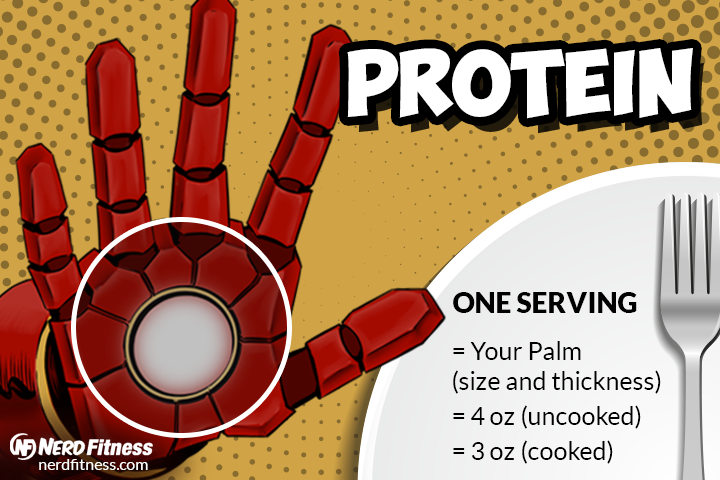
Here’s how much protein is in a serving of food:
- 4 oz (113 g) of chicken has around 30 g of protein.
- 4 oz (113 g) of salmon has 23 g of protein
- 4 oz (113 g) of steak has 28 g of protein.
Want to get more protein? Consider protein shakes. Rebel Leader Steve and I both supplement with shakes daily to meet our protein goals.
Whatever you do, make sure you’re getting enough!
Whenever we speak with new Online Coaching Clients, protein is the macronutrient we begin every discussion with! It’s THAT important when it comes to either weight loss or building muscle. I’m not kidding when I say it should make up a portion of every meal you eat.
The Top Frequently Asked Strength Training Questions for Women

Here are some of the most common questions we receive from women beginning their strength training practice in our 1-on-1 Coaching Program.
#1) Will I get bulky lifting weights? I really don’t want to.
I have GREAT NEWS!
Strength training will not make you bulky, UNLESS you want it to!
And if you want to bulk up? That’s AWESOME!

Here’s how to build muscle correctly.
You get to pick how you want to look, so you do you.
Just remember that women who compete as bodybuilders didn’t start looking like overnight:
- They have eaten, trained, and potentially taken supplements specifically so they can look like that! Which is great. Good for them.
- They’ve been working towards that goal for years, probably decades.
Here’s the truth: when you pick up heavy things (like barbell training), your muscles get STRONGER (but not necessarily bigger).
If you actively eat for the goal of building muscle and getting bigger, you CAN build muscle and size.
Again, if you want bigger arms or stronger glutes, AWESOME. You do you.
Let’s talk about the reverse: If you pick up heavy things and eat a caloric deficit, your muscles will get stronger and denser; you will burn the fat on top of your muscle, and you will lose weight and get that “toned” look that many women are after.
Jump back to our healthy eating section for more on caloric deficits and surpluses.
#2) Can I spot reduce fat with certain exercises?
Sir Mix-A-Lot was wrong. Don’t do side bends and sit-ups, because you’re wasting your time!
- Side bends don’t get rid of love handles. They will simply strengthen your side muscles without actually reducing any fat there, potentially making you bigger around the waist unless you change your diet as well.
- Sit-ups will not remove belly fat. They can also wreak havoc on your lower back, and are an incomplete exercise.
Your body cannot spot reduce fat in specific locations. If you have flabby arms or a big stomach, doing thousands of bicep curls and thousands of crunches won’t help.
Your body is genetically predisposed to storing fat in certain locations in a certain order.
When you start to lose weight, your body will lose the fat you currently have in a certain order as well – it might come off your arms first, then your legs, then your belly, then your chest, and THEN your butt.
Or in a different order, depending on your personal genetic makeup.
No amount of targeted exercise will change how that fat disappears.
Want to lose weight? Reduce your caloric intake in a way that doesn’t make you miserable:
- For some people, that’s counting calories.
- For others, it’s following a Paleo Diet.
- For a rare few, it’s doing a Ketogenic Diet.
We cover ALL the popular diets, and why they will ALL work…temporarily in our article on “which diet is right for you?” (Just don’t do the Military Diet!)
Here’s the truth: your diet – specifically how MUCH you eat – will be responsible for 80-90% of that fat-loss equation.
The other 10%-20% can come from strength training and fun exercises.
Big compound movements that recruit lots of muscle (and thus force your body to rebuild lots of muscle, which requires extra calories burned, even after the workout is done). Our section on the best strength training exercises for women would be good examples of compound movements.
#3) How many days a week should a woman lift weights?
Unless you’ve been strength training for years and know what you’re doing, we recommend that you pick a full-body routine that you can do 2-3 times a week.
You build muscles while resting, not working out, so you generally want 48 hours before engaging the same muscle group again.
If you made it up to our “The Wide World of Barbells” section, you can do the DAY A workout on Monday and the DAY B workout on Thursday. That’ll give you plenty of time to recover.
Want more? Maybe on the weekend, you sneak away for a short hike.

Read “Exercise Without Realizing It” for more ideas on how to keep your body moving!
Don’t worry if this doesn’t seem like a lot at first. We are interested in building the habit of strength training initially. We can up the frequency once you’re rocking and rolling.
Learning to meal prep would also be a good use of your time between training sessions.
4) Can I do strength training at home?
You sure can!
Many of our coaching clients have gotten in great shape simply by doing bodyweight exercises at home.
Here are a few resources to get you strength training in your living room:
- Beginner Bodyweight Workout: many a Rebel have started their fitness journey here, and you can do it right in your own living room (if your dog will let you).
- Advanced Bodyweight Workout: crushed the Beginner Bodyweight Workout? Then try this advanced circuit on for size.
- 42 Best Bodyweight Exercises: want to get your hands dirty? Use this guide to create your own bodyweight workout you can do anywhere!
- 20-Min Kettlebell Workout: own a kettlebell? Want one? With one single piece of equipment you can get in a great workout.
We can also build you a custom workout for your exact situation, whether you’re stuck at home or in an office, we can create a solution that fits your busy life!
How to Begin Lifting Weights as a Woman (Next Steps)

Since 2009, Team Nerd Fitness has learned a tremendous amount about how to best serve the ladies of this community.
I want to share with you my favorite success story.
Meet Leslie, a very sedentary single mom who works long hours that managed to lose 100+ lbs with the Nerd Fitness Coaching Program:

What spurred her epic transformation?
In two words: strength training.
Leslie learned to train the right way, picked up a barbell, fixed her diet, and now does crazy things like handstands and ring work!
So if you’re tired of the same ole same ole and you’re ready to start strength training, you’re in the right place!
Not sure what to do or how to get started?
1) Check out our 1-on-1 Coaching Program! Our philosophies help women like Leslie above and they can be the philosophies that help you become strong inside and out.
Click on the image below to schedule a call and see if we’re a good fit for each other!

2) If you want a daily prompt for doing workouts at the gym (or at home), check out NF Journey. Our fun habit-building app helps you exercise more frequently, eat healthier, and level up your life (literally).
Try your free trial right here:


3) Join the Rebellion! Our free community numbers in the hundreds of thousands scattered throughout the globe, and we need good people like you!
You can join by signing up in the awesome yellow box below, and I’ll send you a bunch of free guides and printable workouts, including our Strength 101 guide!
4) Do a strength training workout this week! The most important step you can do is to actually start.
- Training at home? Perfect. Try our Beginner Bodyweight Workout.
- Heading to the gym? Great! Read our “How to Train in a Gym” and go from Level 1 to 6 in the next month.
You got this. You can do it. I know because we’ve seen it countless times here at Nerd Fitness.
Enough from me though, now it’s your turn:
Are you just starting your strength training journey?
Do you strength train at home or the gym?
Any weight lifting tips or tricks we missed?
Let us know in the comments!
-Staci
PS: Make sure you read the rest of the articles in our Strength Training 101 series:
- Strength Training 101: Finding the Right Gym
- Strength Training 101: Where do I start?
- Strength Training 101: How Much Weight Should I Be Lifting?
- How to Build Muscle as a Woman
- How to Hire a Personal Trainer
###
Photo source: Women’s day 2015, Goodbye Batman, Scenes from an empty lot in Brooklyn, DSC_0254, tonobalaguer © 123RF.com, Pirate girl, The Breakfast of Jedi, Cecaelia has come, Lance Cpl. Tayler P. Schwamb.
GIF source: Thumbs up, Emma Stone Yes, Bird Delete, Lisa Simpson, Duh, Ninja Turtles, hiking.
The post Strength Training For Women: 7 Things You Should Know First! first appeared on Nerd Fitness.
]]>The post Paleo Diet Beginner Guide: 7 Things To Know Before Eating Like a Caveman! first appeared on Nerd Fitness.
]]>
So you wanna learn about the Paleo Diet, aka “the Caveman Diet,” eh?
Paleo is one of the most popular diets on the planet (up there with the Keto Diet), and I bet you have questions.
Welp, I got answers, my friend!
In addition to helping people “go paleo correctly” with our Online Coaching Program, we also create epic guides like this one that cover all the basics.
Below in this guide, I’m going to give you the good, the bad, and the ugly when it comes to the Paleolithic Diet (click to go right to that section):
INTRODUCTION TO PALEO:
WHAT CAN I EAT ON THE PALEO DIET?
- What can I eat on the Paleo Diet? (Paleo Diet Rules)
- What CAN’T I eat on the Paleo Diet?
- Can I eat grains on the Paleo Diet?
- Can I eat dairy on the Paleo Diet?
- Can I eat cheese on the Paleo Diet?
SHOPPING LIST AND EATING PLAN
- Paleo Diet Shopping Guide: List of foods on the Paleo Diet
- What does a typical day look like on the Paleo Diet?
- Paleo Recipes & Paleo Resources.
IS PALEO DANGEROUS?
Now, this guide is SUPER long, so we took the liberty of converting it into a nicely designed guide for easy consumption (not literal consumption, unless you print it on bacon).
Grab your Beginner’s Guide to the Paleo Diet free when you sign up in the box below:
If you can actually apply the rules of the Paleo lifestyle, you can get some pretty solid results.
As the great Mr. Flintstone once said, “Yabadabadooooo!”
What is the Paleo Diet and How does it Work?

Oh lord, another “diet.”
I know, it sounds like a fad/marketing ploy, but The Paleo Diet isn’t really a “diet,” and it’s actually quite logical when you think about it.
Here’s the ENTIRE diet in a nutshell:
“If a cave person didn’t eat it, neither should you.”
As the theory goes, tens of thousands of years ago, before Nike, Cap’n Crunch, and Healthy Choice meals, our ancient ancestors thrived as hunter-gatherers.
Although it’s been a really long time, our genetics haven’t changed that much since then.
And yet…these days we’re overweight, out of shape, stressed out, unhappy, sleep-deprived, and dying from far too many preventable diseases due to lifestyle choices.
So what the hell happened?
Agriculture!
And then delivery and Netflix.

A few thousand years ago, humans discovered farming, the agricultural revolution took off, and we advanced from hunter-gatherers to farmers.
We settled down, formed societies, and the human race progressed to what we are today. Which is obviously great for a number of reasons:
- Not getting eaten by wild animals
- Electricity
- Automobiles
- Nintendo
The problem is that our bodies never adjusted properly to eating all the grains and sugar that we’re now consuming.
As paleo guru Robb Wolf puts it, think of a 100-yard football field:
The first 99.5 yards are how long Homo-Sapiens spent as hunter-gatherers. As they became REALLY good at hunting and gathering our bodies adapted to that lifestyle over thousands of years.
That last half-yard represents our species after the agricultural revolution, where our diet has shifted (but our genetics haven’t).
So, instead of loading up on meat, vegetables, and seasonal fruits, we’ve become a species “dependent” upon grains – bread, pasta, rice, corn, and so on.
66% of us are overweight, 33% are considered obese, and those numbers are only getting worse.[1]
Clearly, something’s not right, and we need to fix it.
The Paleo Diet is an effort to go back to our ancestral roots.

To start eating how we’re biologically designed to eat, allowing us to tap into our genetic potential and start living healthier immediately.
While this video is pretty hyperbolic, it does a pretty good job of explaining the Paleo Diet in a few minutes:
To recap the rules of the Paleo Diet:
- Only eat foods a caveman would eat
- See Rule #1
Note that it doesn’t mention calorie counting or meal timing or macro tracking.
That’s part of the popularity of this diet: eat paleo-approved foods when you’re hungry, and that’s it.
Will I Lose Weight on the Paleo Diet?

This is the question we get above all else:
“Will the Paleo Diet help me lose weight?”
Probably. If you can actually apply the rules of the Paleo lifestyle, you can get some pretty solid results.
It’s helped many people achieve jaw-dropping transformations, including my friend Saint, (whose story you can read here):

Or Staci from Team NF, a Senior Coach in our 1-on-1 Coaching Program):

The Paleo Diet will work for weight loss…provided you actually get into a caloric deficit.
You need to have the right mindset, you need to focus on the right foods, and you need to structure your environment so that you’re not tempted to backslide and abandon the Paleo Diet after a few days.
However, it has nothing to do with what Fred Flintstone ate or didn’t eat.
It comes down to science and thermodynamics.
As I point out in our article on How to Lose Weight: What’s the Perfect Diet (For me?), if you want to lose weight:
- Eat fewer calories than you burn every day.
- Want to also be healthy? Eat mostly real food.
Want to KEEP the weight off?
Add #3: Do those two things consistently for a decade.
Here’s WHY you’ll lose weight on the Paleo Diet:
- You’re only eating meat, fish, veggies, fruits, and nuts. These are foods that are full of nutrients, will make you feel full, but don’t have nearly as many calories as junk food.
- You are completely eliminating calorie-dense, often nutritionally deficient, unhealthy foods. This means no grains (pasta, bread, rice), no dairy, no beans. It also means no soda, no candy, no sugar.
And yup. When you only eat real food and avoid all unhealthy food, you’re more likely than not going to run a caloric deficit – and thus lose weight.
Let me share a really obvious example.
200 calories of broccoli gets you enough veggies to fill up an entire plate:

Or… 200 calories will get you exactly 1/2 a Snickers bar:

Look at that: nobody can eat that much broccoli, and nobody only eats half a candy bar!
My point is this: by eating Paleo-approved foods, you’re more likely than not to eat fewer calories than you did in the past automatically, which can lead to weight loss.
I dig into this in even greater detail in “Why can’t I lose weight?” but it all comes down to “calories in, calories out.”
So YES, the Paleo Diet MIGHT help you lose weight.
You just need to eat fewer calories than you burn every day (Here’s how to calculate your Total Daily Energy Expenditure). And that is easier when you are eliminating foods that people tend to overeat:
- Candy
- Soda
- Pasta
- Bread
- Dairy
But that’s all about what we’re eliminating. What are we keeping!?
what Can I eat on The Paleo diet?
In order to follow the Paleo Diet Lifestyle, here are the foods that are Paleo-approved:
- Meat* – steak, ham, pork, bison, boar.
- Organs – liver, kidneys, heart.
- Marrows – seeing a theme here? Eat ALL parts of the animal!
- Fowl – chicken, duck, hen, turkey…things with wings that (try to) fly.
- Fish – cod, tuna, salmon, and so on.
- Eggs – Look for omega-3 enriched cage-free eggs.
- Vegetables – spinach, broccoli, kale, carrots, peppers, zucchini, onions, etc.
- Oils – minimally processed, derived from plants: olive oil, coconut oil, avocado oil.
- Fats: ghee, lard, or other animal fats.
- Fruits – apples, pears, bananas, grapes, strawberries.
- Nuts – almonds, walnuts, cashews, and their respective butters (almond butter is so good!)
- Tubers – Sweet potatoes and yams.
*If you can, aim for grass-fed beef and organic fruits and vegetables. But don’t go break the bank with your food purchases. Just do the best you can.
As the Paleo Diet explains: Pick any of the foods from that list and eat as much as you want of them.
You might have noticed that a lot of the foods above are loaded with fat. And depending on what your mom told you growing up, you might think fat is the devil.
So let me address that right away…
Does Eating Fat Make You Fat?

If you’re cutting back on carbs, that means you’ll need to fill the void in your diet with the most controversial macronutrient:
Fat!
It’s gotten a bad rap over the past number of decades, so companies have been doing everything possible to make everything low fat and “healthy!” (while adding all sorts of preservatives, chemicals, and sugar).
Yup…cut out the fat, increase the carbs….and look where THAT has gotten us.
Why has fat been vilified? Rather than get into the politics of it myself, I’ll let Gary Taubes, author of the incredibly thorough and well-researched Good Calories, Bad Calories take over.
As he discusses in an article he wrote for the New York Times a decade ago:[2]
These researchers point out that there are plenty of reasons to suggest that the low-fat-is-good-health hypothesis has now effectively failed the test of time.
In particular, that we are in the midst of an obesity epidemic that started around the early 1980’s, and that this was coincident with the rise of the low-fat dogma. (Type 2 diabetes, the most common form of the disease, also rose significantly through this period.)
They say that low-fat weight-loss diets have proved in clinical trials and real life to be dismal failures, and that on top of it all, the percentage of fat in the American diet has been decreasing for two decades.
Our cholesterol levels have been declining, and we have been smoking less, and yet the incidence of heart disease has not declined as would be expected. ”That is very disconcerting,” Willett says. ”It suggests that something else bad is happening.”
“Low fat” foods were created to follow conventional wisdom that fat made you fat (which as stated in the above article doesn’t stand up to scrutiny).
When a company makes a low-fat food, they remove the fat and have to replace the flavor with something.
That “something” is usually sugar (and often more calories).
Crap.

So, according to Taubes and Paleo folks, fat has been vilified and the real focus should have been on sugar and carbs all along.
Because healthy fats are valuable additions to our diet.
Here are some examples of Paleo-Approved Healthy Fats:
- Avocados
- Almond (and almond butter)
- Fatty cuts of meat
- Walnuts
- Coconut oil
- Olive oil
In the Paleo Diet, fat makes up a large portion of one’s diet.
If you’re worried about consuming fat and how it will affect your cholesterol, read our Full Guide to Cholesterol.
WhAT Foods Can’t I eat On the Paleo Diet?

If you are looking to strictly follow the Paleo Diet, then you can’t eat foods that did not exist back in “Caveman times.”
Why?
Because – as advocates of the diet point out – cavemen couldn’t eat those foods because they didn’t exist. There was no way to create cereal and candy – you could only eat what you found or hunted.
So, that’s what the Paleo Diet advocates as the reason for avoiding these foods. And it serves as a good mental model to check with yourself: “Could a caveman have eaten this meal?”
And when you start to answer this question, you identify the foods that you’re not allowed to eat on the Paleo Diet:
- Grains like pasta, cereal bread, and rice
- Dairy like milk and cheese
- Candy, cookies, ice cream, and other processed foods
The Paleo Diet also almost completely eliminates sugar outside of fruit. No candy. No soda. No powdered donuts. Yup, even the mini white ones from the grocery store where you can eat like 100 of them (accidentally, of course).
Many studies have shown that an incredible number of diseases and lifestyle issues can be reversed by cutting out sugar and processed foods.[3]
But I understand grains and dairy are a bit more complex.
Let me explain:
Can I Eat Grains on the Paleo Diet?

Unfortunately, nope.
The Caveman reason why: Grains require some amount of processing, and thus Cavemen would not have eaten them.
The science and psychological reason why: we have a tendency to overeat grains and the other “no-no” foods on the Paleo Diet. They are calorically dense, nutrient deficient, and they can wreak havoc on some people’s blood sugar levels.
This leads to a sugar rush followed by a crash, which can lead to more emotional or hungry overeating…and the process starts again.
Rather than me explain that part with thousands of words, just watch this three-minute video – “Why You Got Fat:”
Let’s get into some more reasons Paleo advocates suggest avoiding grains: most contain gluten and lectins.
What are they and what’s wrong with them? I’m so glad you asked:
- Gluten is a protein found in things like rye, wheat, and barley. It’s now being said that much of our population may be gluten-intolerant (hence all the new “gluten-free!” items popping up everywhere). Over time, those who are gluten intolerant can develop a dismal array of medical conditions from consuming gluten: dermatitis, joint pain, reproductive problems, acid reflux, and more.[4]
- Lectins are natural toxins that exist in grains to defend against consumption! Yup. Grains have evolved to keep themselves from being eaten by us. These lectins are not a fan of our gastrointestinal tract, and they prevent the tract from repairing itself from normal wear and tear. This can cause all kinds of damage.
Long story short: many people cannot process grains properly, and they are usually the food that causes people to eat too many calories. So by eliminating grains from your diet, you’re more likely than not going to eat fewer calories without counting calories.
That’s a Paleo win!

Do I Need to Avoid Carbs on the Paleo Diet?
Not necessarily.
That depends on your goals and your body – you are a special snowflake!
Some people function well on a high fat, low carb diet.
Others function better on a high-carb, low-fat diet.
Personally, I function better on a higher carb, lower fat diet (which is how I lost 22 pounds in 6 months).
I will say the Paleo Diet is USUALLY a Low Carb diet, and large quantities of carbs are not required for somebody to be healthy on a regular diet.[5]
After all, carbs aren’t evil – they’re just…carbs.
Here is the logic and psychology behind why the Paleo Diet is low carb:
On a typical Western diet, we consume plenty o’ carbs, and our bodies convert those carbs to a sugar called “glucose.” This is our body’s preferred method of fueling itself.
In the absence of carbs to create glucose to fuel our bodies, we have to do a few other things instead:
- Transform stored fat into glycerol and fatty acids (this process is called lipolysis).
- Burn fatty acids for energy or transform the fatty acids into glucose for energy (this is called gluconeogenesis)
- In the absence of glucose (through fasting or following a Keto Diet), your body can create ketones for fuel (called “ketogenesis”).
We’re going to focus on the forms of weight loss NOT related to “ketogenesis.” Unless you are avoiding all carbohydrates while going Paleo, or you are doing long fasts, you most likely won’t be in ketosis while going Paleo.
We do cover “Paleo vs Keto: Which is Better” if you’re deciding between the two.
Back to weight loss and Paleo: when you cut back on carbs, and thus most likely ALSO cut back on total calories consumed, you are creating a caloric deficit in your body.
And eat a consistent deficit over a long enough time period, BOOM caveman weight loss.
So, fewer carbs = less glucose in your system, less sugar crashes, less “hangry” moments, and smaller chance of overeating = fewer calories consumed on average.
If you’re worried about adherence to the diet, I understand – it’s the toughest part of Paleo – sticking with it!

Knowing what to eat is part of it, but following this fairly restrictive lifestyle in a modern environment surrounded by cookies and candy and bagels and pasta is really difficult!
If this whole “Paleo, Carbs, and Weight Loss” thing is stressing you out, you’re not alone!
In fact, people like you are the reason we created our 1-on-1 Online Coaching Program!
We work with busy people like you to structure a complete life overhaul: handcrafted workout routines, accountability, mindset changes, and nutritional strategies.

Can I eat Dairy on the Paleo Diet? Can I eat Cheese On the Paleo Diet?

This also depends. Strict Paleo folks tend to stay away from it – a portion of the world is lactose intolerant, and those that aren’t usually have at least some type of an aversion to it.
Why? Because hunter-gatherers didn’t lug cows around with them while traveling – milk was consumed as a baby through breast milk from their mother, and that was it.
So as Paleo-stans will tell ya, our bodies weren’t designed for massive dairy consumption.

There is evidence that some adaptation to dairy has taken place throughout the years, specifically with people with ancestry in herding cultures, but this is not the majority of the population.[6]
Paleo purists will avoid dairy like the plague, while other paleo-ish people have found that consuming dairy in its various forms work for their genetics, goals, and lifestyle.
“What about Cheese? Can I eat cheese on the Paleo Diet?”
You do you, boo. But if you’re going Strict Paleo, then unfortunately cheese is OUT too.
If you’re just looking to lose some weight while following a “mostly Paleo” lifestyle, then adding some high-quality cheese into some of your meals can be okay.
Some cheeses will tend to have lower amounts of lactose or casein – the parts of dairy that can cause digestion challenges.
So, if you’re not sure your body is processing dairy properly, remove dairy from your diet and only introduce it back in when you’re ready to see how your body responds.
If you’re not losing weight while eating a “Paleo + Dairy” Diet, you’re still eating too many calories.
Consider cutting out dairy and see how your body responds.
For reference, this is a portion of cheddar cheese (116 calories):

Paleo Diet Shopping Guide: List of Foods on the Paleo Diet
Because I like you as a person, I’ve created a printable Paleo Diet Shopping List PDF you can bring with you to the grocery store to help you decide what to buy and what to avoid.
Simply right-click on the image below and save as:
 Feel free to print this out and bring it with you to the grocery store. If you happen to run into somebody else who has ALSO printed out this sheet, feel free to high-five each other while singing Baltimora!
What is a Typical Day Like on the Paleo Diet?

Here is an example of a typical day on “The Paleo Diet”:
- Breakfast: Omelet with spinach with fresh fruit.
- Lunch: Grilled chicken, kale, and avocado salad with vinegar and olive oil.
- Snack: Apple slices and almond butter.
- Dinner: Steak with asparagus and sweet potato fries.
- Dessert: Strawberries and a piece of 85% dark chocolate.
That doesn’t sound so bad, right?
Make sure you check out our Paleo Diet Recipes and Resources section too for more options.
Start with a good protein source with each meal (eggs, steak, chicken, fish, pork), and then add a vegetable or fruit.
That’s it.
If you feel hungry constantly, understand that changing up a diet can cause a body a few weeks of adjustment.
Remember, your body is learning to operate on both fewer calories AND fewer carbs – depending on how low carb you go this could be a DRAMATIC change.
And this is often referred to as “carb flu,” and it can be miserable! Your body might take multiple weeks to adjust to these new habits.

Going from a processed, high sodium diet to a paleo diet you will very often end up eating too little sodium, which is an essential nutrient.
So if you’re feeling tired all the time, try adding some salt to your food or consider an electrolyte supplement – this is what we recommend with our Keto readers too.
Is the Paleo Diet Dangerous?

The dismissive criticisms of the Paleo Diet generally fall into one of three categories:
- Cavemen had short lifespans. So there.
- A recent article said that cavemen ate grains. So there.
- Eating that much meat is unhealthy. So there.
As I said at the beginning of this article, it doesn’t matter what cavemen or cavewomen ACTUALLY ate.

The reason this diet works has nothing to do with what our bodies are designed to eat or what cavemen ate 1,000s of years ago.
The Paleo Diet CAN help you lose weight because it gets you to cut out junk food, focus on eating real food, and gives you a framework to evaluate quickly every food choice:
“Did a caveman eat this? Yes or no.”
That’s it!
By following this ONE rule, you’re likely to eat fewer calories than you used to, and thus you’re likely to end up healthier than before.
I personally don’t follow a Paleo Diet, but I do appreciate the fact that it’s easy to comprehend and gets people to take a more active approach in their food!
So, disregarding the fear-mongering, dogma, and anthropological criticisms of what cavemen actually ate, what are the ACTUAL critiques of the Paleo Diet?
#1) “Why is the Paleo Diet expensive?”
Admittedly, while I recommend eating organic fruits and veggies, free-range chicken, and grass-fed beef whenever possible, these products can be more expensive in conventional stores due to the processes needed to get them there.
However, farmers’ markets often have well-priced meats, eggs, fruits, and vegetables that are locally grown and incredibly healthy.

Even if you’re spending a little more money than before, when you factor in your overall health, spending a few extra bucks on healthier food now is a wiser investment than thousands later on costly medical expenses.
Also, if you’re really short on cash, eating the non-organic or grain-fed version of meat, vegetable, or eggs is still better than eating breads, pasta, fast food, and the like.
Most people simply compare the cost of a paleo meal with ramen noodles or pasta and bread and determine Paleo is prohibitively expensive.
Sure, it’s more expensive than those foods, but if you are smart with your money you can eat a much healthier meal and do so pretty inexpensively. Check out this guide on “How to Eat Healthy Without Breaking the Bank” for some tips and tricks.
(This doesn’t even factor in the whole “if you eat cheap unhealthy food now, you’ll pay thousands in medical bills and hospital visits and medications later” argument, which is valid too).
#2) “But cavemen had short lifespans! Of course they don’t have the diseases we do. We live way longer now.”
I agree with you here, but only because you don’t have to deal with the dangers of living back then.

Again we don’t really care to live like cave people!
This is SIMPLY a construct that can help many make more informed food choices.
#3) “Plenty of societies around the world consume grains and aren’t fat and unhealthy like us.”
Awesome – it seems like those people have found a solution that works for them. Have you read our big ass guide to eating a Plant-Based Diet?
The China Study is frequently cited when criticizing the Paleo Diet – focusing on a vegetarian diet and consuming rice is healthier than the Paleo Diet. I respectfully disagree with the conclusions drawn from that book but that’s awesome if you want to go plant-based! [7] I’ll leave you to make your own conclusions based on your own self-experimentation.
You’re here to learn about the Paleo Diet though, so let’s keep the focus there.
#4) “But this is just a meat diet, and eating all meat is bad!”
First of all, consider your sources and do your research before jumping to the conclusions.
Next, this is not an all meat diet like the Carnivore Diet or uber-low carb diets like Keto or Atkins. The biggest component of the Paleo Diet?
Vegetables!
Every meal in a true Paleo diet has a moderate amount of healthy (properly raised chicken, grass-fed beef, hormone free, etc.) meat combined with nutritious veggies or a moderate amount of fruit.
#5) “The Paleo Diet is too restrictive and I can’t live like this.”
This is the most valid criticism I personally have of the diet, as the best diet plan is the one you actually stick with and follow through on! The goal shouldn’t be to go “full paleo” for a few weeks only to go back to how you were eating before.
Instead, the goal here should be to rethink your relationship with food and develop a strategy that you can live with permanently.
There’s nothing worse than going on diets and gaining and losing the same 20 pounds over and over. The Paleo Diet, like other diets, WORKS ONLY IF YOU STICK WITH IT PERMANENTLY!
This makes sense after all: make temporary changes, get temporary results, right?
#6) “Steve, I hate vegetables. How do you make vegetables taste better? HALP.”
I got you. Heres how to start liking vegetables and how to make vegetables taste better.
We know this all too well, and we have helped thousands of people slowwwwly transition their diet over a long period of time to make change less scary, more permanent, and thus make the weight loss permanent too!
If you’re overwhelmed or scared of changing too much, or maybe you’re just sick of dieting and want to find a solution that works for your busy lifestyle and situation, schedule a call with us to learn more about our 1-on-1 coaching program:
Paleo Recipes and Paleo Resources

Here’s our full list of Nerd Fitness Paleo/Healthy recipes, and here are my three favorites:
- 10 Minutes of Prep, 10 Easy Meals
- Paleo spaghetti: freaking delicious, I promise
- How to Make Mini Paleo Pizzas.
I’ve also compiled a list of my favorite sites and recipe books around the internet that can help you get started:
#1) Nom Nom Paleo – Michelle Tam and her husband Henry are amazing people, and their Paleo Blog is absolutely phenomenal. Great photos. Well written. Organized intelligently.
Their “Nom Nom Paleo” cookbook is a fun resource too, and a great place to get started with cooking for your Paleo lifestyle. Oh, what’s that? You have kids and a spouse and you’re all trying to eat healthier too? This book is perfect for that as well!
#2) Mark’s Daily Apple – Easily the most comprehensive resource on the internet for the Paleo Diet – Mark writes an article every weekday about everything Paleo, and it usually blows me away. Some of the posts can get overwhelming, so I suggest starting with his Primal Blueprint 101.
The Primal Blueprint – If you want to read about this stuff in a book rather than on a computer screen, Mark’s book The Primal Blueprint is a great place to get started on not only what to eat, but why you should be eating it.
It’s educational, funny, real-world applicable, and teaches you how to primalize (just made that up) the rest of your life too.
#3) Robb Wolf – Another great resource, and a guy I’ve already referenced in this article multiple times. Check out his site for a comprehensive FAQ on all things Paleo, a shopping list pdf (right-click and save), and plenty of humor.
The Paleo Solution – This article would have been finished 3 hours earlier, but before I wrote it, I read ALL of Robb’s new book. It seriously had me laughing out loud at certain points – not bad for a book on diet!
This book is a little less forgiving than Mark’s book above, but it’s still a great read.
#4) Loren Cordain – Loren is considered the leading expert on the Paleo Diet – Robb is actually one of his students/disciples/Padawans.
Dr. Cordain is probably the foremost authority on this type of eating, which is why I really enjoyed reading both of his books.
MORE RECIPE RESOURCES:
- Ready or Not! 150 Make Now Recipes – The newer book from Michelle Tam of Nom Nom Paleo. It’s super fun. Plus she’s wearing a Nerd FItness t-shirt in some of her photos in the book, so I might be sliiiightly biased

- Mark’s Daily Apple – Although he sells the cookbook on Amazon, Mark also lists over 100 free primal recipes on his site. Pick something on the list, go buy the ingredients, and follow the instructions! So easy even a caveman can do it.
- Everyday Paleo – Great pictures, easy to follow recipes, and pretty interesting combinations. Click on FOOD in the Nav bar, and the meals are broken down into breakfast, lunch, and dinner.
If you’re curious about The Paleo Diet’s recent popularity and thus it’s criticisms, we’ve written two other pieces on Nerd Fitness that might be of interest:
“The Paleo Diet Debunked??” where I address a few of the more recent criticisms that have popped up.
“In Defense of a Paleo-Ish Diet” where I cover how to live a mostly Paleo lifestyle but still enjoy the modern benefits of society.
Who Should and Who Shouldn’t Do the Paleo Diet?

I’m a fan of the Paleo Diet for the RIGHT person:
I love mental models that help us make sense of the world, and I think for SOME people, the Paleo Diet will really help them cut down on overeating.
I personally do NOT follow a Paleo Diet, but I do have rules that I follow.
Do whatever makes you happy and fits in your schedule. I like this kind of stress-free eating.
Regardless of whether or not grains should be vilified, I love this diet because I know it WORKS. I know people that have lost incredible amounts of weight and changed their lives within a matter of months.
People like Staci:

Regardless of how you feel about grains, we can all agree that eating more natural foods and less processed foods is better for you.
YOU SHOULD DO THE PALEO DIET IF:
- You struggle with portion control (meaning you can’t eat just one cookie, or you tend to keep eating even when you’re full).
- You can stick with the changes you’re making permanently! Remember, temporary changes create temporary results.
- You don’t mind eliminating some of your favorite foods completely.
YOU SHOULD NOT DO THE PALEO DIET IF:
- The idea of giving up non-paleo foods makes you want to cry.
- You don’t mind learning about calories and want to track your food.
- Another diet sounds like a better fit for you!
Consider some of these other options instead:
- The Mediterranean Diet which still includes portions of things like pasta or bread (note: I said PORTIONS, not platefuls)!
- Our guide on healthy eating and slowly adjust your nutrition – which would be my recommendation.
- My paleo-ish dietary philosophy that keeps me healthy and happy.
If you want to lose weight and keep it off, you need to make permanent adjustments to your nutrition.
If you don’t see yourself being able to permanently follow a Paleo Diet, I would advise a more ‘wade in from the shallow end‘ approach to dietary change!
How to Do the Paleo Diet Safely

Maybe you’re ready to try out this Paleo lifestyle, but you can’t commit fully. There are certain foods you refuse to give up, or you can’t afford to buy grass-fed beef at the moment.
That’s okay!
If you can even make a few small changes here and there (cut out liquid calories, switch out your rice for steamed vegetables, cut back on bread, etc.) you’ll start to see some changes.
Remember, 20% healthier is better than 0% healthier – as you get more comfortable with the changes you can increase that percentage.
After all, I know how tough it is to stay loyal to a strict diet, especially without a plan to follow. It’s why we created free resources that can help you reach your goals faster without you also going crazy.
Get rid of the temptation: if you’re gonna go at this thing with a full head of steam, remove all the junk food from your house.
It’s going to take a few weeks for your body to adjust to burning fat instead of glucose, and you might want to eat poorly here and there. If there’s no food in your house to tempt you, it will be much easier to stay on target.
Now, it’s your turn.
- Have you tried the Paleo Diet yet?
- What was your experience like?
- Have a criticism of the diet that I didn’t cover before?
- Do you have a favorite paleo resource?
Remember, one of the major Rules of the Rebellion is to question everything!
I hope this article gives you some food for thought (terrible pun, I know), and gives you permission to question conventional wisdom and start addressing the issues in your diet!
In addition to this Beginner Paleo Guide, I hope you consider checking our 1-on-1 Coaching Program as well.
We have designed this program from the ground up to help people like you change their lives and fix their nutrition in a way that doesn’t suck.
Now, go forth. And eat like a caveman.
-Steve
PS: If you want to continue your adventures with us, check out NF Journey, our fun habit-building app that helps you exercise more frequently, eat healthier, and level up your life (literally).

You gain access to this app through Nerd Fitness Prime.
###
photo sources: cavemen elephant hunt, caveman cooking over fire, cavemen hunt paleo bear, milk truck logo, darth vader vendor, storm trooper tomato, lego cook, chef and lego pig, lego explorer, lego muffin, lego bread and carbs, frozen caveman grok lego, lego clock, lego caveman forging for food, caveman with wheel, darth vader and ostrich lego, easing into water lego, lego man with pasta, cheddar cheese,
The post Paleo Diet Beginner Guide: 7 Things To Know Before Eating Like a Caveman! first appeared on Nerd Fitness.
]]>The post How to Start Powerlifting as a Woman: Staci’s Story first appeared on Nerd Fitness.
]]>
Hi, my name is Staci!
or Spezzy as I’m known around the Nerd Fitness community. I have had a pretty crazy 10-year journey:
- Working a sedentary desk job, I slowly packed on weight and ate like a typical unhealthy American. I also smoked a pack of cigarettes a day.
- I tried to get in shape doing what many people start with: I ran a lot and essentially starved myself. I dropped to an incredibly low and unhealthy weight and developed an eating disorder.
- I fell in love with barbell strength training and started lifting HEAVY weights.
- I’m now in the best shape of my life, healthier and happier than ever before, regularly competing in powerlifting meets and deadlifting 430+ pounds!
- Now in 2022, my journey continues.
For the women out there who are scared about “getting too bulky when lifting weights,” this article is for you.
If you are intrigued about powerlifting and don’t know where to begin, this article is for you.
If you’re curious what happens to a gal who packs on 40+ lbs of muscle and starts lifting heavy weights, this article is for you.
I’ve transformed inside and out over the past 10 years, and I hope this story to inspire you to go pick up a barbell the next time you’re in a gym. I actually joined Team Nerd Fitness in a full-time capacity in 2012!
In fact, I’m now a Senior Coach in our 1-on-1 online NF Coaching Program!
I sat down with Steve Kamb (creator of Nerd Fitness) for a multi-year retrospective below…and I’m hoping this can help you on your journey to becoming stronger.
Take it away Steve!
Staci’s Origin Story: 170 Pounds and Unhappy
 This is a picture of Staci back in 2009 before she decided to make some changes in her life.
Starting around age 16, she put on weight relatively steadily through high school, college, and beyond, when she reached her peak at 170 pounds in 2009 at the age of 25.
I asked her what a normal day was like before she tried to fix her health:
I’d get up at 7, go to work, have a Slim Fast shake because I never had time for breakfast. I wasn’t a big snacker but I ate a lot for my meals; I’d typically go out to eat for lunch every day and get a sub or something from D’Angelo’s or Subway, and it was never the 6″ one, it was the big one. And chips. Lots of chips. Or french fries. Getting home I’d either go out to eat with friends or plop in front of the TV playing video games for hours.
My favorite meal was tacos and nachos. I just asked my old roommate what I used to eat because I didn’t remember, and she said “You used to sit in front of the TV with a big plate of meat and cheese and go ‘Hm, I guess I should have some chips with this.'” On many occasions, we’d order pizza or takeout around 11PM too. On top of all of that, I used to smoke a pack of cigarettes a day!
And that’s when her doctor told her that she had high cholesterol and needed to lose some weight if she wanted to live a long healthy life.
Except that she wasn’t really sure how to lose weight, so she did what most people do when they want to lose weight:
Eat way less and run way more.
She joined a gym and started doing the elliptical as much as possible (“because that’s what you do when you want to get skinny, right?”).
STACI: At first I was only able to make it 10 minutes, but eventually got up to about an hour at a time on the elliptical.

I always thought that being super skinny would make me happy, like it was the one missing piece of my life. Everything would just magically be solved if I could just be skinny.
I bought countless exercise machines for my apartment, which all ended up sitting in the corner gathering dust. I bought DDR thinking that if I could exercise in a video game, that would do it. It didn’t.
I even tried “Sweatin to the Oldies” (which, for the record, everyone should do, because it at least gets you laughing and moving). Nothing stuck.
Until I was finally ready. I can’t say what it was, but I just got up one day and said: “OK, I’m going to do this now.” I didn’t set a date ahead of time, I just woke up knowing it was time.
Along with the elliptical workouts, I joined Weight Watchers. But as I started to feel the effects of the weight loss, I got obsessed. I’d weigh myself every day; I got a scale that measured every ounce so I’d know exactly what I lost. How my day went was always based on the number that was on the scale. If I had lost weight, it was a good day. If I had gained, I was worthless and didn’t deserve to have a good day, and had to do a second elliptical session to punish myself.
Following this unhealthy plan, Staci went from 170 pounds all the way down to 110 pounds over the course of a year. And then she started to open her eyes…
STACI: I did lose the weight that I needed to lose, but instead of “finding myself” and becoming comfortable in my own skin, I ended up being LESS comfortable. Everything I did was based on appearance. I couldn’t do certain things because either my body wasn’t “ready” or I was afraid I’d gain an OUNCE back.
I started looking in the mirror and seeing 30 things that needed to change; I developed severe body dysmorphic disorder. When the elliptical and calorie restriction stopped working, I became bulimic; I was just so desperate to be thin. I was tired all the time, I had no energy to do anything even when I was sleeping 10 hours a night. The bags under my eyes were insane. I simply wasn’t getting the nutrients I needed.
It was at this point that I was dating a bodybuilder who informed me I was doing it all wrong. This got the idea in my head that there was a better way, and I started to research nutrition and strength workouts. I got a set of 5lb dumbbells and a Jillian Michaels DVD and tried doing pushups.
I remember struggling to do chest presses with the 5lb dumbbells. And I wouldn’t use weights at the gym because I was so scared of looking like a fool in front of all of the guys on the weight floor. Seriously terrified.
As I found more info on nutrition, I started questioning Weight Watchers, and finally stopped going after I asked a question on how something was healthy and he pulled the line, “we’re not trying to get healthy here, we’re just trying to lose a little weight”[1]. I started doing more research and began my transition to eating more Paleo in April or May 2010. I upped my calorie intake to around 1,500 a day and immediately started to feel better.
Staci starts weight training, goes full Paleo, finds Nerd Fitness

On June 1st, 2010, Staci’s work office opened up a gym with free weights, and she started training.
Because she was working out with coworkers and friends rather than random strangers, she felt comfortable giving strength training a try; she felt okay asking coworkers questions on different exercises and less self-conscious that she was doing everything wrong.
Over the next few months, from June until late August, she continued to educate herself on eating better and getting stronger:
STACI: I finished the Paleo transition in August or September, and stopped counting calories, which was one of the best decisions I’ve ever made in my life; it’s a freedom I can’t even describe. I just ate when I was hungry. I gained weight, but I stayed the same size clothes, so what the scale said started to matter less and less. I went from 110 pounds at my lowest to around 130 pounds (both pictured above) and felt GREAT about it. My scale broke in May of that year, so I threw it away and only weigh myself probably once a month these days out of pure curiosity.
It was right around this time on her search for Paleo diet information that she stumbled across Nerd Fitness and saw an article about the Legend of Zelda (her favorite video game series too). She joined our community and continued to put her focus on strength training, and made sure she ate enough to fuel her workouts. She also sought out professional help for her eating disorder and body dysmorphic disorder.
After tons of encouragement from members of the Nerd Fitness community (including from Jon aka “KnightWatch,” now another NF coach) Staci began barbell training:
And just focused on getting really strong with those movements!
For Staci, that first barbell encounter was electric:
“When I say that the second I touched a barbell I fell in love, I’m not joking. People say to me, ‘Oh, it’s not healthy to lift that much….’ Lifting to me is like going and playing basketball to someone else. It’s a hobby and a passion. I’m not doing it because I have to, I’m doing it because I want to. I’m simply happier on days that I deadlift.”
And that’s how Staci jumped headfirst into the world of powerlifting.
Over the following six months, she strength trained like her life depended on it, keeping track of her gains and making sure she ate enough to continue getting stronger. She learned the movements, took tips from others, and constantly checked in with the Nerd Fitness Community.
Here are her weight training stats for those first six months:

She raised her deadlift from 135 pounds to 315 pounds, added 50 pounds to her overhead press and 50 pounds to her bench press.
You’re probably wondering what happens to a woman’s figure when she goes through this transformation and puts on even more weight. Allow me to show you!
Staci Builds Muscle and Loses Fat

Believe it or not, Staci is 11 pounds heavier (142 pounds) in the picture on the right (May 2011) compared to the picture on the left (131 pounds, October 2010).
So what the hell happened?
How the heck does she look like she weighs less even though she weighs more?
She packed on muscle while getting rid of fat.
Another 2 years go by and Staci gained yet ANOTHER 8 pounds.
(AUDIBLE GASP)
Clearly now she must have gotten too “bulky,” right?
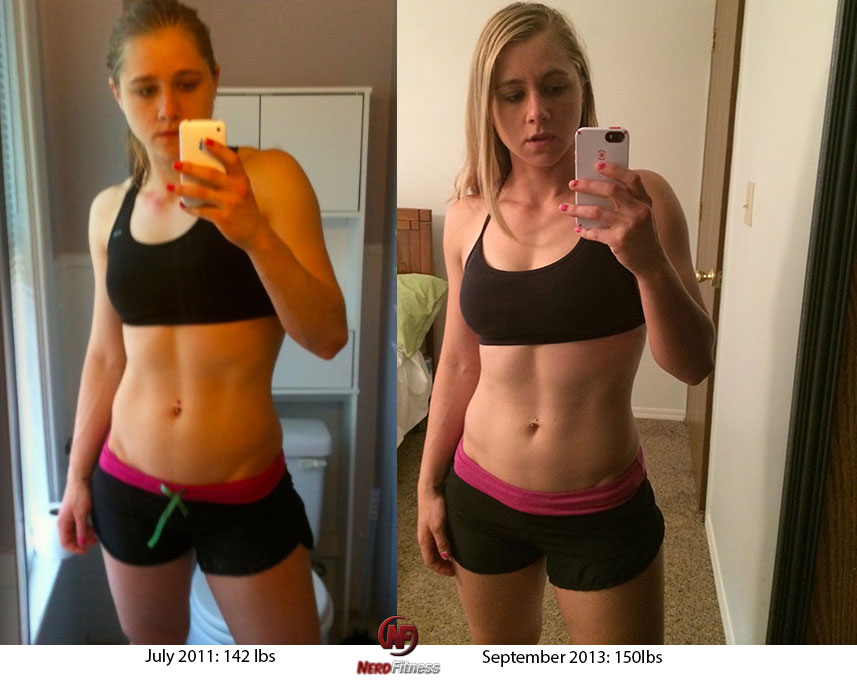
You’re probably wondering, “Why is she getting leaner but somehow also gaining weight?”
The answer is simple:
Magic.
Okay, maybe not magic. It’s time to bust the worst and most pervasive of the myths relating to women and lifting.
YOU DON’T GET BULKY LIFTING WEIGHTS UNLESS YOU’RE TRYING TO!
When you strength train with very heavy weights for low numbers of repetitions, you build incredibly DENSE, tight muscle. If you are eating at a caloric deficit, you are keeping the muscle you have and burning the fat on top of the muscle.
So how did Staci gain weight, then? BECAUSE SHE WAS TRYING TO.
On top of super heavy strength training, Staci was eating 3,000+ calories per day to put on the extra weight.
YES, when we lift weights, our body shape WILL change. When we work out and lift, we’ll develop a body that looks more like an athlete. No look is good or bad.
Staci just wanted to get strong and feel good about herself.
Although she was training in CrossFit for 2+ years (you can read about our thoughts on CrossFit here), after hitting a goal of competing at Regionals in 2012, she decided that she just LOVED lifting heavy, and switched to training on her own, focusing mainly on strength, with some fun conditioning like swimming mixed in here and there.
For the next four years, Staci continued to pick up very heavy weights, eat more calories than most men, and really focus on getting stronger.
In those four years, Staci put on about another 10 pounds.
Surely by NOW she would get too “bulky,” right?
Surely this is when the whole “women who lift weights get bulky” myth gets proven correct…right?
Hmmmm……nope!
Staci’s Training in 2019 and Beyond!

Okay so here we are another 7 years later! What is Staci doing these days?
Did she:
- A) Did she become a yoga fanatic?
- B) Did she keep powerlifting?
- C) Did she fall in love with gymnastics?
- D) All of the above?
Spoiler alert: all of the above. Duh.
Building a solid foundation of functional strength allowed Staci to work on other skills and pick them up quickly.
I asked Staci what her overall goals are these days:
My overall goal, sport-specific aside, is to be able to do whatever I want to do whenever I want to, without warning, without my body holding me back. And by that I mean if a friend calls me tomorrow and says, “I found a secret treehouse in the middle of the woods, but we need to hike a gigantic mountain and bike 50 miles to get there,” I want to be able to say “I’m in” without hesitation. So I always want to push my body’s limits. Plus, it’s fun!
I really enjoy competing sometimes, but my main goal isn’t to be the best at one sport – I have too many goals I’m working towards!
And rather than tell you about Staci, I’d rather share some recent training videos from her exploding Instagram page…
Staci can do all of the above because she built a foundation of functional strength.
She got really strong at big movements like the squat and deadlift, and bodyweight movements like push-ups and pull-ups. She cut her body fat percentage so she wasn’t carrying around excess weight. She taught her body that being strong feels good, and learned that being strong makes her happy.
She also did a few other key things for each of these activities:
- She slowwwwwly progressed with each exercise, and had a strong foundation to start with!
- She followed very specific progressions when it comes to gymnastic rings.
- She followed a progression when it comes to handstands.
- She had a yoga routine to follow (we have a whole course starring Staci with fun yoga routines).
She also had help! Although she learned a lot on her own, Staci over the past 7 years has worked with different coaches and trainers to learn specific skills or improve her ability in certain movements or lifts, as well as help her with proper programming and periodization.
After all, a coach can be a game changer and having somebody who can check your form and offer guidance is like turning on cheat codes for strength gains.
So that’s where she’s at now, but there’s a big question I haven’t answered yet: Just WHAT was she eating to fuel these workouts? After all, we know from Nerd Fitness that nutrition is 90% of the battle when it comes to strength gain and/or weight loss!
So here is her exact nutritional strategy!
Staci’s Exact Nutritional Strategy
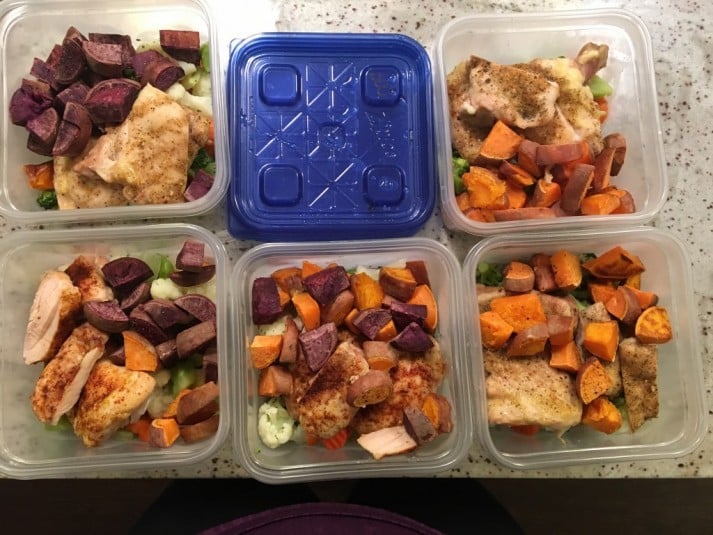
Oh what’s that? You want to know EXACTLY how Staci eats too? Of course you do, you’re reading Nerd Fitness and you want all the nerdy specifics you can get your hands on.
Let’s start by taking a look at what Staci eat through the first few years of her transformation.
Here’s an exact week for her back in mid-2012:
- Every Sunday (or whatever works, but usually it’s Sunday) I cook a few pounds of chicken. I then portion it out and keep them in Ziploc bags. If I don’t have time for that, you can get all-natural precooked sausage (both chicken and pork) that works just as well as a “bring to work” meat.
- 5AM pre-workout: (first thing in the morning): protein shake. (nothing special). It’s not Paleo, and I love every sip of it. Then I go and work out. If I go to the gym with a full stomach, I will not leave with a full stomach.
- 7:30AM on my way to work: apple or pear.
- 9:30AM sweet potato with cinnamon. I keep them at work, and cut them up, throw it in the microwave for 5 minutes with cinnamon. Comes out amazing.
- Another protein shake somewhere in here between breakfast and lunch.
- 12PM lunch: two of the bags of chicken I precooked and a bag of the Steamfresh vegetables. The entire bag is about 3.5 servings of vegetables. My favorite is broccoli, cauliflower, and carrots.
- Lunch 2: spinach salad with shrimp, red peppers, green peppers, red onion, lemon juice.
- 2-3 snacks in the afternoon. Could be one of these: Apple with almond butter, bell pepper (I eat them like apples… I’m weird), carrots (they even make carrots cut like chips), bags of chicken (yes, those bags of chicken I consider a snack as well, not just a meal), a zucchini (yes, plain, raw, uncooked), celery with almond butter and raisins, strawberries, frozen mixed berries.
- 7-8PM dinners: meat (steak, sausage, shrimp, salmon, or chicken) with some of the following: red peppers, green peppers, red onions, broccoli, carrots, cauliflower (Steamfresh bags!), and/or summer squash and zucchini.
- Every once in a while I make something awesome, like this (but really, that takes a lot of time). When I DO make something like that, I make it in bulk and will eat it for the week.
Seems like an absurd amount of food, right?
That’s because it IS an absurd amount of food. This is what Staci does day in and day out in order to gain weight so that she can lift heavier weights.
And I think you’ll agree with me that despite all of this extra work to pack on a lot of weight, the last word you would use to describe Staci’s physique these days is “bulky.”
However, Staci discovered in 2013 that she had Hashimoto’s Thyroiditis, an autoimmune disease that messes with your thyroid.
This diagnosis explained a lot of the struggles she had dealing with random weight gain and anxiety, but it was something she had to address. Although it put a strain on her training, she addressed the disease with her doctor – who initially tried to treat it solely through medication – by actively tracking her nutrition and following a VERY specific type of nutritional strategy (while being monitored by her doctor).
This lead to Staci following a strict auto-immune Paleo protocol[2] for food: meats, veggies, and berries. The autoimmune part of Paleo cuts out nuts and seeds, nightshades (tomatoes, onions, peppers), and eggs. After experimenting with this diet, Staci slowly started re-introducing foods and developed a diet that works best for her.
Now Staci eats meats, vegetables, dairy (but only whole and organic grass fed), fruits, eggs, and rice. She doesn’t eat gluten or soy anymore, no matter what. This may sound restrictive, but she really enjoys it and feels better than she’s felt in her entire life.
She also became a master batch-meal-cooker, preparing her meals for the week step-by-step.
I asked her a few other questions about her diet, specifically: “Do you miss the junk food you used to eat?”
STACI: The thing is…I don’t. Once you’re off of all of the sugar and processed foods, you don’t even think about it. I got ice cream the other day, which has always been my huge weakness, and it was so sweet that I actually had to mix it with berries and even ended up throwing some of it away.
It always bothers me when people will be like “come on, why don’t you live a little!” when I’m out to eat. I’m eating this way out of choice, because I want to. I LOVE steak, I LOVE shrimp, I LOVE broccoli – why would I eat pasta or pizza when I can have any of those? Processed food actually tastes fake to me now, and I don’t feel good afterwards. I really, truly, actually do not want it.
Now, many people would say “Isn’t it super expensive to eat only healthy food all the time? Isn’t it much easier to opt for the cheap, quick, and easy fast food?”
STACI: Sure, it can be, but I made it a priority in my budget. Batch cooking and meal prep saves a lot of money and actually makes it cheaper to eat this way. But also, to me, feeling amazing and being healthy is more important than having 1,000 channels, getting the newest gadgets, or living in the most luxurious apartment. Plus, I save A LOT of money by not going out drinking.
Also, healthy eating doesn’t need to break the bank!
How Else Staci Changed

Sure, Staci changed physically, and her attitude changed, but how she thought about the gym changed too.
Instead of looking at the gym as a negative thing, and how horrible it’s going to be using the boring elliptical, she changed her attitude. Now she thinks, “Hey! I get to do squats today! I wonder if I’ll hit a personal best?”
STACI: “There have been nights where I’ve actually had trouble sleeping because I’m so excited about deadlifts the next day.”
I know it sounds silly, but that little mental change really does make a big difference, especially if you keep doing it.
I’d be remiss if I didn’t mention something else Staci did that was really powerful: she evaluated the relationships in her life and leveled those up too.
STACI: Most people have been super supportive, but others definitely think that I’ve gone too extreme. I learned to drown out the voices pretty early, and just do what I felt was the best for me. With diet, I remember the first few people I told about Paleo definitely were not supportive and were more worried than anything. I started telling people that certain foods just “didn’t sit well with my stomach” or that I was allergic (turns out, it was sort of true). It worked great.
Staci has also had to deal with really negative people that couldn’t deal with her healthy evolution and she had to sacrifice them (not literally!).
I’ve known Staci through nearly this entire journey because she became an active member of our community at the very beginning. Her transformation over these past 7 years has been awe-inspiring. Watching her go from shy message board poster to veteran team member and now Senior Coach at Nerd Fitness has put the biggest smile on my face.
I’m proud to call her a friend and honored to have her as a teammate.
Why Staci was successful for 10+ years and Counting

When most of us reach adulthood, we usually get bigger, slower, unhealthier.
Staci bucked the trend, and instead became healthier, stronger, happier, dealt with a lot of baggage (smoking addiction, eating disorders, Hashimoto’s disease), and came out the other side a powerlifting superhero badass woman. In looking back over her journey and interacting with her practically every day for these 8 years, I can identify a few things she did that specifically aided her on her quest:
#1 SHE EDUCATED HERSELF
When Staci started her weight loss journey, she didn’t really know any better and didn’t know where to turn, so she did what she thought was right: she starved herself and spent hours and hours on treadmills and elliptical machines.
After this left her miserable and depressed, she started doing her research and finally learned how to eat properly.
Shed discovered strength training and started learning how to get stronger. She learned how to do a squat, deadlift, bench press, and other basic strength moves like push-ups.
She used 20 seconds of courage to start training in a commercial gym, quickly realizing that she had every right to train with the guys in the free weight section.
#2 SHE FOCUSED ON STRENGTH, NOT HER WEIGHT
We know that “appearance is a consequence of fitness.” Rather than worry about her weight and how it fluctuated on a daily basis, Staci threw away her scale and only focused on getting stronger. She tailored her meal plan (which is quite extensive) around getting stronger.
She understood that it is ALMOST IMPOSSIBLE FOR WOMEN TO GET TOO BULKY FROM LIFTING WEIGHTS (and “bulky” is quite subjective anyway, right?). So she simply tracked her workouts and tried to get stronger each week, knowing that her appearance would change as a result of this strength. I’d say it worked!
#3 SHE ATE FOR HER GOALS
What you eat will be 90% of your success or failure when it comes to fitness and health.
Staci tried the “eat way less food” method of weight loss, and it turned her into a sickly person with an eating disorder who struggled with 5-pound dumbbells. She got professional help to overcome her disorder, educated herself on nutrition, focused on consuming the right foods for her body, and now no longer worries about how many calories she eats. She has boundless energy, way more confidence, and is happier as a result.
When she was diagnosed with an autoimmune disorder called Hashimoto’s Thyroiditis, she worked with her doctor to treat the problem through a strict nutritional strategy rather than just resorting to medication and pills. It required a fairly large pivot, but Staci will tell you that feeling strong and healthy is worth it.
You can read about our Paleo article here and our strategy for healthy eating.
#4 SHE TRACKED HER WORKOUTS
Staci is a nerd like you and me, which means she loves numbers and stats. You can go back through her old posts on our message boards and see exactly how much she was lifting and how she was training over the years. She tracks every one of her workouts she’s ever done, and can always refer back to them!
On weeks where she didn’t see as much success in the gym, she examined factors like diet, stress, and sleep, and made adjustments where needed to break through any plateaus.
On weeks when she didn’t feel as healthy, she could figure out what needed fixing and how to fix it. As long as the amount of weight at the end of the bar kept going up, she knew she was progressing in the right direction. In other words, “in order to crack the problem, you gotta track the problem!”
#5 SHE HAD A COMMUNITY OF SUPPORT
Staci jumped headfirst into the Nerd Fitness community, asking questions about strength training, participating in our monthly challenges, and asking for support in her quest to live a healthier life. She has since joined our team, became a lead trainer for our 1-on-1 coaching program, is a huge presence in the online community for Nerd Fitness Prime, and has made friends in gyms across the country. And thanks to this success story, she’s inspired hundreds of thousands of women to start strength training!
#6 SHE NEVER STOPPED LEARNING AND SLAYING NEW DRAGONS
Look at Staci’s training regimen in 2019: gymnastic rings, handstands, yoga, swimming, powerlifting, bodyweight training, and Olympic lifting. In 8 years, I have seen Staci evolve and adapt her workout program dozens of times. While many people miserably run on a treadmill and go on a diet until they reach their goal weight (only to put it all back on) …Staci was different.
She understood the concept that “you never get to be done, so you might as well enjoy the journey.” Staci doesn’t HAVE to go to the gym, she GETS to go to the gym. It makes her feel alive. Learning new skills and having new goals consistently keeps her on target and working harder to live better.
You never get to be done – so don’t go on diets or follow a workout program you hate. Pick activities you love and get addicted to progress. Staci got hooked on picking up heavier and heavier weights, and now she’s hooked on seeing what her body is capable of!
In other words, what do you do after you slay a dragon? Go find a bigger one!
How to be Like Staci

“Staci is so awesome. I want to be like her when I grow up, even though I’m older than her” is something you might be saying right now.
You’re inspired and fired up and know that women can lift heavy and still look great and you want to get started. But you have no idea what you’re doing or where to begin, which is why I’m here.
HOW TO BE LIKE STACI:
STEP 1: Get started with bodyweight training by following our Beginner Bodyweight Workout Routine, until you can complete the routine completely.
STEP 2: Read our entire Strength 101 sequence, where we cover how to strength train with weights. Practice at home with a broomstick or PVC pipe to build confidence with the big movements and then…
STEP 3: Read our complete guide on how to train in a gym! Head to a gym and complete your first strength training routine!
STEP 4: Repeat and try and learn and do and mess up and pick up slightly heavier things and repeat and try and fail and succeed and learn a lot about yourself in the process. It’s the journey, not the destination; enjoy it!
Know that you’re not alone on this journey. We have a community of hundreds of thousands of people all over the world that want to help you! But we can only help you once you decide to get started.
What’s that you say? “Steve this all sounds well and good, but please I just want somebody to tell me EXACTLY what to do every day so that I have the confidence and peace of mind that I’m doing things correctly!”
Don’t worry, I got you covered there too!
IF YOU WANT TO BE TOLD EXACTLY WHAT TO DO:
- Consider our 1-on-1 coaching program where we’ll build a powerlifting and nutrition program for you based on your situation and current level of experience, with video form checks and expert guidance. It’s how Leslie, a single mom, lost 100+ pounds!
- On a bit tighter of a budget? No problem! Check out our self-paced online community, Nerd Fitness Prime, which eases you into strength training with both bodyweight and gym routines.
I don’t care how you get started, just that you start!
You might have to deal with jerks in a gym who think they know better, but I promise you they don’t. You have just as much a right to lift in the gym as they do, and you have as much right to use the free weights section as they do.
Go get strong, and be like Staci!
-Steve
###
The post How to Start Powerlifting as a Woman: Staci’s Story first appeared on Nerd Fitness.
]]>The post 10 Ways to Make Vegetables Taste Good: How to Start Eating Veggies! first appeared on Nerd Fitness.
]]>
If the sight of a plate of broccoli makes you gag, this post is for you!
We’ll turn any “Veggie Hater” into a “Vegetable Lover” by showing you how to make a plate full of greens not taste like a wet gym sock [1].
If you’ve been a picky eater your whole life (I didn’t eat veggies until 22!), our guide today will help level up your taste buds!

We work closely with our Online Coaching Clients to help them find their gateway vegetables, and I even picked our coaches’ brains to get their favorite tactics in this guide too.
By the end of this guide, I’m going to have you excited to eat vegetables, and ready to take the “NF Veggie Challenge”:
- Why You Should Eat Vegetables (Your Mom Was Right)
- How to Start Eating Vegetables (Finding Your Gateway Veggie)
- How to Buy Vegetables (Discovering New Veggies)
- 10 Ways to Make Vegetables Taste Good (Hide Them)
- How to Start Liking Vegetables (It’s All in the Preparation)
- What Are the Best-Tasting Vegetables? (the NF Veggie Challenge)
Alright, let’s do this.
Why You Should Eat Vegetables
As Coach Staci mentions above, eating a vegetable once a day is something we recommend all our coaching clients do.
Yeah, I know…you’ve probably been told since you were a toddler to “Eat your vegetables! They’re good for you.”
But do you really know WHY veggies are good for you?
Let me jump into a few reasons why they kick ass.
Here’s why you prioritize eating vegetables:
1) Vegetables are nutrient-dense. It should be no surprise that Popeye turned to a vegetable when he needed a power-up.

Think of vegetables as one of our body’s most efficient fuel sources: they are packed full of vital macro and micronutrients.
Just take a look at our article on how to eat healthy – it should be no surprise that vegetables take up half the plate in our “healthy plate” strategy.
Simply put: vegetables are the backbone of any solid diet.
2) They fill you up, without “filling you up.”
Ever seen what 200 calories worth of broccoli looks like (courtesy of WiseGeek)?
It’s the size of a grocery bag compared to 200 calories of a Snickers:
If you are feeling hungry but don’t want to overeat, choose a vegetable.
Kind of hard to overeat when you’re eating carrots or celery!
We’ve found this strategy is super helpful for those trying to lose weight. In fact, eating more veggies helped Brian lose over 75 pounds!

3) Veggies keep your body operating at max efficiency. Vegetables are a great way to keep your…um…indoor plumbing…functioning properly.
Adding a vegetable or two to each meal (or blending them up in a smoothie) is a great way to keep things working right.
Seriously: you will notice a considerable difference after adding veggies to your diet regularly.
4) They CAN be delicious! It’s all in how they are prepared. As a former veggie hater, I am now firmly on “Team Vegetable.”

A plate full of veggies used to make me want to gag, and now I’m thrilled at the idea of a plate covered in a cornucopia (what a great word, right?) of multicolored fruits and veggies.
“Ok, Steve, I know vegetables are good for me, but I just don’t like them. HALP!”
Here’s how you can get over your vegetable-aversion and get started.
How to Start Eating Vegetables: Finding Your Gateway Veggie

When I was 22 I proudly proclaimed that I was mostly “carnivore” and boycotted veggies.
Essentially, I ate things like chicken, hamburgers, pizza, pasta, french fries, rice, and not much else.
In my mind, all vegetables were disgusting, but the reality was that I hadn’t really tried many.

Don’t be like me.
We’re going to stop saying “I don’t like vegetables!”
Instead, we’ll say: “I haven’t found a vegetable that I LIKE…yet.”
HOW I FOUND MY GATEWAY VEGETABLE: I started using “20 Seconds of Courage” to try a new vegetable whenever the stakes were low, even if it was a TINY amount:
- I went into any new vegetable experience with an open mind and positive mindset.
- Trying any vegetable was considered a victory, even if it was a tiny amount and I hated it.
- If I went out to dinner with friends, I would ask to try a veggie from their plates. Restaurant prepared veggies were my best chance to find one I liked!

MISSION #1: Commit to try and find your gateway vegetable.
Before any new vegetable experience, clear your mind, Neo.
Instead of ALREADY expecting to hate it, change your mindset.
Instead of “This is gonna be gross,” I said, “Let’s see!”
If you’re out to dinner with family and you see a veggie you want to try on your significant other’s plate, ask and try a small bite!
Want to try and prepare a new vegetable at home? See the next section.
What if you try a vegetable and it makes you gag? Who cares! You found a veggie you don’t like. I’m proud of you for TRYING it. On to the next one!
My gateway vegetable: Asparagus.

After trying some bacon-wrapped asparagus while out at a fancy steak dinner, I realized “hey, this is one vegetable that actually doesn’t taste terrible!”
Of course, it didn’t hurt that it was literally WRAPPED IN BACON!
Next, I tried crunchy asparagus without the bacon wrapping, and it was STILL delicious to me.
And thus, I had found my gateway vegetable.
For my first year as an omnivore, asparagus was the only vegetable I ate.
Once I had gotten over the mental block that “all vegetables are gross,” it was time to branch out and repeat the process with other vegetables.
Let’s do the same for you.
How to BUY Vegetables. How to Discover New Vegetables.

First and foremost, buying vegetables can be daunting:
- How can I tell if a vegetable is fresh or not?
- How long can I leave the vegetable in my fridge before it goes bad?
- Which ones should I buy?
For starters, here are just some of the vegetables that are Nerd Fitness approved.
MISSION #2: Pick ONE of these 25 vegetables and bring it home with you.
Who cares if you don’t know how to cook it yet. Pick one, and bring it home. Baby steps!
- broccoli
- collard greens
- kale
- romaine lettuce
- spinach
- artichokes
- asparagus
- beets
- brussels sprouts
- cabbage
- cauliflower
- celery
- cucumbers
- eggplant
- green peppers
- mushrooms
- okra
- onions
- zucchini
- acorn squash
- butternut squash
- carrots
- red peppers
- green peppers
- bok choy
NOTE: we’re not counting tubers (potatoes and sweet potatoes), legumes (beans), or corn.
Those foods do have a place on our healthy plate (shown below), but today is all bout finding low-calorie, high-energy leafy vegetables.

1) PICK A FRESH VEGETABLE: Use this wonderful guide on how to select fresh and tasty veggies at the grocery store.

Don’t overthink this or panic: you’re more likely than not going to pick out good veggies (provided you’re going to a reputable grocery store), but having a bit of confidence in what you’re doing can help too.
Here are a few examples of what to look for:
- Asparagus: Choose firm, smooth, and brightly-colored stalks with compact tips. Avoid limp stalks. Choose stalks of equal thickness to ensure even cooking times.
- Broccoli: Choose broccoli with firm stalks, tight florets, and crisp green leaves. Avoid yellowed or flowering florets.
- Brussels Sprouts: Choose firm, compact, bright green heads. Avoid sprouts with wilted or loose outer leaves.
Noticing a trend? You want FIRM vegetables, not soggy or squishy ones. Just start there, and look for the veggies that seem healthy to you. You can always get better at judging vegetable quality later.
2) CONSIDER PRE-CUT VEGGIES: If you’re worried about picking out fresh vegetables – I know this can be intimidating – look into buying pre-cut bags of vegetables! I personally love buying pre-cut broccoli and cauliflower, and bags of Brussels sprouts.
These are generally on the wall next to the fresh veggies, and might cost slightly more than the produce you bag up yourself.
That’s because a lot of the work is DONE FOR YOU!
I’m all for anything that reduces the number of steps between you and “veggies in your tummy:”

3) LEARN HOW LONG YOU HAVE TO EAT THE VEGGIE:
Once you’ve bought your veggies, use StillTasty.com, to figure out how long you can leave them in your fridge:


Generally speaking, you’ll be good if you cook a vegetable within 3 days of bringing it home: you can batch cook large quantities and then you’ll have MANY more days before the food goes bad.
If you’re NOT sure if you can still cook a veggie, or if it’s gone bad…give it a smell. If it smells funky, or you’re not quite sure…
Here’s a sentence my mom taught me when I started cooking for myself: “When in doubt, throw it out.”
Next time, just cook it sooner!
I can tell you eating rotten vegetables is NOT the path to liking them more.

4) CONSIDER FROZEN VEGETABLES: I always have multiple bags of frozen spinach on hand in my freezer, but it’s not because I prepare spinach regularly – I hide frozen spinach in my daily smoothies and I can’t even taste it!
In addition to frozen spinach, I also keep a few bags of microwaveable frozen veggies on hand too in case I need to quickly add a veggie to my healthy plate but don’t want to actually cook a vegetable.
I’m a huge fan of “steamfresh” bags or similar because preparing them is easy as hell: Most of these only require you throwing the bag into the microwave, opening it, and putting it on your plate.
5) CHECK OUT CANNED VEGETABLES!
They might not be as fresh as regular veggies, and there might be preservatives added to keep them from going bad, but I’d prefer you trying out canned vegetables to no vegetables at all!
Popeye eats canned spinach and he turned out okay.
Honestly, I don’t care WHICH path you pick, or which vegetable you pick…as long you commit to picking one and bringing it home with you from the grocery store.
10 Ways to Make Vegetables Taste Good
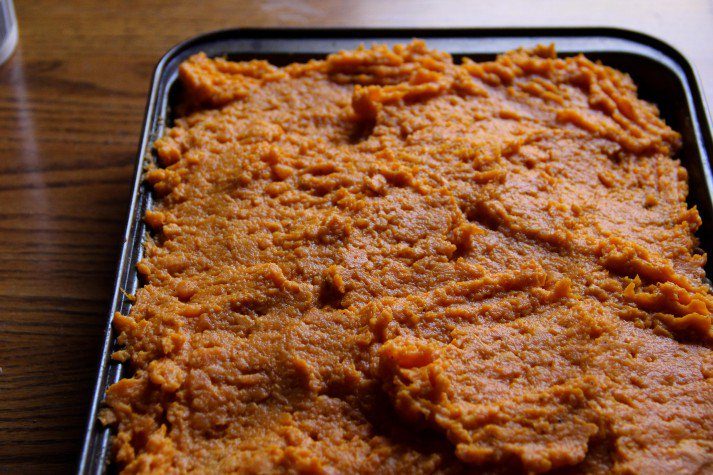
Even if you’re committed to trying more veggies (and I’m proud of you for that), it still might not solve the problem that you dislike the taste or texture.
This is the problem we encounter with many of our Online Coaching Clients: they are committed to eating vegetables, but they’re struggling with taste and texture.
Fortunately, we have a TEAM of Coaches with dozens of success stories from their clients who have learned to like vegetables with some clever tactics:
Essentially, it comes down to “hide them, blend them, pair them, or cover them!”
Here are our Coaching Staff’s 8 Favorite Ways to Make Vegetables Taste Good:
1) Change their state! I don’t enjoy raw broccoli nearly as much as I do steamed broccoli.
And that’s not even it’s final form! Give me a plate full of roasted broccoli covered in “Everything but the Bagel” seasoning from Trader Joes, and it’s Veggie Valhalla.

If you don’t like a particular vegetable yet, try preparing it a different way! From raw to steamed to baked to grilled to sautéed in bacon grease (see #4) to blended, you have so many options!
2) Blend them up! Add frozen spinach or kale to your protein shake smoothies. This is my personal favorite, and is part of the reason I get so many servings of vegetables every day.
Here’s my post-strength training workout smoothie:
- 12 oz of water.
- 2 scoops of whey protein.
- 1/2 cup of Quaker Oats.
- 1 cup of frozen mixed berries.
- 1 cup of frozen spinach.
Believe it or not, adding frozen spinach (or kale) doesn’t really change the taste AND you can get an extra serving of vegetables without trying.
That’s one extra daily serving of a super veggie!
3) Make a combo bite with a food you like: If you can learn to cook something like chicken stir fry, you can make sure that every vegetable bite also has plenty of rice and chicken.
You can do the same if you make mini potatoes, chicken, and broccoli. Get some of each on the fork with each bite for a really healthy plate!

Then, over time you can reduce the amounts of the other foods and increase the amount of the vegetable until you actually enjoy the taste of JUST the vegetable!
Here are some ideas to try to squeeze in some extra veggies with every mouthful of food:
- a single broccoli crown and a big chunk of chicken.
- a chunk of grilled onions and chicken.
- rice, a wedge of zucchini, and steak.
- a slice of asparagus, and salmon.
- a wedge of sweet potato and peppers.
- steak, onions, and pineapple.
4) Cover them in cheese! As we cover in our “healthy eating” guide, we have no problem with cheese in your diet, provided you’re keeping your calorie intake in line with your daily calorie energy expenditure!
If you want to sprinkle Parmesan cheese on some broccoli florets, go for it!
You can also melt some cheese onto your veggies!

Like anything you eat, just make sure you account for those calories in your planning!
5) Wrap it in bacon. Seriously. Bacon makes everything better.
Want to learn to like asparagus? Wrap it in bacon (see #5)!
Here’s another great way to eat some veggies add bacon (courtesy of Team NF Coach Staci):

6) Spice it up! You don’t need to just eat plain boring broccoli and steamed asparagus. Try adding some spices or hot sauce to your foods to change the taste.
Here are some of our favorites:
- Steamed cauliflower covered in Old Bay seasoning, dipped in cocktail sauce.
- Northwoods seasoning by Penzeys on baked or grilled vegetables.
- “Everything but the bagel” seasoning on baked or grilled vegetables.
- Olive oil, salt and pepper. A classic that never fails.
Here’s our guide to Spice Up Any Meal. Literally, for more.
7) Pretend they are other foods! There are lots of options like this:
- Try zucchini noodles: you might need to buy a “zoodle” machine, but boy these are tasty when mixed with other awesome foods.
- Learn to make “Paleo spaghetti” with spaghetti squash! Read our full guide on how to prepare paleo spaghetti, and thank me later.
- Make carrot “fries.”Cut some carrots into fry shapes, toss them in olive oil, put them on a baking sheet, sprinkle with salt and pepper, and roast them in the oven at 450 degrees F (230 degrees C) for 10 minutes. Tada!
- Buy “cauliflower rice” or “mashed cauliflower.” With butter and salt, and on a plate with the right foods, cauliflower can taste like rice or mashed potatoes.
8) Dunk them! Who needs chips? Pssh. You can dunk broccoli florets, cauliflower florets, or carrot sticks in hummus or guacamole.

Think of the vegetable as the delivery vehicle for your favorite dunking food!
9) Add small amounts of spinach, chard, or kale to your homemade chili or guacamole. You won’t notice the difference in the taste, and you’re sneaking extra vegetables into your meals.

I know a coaching client who got started with vegetables by adding them to low carb soups and his homemade chili.
10) Douse them in something you do love. Whether it’s ranch dressing, blue cheese, buffalo sauce, or any other sauce or condiment you enjoy, dunk those veggies and get those greens in your system!
Sure, If the sauce you’re using is really high calorie then this isn’t a long-term strategy, but we can work on that.
For now, we’re building the habit of eating vegetables. Use less sauce each week moving forward.
You can also consider lower-calorie dressings, sauces, and dips to spice things up. And you can never go wrong with hot sauce.

All of the above examples accomplish the same goal:
Getting more vegetables into your system.
This makes your stomach happy, your mother happy, and Popeye happy.
Want to work hand-in-hand (virtually) with a coach that will actually get you to eat your vegetables?
Need a brainstorm partner to find clever ways to “Trojan Horse” some veggies into your stomach?
How to Start Liking Vegetables (It’s All in the Preparation)
“Okay Steve, just give me some options and tell me what to do!”
FINE!
Here are some easy and delicious options for getting started with your first vegetable:
#1) Steamed broccoli
Level 1: Steamfresh bag in the microwave: Steamfresh veggies come in a package that you can throw in the microwave for five minutes, add seasoning, and that’s it.
Add butter or any seasoning like salt and pepper, and eat it with a protein for a healthy meal!

Level 2: Steam broccoli yourself in the microwave:
- Plop those florets (the “tree” minus the “trunk”) in a microwave-safe bowl with a few tablespoons of water
- Cover with a microwave-safe lid or dish
- Cook for 3-4 minutes. If the broccoli isn’t soft and warm, put it back in for a minute or two
Level 3: Steam broccoli on the stove:
- Plop about a 1/2 cup of water in the bottom of a pot
- Separating the broccoli florets from the stem
- Plop them in the water and cook over medium heat for 10-15 minutes
2) Roasted vegetables. Works with bell peppers, asparagus, carrots, onions, broccoli, cauliflower, zucchini, Brussels sprouts, etc:
Roasted veggies can taste very different from steamed and raw veggies (they get crispier and a little sweeter because they caramelize in the oven).
Take your pick of vegetable:

And make roasted veggies:
- Cut them up literally however you want (bite-sized pieces work best).
- Drizzle/toss them toss in olive oil, sprinkle salt and pepper.
- Put them on a foil-lined pan in the oven at 400 degrees F (200 degrees C) for 20-30 minutes.
- Once they look like they’re cooked (a deeper color and slightly brownish edges), take them out of the oven.
- Write down how long they were in for, and eat them!
Don’t overthink this: You can use more olive oil or use less. You can use more salt or use less. You can leave them in there a few minutes longer. Just cut them up, drizzle, and plop them in!
Here’s my recipe for stupidly simple roasted asparagus:

- Put them on a cookie sheet lined with aluminum foil.
- Drizzle each asparagus stalk in olive oil.
- Sprinkle salt and pepper on them.
- Stick them in the oven at 375 degrees F for 12 minutes.
DONE. Crunchy, delicious, and nutritious.
Plus, I felt like a 5-star chef!

#3) Sautéed Vegetables: Cooked on the stovetop! Simple, delicious.
Zucchini and squash both taste great with just a little oil and salt, and are super easy to prepare.

You can choose to:
- Slice them up into slivers
- Use a potato peeler to create noodle-like slices.

Throw the slices into a pan with some olive oil on medium-high heat for about five minutes until they become soft and lighter in color.
All of these options can be paired with basically any protein for a delicious and healthy meal (or eaten as a healthy, stand-alone snack!).
If you attempt to cook a vegetable and burn them to a crisp and “fail,” I’ll still be proud of you. We all suck at stuff the first time, so the sooner we get those first few attempts out the way, we can get to “not sucky,” and then…
One day…
We’ll actually get pretty good at preparing vegetables!
What are the Best Tasting Vegetables? (The NF Veggie Challenge)

“Steve! What are the best-tasting vegetables!?”
Great question.
You’re a unique snowflake, and so are your tastebuds.

They will evolve and change as you evolve and change.
So the best advice I can give you is to try lots of veggies, prepared lots of different ways.
Microwaved Brussels sprouts might be soggy and unappetizing, but take the same veggie, cooked in bacon fat and roasted in the oven?
MMMMMM!
So try multiple veggies, in multiple ways, as part of multiple meals. Keep trying until you find a variation you like!
A final note: the point of eating more vegetables is to fill your plate with low-calorie but nutrient-dense food. It’ll make you a healthier nerd, I promise.
If you’re still overwhelmed at the thought of eating veggies, or you’ve always struggled to stick to a diet for any meaningful amount of time, you are NOT alone.
It’s why we’ve created three key services that help people lose weight, get stronger, and live better:
#1) Our 1-on-1 Online Coaching Program: Get personalized nutrition advice that won’t scare you and handcrafted workouts from a coach that gets to know you. We’ve heard “this program is the first time I’ve ever been 100% honest with another human being about my struggles with food.”
#2) If you want an exact blueprint for eating more vegetables and upgrading your nutrition, check out Nerd Fitness Journey! Our fun habit-building app helps you exercise more frequently, eat healthier, and level up your life (literally).
If you follow our Nutrition missions, you’ll learn to eat more greens while earning XP! Sah-weeeet.
Try your free trial right here:


#3) Join the Nerd Fitness Rebellion!
We have a free email newsletter that we send out twice per week, full of tips and tricks to help you get healthy, get strong, and have fun doing so.
I’ll also send you tons of free guides that you can use to start leveling up your life too:
NOW, Are you up for the Nerd Fitness Veggie Challenge?
For the next four weeks, I want you to try ONE new vegetable each week:
- Use 20 seconds of courage to try a new vegetable as a side when you go out to dinner.
- Buy a new vegetable at the grocery store and learn to prepare it.
- Add vegetables discreetly to your favorite meals (mix in with your smoothies, add to your omelets, etc.).
- Learn to prepare a vegetable in a new way. Whether it’s roasting them in the oven or grilling them on the bbq, try a different way to prepare a vegetable and level up your cooking skills.
Leave a comment and let us know!
We’d love to hear from you:
If you hate vegetables, what are you taking away from today’s post?
Do you have a clever way to get more vegetables into your diet? Share please!
What’s keeping you from starting to eat vegetables, and how can we help?
-Steve
PS: Make sure you read the rest of our healthy eating content!
- How to eat healthy 101: Start eating healthy today
- How to go grocery shopping like a pro.
- Cooking 101: essential kitchen tools
- Cooking 101: essential knife skills
###
The post 10 Ways to Make Vegetables Taste Good: How to Start Eating Veggies! first appeared on Nerd Fitness.
]]>The post What’s the Best Diet to Lose Weight? (Which Diet is Right for Me?) first appeared on Nerd Fitness.
]]>
If you’re currently trying to lose weight, you might be asking yourself:
“Which diet is right for me?”
What’s the best diet for weight loss?”
They’re great questions, both with many different variables to consider.
Today, we’ll unpack it all for you.
We focus on proper diet and nutrition extensively in our 1-on-1 Coaching Program, but we’re gonna tell you everything you need to know below too.
Here’s what we’ll discuss in answering “What’s the best diet to lose weight?”:
- How to eat for healthy weight loss
- Which diet will help me lose weight?
- Why can’t I stick to a diet?
- Which diet is the most effective in weight loss? (The 80% solution)
- What’s a “good enough” diet? (Steve’s 80% solution)
- Will being a vegetarian (or vegan) help me lose weight?
- How to pick the diet that’s right for you (Next steps)
It’s a lot to cover, but DON’T PANIC.
We’ll get through it together using science, stories from our very own community, and one too many pop-culture references:

Let’s get started.
How to Eat For Healthy Weight Loss

#1 – Eat fewer calories than you burn every day.
#2 – Want to also be healthy? Eat mostly real food.
Full stop.
Want to KEEP the weight off?
Add #3: Do those two things consistently for a decade.
This solution will get you like 90% of the way towards a killer physique and a consistently healthy checkup at the doctor.
Mix in the right training and you’ll be 99% of the way there.
The problem is that pesky things like “reality” and “genetics” and “human behavior” keep getting in the way.
It’s why everybody goes on diet after diet after diet, gaining and losing the same 10-50 lbs.
Most people can only stick with a diet for a few weeks before they’re so miserable that they can’t wait to go back to how they were eating before.

They count calories and allow themselves to eat “health food” like low-fat ice cream and low-fat chips and just two Oreos. These people are so nutritionally deficient—eating calorie-heavy, unfulfilling foods—that they struggle to stay under their allotment of calories for the day. D’oh.
To make matters worse, even if they’re counting calories, they’re probably misreporting their food and overeating without realizing it.[2]
This is why people get so dang frustrated when they go on a calorie-restricted diet, track their food, and still don’t lose weight. The only explanation must be that their bodies must have slow metabolisms.
Yes, some people can do well with calorie counting long term – and I do believe EVERYBODY should count calories for at least a week to educate themselves about the food they are eating – but I think it’s only part of a solution that has plenty of room for error.
Watch this quick video of a person who believes she has a slow metabolism[3].
It turns out the exact opposite is true. Crap.
Despite everything stacked against us, Nerd Fitness is FULL of success stories of people who have lost 100s of pounds and kept the weight off. Here are a few dramatic ones (click on the images to read their full stories):

What gives?
Nerd Fitness doesn’t just tell you what to eat. Any Google search can tell you that.
Though we help there too.
At Nerd Fitness, we’re helping you learn HOW to think about eating too.
And that’s the difference-maker.
Which Diet Will Help Me Lose Weight? (Mental Models for the Win)

The Nerd Fitness community is full of ridiculously smart people. Smart people that have tried in vain to lose weight for years or decades.
It’s because we’re fighting a brutal, uphill battle.
For many of us, food is way more than just fuel:
- It’s a coping mechanism.
- It’s how our moms showed us love.
- It’s what we turn to when we’re happy or sad.
- It can provide us with a small bit of happiness during an otherwise boring day.
Add in the fact that unhealthy food has been designed in a laboratory to be so delicious that it must be consumed in mass quantities, and trying to eat “just a few” of something is nearly impossible.

Next, add a dash of “I am obsessive and if I start to track calories I’m going to drive myself insane,” “even if I track my calories I’ll probably underreport how many calories I eat by at least 20%,” and “there is so much information that this all appears so overwhelming, so it’s a lost cause.”
This is why Mental Models are so useful (hat tip to my friend Shane over at Farnam Street Blog who taught me about Mental Models). I’m gonna borrow the concept here for nutrition.
Enter a MENTAL MODEL DIET:
- Paleo Diet: If a caveman didn’t eat it, neither should you. “Okay, what would a caveman eat? Probably things that grow in the ground, so vegetables and fruit, and also animals. They wouldn’t eat candy or bread or pasta or drink soda.”
- Keto Diet: Keep your carb intake under 5% (or more extreme, 10 grams, for example) of your total calories so your body has to burn fat for fuel instead of carbs and sugar. “Time to learn how many carbs are in everything I eat, and start tracking.”
- Slow Carb Diet: Eat legumes, protein, veggies. “Time to learn how to make food that only fits the slow-carb model. At least until cheat day!”
- Intermittent Fasting: Only eat between 12pm and 8pm. Occasionally do 24-hour fasts. “Okay, so I’ll just skip breakfast. That’s one less meal I have to think about.”
In each of the above options, there are a few similarities that make them such trendy/popular diet choices.
For the sake of simplicity, we’re going to hold off on digging into the health benefits that apply to a small percentage of the population on certain diets (Keto to treat epilepsy, Paleo/Keto for Hashimoto’s Disease, identifying a gluten intolerance, etc), we’re going to focus on the reasons MOST people pick these diets.
They’re simple to comprehend and will probably help you lose weight:
#1) They all will result in you eating fewer calories (usually).
If you follow the Paleo Diet, you are eliminating some of the most calorie-dense, nutritionally deficient, unhealthy foods out there. No more soda, no candy, no bread, no pasta, no sugar, no dairy.
If you follow the Keto Diet, you must track your carb intake, which means you’re going to also learn how many calories are in everything else you eat. You’re also essentially eliminating an entire macronutrient from your diet that’s notorious for keeping people overweight.
If you follow the Slow Carb Diet, you learn about which foods you can eat and which foods you can’t eat: yes to beans, no to dairy and grains. Like Paleo or Keto, you’re eliminating massively unhealthy foods from your diet, which will most likely result in weight loss.
If you do Intermittent Fasting, you’re eliminating 1/3rd of your meals for the day! Let’s say you normally ate an 800 calorie breakfast, 800 calorie lunch, and 800 calorie dinner. If you SKIP breakfast, that means you could eat larger lunches and dinners (1000 calories each) and still end up eating 400 calories less per day on average. That’s enough for 3-4 pounds of weight loss per month!
#2) You can answer “YES” or “NO” to adherence.
Sure, it would be great if you could weigh every element of food that you eat, and track each meal in a spreadsheet and KNOW you’re tracking each calorie and macronutrient correctly.
And for some people looking to get to bodybuilder levels of body fat, this level of perfection is required.
However, for the rest of us, working regular jobs, with kids, and lives, this shit is wayyyyy too much.

So these mental models are so damn helpful because they can simplify the overly complicated and allow us to get out of our own heads.
These Mental Model Diets require compliance and consistency. In each instance, there’s a very specific answer you can say every day, and a question you can ask yourself with each meal.
As our favorite green Jedi Master once said:

- Paleo Diet: “Would a caveman eat this?” Yes or no.
- Keto Diet: “Am I in ketosis?” Yes or no. You can even pee on strips to see if you are in ketosis.
- Slow Carb Diet: “Did I only eat slow-carb foods today?” Yes or no.
- Intermittent Fasting: “Did I skip breakfast today? Did I stop eating after my feeding window?” Yes or no.
In each of these examples above, it removes ALLLLLLLL of the fluff, simplifies the heck out of our complex physiology and a complex problem. And it allows us to stop fooling ourselves.
With the mental models above, we have rules and a framework within which we can operate. It starts with black and white YES or NO questions we can ask.

We know what (or when) we can and can’t eat.
It’s a lot easier to fool ourselves when we are sneaking bites of cookies, having an extra roll at dinner, drinking a larger soda during a long night at work, eating some of our kid’s Halloween candy, and overeating while absentmindedly watching television.
When the rules are black and white, yes or no, there’s no place to hide.
Which means we need to get our act together if we’re going to stick with something.
We start to understand the quality and quantity of things we are putting in our pie holes. We start to dig into our relationship with food.
And in MANY cases, we start to lose some weight (again, see #1 above); this starts to make us feel better about ourselves. And we chase that feeling.
We create a positive virtuous cycle where we lose weight, get complimented, wake up not feeling like crap, look forward to exercising, and over time we become permanently changed, healthier, happier people.
In a similar vein, The Whole 30 Diet works for many people (“I only eat Whole 30 foods for the next 30 days”), but it will not result in long term changes if somebody goes back to their original unhealthy diet after the 30 days are up.
Temporary changes = temporary results.
#3) They can be done incorrectly, are tough to stick with long term, and won’t work for everybody.
Depending on our genetics, upbringing, lifestyle choices, addiction to sugar, relationship with food, what foods satiate us, etc., some of these options might work better for us than others.
As mentioned above, if ANY of the above nutritional strategies are done temporarily, they will result in temporary changes. This is how the majority of people go through life: gaining and losing the same 15-30 (or 50, or 100) pounds as they go on a diet and off a diet.
It’s a rollercoaster.

And not the good kind of rollercoaster with flips and corkscrews and probably involving Batman. It’s more like one of those rickety old wooden coasters that ruins your back.
Those rollercoasters suck, and so does putting your body through crazy weight-loss extremes, up-down, yes-no, yo-yo.
Although these Mental Model diets can help people lose weight, they are often done for short time periods to get quick results.
And that’s only if people can actually stick with them long enough to get results!
Why Can’t I Stick to a Diet?

There are two main reasons why these diets won’t work for you.
- Some of them are more strict, have more rules, and require you to be more militant in your approach.
- Even if you are strict in applying the rules, you can STILL do the diets incorrectly and gain weight because of this whole concept of thermodynamics.
Don’t get mad at me. Get mad at science.[4]
MOST PEOPLE GROW FRUSTRATED BY POPULAR DIETS BECAUSE:
#1) You Can Do These Mental Model Diets Incorrectly:
Paleo: I know people who “go paleo” but eat just as many calories as they did in the past: they are eating paleo cookies, buckets of dried fruit (soooo much sugar and carbs), sweet potatoes, and so on. This person will be frustrated when they don’t lose weight.
Keto: If you go Keto but eat 5,000 calories per day, you’re gonna put on weight. Do this while sitting on your ass not doing heavy strength training, and that weight will be all fat.
Intermittent Fasting: If you do intermittent fasting but eat 2,000 calorie lunches and dinners, you’re gonna put on weight. Hell, I put on probably 30 pounds while doing IF, which was my plan.
Slow Carb: If you go slow-carb but eat 6,000 calories of beans and other slow-carb worthy foods, you’re gonna gain weight (and have extreme flatulence).
#2) Sticking with these Mental Model Diets for the long haul can be tough!
The Paleo Diet and the Keto diet often come up dead last when it comes to a “List of Best Diets.”[5]
Now, the people writing those lists certainly have agendas, are trying to deal with the general population, adherence, a number of other factors, and more. In addition, there just haven’t been enough long term studies on some of these newer diet strategies.
Oh, and factor in anybody that wants to get page views by taking shots and tearing down whatever becomes popular. We’ll call this the “hipster phenomenon.” I look forward to the vitriolic backlash to Keto Diets over the next 3 years.
And you never know who to trust. Coca-Cola famously used to bribe scientists to conduct studies claiming sugar was healthy.

So why the hate for diets that have changed millions of lives and will probably help you lose weight?
The reason these diets have poor compliance is that most people will abandon them within days/weeks after starting them:
If somebody is following Paleo or Keto, they’re gonna go through “carb flu” symptoms as their body has to learn to burn fat instead of carbs for fuel. Their body can revolt against this, making them miserable for days or weeks.
Many give up and go back to sweet, comforting carbs. I imagine this happens to the majority of people.
For others, they might make it past the physiological challenges but still give up on the date. They hate having to be the difficult one at barbecues, they hate weighing food or counting carbs, and find the diets too restrictive to fit into their lives.
Compliance and elimination of certain foods can be really challenging, especially for people with families, who travel for work, and aren’t in control of the lunch and dinner options.
In an EXTREME example of a Mental Model diet done for publicity, a professor went on the Twinkie Diet (he ONLY ate Twinkies) and lost 27 pounds.[6]

Disregarding the health implications of only eating Twinkies, I can’t imagine saying “this is a diet I can stick with for the next decade.”
#3) People think “All or Nothing” and quickly abandon the diet when compliance fails.
If you are somebody who is on a Keto Diet or Paleo, you have a very specific set of rules to follow. If you accidentally slip up:
- Oh crap, that food had more carbs than I realized, I am now out of ketosis and my world has ended.
- Oh crap, I didn’t realize this was dairy. I have now brought shame upon my paleo heritage and must atone for my sins.
Life happens. Shit happens. And with these diets, we dumb humans have this unique ability to take one tiny mistake and allow it to ruin the next decade:
“I ate a breakfast that wasn’t Paleo, today is ruined and so this month. I’ll try again next month (even though it’s only the 5th). Oh, look, a pile of carbs! NOM NOM NOM.”
“I got knocked out of Ketosis, which makes me a loser that can’t stick with anything and I hate myself. What’s the point? Who cares that I was in ketosis and lost 30 pounds. I’ll try again later. Now back to my regularly scheduled program of carbs and carbs and carbs topped with carbs!”
No wonder 60+% of America is overweight! We’re surrounded by calorie-dense, nutritionally-deficient foods designed to make us overeat.

We’re also surrounded by diet plans and products that promise fast results with no effort. We sabotage ourselves by thinking “99% complaint” is a failure and thus it’s a quick slide back to “0% compliant.”
It’s for these reasons I LOVE the IDEA of the Mental Model Diets above, but know that they’re not for everybody. They’re actually not for most people.
I think they can be a valuable starting point to help somebody simplify their decision-making process and educate themselves about the food they’re eating.
These Mental Model Diets can help people identify certain nutritional deficiencies or imbalances somebody might have, or unknown allergies.
They can help people identify sugar addictions, gluten intolerances, emotional triggers for food, and other valuable information to uncover.
And as previously mentioned, some of these diets even have serious health benefits for certain conditions (Keto has been used to treat epilepsy, for example).
But let’s stick with the general population and keep things simple.
For somebody that is very overweight, following one of the Mental Model Diets can be a huge boon and momentum builder. They can lose lots of weight early on, and build off this success to beget further success.
I also think long term compliance is really difficult for 95+% of the planet.
This is why the Paleo Diet isn’t for me. Nor is Keto. Or slow-carb. And although I have been Intermittent Fasting for close to 5 years, I still don’t mind eating breakfast or brunch occasionally because it fits for me.
I want the solution that is pretty good. That gets me results. That fits into my reality.
This is the rough philosophy behind our 10-Level system which you can download as a free PDF when you sign up in the box below, which allows you to be damn good most of the time! Simple rules you can follow, and increase the challenge as you build momentum.
What Is the Most Effective Weight Loss Diet? (The 80% Solution)

You are a real person who lives in the real world and thus must deal with this thing called reality.
Sucks, I know.
We have to learn to make a Mental Model diet fit into our personal reality:
If you work in a candy store or a pastry shop, trying to go full Paleo 100% of the time is going to be impossible. You’re setting yourself up for failure, because you’re expecting your reality to be different than it is.
If you’re married to somebody who loves to cook Italian food, cutting out pasta is the first step towards divorce.

If you have kids, only keeping Keto foods will not win you any “Parent of the Year” awards. And you can kiss that “#1 Dad” mug goodbye.
If you can’t have “just one” of something, don’t fool yourself into trying to be disciplined enough to have “just one.” It’s actually why I pay extra money for small cartons of Goldfish Crackers and/or small cans of soda. It makes it easier for me to treat these things like…well, a treat and less like a staple of my diet.
You need to educate yourself about the food you eat. You need to identify the mental models that simplify your decision-making process when it comes to food.
And you need to pick the level of adherence that aligns with your goals:
It’s why I wrote about how I’m “Paleo-ish” in the past. For some people, they start Paleo and settle into a “good enough” mentality that still has guardrails.
It’s why our “Beginner’s Guide to Healthy Eating” is one of our most popular articles.
It’s why thousands have joined Nerd Fitness Prime for our 10-level diet blueprint.
And it’s why our Online Coaching Program doesn’t promote a “one diet fits all” solution. Our coaches have our hundreds of clients track how they’re eating now and then educate them to introduce new rules and challenges from month to month!
We don’t want you to follow a diet for the next 30 days. We want you to follow a nutritional strategy that you can stick with for the next DECADE.
Which means you need a solution that accomplishes three things:
- A strategy that you can follow consistently for 5+ years.
- A strategy that you can track your compliance with.
- If done long enough, a strategy that will help you reach your goal weight/physique.
Following a “pizza, pasta, and soda” diet might be something you can stick with for 5+ years, but it won’t make you reach your healthy weight.
If Keto will help you lose weight but you can’t stick with it for 5+ years, then “strict keto forever” probably isn’t the best strategy for you.
This is why we want rules we can follow, that help us reach our goals, that we can live with permanently.
Think of these rules like bumper lanes in bowling.
You can’t throw it in the gutter (0% compliance), but you have enough guardrails that allow you to still knock over the pins (weight loss).
What’s a “Good Enough” Diet? (Steve’s 80% Solution)

I’ve identified certain mental models and rules that help me make sense of my day without being overly neurotic, still have fun with friends, and ALSO allow me to reach my strength training and physique goals.
Here’s my personal “80% of the time, it works every time” strategy:
#1) Skip breakfast. I don’t eat breakfast. My first feed happens after my 11am workout. Yup, sometimes I’ll eat brunch on a weekend or have a bagel/donut, but that’s rare. I love Intermittent Fasting, it works for me, and I’ll probably do this for the rest of my life.
#2) Eat real food most of the time. I know what real food is. I try to only eat real food. If you hate veggies (as I used to), here’s how I learned to love them. Yup, I still eat rice and potatoes.
#3) Know my calories. I skip breakfast, and I eat the same lunch every day, and I know the basic quantities and calories of foods I normally eat. This means I generally know how many calories I’m eating every day with minimal effort. This is done more strictly if I am targeting certain goals.
Alternatively, we can learn portion sizes, as we cover in our “Healthy Eating” guide:

#4) No unnecessary liquid calories. I drink black coffee, unsweet black tea, or water. No soda. No juice (which is pretty much sugar water). I do put whole milk in my powerbomb smoothies, which I drink specifically to help me overeat on training days to build muscle. I still drink whiskey (neat) or good beer when the occasion calls for it!
#5) Never eat two unhealthy meals in a row. If I eat an unhealthy lunch (pizza and wings and beer), I either make my dinner healthy or skip dinner entirely. If I ate an unhealthy dinner, my lunch the next day is going to be healthy. I know myself, and when it comes to momentum-killing, 1 bad meal is a speed bump, 2 is a brick wall.
Before I help you come up with your own rules, I want to address the elephant in the room.

Hi, elephant!
Okay, now that I’ve addressed him, let’s talk about vegetarians and vegans!
Will Being a Vegetarian (Or Vegan) Help Me Lose Weight?

I actually considered including Vegetarian or Vegan mental models in the above sections, as I know we have plenty of plant-based folks in the Rebellion.
Here’s why I didn’t: neither option satisfies Rule #1 (“By following this strategy, you will most likely lose weight”). Allow me to explain.
Yes, as a vegan or vegetarian, you can ask yourself: “Is this Vegan/Vegetarian? Yes or No” (Rule #2), which does make it a mental model in that respect.
However, in order for you to lose weight and be healthier on either mental model, you need to be very aware of the foods you’re eating and how many calories they have—which introduces more complexity.
Pizza, fettuccine alfredo, bowls of sugary cereal, grilled cheese sandwiches, and calorie-bomb burritos can be vegetarian.[7]
Donuts, pasta, and bread can be vegan.
Plant-based? Technically, yes.
Healthy? Ehhhh.

Just like you can do Paleo or Keto incorrectly, you absolutely can be an unhealthy vegetarian or an unhealthy vegan. The same is true of going gluten-free.
Long story short: if you are thinking of going vegetarian or vegan for whatever reason (nutritional, moral, religion, this new person you’re dating is vegetarian, etc.), go for it!
It might work for you! It might not.
It might help you lose weight! It might not.
It all depends on what foods you are eating in addition to being vegan or vegetarian.
So, if going plant-based ALSO helps you educate yourself on what you’re putting in your body, if it helps you make better food decisions, and changes your relationship with food for the long term, and gets you the health/physique results you’re after, great!
KEEP DOING IT!
Just don’t fool yourself into blindly believing what you’re doing is healthy just because you cut out meat without actually analyzing what you’re replacing it with.
If you are vegan or vegetarian and planned on emailing me angry words for not including them as healthy options above, thus concludes my cover-my-ass explanation. We’re cool, right?
Also, yes. I have read the China Study. [8]
Lastly, if you are contemplating moving to a vegan or vegetarian diet, make sure you check out our massive guide “How to Eat a Plant-Based Diet: A Scientific Look at Going Vegan Safely” for tips and tricks to make it work.
How to Pick the Diet That’s Right For You (next steps)

Those are the rules I’ve picked above that fit MY reality. I adjust based on my progress from month-to-month, whether or not I’m making progress in the gym (and in the mirror!).
Here’s how you can determine the best diet for you: Throw the concept of the “perfect diet” out the window and staple this to your forehead: “The perfect diet is the diet I can actually stick with.”
Actually, don’t staple that to your forehead. It’ll be backwards when you look in the mirror and that will defeat the purpose.
Instead, do this – Be a badass scientist:
#1 – Do some research, juuuuust enough to get started[9], and pick the diet or the rules you want to start with. Pick the rules that you can live with. Then, start. Now.

Here are some sample yes/no rules to get you started outside of the mental model diets. Note the difference in challenge/healthiness – pick the ones at YOUR level:
- I can’t drink more than 5 sodas per week (instead of my normal 10). It’s up to me when I drink them.
- I don’t eat fast food Monday through Friday.
- I eat a vegetable with every lunch and dinner.
- Once per week I’ll do a 24-hour fast.
- I don’t drink alcohol on Sunday afternoon through Friday afternoon. Other than that, all bets are off.
#2 – Track your adherence to the diet or rules. It can be very simple (“Yes I was compliant today”/“No I wasn’t”). A spreadsheet, a calendar where you write X’s on the days where you were compliant, an app, a friend you check in with, etc. Your rules can be “Only drink 5 sodas this week,” “eat two vegetables per day,” or “eat under X amount of carbs.” Pick rules that line up with your life.
#3 – Track your progress, assess your strategy. Compare photos, measurements, and/or lifts in the gym at the end of the month. Are you better off than you were 30 days ago? Do you feel like you can stick with the rules for another few months? Were you able to stick to the plan more than 80-90% of the time?
#4) Stay the course, or course-correct:
- Compliant with your rules and you lost weight? Great! Do it again for another month.
- Couldn’t stick with your rules? Great! Adjust your rules to be less rigid so you’re more likely to stick with them.
- Stuck with your rules but didn’t lose any weight? Great! You identified that your rules weren’t aligned with your goals. Adjust them.
#5) Repeat! Forgive yourself if you don’t succeed (each month is a new experiment). Even “failure” gives you information on what diets DON’T work for your situation.
You will need to follow these 5 steps every month for the rest of your life, so better get used it.
That’s what we call “life.”
Because life IS change and chaos.

Success comes from learning to navigate through the muck!
Your body will change in the coming years, and so will your rules. You might get pregnant or go through menopause. You might get an injury or change jobs or discover a food allergy. You might have kids or move cross country or go on vacation.
Each month, do a quick evaluation of where you are. Decide if you need to stay the course or make adjustments.
Do this consistently, and you’ll eventually arrive at the perfect diet FOR YOU. You are a unique snowflake in an environment and situation that is unique to you.
So again, I do not follow a paleo lifestyle. I don’t even recommend Paleo as the option that’s best for everybody.
What I recommend is treating life like an experiment, and using the resources and community here at Nerd Fitness to identify the rules and strategy that works for YOUR reality.
The Mental Models of Paleo, Keto, Slow Carb, Intermittent Fasting, Vegan, Vegetarian, or other eating models may be able to help you get started, and MIGHT even get you results!
But it’s gotta fit your life and ultimately be sustainable to have any real chance at long-term success.
So I recommend that YOU take control over finding the perfect diet for YOU.
Pick a mental model and incorporate it into your life. Lean on your friends or this community for support. Learn from people who have succeeded in the way you want to succeed. Track your compliance and progress. AND KEEP EVOLVING.
This is why I started Nerd Fitness: to help people cut through the crap and start to make progress that can stick even as the rest of their life goes through change.
If you’re somebody who is super overwhelmed or has struggled with yo-yo dieting for years, you’re not alone! This stuff is tough, and finding a way to navigate a constantly changing, chaotic life while following brutally strict rules ain’t easy.
This is why we created three different paths forward. The next step so you determine the “right diet for me.”
Pick the option that best aligns with your goals:
#1) Our 1-on-1 Online Coaching program: a coaching program for busy people to help them make better food choices, stay accountable, and get healthier, permanently.
You can schedule a free call with our team so we can get to know you and see if our coaching program is right for you. Just click on the image below for more details:

#2) Check out NF Journey, our fun habit-building app that helps you exercise more frequently, eat healthier, and level up your life (literally).
You gain access to this app through Nerd Fitness Prime.
#3) Join The Rebellion! We have a free email newsletter that we send out twice per week, full of tips and tricks to help you get healthy, get strong, and have fun doing so.
I’ll also send you tons of free guides that you can use to start leveling up your life too:
NOW IT’S YOUR TURN!
I want to hear from you with regards to these Mental Models and how they fit into your life:
What are your questions that I didn’t address above? I’ll do my best to respond to all comments!
Which Mental Model Diet worked for you?
Which one didn’t?
Let me know in the comments below!
-Steve
PS: Make sure you check out the rest of our Sustainable Weight Loss Content:
- The 5 Rules of Weight Loss
- Why Can’t I Lose Weight?
- Can you Lose Weight and Build Muscle at the Same Time.
- How to Start Eating Healthy (Without Giving up the Food You Love)
PPS: Please don’t do the Twinkie Diet.
###
Photo source: andersonrise © 123RF.com, Olga Yastremska © 123RF.com, antstang © 123RF.com, luisrsphoto © 123RF.com, Ekaterina Minaeva © 123RF.com, Anton Ivanov © 123RF.com, Artem Evdokimov © 123RF.com, Alexander Raths © 123RF.com
The post What’s the Best Diet to Lose Weight? (Which Diet is Right for Me?) first appeared on Nerd Fitness.
]]>The post The Keto Diet and Exercise: The Ultimate Guide for Training on a Low-Carb Diet first appeared on Nerd Fitness.
]]>
You’ve got questions about the Keto Diet and exercise, and we’ve got answers!
Our coaches help folks with their workouts and nutrition (it’s kind of our thing), and today we share with you the secrets of training under a low-carb diet.
Here’s what we’re going to cover in our Keto + Exercise Guide today:
- The Keto Diet and Strength Training
- The Keto Diet and Cardio
- The Keto Diet and Exercise for Weight Loss
- The Keto Diet and Athletic Performance
- The Keto Diet and Carb Cycling for Athletes
- Getting Started Working Out on the Keto Diet
Real quick: if you are just starting your low-carb journey, make sure you grab our MASSIVE Beginner’s Guide to the Keto Diet. It’ll teach you everything you need to begin Keto. You can grab it for free when you join the Rebellion (that’s us!) by enlisting below:
A Few Notes on Our Approach to the Keto Diet and Exercise
We’re going to approach this guide with a few caveats:
- I don’t care what the “optimal” way to eat or train is. Unless you are an elite-level athlete or trying to build a specific physique, being “good enough” will suffice. This is true for your nutrition and for your training. The OPTIMAL way for you to train and eat is whatever method you will actually stick with long enough to build the habit!
- We’ll look at what happens to your body on both cardio and strength training. You’ll be covered no matter what kind of exercise you follow.
- You might suck at everything for the first few weeks of Keto. As pointed out in The Ketogenic Bible: “Significant declines in physical performance after one week of following a Ketogenic Diet; however, performance levels are restored after about six weeks, although it sometimes takes longer.”
- The jury is still out on all of this – studies[1] have suggested that reducing carb consumption dramatically could impact performance negatively depending on the activity, and below I’ll show you studies that present the exact opposite conclusion. So…

Alright, let’s do this thing…
The Keto Diet and Strength Training
“Steve, I like strength training. What does Keto look like for me?”
Great. I do too.
In fact, I train in a fasted state four days per week. When you strength train or train intensely, your body starts to use up the glycogen stored in your muscles.

And you’re probably wondering “Steve if I don’t consume carbs, which becomes sugar, which my muscles store as glycogen…am I gonna run out of glycogen and my strength training might suffer?”
Good question. Maybe.
“Does eating low-carb alter your body’s reliance on glycogen stores in the muscles? Does it change how much glycogen your muscles use or how quickly these stores are replenished?”
Maybe. We’re still learning.
I did find multiple studies in which strength training was either not impacted or positively impacted by a Keto Diet:
- A 2012 study[2] put 8 male gymnasts on a 30 day Keto Diet – they lost more fat mass and increased lean body mass while following the regimen. Suggesting Keto can help with body composition, which is probably why you are strength training to begin with.
- A 2016 study[3] looking at CrossFit programming showed no significant difference in muscle mass or performance between a Keto group and the control group.
- A 2017 study[4] worked with 25 strength training men – both groups gained muscle mass, while the Keto group lost more fat.
Now, this isn’t law, more studies are being done as we speak, and your results may vary.
What this simply means is that there have been studies done that show one can do resistance training or Crossfit while eating Keto and not lose gains or muscle mass.[5]
Other studies show the opposite.[6] Which means…
Your results MAY vary.

Make sure you give it enough time to push through the Keto flu, the performance-suckage phase, to get a true answer for your situation.
Also: unless you’re a competitive athlete or compete in powerlifting competitions, this might not matter as much!
Athletic performance is often negatively impacted once somebody gets to a low enough body fat percentage, but it doesn’t stop people from chasing that “ripped” six-pack abs look![7]
The Keto Diet and Cardio
“Steve, I’m a runner/biker/etc. and I always carbo-load. Sounds like Keto isn’t for me, right?”
Maybe not.
Your body can only store 1600-2000 calories worth of glucose at any time – but might have 40,000+ calories worth of fat stored in the body.
So instead of having to consistently eat gels and goos and snacks to keep the glucose levels high, what happens if you switch to “Keto-adapted” and fuel yourself with fat?
Let’s go to the science:
Earlier studies had suggested that a moderate-carb diet provides better endurance by increasing the concentration of glycogen in your muscles, but newer research seems to be swinging more in the direction of Keto.
As it turns out, the Keto Diet has been tested in ultramarathoners, Iron Man trainees, and endurance athletes, and in all cases, ketosis resulted in enhanced body composition and some of the highest rates of fat-burning ever recorded!
A 2016 study[8] looked at 20 ultra-marathoners and Ironman distance triathletes – half of which were instructed to be on a fat-adapted diet for at least 6 months and the other 10 were on a traditional carb-focused nutritional strategy.
The results:
- Both groups had the same perceived level of exertion during a 3-hour trial run.
- The Keto group had a fat oxidation rate of 2.3 times higher than the carb group, at an average of 1.5 grams per minute.
- There were no significant differences in pre- or post-exercise glycogen concentrations.
Just like with strength training, this MIGHT work for you – or you might be better off as a carb-adapted runner and athlete. You have to do what works for you.
My above caveat still stands: unless you are an elite athlete, this should be less of a concern for you – follow the diet that makes you look and feel good, and then base your training progress of your previous day’s results!
The Keto Diet and Exercise for Weight Loss
“Steve, I’m not a competition-level ANYTHING, but I like exercising and want to look good.”
While dietary changes make up at least 80% of your weight-loss efforts, exercise will help you stay healthy and build a body you’re proud to look at in the mirror.
So track your workouts, track your nutrition, and work on getting better with it – running one second faster, doing one more rep, lifting 5 more pounds, etc.
Compare yourself to your past self.
The Keto Diet and Athletic Performance
“Steve I read this study that says Keto + Athlete = good/bad/ugly.”
Fair. Do what works best for you!
In my research, and in learning from people that I trust and admire in this space:
Studies are often focused on short term ketosis (a few days or weeks), which could result in adverse performance in athletes who have not become fully Keto-adapted yet.
We are all unique snowflakes and your mileage may vary depending on your physiology. So who cares if you lift 5 pounds less!
If Keto works for you and makes you look better, keep doing that.
If you are going to try Keto + Strenuous Exercise, consider the following advice: Keto might work for you! It might not!
The recommendation from Dr. Steve Phinney:
- Allow 2-4 weeks to become Keto adapted.
- Make sure your electrolytes are in balance.
- Eat enough protein to ensure your muscles are getting the tools they need to rebuild themselves.
- See how your body responds – course-correct as necessary.
Elite performance chaser? Consider “targeted ketogenic dieting” – introducing timed carb intake strategically around training, which we’ll explore next.
The Keto Diet and Carb Cycling for Athletes
“Steve, what’s up with carb cycling? How does that influence exercising on a low-carb diet.”
If you are an athlete and looking to maximize performance on a low-carb diet, consider “carb cycling.”
With carb cycling you follow a low-carb diet, but increase your carb intake around key events, generally training related.
So let’s say you have a really intense training session and want to replenish your glycogen levels. The evening or day after your training, you could perhaps double your carb intake.

That’s carb cycling.
Does it work?
There is some evidence to suggest it does.[9] Carbohydrates do indeed help muscles regain glucose when depleted, so the mechanisms of carb cycling tie out.
However, it should be noted that there isn’t much current research on a carb cycling diet.
My advice: Only experiment with carb cycling if you are looking for top athletic performance. Otherwise, just keep your low-carb diet consistent.
Getting Started Working Out on the Keto Diet
If you are convinced you should try the Keto Diet, and want to train while doing so, let’s provide some resources to get you going.
First, if you have lots of questions on following a low-carb diet, read our Guide to the Keto Diet.
It’ll explain the science behind a low-carb diet, menu ideas, and how to start the Keto Diet.
Plus, there are ninja turtles in it.

What if you’re just starting your exercise journey?
I got you boo:
- The Beginner Bodyweight Workout: if you’re looking for a workout that you can do from the comfort of your own home, start here. It’s designed for a newbie and requires no equipment.
- 5 Best Strength Training Workout Routines For Beginners: if you want to start a strength training practice (our number one recommendation for getting fit), start here. We’ll level up your workouts from simple bodyweight exercises to full compound movements with barbells.
- 6 Beginner Gym Workouts: have a gym membership? Thinking about getting one? Then check out our full guide on becoming a gym warrior.
With these resources in hand, you’ll have everything you need to start working out on the Keto Diet.
However, we often hear from folks that they want MORE help. If that’s you, we built three great options to help you start your fitness journey:
#1) If you want step-by-step guidance, a custom strength training program that levels up as you get stronger, and a coach to keep you accountable, check out our killer 1-on-1 coaching program:
2) Good at following instructions? Check out our self-paced online course, the Nerd Fitness Academy.
The Academy has 20+ workouts for both bodyweight or weight training, a benchmark test to determine your starting workout, HD demonstrations of every movement, boss battles, meal plans, a questing system, and a supportive community.
3) Join the Rebellion! We need good people like you in our community, the Nerd Fitness Rebellion.
Sign up in the box below to enlist and get The Beginner’s Guide to the Keto Diet. It’s all you need to start your low-carb journey.
That should just about do it for this guide.
Alright, your turn:
Are you following the Keto Diet?
Have you noticed you perform differently while training under low-carb?
Any tips or tricks you’ve learned while exercising on Keto?
Let us know in the comments!
For the Rebellion,
-Steve
PS: Make sure you check out the rest of our guides on following a low-carb diet:
- The Beginner’s Guide to the Keto Diet
- The Differences Between the Paleo Diet vs. Keto Diet
- 60 Keto Snacks: The Ultimate Low Carb Snack Guide
- Your Best Low Carb Fast Food Options
###
Photo sources: DECATHLON – Services
GIF sources: Rainbow Bright, Homer, Wheel, Pasta, Ninja Turtles.
The post The Keto Diet and Exercise: The Ultimate Guide for Training on a Low-Carb Diet first appeared on Nerd Fitness.
]]>The post The Differences Between the Paleo Diet vs. Keto Diet: 3 Lessons Learned first appeared on Nerd Fitness.
]]>
What’s that? You wanna know how the popular Keto Diet compares to the Paleo Diet?
Oh Paleo, you were so 2014. Right there with “Let it Go” and the Ice Bucket Challenge.
I kid, I kid. I do want to build a snowman.
The question “how does Keto compare to Paleo” will dive into some interesting concepts, worth discussing. There’s the normal answer, you’ll read on every other site out there. We’ll talk about that too, to cover our bases, just in case you’re unfamiliar with either diet. Knowledge is power and an overview of Keto and Paleo will be helpful for the remainder of the article.
However, here at Nerd Fitness, we keeps it real.

So I’ll give you the honest, “real” answer on how Keto and Paleo compare. And no, it’s not just eating Brussel sprouts (although it’s not-not eating Brussel sprouts). You’re smart, and I think you can handle some real talk on the benefits of Keto and Paleo.
So strap in and get ready for the following:
- The textbook, basic answer on how Paleo and Keto compare
- The Nerd Fitness straight talk on Keto vs. Paleo
- What you can learn from both diets to Level Up your eating strategy
WHAT’S THE PALEO DIET?

The “Beginner’s Guide to the Paleo Diet” is to Nerd Fitness what The Lord of the Rings is to Elijah Wood. While far from the first article I ever wrote, our post on Paleo became SUPER popular and is perhaps what Nerd Fitness is best known for.
If you’ve never heard the term “Paleo” until today, go check out that article and get caught up. It is long though, sort of like the Extended Editions. So I’ll give you a quick recap in case you don’t have much time, or need a general refresher.
The Paleo Diet, in theory, is a way of eating that attempts to mimic how our ancestors would have eaten hundreds of thousands of years ago. The gist is that agriculture is a recent phenomenon in the story of humans. Eating as our ancestors did before this current chapter is more in line with how we evolved, which has health benefits. By ignoring the agricultural revolution, Paleo attempts to align ourselves with a more primal and primitive eating pattern. It’s why people joke about cavemen and all that when discussing Paleo.

Which I am not above.
What did our genetic ancestors eat, prior to agriculture?
In the Paleo Diet, you eat the following:
- Meat. Paleo recommends grass-fed meat whenever possible, which is more in line with how animals exist in nature.
- Fowl. Chicken, duck, hen, turkey…things with wings that (try to) fly.
- Fish. Things you catch with a hook or spear.
- Eggs. Things that come from birds.
- Vegetables. YES.
- Oils. Olive oil, coconut oil, avocado oil – the less refined the better.
- Fruits. Apples, oranges, berries, etc. Although because of their high sugar content (fructose), the Paleo community will recommend limiting these to a few servings a day. I have a somewhat more lenient stance.
- Nuts. Almonds, macadamias, and cashews are quite common on a Paleo Diet.
- Tubers. Foods like sweet potatoes and yams.
That’s a list comprised of REAL food, which I discuss heavily in our Guide to Healthy Eating. In my opinion, REAL food is the key to a successful eating strategy. That’s why I’m a fan of Paleo and/or Paleo-ish.
What’s missing from that list of approved food above?
- Grains
- Dairy
- Legumes
- Processed things (junk food)
Again, the thought is we didn’t evolve eating massive amounts of these foods, so they should be avoided or limited. Granted, with the exception of the last bullet (junk food), this might be overkill. Personally, I eat a little bit of rice regularly, but we’ll talk more about that later.
Okay, that’s the super quick, textbook answer to “What is the Paleo Diet.” If you want more info, make sure to download the PDF of our Beginner’s Guide to the Paleo Diet. If you enter your email below, we’ll route it to you.
Next up!
WHAT’S THE KETO DIET?

In fitness trends, if the Paleo Diet is old and busted, the Keto Diet is the new hotness.
This isn’t the first time we’ve brought up the Keto Diet on this site. If you’re interested in eating low-carb, you should check out our HUMONGOUS article on the subject.
Plus, there are GIFs of a Ninja Turtle and an ACTUAL turtle in there!
What’s that? You don’t like turtles? What about otters?

There are otters in there too! Alright, enough “cute animal” bribes.
For the sake of keeping this article as one resource, let’s chat about Keto.
To understand the Keto Diet, you need to understand that your body can burn both ketones and glucose for energy. Your body obtains and makes glucose, a simple sugar, from most of the food you eat.
That’s one way to fuel yourself.
The other is ketones. Your body can produce ketones from dietary fat, as well as your own fat reserves. The strategy behind the Keto Diet is to limit carbohydrates (which turns to glucose) to such a point that your body is forced to rely on ketones for sustenance. This could include your own fat stores.
That’s why the Keto Diet is all the rage these days because tons of folks want to burn through their stored fat.
To get into this state of ketosis, where your body is relying on fat for fuel, you need to calculate your macronutrient ratio intake. You’ll drastically reduce carbs (5-10% of total diet), eat a moderate amount of protein (15-30%), and round out the rest with tons of healthy fat (60-75%).
You may be asking yourself, “That’s all well and good Steve, but what do I actually eat on a Keto Diet? No one looks at food and says ‘that’s 60% fat.’”
Great point. Here are your low-carb food groups:
- Meat. Red meat (like steak), pork products (sausage and bacon and ham), and white meat (like chicken and turkey).
- Fish. High-fat fish like tuna and salmon are the go-to for Keto.
- Eggs and dairy. White, yellowish, fats and protein for the win.
- Healthy fats. Nuts, seeds, and avocados should be your staples. Although the latter, avocados, contains decent carbs. Be careful.
- Dressings and oils. Greek dressing, Caesar dressing (check the ingredients first!), ranch, aioli. When you need an oil, stick to extra-virgin olive oil, avocado oil, or coconut oil.
- Veggies. Prioritize the less starchy, green ones like spinach, kale, broccoli, and cauliflower (ok, it’s white).
- Meatless proteins. Tempeh, tofu, and seitan can take the place of meats in a vegetarian or vegan Keto Diet. Gotta get that protein from somewhere, right?
The above list consists of foods low in carbohydrates, key if you want to drive your body into ketosis.
Outside of our introductory post on Keto, we also created two resources to help follow a low-carb diet. The first is how to eat Keto at fast food, for when you’re on the road or stuck at the airport. The other is a huge list of snacks to both make and purchase to stay in ketosis. Also if you want a download of our Beginner’s Guide to the Keto Diet, you can get it AND out Paleo Guide by signing up below:
Alright, that’s the short and gist of the Keto Diet.
Now, it should be noted that not everyone does well on a low-carb high-fat diet. For example, me! I’ve found that I perform and feel better when eating whole, unprocessed carbohydrates. It’s why I eat a little bit of rice… which isn’t Paleo or Keto! The horror.
Speaking of Paleo vs Keto…
WHAT’s the Difference on PALEO VS KETO?

The textbook answer on “Paleo vs Keto” will take a Venn diagram like look at both diets. Showing which foods are both low in carbs, and something our great, great, great, great, great, great, great, great grandmother would have eaten.
Is that enough “greats” to get us to the Paleolithic era? Probably.
Such a Venn diagram would look like this, as demonstrated by Paleohacks.

That’s a textbook graph if I’ve ever seen one. But Venn diagrams are nifty, and an easy way for us to visualize concepts.
For example, we can quickly see that Paleo and Keto overlap on:
- High-quality meats. Both diets encourage protein coming from high-quality meat sources.
- Lots of non-starchy vegetables. Whether Keto or Paleo, both include nutrient-dense vegetables like spinach, asparagus, and Brussel sprouts.
- Plenty of healthy fats. What do coconut oil, avocado oil, and olive oil all have in common? They’re all part of both an ancestral and low-carb way of eating.
Of course, not all parts of the circles overlap. Such is the nature of a Venn diagram.
For Paleo, you cut out most dairy, because it’s a more modern dietary food group that causes some people problems. This differs from Keto, where you rely on yogurt and cheeses for fat intake.
For Keto, you cut out fruit and starchy vegetables (potatoes) because the high carb content is an easy way to knock you out of ketosis. This differs from Paleo because fruits and potatoes are whole foods that have been eaten for thousands of generations.
Is there anything stopping you from trying both diets? Nope!
When you combine both strategies, for a Keto-Paleo Diet, you’re left eating low-carb foods that our ancestors had access to.
It should be noted, there are some studies proclaiming the benefits of a paleolithic ketogenic diet.[1] Which is logical, because there are studies galore on the benefits of Paleo and Keto, independent of each other.
However, both diets are SUPER restrictive, which is why a lot of folks have trouble maintaining the lifestyle of Paleo or Keto. The adherence rate for either diet is terrible. Both our posts on Paleo and Keto stress this point as an overall con of either diet. When you COMBINE these two very restrictive ways of eating, you could end up creating a nightmare scenario of food limitations.

Alright, you can pack up your bags. Our official answer comparing the Paleo and Keto Diet is over. The lesson is technically finished. Don’t forget to turn in next week’s assignment at the start of class.
Shhh…
Okay, they’ve taken off. Now lean in close. We’re turning off the PowerPoint presentation. It’s time for Professor Steve to give you the after-hours honest truth on Paleo vs. Keto.
THE REAL TALK ON “KETO VS PALEO?”

The reason Keto and Paleo can often work for people centers on the idea of “Mental Models.”
It’s a concept I’ve graciously borrowed from my friend Shane over at Farnam Street Blog. A Mental Model provides a framework for how we understand the world. A way for us to interpret facts and make sense of what we are experiencing.
Shane describes four different Mental Models for looking at the same data:
“When a botanist looks at a forest they may focus on the ecosystem, an environmentalist sees the impact of climate change, a forestry engineer the state of the tree growth, a business person the value of the land. None are wrong, but neither are any of them able to describe the full scope of the forest.”
Bringing it back to nutrition, Paleo and Keto both provide us with a model for understanding food.
- “That Twinkie is something that came from a factory, that my ancestors would never have touched. It’s unhealthy for me,” says the Paleo follower.
- “That Twinkie is pumped full of sugar and processed carbs, that’ll kick me right out of ketosis. It’s unhealthy for me,” says the Keto follower.
Two different ways to come to the same conclusion: a Twinkie probably isn’t the healthiest thing you can eat.
We are in a food landscape that almost seems designed to make us sick and fat. Full of candy, soda, and junk food. Food that is easy to overeat, and when you eat too much consistently for weeks/months/years, you end up overweight and staying overweight.
So think of Paleo and Keto as blueprints designed to help you avoid these calorie dense and addictive foods. That’s why they can work for people.
By eliminating large swaths of food groups, especially those that have tons of calories, insulin-spiking sugar, and no nutritional satiating value, you’re more likely than not to eat a caloric deficit consistently. Which can indeed lead to weight loss.
For some evidence of REAL food containing way fewer calories than processed junk, check out this post from wiseGEEK. They do a great job of demonstrating the caloric density of different foods.
That’s why a Mental Model centered on REAL food is the true benefit and overlap of Keto and Paleo, because focusing on REAL food is the easiest way to obtain and maintain a caloric deficit.
A plan, or Mental Model, to navigate these food choices will be critical for healthy eating. A clear “yes” or “no” for every meal choice you’ll encounter.
It doesn’t matter if cavemen ate grains, or if the metabolic state of ketosis is desirable. That’s not the true advantage of either diet.
Said again: the reason Keto and Paleo can be great for people is that it provides them with rules on exactly what to eat.
- Is this plate of chicken and broccoli something a caveman could eat? Yep!
- Is this plate of fish and asparagus low in carbohydrates? You betcha!
Eating plenty of vegetables and high-quality meat is great. Most health professionals would agree. However, a Mental Model on how to go about this can help make food choices automatic, like a robot.
And robots rule.

I want to create such an autopilot for you. A system you can depend on to navigate all the meal decisions you will face.
Let’s find you a Mental Model. Something both reliable and sustainable.
Paleo and Keto are two ways to go about this. But if you’ve tried one, the other, or both and found them too restrictive, don’t give up! There’s more than one way to skin a cat.
I don’t give a sh*t if your Mental Model is low-carb, or if Neanderthals ate that way. There are many different strategies for how to eat. Pick one that works for you and try it out! Adjust and learn as you go. A lot of them will work if you’re consistent, as long as it’s not some “crash diet” designed as a quick fix.
Small, sustainable changes for the win.
If you want help developing a Mental Model, we offer two ways to get you there. If you can hold yourself accountable, the Nerd Fitness Academy will teach you everything you’ve ever wanted to know about a proper relationship with food. You can follow many like-minded nerds and set yourself on a path through our self-guided course.
If you want an accountability buddy, we got you there too! We offer a 1-on-1 private coaching program that can do just that. We’ll work with you to find a Mental Model that works perfect for your situation, and provide direction and accountability until these changes become normal and routine. If you want guidance from a trained professional, schedule a call by clicking on the image below and see if we’re a good fit for each other!

DEVELOP A “MENTAL MODEL” TO LEVEL UP YOUR LIFE

We talk a lot about life as a real-life RFG here at Nerd Fitness. Completing quests and goals to gain experience points so you can take it to the next level in life.
That’s where the “Level Up Your Life” tagline comes from. Almost as if you yourself were a character to be upgraded.
And YES, that DOES also happen to also be the name of my best selling book, available online and in bookstores nationwide, thank you for noticing!
There are all sorts of ways to go about leveling up. Things like lifting weights, sleeping better and, playing with friends will advance you in the game of life, leading to castles raided, dragons slain, and fireworks enjoyed.

If you want to advance onto the next level, one sure fire way to do it would be a Mental Model on how to eat. Paleo and Keto are both great options that have helped a lot of people learn better dietary habits for life improvement.
As I said above though, they are far from the only options. You can go vegan, try the Slow Carb Diet, experiment with intermittent fasting, or act like a Mediterranean.
Or do what I do and invent your own.
With a Mental Model on nutrition under your belt, you can consider your life leveled up.
Then we can worry about equipping you with a flaming sword.
-Steve
PS: For those who were expecting some kind of epic showdown between Paleo and Keto, a battle between two popular diets, here’s a gif for you:

PSS: I’ll end this article by again reminding you of the Nerd Fitness Coaching Program. We work with busy people like you to structure a complete life overhaul: handcrafted workout routines, accountability, mindset changes, and nutritional strategies.
###
All photo citations can be found in this footnote right here.[2]
The post The Differences Between the Paleo Diet vs. Keto Diet: 3 Lessons Learned first appeared on Nerd Fitness.
]]>The post How to Cook Spaghetti Squash first appeared on Nerd Fitness.
]]>
I LOVE spaghetti.
Growing up, I would get made fun of by my family for how much of it I would eat (seriously, two or three massive platefuls in one sitting).
Not enough of a visual?
How about this: as a toddler, I’d run into the dining room struggling to rip my shirt over my oversized head so that I could eat my spaghetti as fast as possible without getting sauce on my clothes. After dinner my parents would have to practically hose me down in the backyard I was so messy – totally worth it.
Now, in my quest for a healthier lifestyle over the past few years, I’ve learned that…gasp…gallons of pasta at each meal isn’t the healthiest thing in the world! So, I’ve cut back drastically on my pasta intake – I probably eat pasta once every few months now, when I’m out at an Italian restaurant with friends and feel like letting go for a meal.
If you are a paleo person but love pasta, I feel ya. This could help.
Maybe you’re not paleo, but you’re looking for an alternative to carb-heavy pasta. This will help you too.
Today, you’re gonna learn how to cook Paleo Pasta. Now, this recipe takes a little longer and is a little bit more complex than the easy Chicken Stirfry I taught you how to cook before.
If that was level 1, this is level 2.
Yeah, eating a small portion of regular spaghetti every now and then ain’t gonna kill ya, but I found preparing paleo spaghetti and meat sauce to be a fun challenge, it took me out of my comfort zone in the kitchen by making me do new things, and actually turned out to be freaking delicious and nutritious.
Let’s level up your cooking.
WARNING: PICTURE HEAVY POST!
Ingredients

- 1lb. of Grass-fed Ground Beef (my grocery store didn’t have grass-fed, so I went with regular)
- 1 Onion
- 2 Tomatoes
- 2 Small Cans of Organic Tomato Paste (check the ingredients – it should only contain organic tomatoes…though look for JARRED tomato paste or make your own.)
- 1 Garlic Clove (it’s the small part that you’re breaking off a garlic bulb. i’ll explain more later).
- Pepper…and salt if you want some.
- Italian Seasoning (it’ll be in the spices aisle – pick the one that’s labeled “ITALIAN SEASONING.” To be sure, open and smell – if it smells like ITALIAN SEASONING, you’re on the right track. If you can’t find it at this point, you should probably just sit down and give up).
- 1 Medium Spaghetti Squash – will make enough for two people.
- Olive Oil – I like extra virgin olive oil.
Supplies
- 1 Iron Skillet/Pan
- 1 Medium Sized Pot
- 1 Cookie sheet
- 1 Sharp Knife
- 1 Spatula
- 1 Cutting Board
- Tin Foil
- Oven and Stove
If you’re like me (a nerd who generally stays away from the kitchen), half the stuff on the grocery list will be new to you. I can certainly say I’ve never purchased a spaghetti squash before. Honestly though, I found it fun to go exploring in new parts of the grocery store and track down these items. Just keep the ingredient list with you, ask people for help if you need it, and pretend like you’re a contestant on Super Market Sweep (not that I do that…every time I’m in a store….).
Preparing YOUR SPAGHETTI SQUASH

Start by pre-heating your oven to 400 degrees. This will take a while to get warm so it gives you time to chop up your veggies and so on.
Chop your onion in half, and then peel off the outside layer – we only need half of it. Put the other half in a plastic bag and stick it in your fridge.

After that, start slicing and dicing like a mofo until the onion is all chopped up. Yeah, you might cry – suck it up. If you have a food processor or a Slap Chop (you lucky bastard), this will be way easier. I don’t have either of those, so I did it the old school way.

Next, rip off a clove of garlic – we only need a little bit of it. Hang the rest of the garlic bulb around your neck to ward off vampires.

Take that little section, break it apart, and then carefully chop off the tiny ends of each section. Then, use the side of your knife to smush it by pressing down hard on the side of your knife. Peel off the outer layer, and then chop up the inside of it as small as you can without chopping off any fingers. That would result in a lot of blood, and the vampires won’t care about your garlic necklace, and you’re gonna have a bad time. If you don’t feel like buying/chopping garlic, you can use garlic powder to add to the meat later, though it’s not nearly as fun.

Grab your two tomatoes (not a euphemism). No seriously though, grab those two tomatoes. Use your knife to carefully carve out the top part of it…

Then cut them in half, then chop them up into smaller pieces. Depending on how you like your spaghetti sauce, cut them to your desired size – bigger chunks in your sauce or no? The choice is yours, sucka.

Next, take your spaghetti squash, and use your knife to cut it in half. Because the middle is kind of hollow and full of gooey stuff (like a pumpkin), I found it easiest to cut into the side of the squash, and then work the knife around it the long way. Watch this video for a good demonstration. JUST BE CAREFUL.

Use a spoon and scrape out all of the middle junk in the squash. Yup, it’s kind of gross. Get over it.

Take your hollowed out squash, and drizzle the insides with olive oil, pepper, and tiny bit of salt.

Give them a minute or two to sit and soak in the oil, and then put them face down on the cookie sheet, and stick them in the oven (which is now at 400 degrees) for 40 minutes.

Making the Sauce
While the spaghetti squash is cooking in the oven, put your skillet on the stove, add a little bit of olive oil, and drop in your diced onions. After a few minutes, they’ll start to take on a clear/yellowish color as they sizzle and cook.

Now it’s time to add the garlic, and mix that around for a minute or two…
And then add the beef!
Using your spatula, chop up the beef and mix it up with the onions and garlic.
Now, make it rain with your Italian seasoning and pepper. And by that I mean “sprinkle it liberally.”
Continue stirring and chopping and mixing like a boss until the meat is a nice brown color.
When the meat is done cooking, take the pan off the stove, and place it on one of the other not-hot burners…
OR, you can strain the beef and get rid of the grease. I chose to strain our meal for the evening. Use a strainer, collect the grease in a bowl, and then when the grease cools down, dump it into a coffee canister or other container that you can keep in the freezer and then eventually dispose of properly. Google “how to get rid of grease” if you need help here.
Combining the sauce AND THE SPAGHETTI SQUASH
Now, while your meat is cooking, take your empty pot, open up your two cans of tomato paste, and use a knife to scoop them out and pour in. Then add your tomatoes.
Put the pot on low heat. Around now, your meat should be cooked.
Then dump in the meat, onions, and garlic into the pot and mix it all up. If your sauce isn’t saucy enough, take your empty tomato paste can and dump in a can-sized amount of water (do one and see how the sauce looks, and then add a second if necessary). At this point, feel free to add some more Italian seasoning and pepper.

You can leave the pot on really low heat and cover it up, while you’re finishing up everything else. Just stir it every so often so the bottom doesn’t burn.
Putting it all together
Pull your squash out of the oven after the 40 minutes is up, and using a pot holder and a knife/fork, flip the two halves over over.
Having two plates ready, use a fork to pull apart the inside of the squash…it’ll come apart very easily and look like spaghetti.

Hollow out one, put it on a plate. Hollow out the other, put it on the other plate.
This is the point where you say “OHHHH SO THAT’S WHY ITS CALLED SPAGHETTI SQUASH!”
Add your sauce on top, and BAM you have your home cooked, paleo spaghetti meal. Finish off with a glass of water, red wine (not technically paleo I guess but hey, live a little), or some Drain-O and you’re good to go.
I’m kidding. please don’t drink Drain-O.
Any questions?

The dinner table is set. Flower in empty wine bottle and Shadow of the Colossus on PS3 are optional.
I honestly had WAY more fun cooking this than was expected. (thanks Jessie for helping me out and making sure I didn’t chop off any appendages).
If you’re struggling to come up with a fun date idea…nothing goes over better than cooking a meal together – and I think the total cost of the ingredients was around $15. This meal made full servings for two people with enough sauce left over for two or three more servings.
If you don’t have anybody else to cook for, no worries! This meal will make plenty of food for you to have for dinner tonight, lunch tomorrow, and beyond. Plus, you can eat your spaghetti WHILE playing Shadow of the Colossus and nobody will yell at you.
I’m thinking of doing some more “how to cook easy meals” post here on NF real soon, coming from the perspective of a newbie in the kitchen. They probably won’t all be paleo/primal, but they’ll be healthy and super easy to cook.
Is that something you’d be interested in every few weeks? If I do, anything else you’d like to see in the posts?
Any thoughts, comments, or questions?
Let’s hear it!
-Steve
PS: We’ve been adding these recipes and a few dozen more to our Nerd Fitness Academy, which has recipes, meal plans, workout plans, and the ability to complete quests and missions and level up as you get healthier. Check it out!
###
thanks to Fast Paleo for the recipe inspiration.
The post How to Cook Spaghetti Squash first appeared on Nerd Fitness.
]]>The post Going Paleo? 5 Things You Need to Know. first appeared on Nerd Fitness.
]]>
“Alright, I’m in. Let’s do this Paleo thing.”
Unless you’ve been living under a rock, you’ve probably heard of the Paleo Diet. Actually, if you’re living under a rock, you probably are doing a pretty good job at living a Paleo lifestyle…and I’m impressed you’re reading this.
Anyways! Today’s article isn’t going to dig into what the Paleo Diet is, as I’ve already covered that extensively in the “Beginner’s Guide to the Paleo Diet,” which has been viewed over 9.5 million times.
And if you’re somebody that’s quick to point out “the Paleo diet is flawed for [insert some reason about cavemen eating something]” or because you read the China Study, check out our “Paleo Diet Debunked?” article, where we explain our stance on the diet (and why we’re fans).
Today’s article is for those people who have already decided they want to go Paleo or Paleo-ish, but aren’t quite sure what that means or how to officially get started.
We’ll dig into the different ways to go Paleo, if there’s a WRONG way to do it, what pitfalls to avoid, and how you can set yourself up for success.
Is there a Wrong Way to Go Paleo?
“But the big point of the Paleo Diet is that I can eat as much as I want as long as it’s Paleo right?”
For many people, the reason they’re choosing to go Paleo is because they want to lose weight, and have heard plenty of success stories. Heck, many of the success stories here on Nerd Fitness are from people who have done the same thing:


However, just as there’s a right way and a wrong way to start eating gluten free, and a right way and a wrong way to love somebody (thanks Keith Sweat!), there’s a right way and a wrong way to go Paleo.
The right way: Focus on eating real foods (not processed crap), like protein, healthy fats, and plenty of vegetables.
The wrong way: Switching from normal cookies and pancakes to Paleo cookies and pancakes. Eating as much fruit, potatoes, and dark chocolate as possible.
When you’re getting ready to transition to a Paleo Diet, the point is not to find Paleo substitutes of all of your favorite unhealthy foods – but rather to fundamentally adjust how you think about food and how you fuel your body.
Remember, just about every meal should be loaded with vegetables, along with a protein source. Fresh fruit is great, in moderation, and mixing in nutrient rich complex carbs (like sweet potatoes) is awesome too.
But loading up on tons of ‘Paleo friendly’ carb and sugar sources (like baking cookies with almond flour, or covering everything with honey) defeats the purpose entirely.
So, we’re focusing on eating real foods, right? Great! That’s a good start. But should switch 100% to real foods RIGHT NOW? Or slowly switch over?
Should I go all in, or gradually transition?
Great question. I knew you were smart!
THE “WADE IN” METHOD: Instead of going 100% Paleo, you decide to SLOWLY transition to the diet over weeks or months. You swap out a food here and there, eliminate one type of food after weaning yourself off of it for months, and you make adjustments along the way.
PROS: Your change is gradual, and it’s less of a hit on your wallet. Instead of throwing out ALL of your food and going to buy all Paleo items, you simply stop eating certain foods as you run out of them, replacing them with Paleo items.
Your body has to deal with less of a drastic shock, which means you’re less likely to run out of willpower during your transition. You’re slowly transitioning, pushing your body and tastebuds just slightly outside of the comfort zone.
CONS: When you slowly transition to a Paleo Diet, the “oh my god I feel amazing!” change that many people feel is a lot less pronounced. Because you’re not making drastic changes, your results will be, surprise, more gradual and less drastic!
THE “ALL IN CANNONBALL!” METHOD: If the above method is you wading slowly into the deep end of the Paleo Pool, this is you pulling a Ron Burgundy CANNONBALL! and going all in with 100% Paleo on Day 1. You get rid of all non-Paleo foods, you stop eating dairy and grains, and you “rip the band-aid” off fast.

PROS: You get all of the changes over with immediately, and all of the ‘uncomfortableness’ with transition is all done much quicker. It sucks for many, but it’s over with faster. You also don’t have to worry about deciding which foods to swap out next.
Also, because you’re going full Paleo, you’re more likely to have a drastic weight loss story in the first few weeks, which can be really encouraging and positively reinforcing, making it easier to stay on target.
CONS: Because “carb-flu” is a real thing (which I cover below), it requires a TREMENDOUS amount of willpower and self discipline. It’s very easy to slip up when you go all in, because it’s a drastic shock to your system and body. This is especially true if you normally fuel your body with grains and carbs and are used to eating a LOT of them.
Seriously, those first few weeks can seriously suck, which can be enough to cause people to have a bad day and run to their nearest Pizza Hut.
Personally, Team Nerd Fitness is a much bigger fan of the “wade in” method, as we’ve seen this be more successful for the majority of people. We’re huge fans of small gradual changes that last permanently, but we know everybody is different. What we don’t want is for somebody to go all-in for a month, lose a bunch of weight, but be so miserable that they go right back to eating pizza and pasta and undo all their work.
When NF Team member Staci went Paleo, it took her a total of eight months to complete the transition – slowly removing each item from her diet one at a time. That was back in 2010 – so while the change took a long time, it’s stuck for seven years now.
The choice is yours as to which method you like, as we’ve seen success stories from both types – it comes down to what’s right for you!
Once you’ve decided HOW you’re going to go Paleo, it’s time to figure how to play it out amongst your friends and family – as they’re going to give you a few weird looks for this “eating like a caveman” thing.
Social Paleo Recommendations

“If you’re a vegan who ran a marathon & got your dogs from a shelter, how do you decide which thing to wedge into the conversation first?” -Ken Jennings
“How do you know if somebody does Crossfit? Don’t worry, they’ll tell you.”
Although I’m using the examples above as a joke, you could EASILY mix in “Paleo” or “gluten free” into either of those. When we make a change to our life, we feel like shouting it from the top of the Lonely Mountain. We want to tell anybody and everybody that we feel amazing, and that life is SO much better now that we’ve seen the light. However, doing so is a recipe for getting punched in the face, so here’s how you can still eat healthy without getting ostracized by those around you:
Don’t be a know-it-all: Stay humble, and realize most people need to discover their own path to a healthy life. So don’t preach, and don’t start spouting off facts and figures unless you’re asked; certainly don’t judge those that still eat a typical diet. Remember, that was you. Like, a month ago
Stay creative when navigating the real world: Look, even if you don’t talk about your dietary changes or tell others to make adjustments for your needs, you still live in a world that is designed and built to make you fat. From a “balanced breakfast” which is just a pile of empty carbs, to snacks that are processed and plentiful, our society that is BUILT around grains…it’s a challenge to live a fully Paleo lifestyle in modern times.
You’re like Unfrozen Caveman Lawyer, trying to live like a caveman in today’s society.

You may need to ask your waiter to substitute some items or change your grocery shopping habits. And the weird looks? They’ll come with the territory. Embrace the weird!
Don’t panic. Use common sense: We are not a group of Paleo-book thumping fundamentalists that refuse to eat anything because it didn’t exist back in the day. There’s no purity test, and honestly, we don’t care what Fred Flintstone ate.
We just like the “idea” of the Paleo diet, as it makes eating and maintaining a healthy weight easy. So we don’t freak out about every ingredient, or FLIP out if there’s one meal that’s got some non grass-fed beef in it. Do the best you can to use the Paleo diet as an easy guide to eat more real food and less crap… lighten up, Francis!
Just try a little bit of Paleo

Maybe you like the idea of the Paleo Diet, but you’re not ready to jump in 100%.
Or maybe it scares you! Maybe you’ve heard from people that you need your heart healthy whole grains, and that fat is bad, and without dairy your bones will fall apart.
That doesn’t mean you can’t try a Paleo lifestyle, even a little bit. For example, try swapping out Coke for water. Or try eggs and bacon instead of a cereal, muffin, and orange juice.
A sustainable 10% is better than an unsustainable 100%, or nothing at all. Every little change will have big, long term effects. One Rebel lost 20lb from simply cutting out soda and fast food!
Remember, we’re after long term changes, not a 30-day diet or 10-day cleanse.
If you’re thinking “If I do this Paleo thing, how long do I have to do it for before I can go back to eating normally?” then you need to free your mind and shift how you view these diet changes.
The Paleo Diet isn’t a temporary diet, but a permanent lifestyle change. We recommend making small changes because any change you make should be something you can stick to. Not for a week, ten days, a month, or even a year. It’s a lifestyle change. Forever.
So, we’d rather you make WAY fewer changes, but make them changes you can live with for the rest of your life!
You need to experiment and find the combination of healthy and happy that works long term for you.
We’ve actually structured our Nerd Fitness Academy around this philosophy, with 10 different levels of nutrition that allow you to pick the level that works best for your goals and expectations, along with instructions on how to graduate and level up when you’re ready!
Carb Flu, Cheat Meals, and More

Carb flu is a real thing! If you are somebody that has steadily subsisted on lots of carbs for years (bread, pizza, cereal, bagels, pasta, etc.) and then you switch to a 100% Paleo Diet, your body might struggle for the first few weeks of the transition. When you consumed a lot of carbs before, your body consistently pulled from those carb glucose stores to fuel your body. When you switch to Paleo, your body has to relearn that it can pull from the fat in your body to produce energy…instead of looking for that readily available glucose.
They call this “carb flu.” It doesn’t affect every Paleo person, and it affects people in varying degrees…but it can be a real bummer for many people, leaving them sluggish and depressed (and thus infinitely more likely to bail on the dietary changes). If you are in your first few weeks of dealing with Paleo and you feel really sluggish:
- Make sure you are eating enough! If you just cut out carbs but don’t increase your vegetable/fat/protein intake, you could simply not be eating enough. Add more avocado/nuts/coconut oil/protein to your meals and see if that helps. We suggest tracking your food intake for a few days while you make this transition.
- Consider adding in SOME carbs. If you are truly struggling with a very low carb diet, consider upping your carb intake by eating sweet potatoes or fruit and see if that helps. Paleo is NOT a ketogenic diet, and it shouldn’t be. It’s a lower carb than normal, but not to the extent that keto is.
- Check your sodium levels. Sodium is an essential nutrient, and many who go 100% paleo end up going from an extremely high sodium diet to a diet with almost no sodium at all. Add a bit of salt to your food and see if that helps.
- Consider trying the wade-in method. You will be far less likely to experience the carb flu if you don’t go all-in.
Cheat meals can be rough! Depending on how intolerant your body is to gluten and/or dairy…don’t be surprised if that “cheat meal” of pizza and ice cream one day wreaks absolute havoc on your stomach and causes you to spend the next day curled up in a ball. You’ve been warned.
Your tastebuds can and will change. For those of you that think you’d never give up [a certain food] or can’t live without [blah blah blah] – that’s fine. Feel free to eat those things occasionally – life is too short. However, don’t be surprised when after a few months of healthy living, those same ‘comfort foods’ start to look gross.
Never say never, and don’t assume you’re going to struggle with giving up certain foods. Get started and see how your body reacts, taking changes as they come.
Teach me how to paleo!

I feel obliged to say one last thing about the Paleo Diet: It’s not going to turn you into Superman.
As with anything that becomes popular, people come out of the woodwork to tell you how AMAZING and life changing it is – along with those that scream the exact opposite.
Yes, the Paleo Diet can potentially help you live a healthier life – you’re going to be eating more real food and lots more vegetables. It can help you lose weight or maintain a healthy weight. But it’s not going to make you superhuman overnight. If you are a skeptic and numbers fanatic, consider speaking with a doctor to get your blood work done, and then get tested again in a few months after making your dietary changes.
Second, results may vary. If you go all in on Paleo, and you used to eat terribly before, it’s possible to see a dramatic weight loss within the first few days.
This is because your body was carrying a lot of extra water weight, thanks to all of the grains, carbs, and sodium you were eating. So when you see that scale drop drastically, it’s easy to get overly excited and irrationally optimistic…followed by irrational depression when you stop dropping tons of weight each week. (This also works in reverse. If you eat like crap for a weekend, your water weight could spike UP!)
This is why instead of basing your self-worth on what the scale says each week, we’d rather you base your success on a few other metrics:
- How you feel – Are you feeling better? Sleeping better? Less achey?
- How you look – Compare your before photo to today’s photo (you DID take a before photo, right?)
- How your clothes fit – Are your pants getting looser? Do you need a new belt? And what’s really happening down there?
If you do slip up, we recommend not even stepping on the scale for a few days until you’re back on the Paleo Train Flintstone Car.
Remember, results vary for everyone. Even among experts there is disagreement on if certain types of food are Paleo or not. There is no one exact right way to “go Paleo”. The best thing you can do is figure out what works best for you…and then go eat more vegetables – even if you don’t like them.
What other questions do you have for me about Paleo?
Do you have a success story, or want to share your struggles with the transition? I can think of about 250,000 people who’d love to hear your story – it might help them in their own transition!
Leave a comment below and I’ll do my best to answer them
-Steve
PS: I wanted to share some of my favorite Paleo and healthy eating articles here on Nerd Fitness:
- A College Guide to Healthy Eating
- In Defense of a Paleo-ISH Diet
- How to Eat Healthy Without Breaking the Bank
- A Beginner’s Guide to Healthy Eating
- Paleo Spaghetti
- Paleo Beef Stew
- Paleo Tacos
If you’re looking for more, the NF Academy has recipes, meal plans, and a nutrition leveling system built around Paleo principles.
Over 13,000 Rebels are leveling up in the Academy right now. Come join us!
###
photo sources: Asrar Makrani: caveman – Spelt muffins with cherries and poppy seed – Apples (019/365)
The post Going Paleo? 5 Things You Need to Know. first appeared on Nerd Fitness.
]]>