The post How To Use 20 Seconds of Courage To Do Hard Things first appeared on Nerd Fitness.
]]>
20 seconds.
Today I’m going to issue you a challenge, and it will only require 20 seconds.
It could change your life.
I know 20 seconds doesn’t seem like a lot of time., but I’ve come to learn that when it comes to getting healthy, taking risks, and living a life worth living, 20 seconds is often more than enough to change one’s path.
What began as a fun mental strategy to overcome fear has since become a rallying cry for our community here at Nerd Fitness.
And today, I’m gonna help you do that thing that scares the crap out of you.
The Discovery of 20 Seconds of Courage
As I explain in the video above, today’s concept comes from an obscure Matt Damon movie: We Bought a Zoo.
In it, Matt Damon meets his wife by mustering up strength for a mere 20 seconds of courage to talk to her, despite being a complete nervous wreck before and after.
Had he never taken those 20 seconds to step outside of his comfort zone, he never would have met the love of his life.
One decision changed everything:
What does 20 seconds of courage have to do with leveling up our lives?
We Can Do Things Differently
As we think about our lives and how much we think we might be stuck on a certain path…
There are two realizations that might help us break free:
REALIZATION #1: Our lives are made up of a never ending series of decisions that actually take very little time:
- Walking through a door.
- Picking a seat on the train.
- Signing up for a class.
- Starting an uncomfortable conversation.
- Filling out a form.
Of course, there’s lot of internal thought, plenty of inertia, and years of ingrained behavior that happen before an action is taken…but the action itself is often a split second.
This means that no matter what decisions we’ve made up until now, we still have infinite paths available to us moving forward.
As Alan Watts points out:
You are under no obligation to be the same person you were 5 minutes ago.
I’m reminded of this amazing graphic from my friend Tim Urban at Wait But Why:

Each decision creates a new branching path in our history. We can’t change the past, but we can decide to make act differently moving forward and change our fate.
REALIZATION #2: Humans (especially us nerds) tend to be risk averse, comfortable, and wary of doing things that scare us.
This isn’t surprising or unusual: we’re hardwired to trust our gut and be cautious of things that raise our anxiety. The decision to avoid certain things is what kept us alive during our cave-dwelling days.
In other words, a cautious cavewoman 120,000 years ago listened to that instinct, avoided the scary noise coming out of the brush, and lived long enough to pass along her cautious genes to you today.

These days, we’re still wired to avoid things that scare us – not animals in the brush, but rather conversations with strangers, activities that might embarrass us, and events that are anxiety-inducing.
If we are going to get the things we actually want out of life, it’s going to require us to overcome that fear mechanism to make a decision that is counter to 120,000+ years of DNA-sequencing.
Which ain’t easy.
But boy it can be life changing at best, or a lesson learned at worst:
As author Brandon Sanderson points out[1]:
“I can do hard things. Doing hard things has intrinsic value, and they will make me a better person, even if I end up failing.”
Why 20 Seconds of Courage works
By using 20 seconds to do something you normally would have avoided, or saying YES when you normally say NO, three amazing things happen:
- If it doesn’t work out, you learn a lesson and become more resilient. You quickly learn the world didn’t end, and you are more likely to try new things in the future because failure wasn’t that bad! And you can develop some crucial self-compassion.
- If it DOES work out, your life is now better as a result of your targeted bravery. A relationship, a new job, a new hobby, lifelong friend, are often results of a single decision made by somebody. This is you taking action rather than waiting for fate to intervene.
- You NEVER have to wonder “what if?” when thinking about what could have been had you done that thing!

How 20 Seconds of Courage Can Change Your Life.

“Courage is being scared to death, but saddling up anyway.” – John Wayne, clearly a fan of 20 Seconds of Courage.
Here’s how to implement 20 Seconds of Courage into your life:
- Identify the thing you terrified of.
- Put ALL of your focus into a single specific action that will take less than 20 seconds but will result in you attempting the thing you’re scared of.
- Work yourself up into a frenzy if you need to. Give yourself a pep talk in the mirror. Recruit a buddy if you have to.
Get scared to hell before.
Pee your pants (preferably after).
Just focus on the 20 seconds required for you to start or complete the action that is needed for you to change your path.
And then, welp… you’ve already started, and the hard part is done, might as well keep going:
- Afraid of the free weight section at your gym? Turn on Berserker mode. Give yourself 20 seconds and walk into the section before you realize how scared you are. After your 20 second are up, you can go back to being afraid, but you’re already IN the free weight section, maybe even with a weight in hand. Might as well do the workout now, right? Who cares about the people around you – they’re too busy being self-conscious anyway.
- Don’t think you can start your workout? Too tired? Put on a great freaking pump up song, jump around, psyche yourself up, and just GET started. Don’t worry about what happens in the 20 seconds after you get started. JUST focus on those 20 seconds that are needed to get you out of bed or out the door.
- Afraid to sign up for a class? Afraid to try something new? No problem, be afraid. Sign up in those 20 seconds and make your commitment before you have a chance to back out. All of a sudden, you’re signed up and have to follow through!
- Are you typically a push over? Do you never stand up for yourself at work? Beast mode. At the next meeting, take 20 seconds to really stand up for yourself and present YOUR opinions. Work up the courage to begin the conversation with your boss about getting that raise you deserve. Once you’re in the office and the conversation has begun, you might as well keep going.
- See that cute person at the coffee shop? Normally you say NOTHING, and then go home and wish you had? Give yourself 20 seconds of courage. Be scared shitless before and scared shitless after, but give yourself 20 seconds of courage: “Hey, I need to get back to my friend/work, but I saw you from across the room and wanted to come introduce myself. Can I buy you a cup of coffee sometime?” At the very least, give them a drive-by compliment. You’ll never have to wonder “what if…”
Lao Tzu once said, “A journey of a thousand miles begins with a single step.”
A life where you actually might get what you want and deserve begins with 20 seconds of courage.
Make the step. Approach that person.
Sign up for that club/class/speaking engagement.
Have that uncomfortable conversation you’ve been avoiding.
Finally be honest with yourself and confront the monsters in Pandora’s Box.
It’s how Jaime, after 3 decades of struggle, managed to change her life. It started with 20 seconds of courage and a single decision:

I’ve used 20 seconds of courage dozens of time in my life too.
Sometimes with health or fitness, sometimes with relationships, and other times with my own life level up quests, which I discuss in my book, Level Up Your Life.
“Steve this is great. But I’m still cautious and Matt Damon is cool and all, but give me nerdy stories I can learn from regarding 20 seconds of courage!”
Fine! Here are my favorite examples of 20 seconds of courage:
- Super Mario Bros: Star Power makes Mario invincible for a short amount of time. He’s normal before and after, but in those few seconds he can cover some serious ground and wipe out a LOT of Koopas.
- Transformers: Some transformers had the ability to transform from a robot into an animal form, just for a time. This was referred to as “Beast Mode!”
- Ancient Viking lore: Berserkers were Norse warriors who worked themselves into a rage before battle, and fought in a nearly uncontrollable, trance-like fury.
- Lord Urthstripe in the Redwall Series: A badger lord who goes into “bloodwrath” mode to vanquish his foes.
- Will Ferrell in Old School: He puts together less than 20 seconds of pure genius in his debate with James Carville. Sure, afterwards he has no recollection of his answer (and before he was probably freaking out), but this 20 seconds saved his fraternity:
The 20 seconds Of Courage Challenge!

Today, I’m issuing a 20 Seconds of Courage Challenge.
You have 7 Days to use 20 Seconds of Courage to do something you’re scared of.
Everybody is fighting their own demons and chasing their own dragons (not a euphemism),
- Leading an army of Transformers against the Decepticons.
- Saying yes to something you’d normally say no to.
- Eating a new vegetable that you’d normally avoid.
- Going to that part of the gym that you’re afraid of.
- Establishing boundaries with your family.
- Having an uncomfortable conversation.
- Taking more initiative at work.
- Doing a new workout/exercise.
- Talking to a complete stranger.
- Signing up for a new class.
- Standing up for yourself.
- Buying a Zoo.
Change can happen in an instant, and your life’s path can change as a result of any single decision you make.
I think this quote paints that picture better than most:
“Easy choice, hard life. Hard choice, easy life.”
Fortune favors the bold, and doing sh** that scares us is often the only way to actually get what we want out of life.
So here’s how to not let that fear keep you prisoner: 20 Seconds of Courage!
Here’s how to participate:
- Pick something you want to do but have been too scared to attempt.
- Freak the F out before you do the thing.
- Muster up 20 seconds of courage and take that one action.
- Pee your pants after (optional).
Just 20 seconds!
-Steve
###
photos: berserker, fire poi, beast mode,
The post How To Use 20 Seconds of Courage To Do Hard Things first appeared on Nerd Fitness.
]]>The post Intermittent Fasting Guide: Myths, Facts, & Strategies first appeared on Nerd Fitness.
]]>
“…Tony the Tiger tells us that breakfast is the most important meal of the day! It’s grrrrrreat!”
This adage about breakfast has become commonplace that it’s readily and unquestionably accepted as fact.
Well then, what’s with the growing popularity of Intermittent Fasting and SKIPPING breakfast?
(Tony just audibly gasped.)
In this Ultimate Guide to Intermitting Fasting, I’ll teach you everything about the science of fasting and what results you can expect:
- What is Intermittent Fasting?
- How does Intermittent Fasting work?
- Should I eat 6 small meals a day?
- Should I try Intermittent Fasting? (6 Things to Consider)
- What are the negative effects of Intermittent Fasting?
- Can I build muscle and gain weight while Intermittent Fasting?
- Should I do Intermittent Fasting and the Keto Diet?
- Does Intermittent Fasting have different effects on men and women?
- Top 5 questions about Intermittent Fasting.
- 5 tips and tricks for fasting.
- Intermittent Fasting: next steps.
- Download our Intermittent Fasting Plan.
Let’s dig in!
What is Intermittent Fasting?

Intermittent fasting is not a diet, but rather a dieting pattern:
Intermittent Fasting: making a conscious decision to skip certain meals, or avoid consuming food for a specific time period.
Let’s talk about why it’s become so popular: because it can work incredibly well for weight maintenance!
When you skip meals or only eat during certain hours, you’re more likely to eat fewer calories overall, which can result in a lower number on the scale!
(We dive deeper into the science on this in the next section.)
Let’s now talk about some popular Intermittent Fasting Strategies:
#1) INTERMITTENT FASTING 16/8 PLAN
What it is: Fasting for 16 hours and then eating within a specific 8-hour window. For example, only eating from noon-8 PM, essentially skipping breakfast.
Some people only eat in a 6-hour window, or even a 4-hour window. This is the “feasting” and “fasting” parts of your days and the most common form of Intermittent Fasting. It’s also my preferred method (5 years running).
Two examples: The top means you are skipping breakfast, the bottom means you are skipping dinner each day:
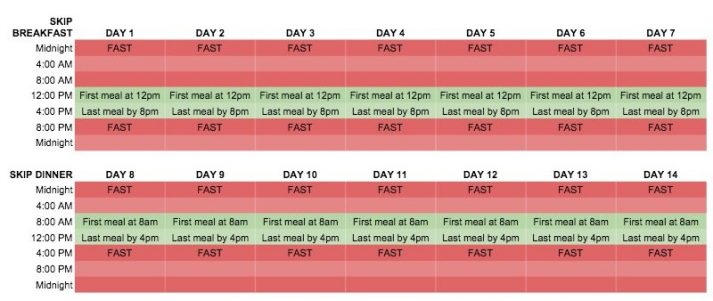
Adjust this window to make it work for your life:
- If you start eating at: 7AM, stop eating and start fasting at 3pm.
- If you start eating at: 11AM, stop eating and start fasting at 7pm.
- If you start eating at: 2PM, stop eating and start fasting at 10pm.
- If you start eating at: 6PM, stop eating and start fasting at 2AM.
#2) INTERMITTENT FASTING 24-HOUR PLAN
With this plan, you eat your normal 3 meals per day, and then occasionally pick a day to skip breakfast and lunch the next day.
Eat on a normal schedule (finishing dinner at 8PM) and then don’t eat until 8PM the following day.
If you can only do an 18 hour fast, or a 20 hour fast, or a 22 hour fast – that’s okay! Adjust with different time frames and see how your body responds.
Two examples: skipping breakfast and lunch one day of the week, and then another where you skip lunch and dinner one day, two days in a week.

These are just two popular strategies, though there are many variations of both that you can modify for yourself:
- Some people eat in a 4-hour window, others do 6 or 8.
- Some people do 20-hour fasts or 24-hour fasts.
- Another strategy is to eat only one meal a day (OMAD).
You’ll need to experiment, adjust to work for your lifestyle and goals, and see how your body responds. If there’s one thing we’ve learned after Coaching over 15,000 1-on-1 clients: there is no “one-size-fits-all” approach to exercise and nutrition that works for everyone, all of the time.
Let’s first get into the science here behind Intermittent Fasting and if you should consider it!
How Does Intermittent Fasting Work?

Now, you might be thinking: “okay, so by skipping a meal, I will eat less than I normally eat on average (2 meals instead of 3), and thus I will lose weight, right?”
All things being equal, yes.
By cutting out an entire meal each day, you are consuming fewer calories per week – even if your two meals per day are slightly bigger than before. Overall, you’re still consuming fewer calories per day.

In this example, you’re eating LARGER lunches and dinners than you normally do, but by skipping breakfast you’ll consume 500 less calories per day.
And thus, weight loss!
However, that doesn’t mean this works 100% of the time, for everyone. By understanding the underlying mechanism of weight loss (i.e. calorie deficit), we can better understand how our dieting strategy is affecting our behavior. Then we know if this strategy will work for us or not.
In the case of intermittent fasting, by condensing the eating window, many people feel more full and naturally eat less (like in the example above.)
However, it’s also totally possible for somebody to be so hungry as a result of fasting that they overconsume calories during that same period, which would result in weight gain instead of weight loss.
If you were reliant on the idea that “Intermittent Fasting works for weight loss” – full stop – you could be easily discouraged if it didn’t work.
You might think: “Is my metabolism broken?” But because we know that intermittent fasting is one dieting strategy that CAN work for weight loss if it helps you stick to a caloric deficit more easily, you’re empowered to decide if this is a good fit for you. Eureka!
This is highlighted in a recent JAMA study[2] in which both calorie-restricted dieters and intermittent fasters lost similar amounts of weight over a year period.
You might be thinking: “Ok, ok, I get it. Caloric deficit. But what about the timing of meals – can’t that also influence how your body reacts?”
Yes, your body operates differently when “feasting” compared to when “fasting”. But it’s important to understand how this fits into the big picture.
When you eat a meal, your body spends a few hours processing that food, burning what it can from what you just consumed.
Because it has all of this readily available, easy-to-burn energy (thanks to the food you ate), your body will choose to use that as energy rather than the fat you have stored.
During the “fasted state” (the hours in which your body is not consuming or digesting any food) your body doesn’t have a recently consumed meal to use as energy.
Thus, it is more likely to pull from the fat stored in your body as it’s the only energy source readily available.
However, when we compare the differences in energy used from body fat over an entire day, that’s entirely dependent on the total calories consumed. So while your body is more likely to pull energy from a recent meal, and will rely on fat stores once that energy runs out, if you eat the same amount of calories throughout the day, the result is the same amount of energy pulled from fat. It all balances out in the end.
The same goes for working out in a “fasted” state.
Without a ready supply of glucose and glycogen to pull from (which has been depleted throughout your fasted state, and hasn’t yet been replenished with a pre-workout meal), your body is forced to adapt and pull from a source of energy that it does have available: the fat stored in your cells.
While many of us get excited about the idea of being in a “fat-burning mode”, the same principle holds. If we burn an equal amount of calories, whether fasted or not, the result is less total energy stored in our fat cells at the end of the day. (There’s even an argument for athletes whose sports require glycogen to be readily available to meet their energy demands – making sure these stores are never depleted is important so an athlete doesn’t ‘bonk’ in the middle of their competition.)
Hopefully, you can see how easy it is to take a true fact of our biology (we burn more fat from fat stores when in a fasted state) and extrapolate it to seem more than it is. The same goes for six meals a day!
The truth is, there isn’t a magic pill or solution that’s going to overcome the basics. The best reason to do Intermittent Fasting is because you like it and it fits within your lifestyle.
TL/DR: Fasting can help promote weight loss and muscle building when done properly ~ though it isn’t the ONLY method that works.
Should I Eat 6 Small Meals a Day?

There are a few main reasons why diet books recommend six small meals:
1) When you eat a meal, your body does have to burn extra calories [9] just to process that meal. So, the theory is that if you eat all day long with small meals, your body is constantly burning extra calories and your metabolism is firing at optimal capacity, right? Well, that’s not true.
Whether you eat 2000 calories spread out throughout the day, or 2000 calories in a small window, your body will burn the same number of calories processing the food [10].
So, the whole “keep your metabolism firing at optimum capacity by always eating” sounds good in principle, but reality tells a different story.
2) When you eat smaller meals, you might be less likely to overeat during your regular meals. I can definitely see some truth here, especially for people who struggle with portion control or don’t know how much food they should be eating.
However, once you educate yourself and take control of your eating, some might find that eating six times a day is very prohibitive and requires a lot of effort. I know I do.
Also, because you’re eating six small meals, I’d argue that you probably never feel “full,” and you might be MORE likely to eat extra calories during each snack.
This is why personal preference is so important when picking a diet strategy that works for you.
Although grounded in seemingly logical principles, the “six meals a day” doesn’t work for the reason you think it would (#1), and may feel prohibitive to prepare and eat 6 times a day (#2). Other people may find that 6 meals a day fits them perfectly. If you find what works for you, that rules!
If we think back to caveman days, we’d have been in serious trouble as a species if we had to eat every three hours. Do you think Joe Caveman pulled out his pocket sundial six times a day to consume his equally portioned meals?
Hell no! He ate when he could, endured and dealt with long periods of NOT eating (no refrigeration or food storage) and his body adapted to still function optimally enough to still go out and catch new food.
A recent study (written about in the NYT, highlighted by LeanGains) has done a great job of challenging the “six-meals-a-day” technique for weight loss [11]:
There were [no statistical] differences between the low- and high- [meal frequency] groups for adiposity indices, appetite measurements or gut peptides (peptide YY and ghrelin) either before or after the intervention. We conclude that increasing meal frequency does not promote greater body weight loss under the conditions described in the present study.
That’s why we made this:

Should I Try intermittent fasting? (4 Big Benefits)

Now that we’re through a lot of the science stuff, let’s get into the reality of the situation: why should you consider Intermittent Fasting?
#1) Because it can work for your goals. Although we know that not all calories are created equal, caloric restriction plays a central role in weight loss.
When you fast, you are potentially making it easier to restrict your total caloric intake over the course of the week, which can lead to consistent weight loss and maintenance.
#2) Because it simplifies your day. Rather than having to prepare, pack, eat, and time your meals every 2-3 hours, you simply skip a meal or two and only worry about eating food in your eating window.
It’s one less decision you have to make every day.
It could allow you to enjoy bigger portioned meals (thus making your tastebuds and stomach satiated) and STILL eat fewer calories on average.
It’s a point that Coach Matt makes in this video on intermittent fasting:
#3) It requires less time (and potentially less money). Rather than having to prepare or purchase three to six meals a day, you only need to prepare two meals.
Instead of stopping what you’re doing six times a day to eat, you simply only have to stop to eat twice. Rather than having to do the dishes six times, you only have to do them twice.
Rather than having to purchase six meals a day, you only need to purchase two.
#4) Plus, Wolverine does it:
If adamantium-clawed superheroes do Intermittent Fasting, it can probably work for you too, if you can make it work for your particular lifestyle and situation!
What Are the Negative Effects of intermittent fasting?

It’s important to understand Intermittent Fasting is NOT a cure-all panacea.
Let’s talk about some of the potential drawbacks of Intermittent Fasting:
#1) If you skip breakfast, you might be so hungry from this that you OVEREAT your other meals, which can lead to weight gain. The important thing here is that with an intermittent fasting plan, you’re eating fewer calories than normal because you’re skipping a meal every day (if your goal is weight loss.)
In other words, don’t delude yourself into thinking that if you skip breakfast and then eat 4,000 calories of candy bars for lunch and dinner that you will lose weight.
This is simply a math and behavior strategy for giving yourself fewer chances to overeat and put your body into a caloric surplus.
(If you struggle with portion control, figure out your calorie goals and track your calorie intake in your meals to make sure you’re not overeating.)
#2) Skipping meals can result in feelings of lethargy, hunger, and “hangriness”!
If you eat breakfast every morning, your body expects to wake up and eat food.
Once you retrain your body to NOT expect food all day every day (or first thing in the morning), it’s possible that these side effects become less of an issue. In addition, ghrelin (a hormone that makes you hungry [13]), is actually lowest in the mornings and decreases after a few hours of not eating.
#3) Intermittent Fasting can be more complex for people who have issues with blood sugar regulation, suffer from hypoglycemia, have diabetes, etc. If you fit into this category, check with your doctor or dietitian before adjusting your eating schedule.
#4) Intermittent Fasting can affect women differently: there’s a whole section dedicated to that here.
Can I Build Muscle and Gain Weight While Intermittent Fasting? (Pros and Cons)

It is possible to build muscle and strength while Intermittent Fasting, though it’s not inherently superior to building muscle and strength while following a traditional eating pattern.
(We have our big “how to build muscle” guide, in addition to a whole “Strength 101” series – and I’d recommend you read those if you’re looking for a place to start strength training.)
Personally, I did intermittent fasting from 2015 to 2020 while building muscle and strength:
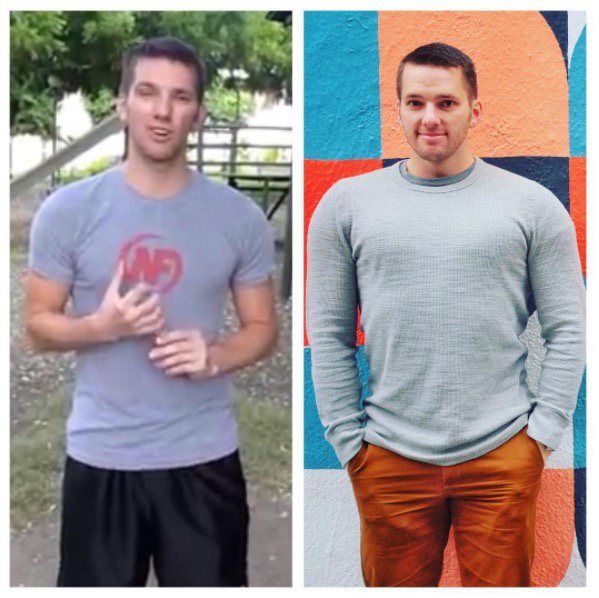
Let’s talk first about the nutritional strategy first, and then we’ll get into the exercise portion.
Here’s how I built muscle while simultaneously fasting: In order to gain weight and build muscle, I had to be in a caloric surplus.
And because I was not eating for 16 hours, that meant I was cramming 3000 nutritious calories into an 8 hour window, which often left me feeling bloated and overly full.
- 11 AM Work out with heavy strength training in a fasted state.
- 12 PM Immediately consume 1/2 of my calories for the day (a regular whole-food meal, followed by a calorie-dense homemade protein shake).
- 7 PM Consume the second portion of my calories for the day in a big dinner.
- 8 PM – 12 PM the next day: Fast for 16 hours.
After following this strategy for a number of years, I gave up fasting in 2019, and instead consumed my calories throughout the day.
Here’s a different strategy for Fasted Muscle Building: my friend Nate Green packed on a crazy amount of muscle while fasting for a full 24 hours on Sundays. [15]
Let’s now talk about strength training!
If you want to build muscle while fasting, you need to work out. Specifically, by lifting heavy, so here are a few workout options!
#1) “Build Your Own Workout Routine” and get your hands dirty. Our guide will walk you through building a full-body exercise program in 10 simple steps.
#2) Follow our Strength Building Guide and start training today. You’ll want to do lots of heavy compounds lifts:
How to tie it all together: pick up heavy things, eat enough protein, and consume enough calories, and you’ll build muscle and strength.
Should You Do Intermittent Fasting and the Keto Diet?

We have a crazy extensive guide on the Keto Diet in case you’re not familiar with it, so here it is in a nutshell:
By only eating fat and protein, your body must adapt to run on fat for fuel instead of carbohydrates. In the absence of carbs/glucose, your body converts fats to ketones and uses them for fuel.
This process is called “ketosis,” and there are two ways for a body to enter ketosis:
- Eating in a way that induces ketosis (very low carb, high fat).
- Fasting…Hey, that’s what you’re reading about right now!
We actually have an amazing success story here on Nerd Fitness, Larry, who followed our strategies, went Keto and start intermittent fasting. He ended up losing weight, getting stronger, AND overcame the challenges of rheumatoid arthritis (click on the image for his story)!

Why Keto and Fasting can work: eating Keto can be really challenging. And every time you eat, it’s an opportunity to do it wrong and accidentally eat foods that knock you out of ketosis.
You’re also tempted to overeat.
So, by skipping a meal, you’re eliminating one meal, one decision, one chance to screw up.
Note: if you’re thinking “Steve, am I losing weight because I’m skipping 1/3rd of my meals for the day, AND eliminating an entire macronutrient?”, then you’d be right.
Both Keto and IF have secondary effects that could also be factoring in – physiological benefits which I explain in both articles.
Your value may vary!
You need to decide what works for you.
You probably won’t become “keto-adapted” (your body running on ketones) just skipping breakfast every day – your body will still have enough glucose stored from your carb-focused meals for lunch and dinner the day before.
In order to use fasting to enter ketosis, the fast needs to be long enough to deplete your carb/glucose stores, or you need to severely restrict carbohydrates from your meals in addition to IF in order to enter ketosis.
MORAL OF THE STORY: Experiment and try different strategies that will work for you.
By skipping a meal or minimizing carbohydrate intake, you’re more likely than not to lose weight:
- You can do intermittent fasting without eating a Keto Diet and lose weight.
- You can do a Keto Diet without intermittent Fasting and lose weight.
- You can combine them and lose weight.
- You can do neither and lose weight.
Sticking with Keto is BRUTALLY difficult, and probably not the right diet for 98% of the planet. Those people would be better off following our “Start Eating Healthy” guide with small changes.
Does Intermittent Fasting Have Different Effects on Men and Women?

The quick answer is: “yes, Intermittent Fasting can affect men and women differently.”
Anecdotally, we have many women in our online coaching program that swear by Intermittent Fasting, while others have had adverse effects.
Let’s dig into the science and studies.
A recent PubMed summary concluded that “fasting can be prescribed as a safe medical intervention as well as a lifestyle regimen which can improve women’s health in many folds [18].
Now, in that extract, many of the studies cited are focused on specifically calorie restriction (and not just fasting), and they also say that “future studies should address this gap by designing medically supervised fasting techniques to extract better evidence.”
Digging into the PubMed Archives brought me to the following conclusions [19]:
One small study (with 8 men and 8 women, all non-obese) resulted in the following: “Glucose response to a meal was slightly impaired in women after 3 weeks of treatment, but insulin response was unchanged. Men had no change in glucose response and a significant reduction in insulin response.”[20]
Another small study (8 women) studied the effects on their menstrual cycles after a 72-hour fast – which is significantly longer than any fast recommended in this article: “in spite of profound metabolic changes, a 72-hour fast during the follicular phase does not affect the menstrual cycle of normal cycling women.” [21].
Yet another study tracked 11 women with 72-hour fasts (again, longer than we’d recommend) and it found that “Fasting in women elicited expected metabolic responses – included increased cortisol (a stress hormone) – and apparently advanced the central circadian clock (which can throw off sleeping patterns). [22]
Those studies above, in working with small sample sizes, and different types of fasting than recommended here, would lead me to believe that fasting affects men and women differently, and that many of the weight loss benefits associated with intermittent fasting (that affect insulin and glucose responses) work positively for men and negatively for women.
There are also a series of articles[23] out there that dig into the potential reproductive health issues, stress challenges, induction of early-menopause [24] associated with fasting (and calorie restriction) for women.
Precision Nutrition – a great resource – recommends not attempting Intermittent Fasting as a woman if:
- you’re pregnant
- you have a history of disordered eating
- you are chronically stressed
- you don’t sleep well
- you’re new to diet and exercise
The challenge associated with all of this is that there aren’t enough long-term studies, with large enough sample sizes, specifically targeting female humans, with relation to the different types of Intermittent Fasting.
It does appear that men and women will have different experiences with intermittent fasting; we’re all unique snowflakes (yep, especially you), and your body will be affected by intermittent fasting differently than the person next to you.
There is enough evidence as cited in the articles and studies above that would give me pause to recommend Intermittent Fasting for women, especially if you are considering getting pregnant in the near term.
If you are looking to attempt fasting for weight loss reasons, my research has shown me that Intermittent Fasting could be less effective for women than men with regards to weight loss, and thus you would be wise to keep your efforts elsewhere:
- Focusing on the total calories and quality of your food (here’s how to eat better).
- Start exercising regularly!
- Make sure you are getting enough sleep.
Now, if you’ve read the above warnings, you are still curious about Intermittent Fasting, and you want to give it a try as a female, that is your choice!
You know your body best.
So, get blood work done, speak with your doctor and get a check-up.
Give intermittent fasting a shot, track your results, and see how your body/blood work changes as a result of Intermittent Fasting and decide if it’s right for you.
Your mileage may vary, so speak with a doctor or find a doctor versed in intermittent fasting plans and treat it like an experiment on yourself!
Top 5 Questions about Intermittent Fasting

1) “Won’t I get really hungry if I start skipping meals?”
As explained above, this can be a result of the habits you have built for your body. If you are constantly eating or always eat the same time of day, your body can actually learn to prepare itself for food by beginning the process of insulin production and preparation for food.
After a brief adjustment period, your body can adapt to the fact that it’s only eating a few times a day. The more overweight you are, and the more often you eat, the more of an initial struggle this might be.
Remember, your body’s physical and cognitive abilities most likely won’t be diminished as a result of short-term fasting.[25]
2) “Where will I get my energy for my workouts? Won’t I be exhausted and not be able to complete my workouts if fasting?”
This was a major concern of mine as well, but the research shows this might not be the case: “Training with limited carbohydrate availability can stimulate adaptations in muscle cells to facilitate energy production via fat oxidation.”[26]
In other words, when you train in a fasted state, your body can get better at burning fat for energy when there are no carbs to pull from!
The caveat to this is that pulling energy from fat oxidation is a slower process than breaking down carbohydrates. If your workout is super intense (high-intensity interval training, MMA, even bodybuilding) – you’ll likely benefit from having more readily available energy to fuel your workouts for better performance.
3) “I like the idea of fasted training, but I work a regular 9-5 or a night shift and can’t train at 11AM as you do. What am I supposed to do?”
Depending on your training schedule, lifestyle, and goals, go back to the portion above where I talk about the 16/8 protocol and simply adjust your hours of fasting and feasting.
LeanGains digs into various options here, but here is really what you need to know:
- Don’t overthink this. If you can’t train until 5pm, that’s okay. Consume a small meal for lunch, or shift your Intermittent Fasting window to eat all of your meals in the 8 hours post-workout. Better to do that than abandon it as a lost cause and have 0% compliance.
- If you are an elite athlete, speak with a coach or nutritionist about your specific concerns and expectations. Otherwise, make intermittent fasting work for you Consider trying the 24-hour protocol below instead of the 16/8 protocol.
- If you train later in the day (say, 7pm) but break your fast before training (aka Lunch), make it a smaller meal focused around fats and protein – which should be a solid goal even if you aren’t Intermittent Fasting! Try to time your carb and big meal consumption to happen AFTER your workout.
- If you exercise BEFORE work, but then don’t eat until lunchtime: consider a protein supplement immediately after your workout, or simply wait until lunch to start eating. See how your body responds and adjust accordingly.
Do what you can, and don’t psyche yourself out! Get started and adjust along the way.
4) Will Intermittent Fasting cause muscle loss?
Good news: Our bodies are quite adept at preserving muscle even when fasting [27], and it turns out that protein absorption by our body can take place over many many many hours.
Not only that, but you can even burn fat AND build muscle at the same time if you have the right system in place!
Protein consumed in a shorter period of time has no difference on the body compared to protein spread throughout the day.
5) How much should I eat while intermittent fasting?
Simple: Eat for your goals! You do know how many calories you should eat every day, right?
If your goal is weight loss, you still need to consume fewer calories than you burn every day to lose weight, full stop. If your goal is bulking up, you’ll need to consume more calories than you burn every day. Intermittent Fasting isn’t a cure-all, it’s a PART of the puzzle.
To start, begin intermittent fasting and eat your normal-sized meals and track your weight and performance. If you are losing weight and happy with the progress, keep doing what you’re doing! If you are NOT losing weight, you could be eating too much. It’s a message I really strike home in our guide “Why Can’t I Lose Weight?”
That’s why you should track your calories for a week, and then target a 10% reduction in calories and continue. Here’s a calculator for you to determine the amount of calories you need daily.
6 Tips and Tricks about Fasting

#1) Don’t freak out! Stop wondering: “can I fast 15 hours instead of 16?” or “what if I eat an apple during my fasted period, will that ruin everything?” Relax. Your body is a complex piece of machinery and learns to adapt. Everything is not as cut and dry as you think.
If you want to eat breakfast one day but not another, that’s okay. If you are going for optimal aesthetic or athletic performance, I can see the need to be more rigid in your discipline, but otherwise…freaking chill out and don’t stress over minutiae!
Don’t let perfect be the enemy of good when it comes to your intermittent fasting plan. It’s just one tool in your toolkit.
#2) Listen to your body during your strength training workouts. If you get lightheaded, make sure you are consuming enough water.
If you notice a significant drop in performance, make sure you are eating enough calories (especially fats and protein) during your feasting window.
And if you feel severely “off,” pause your workout. Give yourself permission to EASE into intermittent fasting and fasted workouts. This is especially true if you are an endurance athlete.
#3) Stay busy. If you are just sitting around thinking about how hungry you are, you’ll be more likely to struggle with this. For that reason, I time my fasting periods for maximum efficiency and minimal discomfort:
- My first few hours of fasting come after consuming a MONSTER dinner, where the last thing I want to think about is eating.
- When I’m sleeping: 8 of my 16 hours are occupied by sleeping. Tough to feel hungry when I’m dreaming about becoming a Jedi.
- When I’m busy: After waking up, 12 hours of my fasting is already done. I spend three hours doing my best work (while drinking a cup of black coffee), and then comes my final hour of fasting: training.
#4) Zero-calorie beverages are okay. I drink green tea in the morning for my caffeine kick while writing. If you want to drink water, black coffee, or tea during your fasted period, that’s okay. Remember, don’t overthink it – keep things simple! Although be aware that Dr. Rhonda Patrick over at FoundMyFitness believes that a fast should stop at the first consumption of anything other than water, so experiment yourself and see how your body responds.
If you want to put milk in your coffee, or drink diet soda occasionally while fasting, I’m not going to stop you. Remember, we’re going for consistency and habit-building here – if milk or cream in your coffee makes life worth living, don’t deprive yourself.
There are MUCH bigger fish to fry with regards to getting healthy than a few calories here and there during a fast.
80% adherence that you stick with for a year is better than 100% adherence that you abandon after a month because it was too restrictive.
If you’re trying to get to a minimum bodyfat percentage, you’ll need to be more strict with overall calories – until then, however, do what allows you to stay compliant!
#5) Track your results, listen to your body:
- Concerned about losing muscle mass? Keep track of your strength training routines and see if you are getting stronger.
- Buy a cheap set of body fat calipers and keep track of your body fat composition.
- Track your calories, and see how your body changes when eating the same amount of food, but condensed into a certain window.
#6) Don’t expect miracles. Yes, Intermittent Fasting can potentially help you lose weight, increase insulin sensitivity and growth hormone secretion (all good things), but it is only ONE factor in hundreds that will determine your body composition and overall health. Don’t expect to drop to 8% body fat and get ripped just by skipping breakfast.
You need to focus on building healthy habits, eating better foods, and getting stronger.
This is just one tool that can contribute to your success.
Getting Started with Intermittent Fasting: Next Steps

Intermittent fasting can potentially have some very positive benefits for somebody trying to lose weight or gain lean body mass.
Men and women will tend to have different results, just like each individual person will have different results. The ONLY way to find out is through a conversation with your doctor and self-experimentation.
There are multiple ways to “do” an Intermittent Fasting Plan:
- Fast and feast regularly: Fast for a certain number of hours, then consume all calories within a certain number of hours.
- Eat normally, then fast 1-2x a week: Consume your normal meals every day, then pick one or two days a week where you fast for 24 hours. Eat your last meal Sunday night, and then don’t eat again until dinner the following day.
- Fast occasionally: probably the easiest method for the person who wants to do the least amount of work. Simply skip a meal whenever it’s convenient. On the road? Skip breakfast. Busy day at work? Skip lunch. Eat poorly all day Saturday? Make your first meal of the day dinner on Sunday.
After that, get started! Take photos, step on the scale, and track your progress for the next month.
See how your body responds.
See how your physique changes. See how your workouts change.
And then decide if it’s something you want to keep doing!
4 years later, I have no plans on going back to eating breakfast. Sorry General Mills and Dr. Kellogg!
Thanks for reading, and I hope we gave you ALL the information you wanted about Intermittent Fasting, it’s underlying mechanisms for success, and reasons it may (or may not) work for you!
-Steve
PS: Before you take off, grab our Intermittent Fasting Worksheet to help you start your fasting practice:
PPS: Make sure you check out the rest of our guides on losing weight:
- The 5 Rules of Weight Loss
- How to Start Eating Healthy (Without Being Miserable)
- 9 Strategies for Losing Weight Quickly
###
Photo Source:[29]
The post Intermittent Fasting Guide: Myths, Facts, & Strategies first appeared on Nerd Fitness.
]]>The post How To Build Healthy Habits That Stick first appeared on Nerd Fitness.
]]>
At some point in the past week (or five minutes ago after a Google search), you’ve made a resolution to change your life.
Maybe you decided to exercise every day. Perhaps it’s time to start eating better.
Or maybe you decided to stop wearing jorts.

Well my friend, I’m excited for you, and I want you to know you’ve arrived at the right place!
We help folks build healthy habits as part of our 1-on-1 Online Coaching Program, so you’ve come to the right place to fulfill your resolution.
Here’s what we’ll cover in our Guide to Build Healthy Habits in 2024:
- Why do we suck at building healthy habits?
- The first step of building healthy habits (Know your “Big Why”)
- How to build healthy habits (The three parts)
- The key to sustainable healthy habits (Use systems)
- 5 hacks for effortless healthy habit building
- The secret to fulfilling your resolution (Do less)
- Pick your habit and GO (Next steps)
Let’s get right to it so you can start rocking 2022!
Why Do We Suck At Building Healthy Habits?

“I know what I’m supposed to do, I just can’t get myself to do it!”
Welcome to the club – we all know what we need to do, but we just can’t get ourselves to make the important changes.
We know how to get in shape: move more and eat less!
We know how to exercise: get your heart rate up, do some push-ups, get stronger.
We know how to eat healthy: more vegetables and less sugar.
And yet, we can’t get ourselves to stick with ANY of these things for longer than a few weeks.
Why?
Simple: Building new healthy habits is tough, our lizard brains crave instant gratification, we don’t fully understand how habits are built, life gets busy, and our default behavior is often as unhealthy as it is easy.
As a result, we don’t put the right systems in place in order to make changes stick.
We also rely wayyyyy too much on willpower and motivation.
We tend to bite off more than we can chew, go too fast too soon, and then get overwhelmed too quickly.

Does this sound familiar?
- I’m going to eat 100% Paleo/Keto AND
- I’m going to run 5 miles a day AND
- I’m going to work out in a gym five times a week.
If you’re somebody that eats a typically poor diet, never runs, and hasn’t set foot in a gym since grade-school dodgeball with Mr. Wazowski, changing alllll of these at once is almost a surefire way to succeed at precisely NONE of them.
We’re conditioned these days to expect and receive instant gratification. If we want food we can get it from a drive-through, stick a frozen meal in a microwave, or sit down at a restaurant that’s open 24 hours. If we want a game we can download it to our computers/phones/PS5s within a matter of seconds. If we want to watch a TV show, it’s a few clicks away.
Hell, Netflix even starts the next episode for you without any action required!

We expect getting in shape to go the same way.
And this is why we suck at building healthy habits that stick.
We tell ourselves “Hey, I’ve been dedicated for a whole two weeks, why don’t I look like Ryan Reynolds yet?”, not remembering that it took us decades of unhealthy living to get where we are, which means it’s going to take more than a few weeks to reverse the trend.
And then we miss a workout because life was busy or our kid got sick. And we get disheartened that exercise or giving up candy is not nearly as fun as Netflix and video games and Peanut M&M’s.
This is where everybody gives up:
- They try to change too many habits too soon
- They get impatient the results don’t come more quickly
- They slip up when life gets busy
- And they go back to square one
It’s why we are doomed to stay overweight and suck at building habits. It’s the videogame equivalent of attacking too many bad guys at once, which always leads to game over.
We’ll cover the specific healthy habits and resolutions you SHOULD be picking later in this article, but I have a big damn question to ask you first:
“But why though?”
The First Step of Building Healthy Habits (Know Your “Big Why”)

Before we do ANYTHING with actually building habits, it can help to have a good reason as to why you want to build them in the first place or the changes will never stick.
This whole “change who I am” stuff can be really powerful for keeping us focused when life starts to get busy.
If you’re here because you decided you “should” get in shape, you’re going to fail the second life gets busy.
If you are dragging yourself to the gym because you think you “should” run on a treadmill five days a week even though you hate it, you’re screwed!
As you’re determining the habits or resolutions you’re trying to set, make the habit part of a bigger cause that’s worth the struggle.
You’re not just going to the gym, you’re building a new body that you’re not ashamed of so you can start dating again.
You’re not just learning to like vegetables, you’re getting fit so you can feel great while on vacation this summer.
You’re not just dragging yourself out of bed early, you’re getting up earlier so you can work on your side business before your kids get up so you can set money aside for their college education.
In our 1-on-1 Coaching Program, we refer to this as your “Big Why.”
Tie your journey to a greater cause and you’re more likely to push through the muck and mire to get it done.
So dig 3 levels deep and ask “why” until you get to the root cause of WHY you want to build a new healthy habit or change a bad one. Write it down. And hang it up somewhere you can see it every day.
Got your reason? Great.
Now let’s get into the science of habits.
How to Build Healthy Habits (The Three Parts)

As Charles Duhigg points out in The Power of Habit (a must-read for anybody interested in behavior change), there are three parts to a habit:
#1) Cue (what triggers the action): It can be a feeling: I’m tired, I’m hungry, I’m bored, I’m sad. Or it can be a time of day: it’s Monday at 9am, work is done, etc.
#2) Routine (the action itself): This can either be a negative action you want to cut back: I drink soda, I eat cake, I snack, I drink alcohol, I smoke cigarettes, I watch TV – or a positive one: I go to the gym, I go for a run, I do push-ups, I read a book.
#3) Reward (the positive result because of the action): I’m now awake. I am temporarily happy. My hands/mind are occupied. I can forget the bad day I had. I feel energized. I feel good about myself.
Depending on your routine/action above, habits can either be empowering and amazing, or part of a negative downward spiral. Your body isn’t smart enough to KNOW what it needs to do: it just wants to fix the pain or chase the pleasure of the cue, and whichever way you choose to respond will become the habit when it’s done enough times.
Factor in genius marketing, behavioral psychology, and an environment set up for us to fail – and bad habits rule us.

It’s why we crave certain foods, why we can’t help but check our phone every time it vibrates, and why we can’t keep ourselves from watching one more episode or grinding one more level in World of Warcraft.
Duhigg lays things out very clearly:
“There is nothing programmed into our brains that makes us see a box of doughnuts and automatically want a sugary treat.
But once our brain learns that a doughnut box contains yummy sugar and other carbohydrates, it will start anticipating the sugar high. Our brains will push us toward the box. Then, if we don’t eat the doughnut, we’ll feel disappointed.”

Picture this:
- We have trained your brain to take a cue (you see a doughnut), anticipate a reward (a sugar high), and make the behavior automatic (nom nom that donut).
- Compare that to a cue (you see your running shoes), anticipate a reward (a runner’s high), and make the behavior automatic (go for a run!).
The Dark Knight himself said it best: “It’s not who I am underneath, but what I do that defines me.”
Let’s take a look at each part of the habit-building process and start to hack the sh** out of it!
Learn Your Cues: Recognize the triggers.

Whether you are trying to change an old habit, stop an unhealthy habit, or begin a healthy habit, it starts with the first step in the process:
“The Cue.”
If you want to stop drinking soda, but feel like you need it every afternoon to get through work, your brain has been wired to think SODA after the cue:
- Cue: I’m tired, thirsty, and have no energy.
- Routine: I drink a soda around 3pm.
- Reward: Weeeeee caffeine! Sugar! Happy! My life has meaning!
When identifying bad habits to avoid, it starts by becoming aware of the cue that sets the habit in motion. Simply being aware of the cue is a great start to breaking the cycle:
- When I get bored (cue), I eat snacks (routine), and it fills the void with a happy stomach (reward).
- When I come home from work (cue), I plop down on the couch and play video games (routine), and it helps me forget about work (reward).
- When I get nervous (cue), I start to bite my nails (routine), to take my mind off the awkwardness (reward).
So if you are looking to break a bad habit, it begins by identifying what the cues are that make you take the action that you’re trying to stop.
At the same time, you can mentally train yourself, just like Pavlov’s dog, to build a new healthy habit by identifying the habit you want to build and the cue you want to use to proceed it:
- When I wake up (cue), I will go for a walk (routine), and reward myself with an audiobook on the walk (reward).
- When I get tired (cue), I will drink black coffee instead of soda (routine), and along with the caffeine boost. (reward), I’ll get new running shoes after 30 soda-free days (reward), and satisfaction from the weight loss thanks to fewer calories (reward).
- When I come home from work (cue), I will walk straight to my computer to work on my novel for 30 minutes (routine), and reward myself with Netflix after I have written 500 words (reward).
So, whether you’re breaking a bad habit or starting a new one, it begins by recognizing the cue that triggers the habit.
Once you recognize or pick the cue, you can start working on fixing the routine (action).
The Key to Sustainable Healthy Habits: Use Systems

“Steve, I get it, but I still struggle with the ‘building the routine’ part…for some reason I just can’t bring myself to do it.”
Yup – welcome to the toughest part of a habit:
The Routine (the action itself!).
This is where we’re going to start thinking and acting like nerds and scientists.
Whether we’re trying to stop a negative routine (stop drinking soda) or start doing a healthy routine (start running), both need to be addressed with a different plan of attack.

For starters, we’re going to stop relying on two things:
- Willpower: if you have to get yourself to exercise, you’ll give up when you get too busy or it’s too cold.
- Motivation: if you need to be motivated, you’re going to give up and then beat yourself up for not being more motivated!
Both motivation and willpower are finite and fickle resources that will abandon you when you need them most. Most people hope and pray that they have enough motivation and willpower to build a habit.
Not us though!
We’re going to remove both from the equation and use systems and outside forces to make the routine even easier to build (or tougher to build if it’s a bad habit you’re trying to swap!).
This can be done in a few ways:
- Environmental hacks: making the routine easier by removing steps needed to complete it, or adding steps between you and a bad habit.
- Programming hacks: add your habit to your daily calendar, track your progress daily with a journal, and make it part of your day.
We are products of our environment. We can use this information to our advantage and make the process of building a new habit or changing a bad habit easier by modifying our environment. I dig into this more fully in our article: “Build your Batcave for Habit Change,” but I’ll cover the basics here.
Look at the places you spend your time. Reduce the steps between you and a good habit, and increase the steps between you and a bad habit. You’ll be less reliant on willpower and motivation and more likely to do the healthy habit or skip the bad habit.
Here are five examples of environmental hacks you can use:
- RUN EVERY MORNING: Go to sleep with your running shoes at the foot of your bed, with your running uniform laid out already. Hell, you can sleep in your running/workout clothes. Put your alarm clock on the other side of the room so you HAVE to get out of bed to turn it off.
- GO TO THE GYM AFTER WORK: Pack your gym bag BEFORE going to sleep the night before. That way, every morning you already have a bag to throw in your car or bring with you. As soon as 5pm hits, you are in your car on your way to the gym. (Don’t want to head to the gym? Here’s how to build a gym in your home).
- EAT HEALTHIER: Don’t give yourself the option of not eating healthy – throw out the junk food in your house and start preparing meals the night before. Put a lock on your web browser from ordering pizza online (yes, you can do that now), and don’t drive down the street full of fast food places.
- WATCH LESS TV/PLAY FEWER GAMES: Use your laziness in your favor. Unplug the TV/system. Increase the steps between you and watching the TV. Put parental controls on your own system and have your friend set the time limit and the password. I knew somebody who put his TV in his closet and cut his TV viewing by close to 100%. Don’t rely on willpower – make it more difficult!
- CHECK YOUR PHONE LESS: Turn off your notifications and uninstall the apps that waste your time. Put your phone in Do Not Disturb mode when you are at work, and put it in your desk drawer. Don’t rely on willpower to get yourself to not check your phone when it buzzes – get rid of the buzz.
You can also use programming hacks to help build NEW healthy habits:
- EXERCISE: If you want to exercise more, set calendar alerts at the beginning of your week so that every day at 8AM you receive a cue (ding! on your phone) and a reminder to do the activity. You’re much more likely to stay on target when the activity has been scheduled ahead of time.
- HEALTHY EATING: Consider batch cooking! If cooking healthy meals every night sounds like way too much work (I hear you on that), consider doing it all on ONE day – it’s a significant time-saver, and it also will reduce the steps between you and healthy eating because the meal is already cooked and in the fridge!
- WRITING: If you want to write a book, tell yourself you have to write 500 crappy words every day. This is how I wrote Level Up Your Life. Buy a calendar, and draw a big red X on every day you complete your task. Make your singular focus every day continuing the streak[1].
Make the Reward Momentum-Building

And we are finally at the third part of the habit:
“The Reward.”
When looking to replace bad habits, do some reward analysis on your bad habits:
Soda gives you a caffeine kick and a burst of energy in the afternoon when you’re tired.
Can you replicate that energy boost for your body in a healthier way? Perhaps you can switch to black coffee and go for an afternoon walk.

Here’s another example:
You find you spend too much time watching TV because you love escaping into worlds, and it’s affecting your health.
Can you listen to your favorite audiobook only when you walk?
(This is called temptation bundling).
This step will require some analysis, by digging into the reward you’re trying to recreate, without the negative action. This can lead your brain to some tough places, but it’s healthy to dig into it.
For example, if you want to start drinking less (or give up completely), you might discover that the reward you’re chasing is actually “escape from a job I hate” and “avoiding social anxiety.”

Dig into your reward and what your brain is craving, and then see if you can reverse engineer a healthier routine with the same reward.
And then use outright bribery to get yourself to actually do the new healthier and choose the better action/routine.
What works for science and physics also holds true to building habits: inertia and momentum will work against you when it comes to building habits…until it starts to work for you as the habit becomes automatic.
We can fix the third part of the habit-building loop, the reward, with momentum-building prizes or results to bribe ourselves to continue. With each healthy and positive reward, with each completed routine, we make the habit sliiiiightly more likely to become more automatic the next time.
In other words, create rewards that reward you back!
DON’T reward your routine (running!) with an unhealthy reward (cake!). That’s “one step forward, two steps back.” And nutrition is 90% of the equation when it comes to weight loss anyway!
DO reward your routine (running for 5 minutes every day for 30 days straight) with a reward that makes you want to keep running (a snazzy new pair of running shoes).
Our new app, Nerd Fitness Journey, specifically follows this “cue, routine, and reward” format to help build new habits. In the app, we “reward” you with cool loot and XP, so you can level up (literally) while you getting lean and strong.
If you’re interested, you can try it for free right here:


5 Hacks for Effortless Healthy Habit building

Your life will get busy.
There will be days when you don’t want to do your new habit. Or you want to backslide and go back to old habits. Actually, that will pretty much be every day, especially early on.
So don’t leave it up to yourself!!!
Stop relying on yourself and start relying on outside forces. Here are the best tips you can use to get yourself to actually follow through with a habit:
1) RECRUIT ALLIES: find a friend or group of friends to build the habits with you. A recent study [2] showed that:
Among the weight loss patients recruited alone and given behavioral therapy, 24% maintained their weight loss in full from Months 4 to 10.
Among those recruited with friends and given therapy plus social support, 95% completed treatment and 66% maintained their weight loss in full.
You do not have to go on this habit-building journey alone. Building a guild or recruiting a group of people to support you and help you and make you better could be the difference-maker in building habits!
When your friend is already at the gym waiting for you, you HAVE to go. If it was up to you, skipping out and watching Netflix has no negative consequences. Recruit friends and allies!
Don’t have that support group at home? Consider joining ours 
Remember, those first few weeks are the toughest, which means they’ll require the most effort to get started.
2) CULTIVATE DISCIPLINE WITH ACCOUNTABILITY: When you can’t get yourself to follow through on a new healthy habit you’re desperately trying to build, make the pain of skipping the habit more severe than the satisfaction you get from skipping it.
Allow me to introduce some comical consequences:
- Every time I skip ______________ this month, I will pay $50 to my wife/husband/friend who will donate my money to a cause I HATE.
- Every time I decide not to _______________ this month, I have to run around my house naked.
- Every time I do ____________ when I shouldn’t, I will let my three-year-old do my makeup before work.
Do any of these results sound like fun? If you can’t afford to pay your friend $50, if running naked around your house might get you arrested, and if you’ll get fired looking like a drunk clown thanks to your kid’s makeup skills…maybe you just do what you know you need to do. The more painful it is to skip something, the more likely you’ll be to actually suck it up and do it.
3) NEVER MISS TWO IN A ROW. What happens if you miss a day? Who cares! One day won’t ruin you – but two days will, because 2 missed days can become a month or a year in the blink of an eye.
It’s something I bring up in this video over on our YouTube Channel:
As pointed out in a research summary:
“Missing the occasional opportunity to perform the behavior did not seriously impair the habit formation process: automaticity gains soon resumed after one missed performance.[3]
4) DON’T PICK HABITS YOU HATE: “Steve, I know I should run so I’m trying to build a running habit even though I hate running.” Stop.

Can you get the same results with a different habit, like rock climbing or hiking or swing dancing? Pick a habit that isn’t miserable and you’re more likely to follow through on it.
At the same time, we have tons of success stories of people who went from hating exercise to loving how it feels.
It’s because they made the habit part of a bigger picture: “I am working out because I am building a kickass body so I can start dating again!”
Or even if they don’t LOVE strength training, they love feeling strong and confident and powerful, so they build the habit and make it a priority.
It’s because they had a BIG enough why to overcome their initial dislike of exercise until they learned to love how exercise made them feel.
5) TRY TEMPTATION BUNDLING: Consider combining a habit you dislike with something you LOVE, and you’ll be more likely to build the habit.
If you hate cleaning your apartment, only allow yourself to listen to your favorite podcast when you are cleaning or doing the dishes.
Want to go to the gym more? Allow yourself an hour of watching Netflix, but ONLY while you’re on the elliptical.
This is called temptation bundling, and it can be a powerful change.
The Secret to Fulfilling Your Resolution (Do Less)

Now that you’re educated like a boss on the different parts of a habit, it’s time to build one!
I’ll leave you with a final bit of advice: if you decide that you want to run a marathon or save the world or lose hundreds of pounds, you’re going to screw up unless you internalize the following information:
DO WAY LESS.
Or in the immortal words of Kunu from Forgetting Sarah Marshall: “The less you do, the more you do”:
Pick ONE habit, make it small, and make it binary. Something that at the end of every day you can say “yes I did it” or “no I didn’t.”
Habits that are nebulous like “I am going to exercise more” or “I’m going to start eating better” are more useless than a Soulcycle membership for Jabba the Hutt.
Here are big examples. Be specific. Be small. And track it:
- Want to start exercising more? Awesome. For that first week, ONLY go for a walk for just 5 minutes every morning. Literally 5 minutes.
- Want to start cooking your own healthy meals? Just aim for one meal per day or one meal per week. Whatever works for you and your schedule.
- Want to stop drinking a 2 liter of Mountain Dew every day? Scale it back to 1.9 liters a day for a week. Then 1.8 for a week. Then 1.7…
- Want to get out of debt and build the habit of frugality? Start by saving an extra five bucks a day, or finding a way to earn an extra 5 bucks a day.
- Want to learn a new language? Speak your new language out loud for 10 minutes per day. That’s it!
Keep your goals SMALL and simple. The smaller and simpler they are, the more likely you are to keep them. And the habit itself pales in comparison to the momentum you build from actually creating a new habit.
I don’t care how many calories you burn in a 5-minute walk, just that you can prove to the new YOU that you can build the habit of walking, and only then can you up the difficulty.
We’re thinking in terms of years and decades here! So think small.
My real-life example: I wanted to build the habit of learning the violin at age 31, but couldn’t get myself to do it because I told myself I was too busy, which is a lie (“I only have 25 minutes; I need 30 minutes to practice…might as well not practice at all”), and thus I never played!
Once I lowered the threshold to “I have to only play for 5 minutes per day,” it gave me permission to pick it up here and there – and I ended up practicing WAY more frequently, and got better much faster.
I still suck, mind you, but I’m lightyears ahead of where I was before!
And please: DON’T BUILD ALL THE HABITS AT THE SAME TIME.
If you’re new to building habits, or you have never stuck with anything long enough to make it automatic, it’s because you did too much. Habits are compound interest.
As you build a new habit, it bleeds over to other parts of your life and makes future habits easier to build too – momentum!
As Mark Manson lays out in his guide on Habits:
“Willpower is like a muscle. It can be exercised and practiced and built up. It can also be forgotten, weakened and atrophied.
Just like going to the gym and building up strength and endurance, you can build up your discipline and willpower over a long period of time by setting and accomplishing a series of tasks on a consistent basis.”
You’ve probably tried the whole “build all the habits at once” and it doesn’t work. So try building ONE habit for 30 days. And then pick a habit that stacks on top of that one and helps you build more and more progress and more and more momentum.
Start today: Pick Your Habit and Go

I’ll leave you with a final quote from Duhigg’s The Power of Habit:
“If you believe you can change – if you make it a habit – the change becomes real. This is the real power of habit: the insight that your habits are what you chose them to be. Once that choice occurs – and becomes automatic – it’s not only real, it starts to seem inevitable, the thing…that bears us irresistibly toward our destiny, whatever the latter may be.”
You’ll need more brainpower initially, until your default behavior becomes the automatic habit-building you’re chasing.
With each day of you building your new habit, you’re overcoming any self-limiting belief, building momentum, and becoming a habit-building badass! And then those habits become automatic. Then, we rejoice:

So today, I want you to look at just ONE habit you want to change:
- Identify the cue that spurs it on – Is it the time of day? Boredom? Hunger? After work? Stress?
- Identify the potential rewards – Happiness? Energy? Satisfaction?
- Identify a new routine you’d like to establish that results in the same “reward” from the negative behavior…but in a more productive and healthy way.
Want more help?
I write the best newsletter in the galaxy – it’s two short emails a week, directly from my brain to your inbox, and I promise to make you laugh and live a bit better!
Want expert guidance on your healthy habit building in 2024? Sign up for a free call with our coaching team in the box below to learn more about the program and see if it’s the right fit:
I want you to leave a comment below: pick ONE habit that you’re going to build this month and identify the three portions of the habit you’re looking to build.
Good luck – now go build some momentum.
And ONE habit.
-Steve
###
photo source: Syahrir Maulana © 123RF.com, KHOTCHARAK SIRIWONG © 123RF.com, alphaspirit © 123RF.com, Evolution – Alternative, Nattapol Sritongcom © 123RF.com, obradov © 123RF.com, Chayapon Bootboonneam © 123RF.com, Boris Rabtsevich © 123RF.com, #13/366 Placing the head, Mixed Messages
The post How To Build Healthy Habits That Stick first appeared on Nerd Fitness.
]]>The post 7 Ways to Measure or Calculate Your Body Fat Percentage (and Lower It!) first appeared on Nerd Fitness.
]]>
Today we are going to teach you everything you’ve ever wanted to know about body fat percentage but were too afraid to ask.
We’ve been helping thousands of people get their body fat percentage to their desired level through our 1-on-1 Online Coaching Program, and I’m pumped to share with you our strategies in this guide.
Plus, lots of cute animal videos as rewards for reading each section.

Fair warning: lots of half-naked people of all different shapes and sizes in this guide!
In this Body Fat Measurement Ultimate Guide, we’ll cover:
- What is body fat percentage?
- What are some examples of body fat percentage?
- What should my body fat percentage be?
- How do I calculate or measure my body fat percentage?
- What’s the best way to lower body fat percentage?
- Is BMI the same as body fat percentage?
If you have been struggling with your weight (and having too high of a body fat percentage) for a while, I know how frustrating that can be.
It’s why we built our popular 1-on-1 Online Coaching program, so this time things can be different. Your NF Coach will help you track the right metrics (like body fat percentage) and set the right goals.
What is Body Fat Percentage?

In its simplest form: body fat is the amount of fat in your body, compared to everything else:
- your organs
- muscles
- bones
- tendons
- water
- any demons currently possessing you
- and so on
Both men and women carry different amounts of body fat percentage due to…you know…being different.
A super ripped male bodybuilder who is minimizing body fat percentage could have a percentage down as low as 3-4%, while a super ripped female bodybuilder who is minimizing body fat percentage would only get as low as 8-9%.
A male athlete could be in fantastic shape and have 10% body fat, while a women at a comparable level of athleticism and appearance might be at 18-20% body fat.
To take the comparison to the other end of the spectrum, an overweight male at 30% will look vastly different than an overweight woman at 30%.
Feel free to take a break with this video of a lion cub hanging out with a puppy and a rabbit.
What are Some Examples of Body Fat Percentage?
Below, you’ll see images of what people look like with different amounts of body fat.
Some Examples of Body Fat % for Men:


Some Examples of Body Fat % for Women:


A quick note: your body fat percentage is just the amount of body fat you have.
It has nothing to do with the amount of muscle mass you have, which means you can have two people with the same amount of body fat percentage that look WAY different from each other.
Are you surprised about what you thought and what the actual percentages look like?
If so, don’t worry about it – most people have no idea what their body fat percentage is, and will often over or underestimate it pretty dramatically.

We’ll get into what’s a good number to AIM for, and how to measure it next.
We work with both men and women in our Online Coaching Program, and help them reach a level of body fat that they’re happy with.
More importantly? We do it sustainably, and without making you only eat chicken and broccoli.
You have unlocked this video of a baby sea otter trying to sleep on mom:
What Should My Body Fat Percentage Be?

Here is the “generally accepted” (yeah, I don’t like this term either) chart for women and men when it comes to body fat percentage:
|
Women |
Men |
|
|
Essential fat |
10-12% |
2-4% |
|
Athletes |
14-20% |
6-13% |
|
Fitness |
21-24% |
14-17% |
|
Acceptable |
25-31% |
18-25% |
|
Obese |
32% plus |
26% plus |
In what I’m sure is news to nobody, body fat is essential to survival – fat protects your internal organs, provides you with necessary energy stores in times of peril, and more.
“Essential fat” means the minimal amount of fat required for survival – Anything less than this amount would mostly likely result in organ failure, but even approaching this amount of body fat is dangerous.

It’s for this reason that bodybuilders, who can minimize their body fat to the “essential fat” level only do so when prepping for a show – during the rest of the year they maintain a higher body fat percentage so that they can stay healthy and function properly.
If you are looking to have that “ripped” or “toned” look, you’ll want your body fat percentage to hover in the “athletes” section.
(I cover the philosophy behind this extensively in our “How to build any physique” article.)
If you’re just looking to get healthy and look in the mirror with pride, aim for the Fitness range.
Once you get into the upper ends of “acceptable” and “obese,” a decrease in body fat percentage would benefit your health.
Now, I’m going to GUESS you’re reading this article because you’re interested in reducing your body fat percentage.
For starters, you need to determine what’s an optimal goal for you:
- If you are trying to look like Ryan Reynolds or Jessica Beil in Blade III, good luck! You’ll need to aim for a body fat percentage of 6-8% (men) or 13-15% (women). Note: your athletic/strength gaining performance will most likely suffer at this percentage, and can be really really challenging to maintain. Your call.
- If you are interested in getting that coveted six pack, drop your body fat down to the 8-11% range for men and 15-17% range for women.
- If you are an athlete and interested in optimal athletic performance, aim for a body fat percentage around 15% (men) or 20% (women). NF team member Staci trains much better at 20% body fat than at 15% body fat.
- If you are just interested in looking pretty good and feeling pretty good, anything less than 18% for men and anywhere in the 20-23% range for women should get you the “hey, lookin pretty good!” response from your friends.
- Ladies: if you are concerned about menstruation or fertility, it has been said not to drop below 15% body fat. Studies are conflicted on this, your results may vary, but I thought it was worth mentioning!
Want a step-by-step plan to follow that will help you lower your body fat percentage safely and permanently? Great!
That’s literally what our Online Coaching Program is for!
Hey, you’re still awake!
You’ve unlocked the “cute baby pigmy goat jumping around” video:
How Do I Calculate or Measure my Body Fat Percentage?

This question I get asked above ALLLLLL others.
There are seven main methods that you can use, each with varying levels of accuracy and cost:
Here’s How to Calculate Your Body Fat %:
1) Take a Look – This might be my favorite method, although it requires a trained eye and isn’t exact. By having an accurate progression of pictures from week to week and comparing a picture of yourself, you can determine somewhat closely what your body fat percentage is.
Make sure to note the difference in the two men, both at 10% body fat further down the page.
2) Body Fat Calipers – Pick up a set of calipers for $5. Pull the fat away from your muscles, pinch them with the caliper, take the measurements, and look at a chart to figure out your body fat percentage. Some recommend using one test site, some multiple.
In my experience, I have found that these calipers tend to slightly underestimate body fat percentage (mine tell me that i’m 9 or 10% when I’m really 12%, and Staci’s say she’s 17% when she’s more like 20%), but are surprisingly accurate considering how cheap they are.
However, the accuracy isn’t as important as the fact that you pinch and measure the same area, under the same conditions, from week to week. By doing so, you can track overall trends in how the measurement changes to make sure you’re on the right path.
3) The measurement method – By taking measurements (like the US Navy measurement or the YMCA measurement), you can calculate your body fat percentage. I have found, as have others, that this method isn’t incredibly accurate as it can very easily overestimate your body fat.
Considering it only takes a few points of data, this is not surprising.
4) Body fat scales and monitors – An electrical current is sent through your body and uses “biometrical impedance analysis.” I don’t really like this method, as I find the number that it spits out can be horribly inaccurate.
Because they send an electrical current through your body, the amount of water you are carrying can drastically adjust this number too.
5) The Bod Pod – The method calculates your body fat percentage by using air displacement to measure your body mass, volume, and density. This is also pretty darn accurate, but also pretty darn expensive at usually around $75 per session. Find a bod pod location by putting in your location in the right hand column.
6) Water displacement – Although very accurate (within 1-3% percent), it’s expensive, tedious, and a huge pain in the butt. If anybody has any experience with a water displacement test, please share your story in the comments.
7) DEXA Scanning– This is considered the most accurate method, as it actually takes a full dual X-ray of your body composition and gives you numbers. You can get this done at a health facility, and involves you lying on an X-Ray table for about 10 minutes. It’s typically expensive, anywhere from $50-150 per session depending on where you are located.
VERY IMPORTANT: If you are going to start testing your body fat percentage, do whatever you can to test yourself under the same conditions each and every time.
For example: every Monday morning, on an empty stomach, while drinking a single glass of water. This way, even if you’re not getting the correct body fat percentage (due to user error), you’ll at least get a consistent incorrect body fat percentage and can calculate how much you lost or if you are progressing in the right way.
“Steve, just tell me the best method!”
If you have the money, and you have a Bod Pod center close to you, then I’d say this would be the best combination of practicality and accuracy.
If you don’t have the money, then I would go with a simple body fat caliper, along with the “take a look” method of taking weekly photos. Take a photo of yourself each week and compare the photos week to week to see if you can notice more definition in your muscles (which happens when you start to reduce your body fat percentage!).
Here’s the thing with body fat percentage: although it’s fun to know and fun to see it getting lower as you get leaner, methods to track it can often be inaccurate.
Take multiple tests with your preferred methods and understand that even then it might be off by 1-3% in either direction. So, track overall TRENDS and go off how you look, and that will get you 95% of the way there.
It comes down to this: Look in the mirror, and compare your progress photos: do you like how you look and are you moving in the right direction? Awesome.
DON’T like what you see?
Let us help!
Our Online Coaching Program is changing people’s lives every day. We help folks like you make better food choices, follow the right workout program for your goals and keep you accountable!
Another section, another reward.
You’ve unlocked the “baby otter attacks a stuffed animal walrus” video:
What’s the Best Way to Lower Body Fat Percentage?

Alrighty! Let’s say you’re interested in dropping your body fat percentage, like my childhood friend Saint above.
Staci (follow her full success story) also followed the principles of Nerd Fitness to get her results and significantly reduce her body fat percentage:
I’m sliiiiiightly biased, but both Saint and Staci, along with 35,000+ other students, reduced their body fat percentage by following the methods we teach all clients in our 1-on-1 Online Coaching Program.
Not only that, but Staci is now one of our Lead Coaches!
As you’ll read below, the biggest piece of the puzzle to getting to a low body fat percentage is having the right nutritional strategy of consistent caloric restriction, the right mental attitude, a supportive network of people to help you, and a plan to follow.
We know how tough it can be to change your diet. If you’re not sure what to eat, or you’re sick of trying a diet only to give up a few weeks later, I got you covered.
It’s something I’m really proud of, and I know it’s helped a lot of people: our 10-level Nerd Fitness Diet Cheat Sheet. Pick the level you’re comfortable with, stick with it for at least 2 weeks, and then level up when ready and follow the next level! Simple.
Grab your cheat sheet free, along with 4 other free guides, when you sign up in the box below – I’m confident it can help you reduce your body fat percentage permanently.
I can’t teach you everything in a quick article, though I can absolutely give you some overall tips and tricks below to get you started.
Here are the Nerd Fitness methods we recommend to all coaching clients get down to a lower body fat percentage.
Note: these are JUST suggestions, your results may vary!
If you only want to drop a few percentage points (to a healthier weight), you can start with the advice at the top, and work your way down towards the bottom as you get lower and lower – the closer you get to single digits (dudes) or low double digits (ladies), the more strict you need to be with your diet and training.
1. Eat a caloric deficit – Although I believe there is more to it than just this, in order to lose weight, you need to be eating a caloric deficit – burning more calories than you consume consistently.
Don’t forget to calculate your daily caloric needs first! If you are not strength training while eating a caloric deficit, you will most likely be losing muscle along with fat, which is not optimal but will help you lose body fat.
Do this consistently and you’ll start to lose body fat.
2. Lift heavy things and move frequently – When you strength train with heavy objects (or with intense bodyweight training), you get stronger and keep the muscle mass that you already have.
And yes, you can build muscle and burn fat at the same time. On top of that, you also push your metabolism into an “afterburner” effect which burns extra calories even after you are done working out.
3. Incorporate sprints into your off days – When you run sprints, you create a similar afterburner effect with strength training, meaning extra calories burned after the completion of your workout.
4. Consume enough protein, experiment with lower carb or lower fat – Set your caloric intake to be low enough that your body must pull from fat stores to fuel itself, resulting in fat loss.
I’d recommend consuming enough protein to keep your muscles growing and rebuilding, while determining what’s best for your body to make up the rest of your calories each day: many people work better on a low carb diet.
Others (like myself) can lose weight faster on a low-fat diet. Your results may vary. Read up more on the Keto Diet, the Paleo Diet, the Carnivore Diet, and the Mediterranean Diet for popular strategies.
And no, don’t do the Military Diet.
5. Work out in a fasted state, consider intermittent fasting – Although advanced techniques to get to super low body fat percentages are beyond the scope of this article, here’s another tactic if you want to drop the last few percentage points:
Strength train in a fasted state, and don’t consume your first meal of the day until AFTER your workout.
Added bonus: by skipping a meal occasionally, you’re more likely than not to end up in a caloric deficit compared to when you were eating 6 meals per day.
I’ve been training in a fasted state for 5 years with zero issues on energy, but your results will vary.
6. Not losing weight? You’re eating too much! Get more accurate with your tracking. Consider a cheap food scale to make sure you’re actually eating the number of calories each day you think you’re eating.
Example: I eat 1 serving of oats each day. If you look at a container of oats, it says “1 serving = 1/2 cup, or 40 grams.” I then put half a cup of oats on a food scale, and it weighed 60 grams. This means that every day, I was eating 1.5 servings of oats, not 1 serving.
By weighing my food, I got my calories dialed in, and managed to lose about 15 pounds over the past 6 months, dropping my body fat down to 8%, while also hitting a deadlift PR.
7. Hire a Coach! Doing all of this stuff alone is absolutely manageable, it just requires a lot of trial and error. If you are somebody that wants to work with a trainer, here’s how to find a good trainer!
Oh what’s that? You want a coach you can take with you everywhere, that will check your form AND help you with food and essentially do everything except the actual heavy lifting of weights?) Sure!
Along with the above, keep reading Nerd Fitness articles, join our community, and start to implement the philosophies here and you’ll be on the right track.
The important thing to remember: this is NOT an overnight process. The best thing you can do is start treating yourself like a science experiment.

Implement the suggestions above, track your bodyfat and see how it changes, and then course-correct and adjust based on results!
And another big thing to remember:
TEMPORARY CHANGES GET TEMPORARY RESULTS.
If you starve yourself to get shredded but then rebound aggressively by eating buckets of ice cream when you’re “done,” say goodbye to those abs!
Instead, our advice would be to find a nutritional strategy that works for you, a workout you enjoy, that you can see yourself sticking with permanently, that gets you at a body fat percentage you can maintain without being miserable.
Also, here’s a video of a wombat. Because, wombats:
Is BMI the Same as Body Fat Percentage?

When you go to a doctor, they will most likely ONLY calculate your Body Mass Index (BMI).
Body Mass Index looks at your height and weight; based off this ratio, it tells you whether you are underweight, normal, overweight, or obese.
Seems pretty straightforward right? Obviously, as your weight increases disproportionately compared to your height, you are more likely to be overweight.
Notice I just said “more likely.”
Here’s why: Your BMI isn’t directly correlated to your body fat percentage – it only factors in your height and weight. It will give you the same reading if you’re made of 180 pounds of pure muscle, or 180 pounds of pure Cheetos.
For example, if I was six feet tall and 185 pounds with a body fat percentage of 10%, I would be put in the same “overweight” category as a guy who was six feet tall, 185 pounds, and a body fat percentage of 25%.
If two women have the same amount of body fat, and one tends to carry more water weight or have bigger bones than the other, one woman could be considered “overweight” while the other might be “average.”
For example: LeBron James is considered borderline obese when measured on the BMI scale, at a height of 6’8″ and 250 pounds.
Of course, unless you look like LeBron James, or you can see your abs, disregarding BMI is missing the point.
I do believe BMI can be helpful if you are above 20% body fat (men) or 25% (women). Both your BMI and your body fat percentage would tell you that fat loss can be a worthwhile goal.
HOWEVER, as soon as you start to get serious about your body weight and training and drop down to flat stomach levels of body fat percentage, then BMI becomes less of an accurate indicator of health.
If you like our style here with cute animal videos and fun content, let us help you reach your body fat and BMI goals with our 1-on-1 Online Coaching Program!
You’ve unlocked the final reward: “the hedgehog boat”:
What Other Questions Do You Have on Body Fat Percentage?

And that concludes today’s lesson on body fat percentage, friend!
I do most of my work in coffee shops these days, so I hope you understand the amount of work and the ridiculous number of awkward Google searches that had to happen in order to bring this post together.
Now, I know this is one of those super complicated topics, so I’d love to help any other way than I can.
If you are somebody that wants to know they are following a program that is tailor-made for their life and situation and goals, check out our popular 1-on-1 Coaching program.
You’ll work with our certified NF instructors who will get to know you better than you know yourself, and program your nutrition and workouts for you.

If you are fired up and want to start reducing your body fat percentage in a healthy, sustainable way, consider trying our 10 Level Nerd Fitness Diet – we’ll send you a cheat sheet telling you exactly how to change your diet each week so you don’t get overwhelmed!
Grab your NF Diet sheet along with four guides to help you reduce your body fat percentage when you sign up in the box below:
We’ve helped tens of thousands of people transform into real life superheroes.
Either way, continue to poke around Nerd Fitness – all of our content is focused on helping you get results in a fun, non-condescending, supportive, and (most importantly) effective way.
Also, if you’re willing to put in the time, you WILL get the results you’re after.
Okay, time to watch more cute animal videos
-Steve
PS: Admittedly this article took 10 hours longer than it needed to, because I kept getting lost in YouTube watching cute animal videos!
###
The post 7 Ways to Measure or Calculate Your Body Fat Percentage (and Lower It!) first appeared on Nerd Fitness.
]]>The post Iron and the Soul – Henry Rollins first appeared on Nerd Fitness.
]]>Iron and the Soul
I believe that the definition of definition is reinvention. To not be like your parents. To not be like your friends. To be yourself. Completely.
When I was young I had no sense of myself. All I was, was a product of all the fear and humiliation I suffered. Fear of my parents. The humiliation of teachers calling me “garbage can” and telling me I’d be mowing lawns for a living. And the very real terror of my fellow students. I was threatened and beaten up for the color of my skin and my size. I was skinny and clumsy, and when others would tease me I didn’t run home crying, wondering why. I knew all too well. I was there to be antagonized. In sports I was laughed at. A spaz. I was pretty good at boxing but only because the rage that filled my every waking moment made me wild and unpredictable. I fought with some strange fury. The other boys thought I was crazy.
I hated myself all the time. As stupid at it seems now, I wanted to talk like them, dress like them, carry myself with the ease of knowing that I wasn’t going to get pounded in the hallway between classes.
Years passed and I learned to keep it all inside. I only talked to a few boys in my grade. Other losers. Some of them are to this day the greatest people I have ever known. Hang out with a guy who has had his head flushed down a toilet a few times, treat him with respect, and you’ll find a faithful friend forever. But even with friends, school sucked. Teachers gave me hard time. I didn’t think much of them either.
Then came Mr. Pepperman, my adviser. He was a powerfully built Vietnam veteran, and he was scary. No one ever talked out of turn in his class. Once one kid did and Mr. P. lifted him off the ground and pinned him to the blackboard.
Mr. P. could see that I was in bad shape, and one Friday in October he asked me if I had ever worked out with weights. I told him no. He told me that I was going to take some of the money that I had saved and buy a hundred-pound set of weights at Sears. As I left his office, I started to think of things I would say to him on Monday when he asked about the weights that I was not going to buy. Still, it made me feel special. My father never really got that close to caring. On Saturday I bought the weights, but I couldn’t even drag them to my mom’s car. An attendant laughed at me as he put them on a dolly.
Monday came and I was called into Mr. P.’s office after school. He said that he was going to show me how to work out. He was going to put me on a program and start hitting me in the solar plexus in the hallway when I wasn’t looking. When I could take the punch we would know that we were getting somewhere. At no time was I to look at myself in the mirror or tell anyone at school what I was doing.
In the gym he showed me ten basic exercises. I paid more attention than I ever did in any of my classes. I didn’t want to blow it. I went home that night and started right in. Weeks passed, and every once in a while Mr. P. would give me a shot and drop me in the hallway, sending my books flying. The other students didn’t know what to think. More weeks passed, and I was steadily adding new weights to the bar. I could sense the power inside my body growing. I could feel it.
Right before Christmas break I was walking to class, and from out of nowhere Mr. Pepperman appeared and gave me a shot in the chest. I laughed and kept going. He said I could look at myself now. I got home and ran to the bathroom and pulled off my shirt. I saw a body, not just the shell that housed my stomach and my heart. My biceps bulged. My chest had definition. I felt strong. It was the first time I can remember having a sense of myself. I had done something and no one could ever take it away. You couldn’t say **** to me.
It took me years to fully appreciate the value of the lessons I have learned from the Iron. I used to think that it was my adversary, that I was trying to lift that which does not want to be lifted. I was wrong. When the Iron doesn’t want to come off the mat, it’s the kindest thing it can do for you. If it flew up and went through the ceiling, it wouldn’t teach you anything. That’s the way the Iron talks to you. It tells you that the material you work with is that which you will come to resemble. That which you work against will always work against you.
It wasn’t until my late twenties that I learned that by working out I had given myself a great gift. I learned that nothing good comes without work and a ceratin amount of pain. When I finish a set that leaves me shaking, I know more about myself. When something gets bad, I know it can’t be as bad as that workout.
I used to fight the pain, but recently this became clear to me: pain is not my enemy; it is my call to greatness. But when dealing with the Iron, one must be careful to interpret the pain correctly. Most injuries involving the Iron come from ego. I once spent a few weeks lifting weight that my body wasn’t ready for and spent a few months not picking up anything heavier than a fork. Try to lift what you’re not prepared to and the Iron will teach you a little lesson in restraint and self-control.
I have never met a truly strong person who didn’t have self-respect. I think a lot of inwardly and outwardly directed contempt passes itself off as self-respect: the idea of raising yourself by stepping on someone’s shoulders instead of doing it yourself. When I see guys working out for cosmetic reasons, I see vanity exposing them in the worst way, as cartoon characters, billboards for imbalance and insecurity. Strength reveals itself through character. It is the difference between bouncers who get off strong-arming people and Mr. Pepperman.
Muscle mass does not always equal strength. Strength is kindness and sensitivity. Strength is understanding that your power is both physical and emotional. That it comes from the body and the mind. And the heart.
Yukio Mishima said that he could not entertain the idea of romance if he was not strong. Romance is such a strong and overwhelming passion, a weakened body cannot sustain it for long. I have some of my most romantic thoughts when I am with the Iron. Once I was in love with a woman. I thought about her the most when the pain from a workout was racing through my body. Everything in me wanted her. So much so that sex was only a fraction of my total desire. It was the single most intense love I have ever felt, but she lived far away and I didn’t see her very often. Working out was a healthy way of dealing with the loneliness. To this day, when I work out I usually listen to ballads.
I prefer to work out alone. It enables me to concentrate on the lessons that the Iron has for me. Learning about what you’re made of is always time well spent, and I have found no better teacher. The Iron had taught me how to live.
Life is capable of driving you out of your mind. The way it all comes down these days, it’s some kind of miracle if you’re not insane. People have become separated from their bodies. They are no longer whole. I see them move from their offices to their cars and on to their suburban homes. They stress out constantly, they lose sleep, they eat badly. And they behave badly. Their egos run wild; they become motivated by that which will eventually give them a massive stroke. They need the Iron mind.
Through the years, I have combined meditation, action, and the Iron into a single strength. I believe that when the body is strong, the mind thinks strong thoughts. Time spent away from the Iron makes my mind degenerate. I wallow in a thick depression. My body shuts down my mind. The Iron is the best antidepressant I have ever found. There is no better way to fight weakness than with strength. Once the mind and body have been awakened to their true potential, it’s impossible to turn back.
The Iron never lies to you. You can walk outside and listen to all kinds of talk, get told that you’re a god or a total bastard. The Iron will always kick you the real deal. The Iron is the great reference point, the all-knowing perspective giver. Always there like a beacon in the pitch black. I have found the Iron to be my greatest friend. It never freaks out on me, never runs. Friends may come and go.
But two hundred pounds is always two hundred pounds.
-Henry Rollins
Great article. That last paragraph really resonated with me: you can be whoever you want to be, hear whatever you want to hear from anybody around…but at the end of the day you only have to answer to yourself.
Lifting weights and exercising gives you immediate feedback and sense of accomplishment. If you ran a mile in 6 minutes last week, and 5:55 this week…you’re improving. If you lifted 200 lbs last month and 205 this month, you’re getting stronger. One day at a time, one pound at a time, one rep at time.
Set a list of goals, and you can work every single day towards reaching them. When you get there, you’ll know it’s because of your hard work and dedication. Make it happen.
-Steve
###
The post Iron and the Soul – Henry Rollins first appeared on Nerd Fitness.
]]>The post 5 Ways to Appear More Confident (Instantly) first appeared on Nerd Fitness.
]]>
Today I’m going to teach how you to appear more confident.
Why? Because confidence is one of the most important skills in life that you can acquire (other than learning to use the Force, obviously).
I know how important even a little bit of confidence can be in everyday situations, whether it’s negotiating with your boss for a raise, buying a car, giving a presentation, or meeting your fiance’s parents.
We’re naturally attracted to and will have our opinions swayed by those who have (or appear to have) a lot of confidence.
Nerds usually get the short end of the stick in the “naturally confident” department, but that doesn’t mean we can’t acquire it like a new skill, Matrix-style!

So today we’ll discuss five steps that you can take to start seeing a difference in self-confidence immediately.
Here’s what we’ll cover:
- #1) The importance of good posture
- #2) Slowing down
- #3) When (and how) to smile
- #4) Winning the starring contest
- #5) Getting out of our head
Wanna know something interesting? Many of our coaching clients report “increased confidence” as a consequence of our program. It’s because once you’ve changed your nutrition strategy, lost some weight, and learned to pick up a barbell, you start to understand what you’re truly capable of. That’s a huge confidence boost!
If you’d like to learn if our 1-on-1 Online Coaching Program would be a good fit for you, you can click on the image below for more info:

#1) Stop slouching

If you can develop good posture (a trait that can bypass us nerds), you’ll appear approximately 145% more confident within seconds.
I definitely made up that stat, by the way.
I used to have awful posture throughout most of my life (which caused lots of lower back pain). It wasn’t until I made a conscious effort to focus on standing up straight and strengthening my lower back that the pain went away.
In order to stay on target, I actually hung a “POSTURE!” post-it on my bedroom door so I wouldn’t forget each morning.
Here’s how you can improve your posture:
- Stand up as TALL as you can, like you’re a puppet and somebody just pulled the string that’s attached to the top of your noggin.
- Pull your shoulder blades down and back as far as possible – This will feel really weird if you spend a lot of time hunched over a desk.
- Pick your chin up and look straight ahead – stop looking down while walking around, there’s a whole world out there for you to see.
So not this:

If you have trouble pulling your shoulder blades back, a couple of back exercises might help.
#1) Lat Pull-Downs:
#2) Dumbbell Rows:
This will build up the muscles in your upper back and allow you to actually pull those shoulder blades back together.
Want something easier?
Try standing with your heels, butt, and head against a wall, and then pull your shoulder blades back until they’re touching the wall too. Do this daily and increase the length of the stretch each time.
If you spend all day in a chair, try this: sit down in your chair, and then stand back up WITHOUT having to rock forward. If you have to lean forward even slightly, you’re doing it wrong.
Sit straight up like you’re always ready to stand without having to lean forward. Your lower back will probably get tired as hell sitting like this because it’s not used to the new position – work on it.
Do planks every other day (working your way up to two minutes), and you’ll have a rock-solid core and incredibly strong lower back.

This is probably the hardest step of all, as many of us have spent years and years developing poor posture without even thinking about it. But if we spend a month making a concerted effort to have better posture, we’ll be well on our way to a more confident appearance. Pretty soon we won’t even have to think about it!
I mentioned earlier that back exercises like pull-ups and inverted rows can help a lot with posture. If you have no clue where to start on your strength training journey, make sure you download our guide: Strength Training 101: Everything You Need to Know.
It walks you through every aspect of starting a strength training practice, from equipment, and specific workouts, and how to know when you should progress to lifting more weight. You can grab it for free when you join the Rebellion below!
#2) Slow down

I am terrified of public speaking. Seriously, I hate being in front of even a small crowd. However, you would never know this, given all the speeches I’ve presented over the years.
You know how I did it?
By taking a deep breath, slowing down, and practicing. I still get nervous, but I’ve learned to manage it so well that nobody notices.
What’s the importance of slowing down? When you get nervous, your voice tends to go up a few notes and you’ll talk faster than you realize. These are two dead ringers for “scaredy cat.”
It’s a lesson I learned in wayyy back in college while presenting my senior business proposal.
It’s now time for a flashback…

About thirty seconds into my college presentation – which I thought was going well – I noticed my friend Deepa in the back of the room frantically waving her arms at me, mouthing “SLOOOWWW DOWNNNN.”
I quickly readjusted my speech, talked WAY slower than I thought I needed to, and took long breaths between sentences. She later told me that she couldn’t understand the beginning at all but the rest of it came out perfectly.
The rest of that class was molded by that presentation, so thanks Deepa for saving me!
If you get nervous in front of people no matter how big or small the group, talk slower than you think you need to, and don’t forget to breathe. In your head, it might seem way too slow, but out loud it’s just right.
#3) Smile

People don’t smile enough these days, so we’re bringing it back.
When dealing with any situation or scenario where we’re uncomfortable, it’s easy to get caught up in our heads. We might be frowning without even realizing it.
The solution: smile.
Not a fake smile, not a creepy smile, but a genuine smile.

We’ll work on it.
Don’t know how to smile correctly? Stand in front of a mirror, close your eyes, and look down. Look up, smile, and open your eyes at the same time.
See that smile right there?
THAT’S a genuine smile.
#4) Win the staring contest

Many of us now work from home, hanging out in our underwear and only interacting with our dogs (or maybe this is just me).
But we’ll still come across people like:
- The person behind the counter at CVS.
- Your waitress at lunch.
- Random strangers that you pass on the street.
When was the last time you looked somebody in the eye until THEY looked away first? If you’re like me, you’ve probably always been the first to “flinch.”
I’m not very good at staring contests:

I say no more!
Starting right now, we’re going to be the person that doesn’t look away.
Think of each interaction as a mini-battle – our eyes against theirs.
As long as we’re smiling and blinking, it’ll come across as friendly and warming.
If we’ve always been shy, the first few times doing this will be absolutely nerve-wracking. Try and power through it.
When practicing, you’ll find that lots of folks will ignore your welcoming glance. They’re probably just nervous too.
#5) Get out of your head

If you feel out of place in a situation, remember this: everybody around you probably does too. We all have our own insecurities; just some of us can exist outside of our brains and project confidence.
As a fellow nerd and chronic over-thinker, I know this is tough to do: stop thinking so dang much and just go for it.
Here are some tips for getting out of your head in a social setting:
- Once you spot somebody you’re interested in, don’t give yourself more than three seconds before approaching them. Anything beyond that will cause you to over-analyze the situation in your head and probably end up doing nothing. You’ll quickly learn that “if you don’t ask, the answer is always no,” so you have nothing to lose.
- Introduce yourself immediately to strangers at a party – get the awkwardness out of the way immediately, and you’ll come across as cool and collected.
- Once you have your speech or presentation prepared, don’t give yourself hours to get nervous – concentrate on something else to occupy your mind until it’s time to present. Don’t overthink, just follow the plan and talk slowly.
Ralph Waldo Emerson once said:
He who is not everyday conquering some fear has not learned the secret of life.
I bet those three things listed above seem scary to 95% of the population (they all scare the bejeezus out of me, which is precisely why I force myself to do them).
Part of building confidence is taking risks and having the ability (and the guts) to do stuff that scares you. Around here we call it “20 Seconds of Courage.”
Your mission: Build Confidence Today
As you follow these five steps, you’ll start to appear more confident. That can make some of your encounters more successful…which will instill more confidence in you. Then this will make even MORE of your encounters successful. And so on.
Think of your confidence like a giant snowball with lots of inertia – tough to get started, but once it’s rolling the momentum will take over.
Your homework – while walking down the street with your head held high, shoulders back, and a big smile on your face, make direct eye contact with at least five strangers that walk by and give them a simple “hi.” Remember, they have to be the ones to look away first, not you.
The first few times will feel really awkward, but who cares – you’ll probably never see them again. As you get more “missions” under your belt, you can progress to other more challenging objectives, like striking up a conversation with a stranger, giving a speech, robbing a bank, etc.
One last thing: with great power comes great responsibility.
There is a fine line between having confidence and being cocky – nobody likes the cocky person who is full of themselves. Remember to be humble.
If you’re trying to figure out how to develop true confidence and apply it to your life, I’d check out Mark Manson’s The Confidence Conundrum:
Confidence is not necessarily linked to any external marker. Rather, our confidence is rooted in our perception of ourselves regardless of any tangible external reality.
The obvious and most common answer to the confidence conundrum is to simply believe that you lack nothing. That you already have, or at least deserve, whatever you feel you would need to make you confident.
In other words: Don’t change what you are, just learn to be more confident in who you are.
So, what tips did I miss or mess up? Any other words of wisdom to pass along? Us nerds need all the help we can get!
-Steve
PS: If you’re looking to boost your confidence, I’ll again remind you of our 1-on-1 Online Coaching Program. We work with busy nerds just like you to complete life overhauls, from adjusting nutrition strategies for weight loss to learning how to strength train.
And as I mentioned earlier, many of our clients report increased confidence as a result of our program. Click below to learn more:
###
All photo sources can be read right here.[1]
The post 5 Ways to Appear More Confident (Instantly) first appeared on Nerd Fitness.
]]>The post How Do I Sleep Better? The Ultimate Guide for Improving Sleep first appeared on Nerd Fitness.
]]>
You’re here because you want to get better sleep.
Well my friend, you’ve come to the right place!
We believe proper sleep is so critical for health, we discuss it with each one of our coaching clients. Today, we’ll share our tips for sleeping like a log with you too.
Here’s what we’ll cover in our Ultimate Guide to Getting Better Sleep:
- Why do I need to sleep? (Why sleep is awesome)
- How much sleep do I need?
- What does good sleep look like? (The perfect night)
- What are the stages of sleep? (REM isn’t just a band)
- 10 Tips on how to get BETTER sleep (Plus the single best advice on better shuteye)
- How to get MORE sleep
- How to wake up (The NF Sleep Calculator)
- Am I a Night Owl or a Lark? (Why am I NOT a morning person?)
- Should I take naps? (How to nap during the day)
- What is sleep apnea? (What’s the best treatment for sleep apnea?)
- What is second sleep? (Waking up in the middle of the night)
- 4 Tips and tricks to hack sleep
- Start sleeping better tonight (Next steps)
Let’s get right to it so you can go hit the hay.
Why Do I Need to Sleep? (Why Sleep is Awesome)

Sleep is freaking important, and you should get more of it!
Article over, I’m going on break!
Kidding.
Before we cover why sleep is important, let’s talk about what happens when you don’t get enough.
For example: If you manage to only get four hours of sleep, a sleep-deprived body can actually act similarly to an intoxicated body. [1]

Getting less sleep than average regularly? This is correlated with increased body fat percentage, more issues with insulin sensitivity, and even a disproportionate decrease in lean muscle mass when eating a caloric deficit.[2]
We all know missing sleep can make us grouchy, miserable, unfocused, and unproductive.
I know I’m going to have a crappy day in the gym when I don’t get enough sleep the night before. I know not sleeping enough AFTER a workout day can further hinder the muscle-building process. So, what else happens when you don’t get enough sleep?
Here are some potential consequences of forgoing sleep:
- Brain shrinkage. Studies have found a correlation between sleep deprivation and brain atrophy.[3] While correlation doesn’t prove causation, it’s believed that disrupting sleep impacts our ability to restore and heal our organs, including our brains.
- Raised blood pressure. Insufficient sleep might increase your blood pressure.[4] A lack of sleep can impact your central nervous system and your body’s ability to regulate blood pressure.
- Increased risk of obesity and diabetes. Certain metabolic diseases, like diabetes, are associated with sleep deprivation. This study found that disrupted sleep might influence our hormones, perhaps increasing our chance of insulin resistance.[5]
- Shortened lifespan. When you add up the increased risk of disease from too little sleep, it’s no wonder that a meta-analysis found a lack of sleep is associated with an increase in all-cause mortality.[6]
Not good.

Conversely, let’s talk about the awesomeness that is sleep. Here are the benefits associated with getting enough shut-eye:
- Sleep will enhance your memory performance and creative problem-solving skills. You know, those things that make you smart.[7]
- Sleep can boost your athletic performance. And we all know appearance is a consequence of fitness.[8]
- Sleep triggers the release of human growth hormone (HGH), which plays a huge role in muscle and cellular regeneration.[9]
- Sleep cuts your risk for the common cold and other basic illnesses. Less sick days at work = more productivity, more awesome, more leveling up.[10]
- Sleep makes you more resilient to daily stress..aka more willpower!
Moral of the story: Sleep is awesome.
This is going to lead to a natural question…
How Much Sleep Do I Need?

There’s some debate on exactly how much sleep a person needs.[11]
But there are some best practices.
7 to 9 hours is widely accepted as the ideal target for a good night’s rest. The National Sleep Foundation promotes this range, and researchers in the UK did a study that corroborated the recommendation.[12]
We’ll roll with 7 to 9 hours as an ideal target for a good night’s sleep.
I should note, that there is a small percentage of people who have a “rare” gene that allows them to get by on 6 hours of sleep or less.
“Steve, I’m sure I’m one of those mutants who only needs 6 hours of sleep. Sounds like I’m good to go, right?”
As much as we all want to be part of the X-Men…

I used the word rare there intentionally because only about 4 in 100,000 people have this specific mutation.[13]
Realistically, you probably don’t have the special gene that makes you need less sleep. Sorry.
This is why the American Academy of Sleep Medicine and the Sleep Research Society both recommend “healthy adults” get at least 7 hours of sleep.[14]
Knowing you need to get 7 hours of sleep is one thing. But knowing is only half the battle…

So let’s get to the root of the problem for most:
“I know I need to sleep more, but my day is too busy and I just can’t get to bed sooner or wake up earlier.”
First and foremost, you’re not alone. According to a recent report from the Centers for Disease Control and Prevention, nearly a third of all working Americans get six hours or fewer of sleep a night.[15]
Does any of this sound like you?
- I am always freaking tired, and I need five cups of coffee to get through the day.
- Even on days when I get enough sleep, I wake up groggy.
- I get to ‘bed’ but I toss and turn and it takes me forever to fall asleep.
- I hit snooze half a dozen times before miserably crawling out of bed.
Let’s see if we can fix these issues.
What Does Good Sleep Look Like? (The Perfect Night)

Let’s imagine a perfect night:
You go to bed at a time that you’re happy with. You’re not stressed out because you didn’t just watch The Walking Dead, you’re reading a good fiction book in bed that’s putting you closer to sleep rather than checking your smartphone or screwing around on the internet (damn you Twitch.tv).
You sleep uninterrupted through the night. You have kickass dreams.

When you wake up, whether naturally or with an alarm…you immediately get out of bed, without a single snooze, and you feel damn good. You then crush your morning routine and dominate your day.
If you’re looking at your screen and laughing right now, you’re not alone. I’d guess this is a pipe dream for a huge majority of our society because they’re not sure how sleep actually works, and thus have NOT made sleep a priority.
It’s time to start looking at sleep as one of your most important tasks. Like I said, we value it so much here, that we bring up sleep duration and quality with every single member of our 1-on-1 Online Coaching Program.
What Are the Stages of Sleep?

Like the Indiana Jones movies, sleep can vary in quality.
Some types of sleep can be great, while some sleep can be crappy (and potentially involve aliens).

Let’s take a quick look at the different stages of sleep first.
We have Rapid Eye Movement (REM) Sleep, and Non-Rapid Eye Movement Sleep:[16]
- Non-REM Sleep Stage 1: Where you’re kind of asleep…but not really…but working on it. This lasts about 5-10 minutes.
- Non-REM Sleep Stage 2: Your heart rate slows, your body temperature decreases, and you start to drop further into slumber…this can last about 20 minutes or so.
- Non-REM Sleep Stage 3 and 4: also called “slow-wave sleep,” and each can last up to 30 minutes. These stages are where you get “deep sleep.”
- REM Sleep: This is the point of the night where your eyeballs flail around your eye socket. It’s also when dreaming occurs, and one of the most important stages for mental functioning the next day.
Your body goes through these stages in order, but as you repeat sleep cycles (which are 90 minutes), the duration can shift dramatically.
Sleep Junkies provides a pretty good graph of different sleep cycles (in their article on sleep and alcohol), which we’ll borrow below:

In this example of “Cycle 5” the sleeper barely spends any time in “deep sleep,” but much more time in REM sleep.
Our bodies are cray like that.
What’s with the different stages of sleep?
- During the deep stages of NREM sleep (3 and 4), our bodies build bone and muscle (like after you strength train), repairs tissue, and boosts our immune system.[17]
- When your body kicks into REM sleep, this is when your brain has increased activity and leads to dreaming, while your body is the most ‘paralyzed’ and knocked out. Some studies say that REM is most important for restoring brain functions. [18]
What’s crazy is that your entire morning can be dictated by what stage of sleep you were in before waking up. If you’ve ever only slept a few hours and woke up feeling great, or conversely slept plenty of hours but woke up groggy, this could explain it!
Don’t worry, I’ll explain exactly how to stop this from happening with the Nerd Fitness Sleep Calculator.
How to Get Better Sleep (The Single Best Advice on Better Shuteye)

We have a circadian rhythm (a daily biological clock) that ebbs and flows throughout the day.
Our body uses outside stimuli and our own activity to produce certain hormones at certain times to make our body more prepared for the required functions at that time (alertness vs restfulness).
Look at it from an evolutionary perspective – way back in the day (which was a Wednesday):
- When the sun rose, our bodies are signaled “the day has begun! get cracking!” We reduce the hormones that make us sleepy, and produce more hormones that allow us to do the things that need to get done.
- As the sun went down, our body starts to produce more melatonin, which produces that sleepy feeling and encourages us to rest/recover. Our only option for light back then was a candle or campfire. If that went out, we’d have moonlight and nothing else.
- While sleeping, our bodies knew to cut back on urine production, decrease body temperature, decrease heart rate, and muscle activity. Our brains are still highly active during our sleeping.
Unfortunately, these days, our bodies aren’t tied to the rise and fall of that giant ball of gas above us.
Instead, we can use electricity, alarm clocks, computer screens, smartphone screens, and all other sorts of outside stimuli to adjust our natural sleeping schedule.
This means that our bodies often have no effin’ clue what time it is!

Outside of our circadian rhythm, we have another biological system that tells us when to go to bed: the chemical adenosine.[19]
Think of it as “sleep pressure.” As soon as you wake up, your body starts to produce adenosine. When it hits a certain threshold, you get tired and start thinking about your pillow.
You really want your circadian rhythm and adenosine buildup in sync. When they’re not, it’s terrible.
You may have experienced it: jetlag comes about when you’re in a different part of the world than your home, so the change in daylight throws off your circadian rhythm.

For example, let’s say it was daylight when I left London and it’s daylight when I arrive in New York 10 hours later.
But your sleep pressure system doesn’t know this, so it’s trying to send you to bed, despite it being high noon.
Here’s when things can really go haywire: you finally get to bed in New York, but your circadian rhythm is still linked to London (which is now morning), so it starts making you more alert despite being nighttime in Manhattan.
And insomnia ensures…

This brings us to the single best advice on getting better sleep: do what you can to go to bed and wake up at the same time every day.[20]
Even on weekends whenever possible.
This helps your circadian rhythm and adenosine buildup stay in line with each other. Things get awful when these two systems are out of whack.
This isn’t our only piece of advice on getting better sleep!
Here are 10 more tips on engineering a perfect night’s rest:
#1) Avoid screens as you get closer to bedtime. Why avoid screen time? A couple of things to consider:
- There is some evidence that the light emitted from electronic devices interferes with our circadian rhythm.[21] Artificial light, specifically blue light, is thought to confuse our body’s internal block. To capitalize on this concern, companies are now selling blue light-blocking glasses, which are advertised as sleep aids. Studies done on the effectiveness of these blue light blockers are mixed.[22]
- What else can be going on? Our devices are designed to monopolize our attention, which means we spend more time on our phones instead of sleeping. We’ve all been there. This is why there’s an association between social media use and sleep deprivation.[23]
#2) Consider purchasing red lightbulbs to use in your bedroom lamps, so your bedroom is a place of soft light rather than bright/harsh light.[24]
#3) Keep your bedroom cool (but not too cold). Outside of light, our bodies use temperature as a signal to go to bed.[25] It gets colder at night, so this shift in temperature tells our body it’s time to go to sleep. Personally, I’ve found that keeping my bedroom cool helps me fall asleep. It’s been a real game-changer. What’s the sweet spot? Experiment a little here, but shoot for somewhere between 60-67 degrees Fahrenheit (15-19 Celsius). Just don’t go too cold, which can also disrupt your rest.
 #4) Consider getting black-out curtains for your bedroom windows, especially if you live in a city. Living in a city, there’s always something bright and shiny happening outside my window – it wasn’t until I purchased super dark curtains to cover up my windows that I noticed an improvement in my ‘fall-asleep time.’
#5) Earplugs or a white noise machine might be a good idea. Sounds and other forms of ear pollution can be a distraction when you’re trying to sleep. White noise machines might drown some of this out, and studies show they do help, but some good ole fashioned earplugs could do the trick too.[26]
#6) No TV in bed. This might be incredibly difficult for you if you’ve been falling asleep to TV for years. Instead of falling asleep with the blue glow of a TV at the foot of your bed, read a book – trust me, it will put you right to sleep.[27]
#7) Get in the habit of reading fiction. Reading puts me to sleep within a few minutes most night, though only if I’m reading fiction. When reading non-fiction, my mind starts to race with all of the new ideas and things I could be working on. Either read real books or read on a Kindle, no iPads!
#8) Buy the right TYPE of Mattress for you: I slept on a soft mattress with two mattress pads for a few months years ago and wondered why I woke up with lower back pain every day. Turns out, my back was jacked up, and the soft mattress made things even worse. Since switching to a firm mattress, I wake up without back pain. Lesson learned here: I’m not smart.
#9) A lot of this can depend on HOW you sleep! Are you a side sleeper? Back sleeper? Stomach sleeper? Turns out there are some evolutionary reasons why some styles work better than others! Personally, I use the “half-military crawl position” outlined by Tim Ferriss (scroll down to tip 11 for the position).
#10) Have allergies? Try a hypoallergenic pillowcase! Your allergies could be affecting you while you sleep, and having the proper pillowcase can make a world of a difference.
How to Get More Sleep

So we’ve covered how to get BETTER sleep, what if you also need to get more of it?
In order to start getting more sleep, sleep must become more of a priority. If you constantly stay up too late because things need to get done, evaluate how your time is spent after work. Seriously, think about it!
- Are you doing the important tasks first? Or are you messing around on the internet and not starting your tasks until late in the evening.
- Are you watching late-night shows long after they’ve become enjoyable, simply because your DVR records them?
- Are you checking your smartphone while in bed, watching Twitch, or using your laptop to watch more shows you don’t really care about on Netflix?
Yes, I understand we have parents who read Nerd Fitness and have to stay awake and function on minimal sleep (I commend you, and wish you luck!).
However, for many of us, less sleep is often a result of disorganized priorities and poor use of our time.
Here are the best practical tips for giving you the greatest chance at getting into bed earlier:
- Don’t drink caffeine after lunch if possible. Caffeine can have an effect up to 6 hours after consumption. We love caffeine for many reasons (in moderation); however, you want to make sure it’s not consumed too late or your body will revolt.
- Turn off the electronics sooner. I have to enforce a “laptops closed by 8PM” or a “TV off after 10PM” rule on many nights or I never get to bed. I get lost in Internetland far too easily. Putting in actual barriers really helps. If you find yourself checking Facebook and Twitter and other sites incessantly, BLOCK YOURSELF from those sites after a certain time.
- Stop watching crap TV shows! Just because it exists doesn’t mean you need to watch it. Pick a FEW shows you watch on Netflix, but be wary of the “auto-play” next episode! Netflix is counting on you to be lazy to watch another episode accidentally instead of getting sleep.
- Shift things by 15 minutes every week. If you want to get to bed sooner, don’t just try to get to bed an hour earlier than normal. You’ll probably lie in bed for that whole hour wondering why you can’t fall asleep, stressing yourself out and making things worse (remember our lesson on circadian rhythm). I shifted my pattern by waking up 15 minutes earlier and getting to bed 15 minutes sooner. Then I repeated that process over a series of weeks. Eventually, you can shift your bedtime by an hour or two, but do it gradually!
How to Wake Up (The NF Sleep Calculator)

Is there any more annoying sound in the world than the “beep beep beep” of an alarm clock?
Well, maybe this.
But you get the point.
So here you are, dreaming about riding a dragon, doing improv with Liam Neeson, and playing poker with Iron Man and Spock…and that damn alarm clock wakes you up. You are now incredibly groggy and miserable.

Here’s what’s happening: Remember earlier how we talked about different sleep cycles? Depending on which cycle you were woken up during, your body can struggle to move from “asleep” to “wide awake.”
- Wake up in the right phase and you can feel energized and ready to go.
- Wake up in the wrong phase and you will feel lethargic and sleepy.
Because we’re often waking up at times when we’re not ready to wake up, timing can be everything when it comes to getting out of bed.
Have no fear! Let’s give you a timetable to base your sleep schedule on, so your alarm clock isn’t so jarring.
Here are some assumptions we’ll use:
- You need about 15 minutes to fall asleep.
- A sleep cycle is 90 minutes.
- You want 5 or 6 sleep cycles (our 7-9 hours range).
THE NERD FITNESS SLEEP CALCULATOR
Wake up: 5am
- Bedtime for 5 Sleep Cycles (7.5 hr): 9:15pm
- Bedtime for 6 Sleep Cycles (9 hr): 7:45pm
Wake up: 6:30am
- Bedtime for 5 Sleep Cycles (7.5 hr): 10:45pm
- Bedtime for 6 Sleep Cycles (9 hr): 9:15pm
Wake up: 8am
- Bedtime for 5 Sleep Cycles (7.5 hr): 12:15am
- Bedtime for 6 Sleep Cycles (9 hr): 10:45pm
You get the gist. Try to time your alarm clock to a natural break between sleep cycles.
Technology might help here too!
- Set a “go to bed” alarm, rather than a wake-up alarm! Remind yourself WHEN you should go to sleep. Bonus points if you can rig it to also shut off your wifi so that you actually have nothing exciting left to do in your house except read a book and go to sleep!
- Try a dawn-simulator alarm clock. Rather than waking yourself up in pitch black with a disgusting beeping noise, why not gradually rise as if there was a natural sunrise in your room?
Feel free to sing the first line of “Circle of Life” at this point. I just did.
Also, DON’T SNOOZE!
Instead of snoozing, set your alarm for 30 minutes later and SKIP snoozing entirely. If this is an issue for you, put your alarm across the room so you need to physically get out of bed to turn it off!
Here are a couple more tips to help your alertness in the morning:
- Still feeling groggy? Go for a walk first thing. A mile every morning, if you can. Heck, do it while walking to Mordor! Walking outside and seeing that blue sky can trigger your body to release the hormones that encourage you to feel more awake and alive.
- Consider blue light therapy during the day. Productivity guru Tim Ferriss swears by it, and the reviews are overwhelmingly positive, so I’ll be testing one out during the winter months to see if my mornings are marked by increased energy. If you’ve used one and had positive/negative experiences, I’d love to hear about it in the comments.
Am I a Night Owl or a Lark? (Why Am I Not a Morning Person?)

According to studies, about 1 in 10 people are true morning people (“larks”), while 2 in 10 are considered “night owls.” The rest fit somewhere in the middle as “hummingbirds.”
What this means: Some of us are more alert at certain times of the day and naturally want to rise earlier or stay up later. [28]
Now, the difference between the two extremes isn’t as DRASTIC as we’ve made it out to be. Humans can never be truly naturally nocturnal – we don’t have night vision (yet…).

We’re not programmed to operate during the middle of the night. But, we CAN use our natural tendencies to help us be more efficient and productive during certain parts of the day.
We can change and adapt. Just like those who successfully work a night shift job (tips on that here), many who consider themselves a night owl may find they can become a morning person if they set themselves up for success.
I used the excuse for years of being a “night owl” to screw around all day and work from midnight to 4 AM each night, when it really just required a shifting of my priorities and productivity hacks.
What this all means: Identify your biological clock and try to adjust around it if possible. However, if your job requires you to get up early or stay up later, most of us can make an adjustment. Don’t let your poor habits blame “being a night owl” like I used to.

Should I Take Naps? (How to Nap During the Day)

Although generally not part of a day here in the States, we’re actually programmed to desire a quick nap in the early afternoon.[29]
In other countries, naps are more socially acceptable (Siesta? Si, por favor!). If you feel bad that you get tired in the early afternoon, it’s not because you’re lazy. It’s because you’re naturally wired for naptime. Now, you might still be lazy, but it’s not related to your nap schedule.
So, behold the power of the power nap:
Didn’t get enough sleep last night? Only have 20-30 minutes for a quick break? Try the caffeine-fueled power nap.
Fun fact: If you’ve slept less than normal, taking a 90-minute nap the following day could lead to an increased amount of REM sleep in that nap.[30]
What Is Sleep Apnea? (What’s the Best Treatment for Sleep Apnea?)

Sleep apnea is a condition where someone periodically stops breathing while sleeping.
While there are a few different versions of sleep apnea, the most common is “Obstructive Sleep Apnea,” which occurs when throat muscles become overly relaxed.
A telltale sign of obstructive sleep apnea is loud snoring, although not everyone who snores has sleep apnea.

Sleep apnea can potentially be pretty serious, what with the whole not breathing thing going on. It depends on the severity of the condition.
- If it’s mild, it could be mostly harmless.[31]
- If it’s serve, not breathing correctly could majorly disrupt sleep, to the point of increasing the risk of certain diseases.[32]
How do you know if your sleep apnea is mild or severe?
Unfortunately, the only way to really be sure is to head to the doctor. If you go to your primary care physician, they will likely refer you to a sleep specialist to find out.
If you feel tired in the morning despite getting plenty of sleep, and a partner or loved one complains that you snore, it might be worth looking into a sleep apnea diagnosis.

I will mention that being overweight can contribute to obstructive sleep apnea, so weight loss could be a possible treatment.
If weight loss is your goal, then you’ve come to the right place. We specialize in helping people achieve sustainable weight loss.
I’ve got a couple of resources to help you start your journey:
- How to Lose Weight (Without Dieting): check out our guide on the 5 rules for sustainable weight loss. If you’re not sure where to start, start there.
- Our 1-on-1 Online Coaching Program: if you want a trained professional to tell you exactly what to do, check out our coaching program. Many clients jumpstart their weight loss journey with the help of a NF Coach, and the results they’ve achieved can be incredible.
In the meantime, try a different sleeping position (like the aforementioned half-military crawl position to keep your passages open).
What Is Second Sleep? (Waking up in the Middle of the Night)

Biphasic Sleep is sleeping in two distinct periods.
We’re gonna go back in the day again: during winter months, nighttime could last 12-14 hours.
With our bodies’ production of melatonin (the “sleepy time” hormone) kicking into high gear when that sun drops, people had nothing else to do (no TV, PS4, or iPads) and would fall asleep early. Then they would wake up for an hour or two in the middle of the night to read, pray, or think, and then fall back asleep for another 4-5 hours before waking up for the day.
If you’ve ever gone to bed at a normal hour, and then woke up in the middle of the night without being able to fall back asleep for an hour or so, you know what I’m talking about.

Here’s the thing: this is actually quite natural![33]
Rather than freaking the heck out and lying in bed wondering why you can’t fall asleep…consider it something that is more common than our current sleep schedule.[34] Don’t be afraid to turn on the light (red light!) and read a book or use the time for meditation until you can fall back asleep.
This one ‘mental shift’ alone can keep your stress levels down and let you get back to sleep faster and provide you with BETTER sleep.
4 Tips and Tricks to Hack Sleep

#1) Macrodozing:
I stumbled across the BEST biohack for optimal human performance.
It’s tricky, but here’s what to do:
Lie in bed with your eyes closed, for like, 7-9 hours.
If you can actually pull this off, productivity for the next 16 hours will be INSANE.
I call it “Macrodozing.”
— Steve Kamb (@SteveKamb) January 31, 2020

#2) Clear your mind, Neo.
I often spend my nights in bed thinking and worrying about all of the things I need to do the next day. Instead of stressing out about it, take a minute and write down the things you need to do the next day. Then set it aside.
A notebook, a post-it note, an Evernote file, whatever.
Do a brain-dump and clear your head so you can focus on reading A Game of Thrones without thinking about the next day’s tasks.
#3) Want to control your dreams? It’s called “Lucid Dreaming,” it’s possible, but requires work. I’ve only been able to do it once, but haven’t given up hope that it can become a more common occurrence! Ultimately, this allows you to live out a real-life version of Inception.

#4) Have way too much time on your hands and not constricted by societal norms? Try Polyphasic sleep and then tell me how it goes ? It didn’t work for Kramer, but it might work for you!
Start Sleeping Better Tonight (Next Steps)

Like, anything, that which gets measured gets improved.
Now, if you’re somebody that isn’t really detail-oriented, just start by picking ONE or two changes above, and focus on building that Hard Hat Habit. However, if you like to nerd out about certain details, why not nerd out about your sleep?
Starting tomorrow morning, when you wake up, recap the previous day with a journal entry:
- What time did you wake up, and what time did you actually get out of bed?
- How many times did you hit snooze?
- After work, how much television did you watch? After you finished watching, did you go right to bed? Did you fall asleep with the TV on?
- How long did you lie in bed before actually falling asleep (obviously this will be tough to tell, but you can estimate).
A quick recap on what to do:
- Change one or two things about your current strategy.
- Turn off the computer 15 minutes earlier.
- Stop watching TV in bed.
- Read fiction.
- Limit the amount of blue light and screen activities that amp you up at night.
- No more snoozing.
- Set the alarm clock across the room.
- Go for a walk in the morning outside.
If you want to use technology: F.Lux for your computer, red bulbs in the bedroom, Sunrise alarm clock for waking up without disturbing deep sleep.
That should just about do it for today’s article.
If you’re looking for where to go from here, I’ve got some options for you. But I’m only gonna tell you, because you’ve been a good sport this whole article.
NEXT STEPS IF YOU WANT TO GO FARTHER!
#1) Our 1-on-1 Online Coaching Program: a coaching program for busy people to help them lose weight, get strong, and level up their lives!
We take sleep so seriously, we discuss it with each and every client.

#2) If you want an exact blueprint for getting in shape, check out Nerd Fitness Journey! Our fun habit-building app helps you exercise more frequently, eat healthier, and level up your life (literally).
If you follow our Sleep missions, you’ll learn to improve your night rituals while earning XP! Sah-weeeet.
Try your free trial right here:
#3) Join our amazing free community, the Nerd Fitness Rebellion! Not only is it free to join, but we’ll provide you with loads of free goodies when you sign-up:
Now, I’d love to hear from you:
- What questions do you have about sleeping?
- How have you learned to be better at it?
- What are you still struggling with?
- Have you tried sunrise alarm clocks or blue-light devices?
- What are your favorite sleep aids or sleep hacks?
Let’s hear it!
-Steve
###
gif sources: Gremlins, Storm, GI Joe, Yogi, South Park, South Park II, What time is it, Armageddon, Morning Bugs, Night Vision, Bugs Insomnia, Buddy, Bill Murray, Snoring Homer, Patrick Sleeping.
photo sources: Sleep Cycle, Tired Lego, Sleeping Lego, Sleeping Puppy, Sleeping Baby, Sleeping Cat, Sleeping Koala, Sleeping Bunnies, Side Sleeping Lego, Sleeping Kitty, Owl, late alarm clock, Sleeping Tiger, Notepad, Laughing Buddha,
The post How Do I Sleep Better? The Ultimate Guide for Improving Sleep first appeared on Nerd Fitness.
]]>The post How to Get in Shape Quickly and Safely: 4-Step Beginner Guide first appeared on Nerd Fitness.
]]>
This step-by-step strategy guide will tell you everything you need to do to lose weight and get healthy starting today.
I know you have lots of questions, and I promise I’ll answer every single one of them (yes, even that one).
These are the exact strategies we tailor to each 1-on-1 Online Coaching Clients, and I’m excited to share them with you today.
In this guide we’ll discuss:
- Step #1: WHY you want to get in shape (Inspiration)
- Step #2: HOW to eat (Nutrition)
- Step #3: WHAT to do for exercise (Move!)
- Step #4: WHO belongs on your Squad (Support)
- Real Talk: How quickly can I get in shape? (The Truth)
Four easy steps to obtain the Nerd Fitness “Triforce of Winning!”
“But Steve, ‘tri’ means three…”
…don’t worry about that, because Triforce!

Either way, you got this.
You can read our overall philosophy below (which has helped hundreds of thousands of people), and help you get started today!
Step 1: WHY Do You Want to Get In Shape? (Inspiration)

Let’s start here: WHY are you reading this guide?
Do you want to get in shape to:
- Start dating again?
- Win a weight loss competition at work?
- Eventually play with your newborn son?
- Grow old with your significant other?
- Prove everybody wrong who said “you can’t do it?”
- Because you just want to look good naked?
Have a freaking reason, friend!
Write it down, hang it up in your bedroom, tattoo it on your face, write it down on a piece of paper and staple it to your forehead.
Whatever.
Just keep that reason for wanting a better life at the front of your mind at all times.
With our 1-on-1 Coaching Clients, we call this “Your Big Why.”
This reason is going to help you keep going when it’s raining or you’re tired or you had a crappy day at work and you just want to binge-watch the Office and eat takeout.
In addition to having a good reason, many people get inspired by reading success stories of folks like them.
Luckily for you, we have lots of those stories on Nerd Fitness with many more to come. These are real people who love video games and books and work desk jobs (click on each to hear their full story):
#1) LESLIE THE SINGLE MOM WHO GOT STRONG AS HELL:

#2) JIMMY THE AEROSPACE ENGINEER WHO TURNED HIMSELF INTO SPIDER-MAN:

#3) STACI WHO STARTED POWERLIFTING AND FOUND CONFIDENCE:

#4) JEFF THE DOCTOR WHO TRAVELS 2 WEEKS EVERY MONTH – HE FINALLY GOT HEALTHY:

#5) CHRISTINA WHO GREW STRONG TO DO PULL-UPS AND BEGAN TO HIKE THE WORLD:

Maybe success stories aren’t your thing.
Completely understandable.
Instead, perhaps you like to get your inspiration from slightly nerdier articles from your favorite stories:
- Indiana Jones
- The Lord of the Rings
- The Legend of Zelda
- Hunger Games
- Assassin’s Creed
- Star Wars
- The Matrix
Or maybe you’re a video fan!
Well then, videos like these might make you want to run through brick walls.
#1) Here’s a video that states “When you want to succeed as bad as you want to breathe, then you’ll be successful.”
#2) Some tips from the Terminator might get you motivated too:
#3) You might shed some tears of inspiration with this one:
…like to read?
This article will make you want to start strength training today.
Why all the focus on inspiration and motivation?
Because getting in shape will never be “easy”.
The first week – while you’re excited – is fun.
It’s the rainy days and snow days and busy days at work when you DON’T want to work out that will decide whether or not you actually get in shape.
But…

Unless you can find the discipline to push through those tough days, it becomes easier than ever to give up at the first sign of resistance.
And the name of the game is “consistent adherence.”
In other words, not skipping a workout and consistently eating healthy.
Step 2: How to Eat (Nutrition)

If you want to get in shape quickly, start making slightly better food choices!
80% of your success when it comes to getting healthy will depend on your diet – unless you are running marathons on a daily basis, you cannot outrun your fork, and you can’t out-train a bad diet.
If you’re not losing weight, it’s because you’re eating too many calories!

So, if you can work on making SLIGHTLY better food choices, and filling up your plate with plenty of protein and vegetables, you’re less likely to overeat calories!
Whether you want to count calories, cut out certain foods, or attempt a new diet altogether, this is the most important step you can take.
Here are some resources to level up your nutrition:
- How to Eat Healthy (Start Here) – yes, it’s a long read. But it covers the basics and teaches you what to eat and not to eat.
- The 5 Rules of Weight Loss – This guide will help you lose weight without having to go on “yet another diet.”
- “How to Lose Weight: Pick the Right Diet“ – Speaking of diets, here’s an explanation of all the popular diets and how to pick the one that’s right for you.”
- Short on money? – No problem, here’s How to Eat Healthy Without Breaking the Bank.
Now, most people can’t stick with nutritional changes because they try to make TOO many changes at once, their stomach freaks out and they run back to their comfort foods.
Sure, you can do things like the Keto Diet or Paleo Diet, but restrictive diets are really tough to stick with for the long term.
And temporary changes create temporary results!

My advice? Pick one food change every few weeks, and stick with it.
Here are some examples of nutrition adjustments you can make to get in shape:
- Eating fewer calories per day.
- Switching to diet soda.
- Eating more vegetables.
- Cooking your own meal once a week.
These small changes can lead to big successes in the long run.
I know how changing your diet can be overwhelming sometimes, and sticking with changes in the long term is really tough.
It’s why we built a 10-level NF Diet that tells you exactly how to transition your diet slowly so you can lose weight the right way and transform your physique permanently!
Step 3: What to Do For Exercise (Move!)

Okay, so now you should be all fired up and inspired and thinking,
“Hey Steve, this Nerd Fitness stuff is cool. I’m ready to get in shape.”
Perf. Let’s get started.
A) Pick goals that are SMART (specific, measurable, achievable, relevant, and timely).
Be incredibly specific with your goals so that you can actively plan what steps are needed to achieve those goals:
“I’m going to lose 25 pounds this year by going to the gym 3 times per week for the next 6 months.”
That’s a good goal.
Alternatively, you could also work on a reoccurring habit that will indirectly help your goal.
EXAMPLE: “I’m going to walk to Mordor by walking a mile every day for a month. If I go for a walk, I win.”
This allows you to review your day/week with a simple question: “Did I do what I set out to do?”
Whichever method you decide, it’s important to be deliberate in your actions:
- If you are setting goals – be SUPER SPECIFIC, write them down, and plan them out.
- If you are building new habits – add them to your calendar, set phone alarms or alerts, and do them EVERY DAY.
- Understand that Rome wasn’t built in a day, and Optimus Prime didn’t transform in one move. This is NOT a diet, or a quick fix, but a LIFESTYLE CHANGE. Don’t expect results overnight, or abs in two weeks. Slow, steady progress.
Next, we need to…
B) Identify your Kryptonite.
Think back to the last time(s) you tried to get in shape and lose weight.
- How successful were you?
- How long did you stick with it?
- What made you fall off the wagon?
If you failed, congratulations!
You already know which “get in shape” method doesn’t work for you.
It’s simply the wrong piece of the puzzle you’re trying to solve.

They say the definition of insanity is doing the same thing over and over again and expecting different results.
So unless you enjoy not getting results, don’t try to get in shape the same way you did last time…it AIN’T gonna work!
If you counted calories, ran on a treadmill, and did kickboxing and you’re not happy with the results, it’s time to try something new.
Ask yourself:
- Did work get busy or you went on vacation?
- Was it because you actually hated exercising?
Whatever it was, you need to pick a different strategy this time.
C) Find an activity that makes you happy, and do it all of the time.
- Do you like to run? Awesome, do that (just do it right).
- Do you like to lift weights? Awesome, make sure your workouts don’t suck.
- Maybe you like yoga, or dodgeball, or Ultimate Frisbee, or rock climbing, or whatever!
If you tell me that “I don’t like to exercise,” then you just haven’t found the activity that makes you happy yet.
Here are 40 Ways to Exercise Without Realizing It.
We’re genetically designed to be active, so find something you enjoy doing.

So if you “don’t like exercise,” it’s time to try new things until you find something that you DO like.
Sign up for a new class, join your company’s running club for a day, try out something in your basement or living room, just keep trying new stuff until you find something that you like.
And then do it as often as you can. As long as you’re consistently under your daily caloric energy expenditure, you will lose weight.
D) Supercharge your results and build a great physique.

And last but not least, learn how to get strong.
Getting stronger is one of the BEST things you can do to lose weight and get in shape.
Your body processes calories differently when you are strength training compared to other forms of exercise.
Coach Matt explains this in our video for body recomposition:
If you want more here, check out Losing Fat and Gaining Muscle (at the Same Time).
A quick explanation:
Your body needs to burn extra calories to rebuild all the muscles you just worked out during a strength training workout.
Therefore, after resistance trainng, there will be fewer calories to go around to store as fat!
This leads to lower body fat percentage and tighter muscles.
WIN WIN WIN!

My Advice: don’t overcomplicate things.
Here is a basic beginner bodyweight workout today that you can do in your own home too:
Here are 8 more Home Workouts for you to wet your whistle with.
Oh, what’s that? You enjoy working out in a gym?
Great! Here are 6 Beginner Gym Workouts you can start today.

And if you need even more examples, here are 15 Circuit Training Workout Routines to follow too!
To recap…
Here’s how to start getting in shape today:
- Determine your goals or habits you want to establish.
- Determine why your previous attempts didn’t work.
- Pick a fun exercise that makes you happy, and do it. A lot.
- Get stronger than you were yesterday.
If you’re overwhelmed at the very idea of how to get in shape, I hear ya.
From bootcamps to “What is CrossFit” to Weight Watchers to paleo to vegan to Klingon, how are you supposed to make sense of all this information to find the right path?
The truth is that there is no ONE path that works for everybody.
So, if you want a coach to build a workout program and diet plan that’s specific to YOUR unique situation, check out our 1-on-1 Online Coaching Program.

Step 4: Who is On Your Squad? (Support)

Last but not least, you need support.
Yes, I understand it’s kind of fun to be an army of one: the lone ranger trying to succeed against insurmountable odds….but it’s not necessary.
Once you decide to get in shape, want to know the best way to guarantee success?
Here are 5 ways to find support while getting in shape:
#1) Consider making it public.
- Tell your friends, start a blog, and/or inform your co-workers and ask them to keep you accountable!
- Unless you like being called a quitter, you’ll probably think twice about skipping out on your workouts.
- Maybe your word isn’t your bond, and you need a different kind of motivation and support to succeed.
#2) Put your money where your mouth is.
My buddy Saint said he would pay his friends $500 if he didn’t get in absolutely incredible shape for his wedding six months down the road.
Saint didn’t have $500 to lose, so he decided instead to just get in great shape…and it worked.

#3) Build your own Jedi Council.
Find people who are:
- Stronger than you and work out with them.
- Faster than you and run with them.
- More educated than you and ask them questions.
There could even be a droid out there you’re looking for…

These are people that you can turn to when you need advice or help. If you don’t know anybody in real life, keep reading…
#4) Find a workout buddy, hire a trainer, or hire a coach!
There are going to be days when you want to sleep in and skip your workout. There will be afternoons following a crappy day of work where all you want to do is play Halo.
Find somebody who’s at a similar level of fitness as you, and work out with them!
He/she will push you on days when you’re dragging, and vice versa.
You can inspire and support each other, feed off of each other’s success, and offer up tough love when the complaining gets too much (and yes, there will be complaining).
Now, let’s say you’re the ONE person in your group of friends that wants to get in shape.
Or you’re the only person in your office who doesn’t stuff his face every day. Maybe you don’t have anybody to turn to for support or advice…
Welp, we’ve got you covered:
The Nerd Fitness community – a persistently amazing, always inspiring, never judgmental group of people who want nothing more than to help you succeed.

I have never been more excited and proud to be part of a community.
Or if you want to take it to the next level…
#5) Join our coaching program: If you like the cut of our jib, consider hiring one of our nerdy trainers to keep you accountable and answer any questions you have.
I’ve been working with an online trainer for 4+ years now and it’s the best money I spend each month.
Real Talk: How Quickly can I get in Shape? How Fast Can I lose Weight?

Today is the first day of the rest of your life.
Pick a goal that you hope to accomplish in the next 30 days and then start working towards it.
Keep it simple but specific, and get started today.
But I know your next question:
“How fast can I get in shape, Steve?”
We have a full article right here answering that question, but I’ll give you the short honest answer here:
You can expect to lose around 1-2 pounds per week safely if you start reducing your calorie intake (80% of the equation) and moving more (20% of the equation).
I know there are absurd diets like the Military Diet that says “Lose 10 pounds in 7 days!” But don’t believe it.
Temporary changes create temporary results!
And our goal is for you to be slightly healthier today than you were yesterday.
And then healthier and happier next year compared to this year.
It means you should be thinking in terms of Years and Days, not weeks and months:
Instead of asking “How quickly can I lose weight?” instead ask “What do I need to do to build the right habits NOW so they become automatic LATER?”
- Do a few push-ups.
- Go for a walk.
- Eat a vegetable.
Join the Rebellion – start fixing your nutrition with small changes today.
If you just finished reading these 2,500 words and you’re still overwhelmed, you’re not alone!
This stuff overwhelms the best of us. If you are looking for a bit more hands-on instruction, or you really want the peace of mind knowing that you’re doing the correct program, I got ya!
We have three options that have both helped thousands upon thousands of people like you get started:
#1) Most involved: Our 1-on-1 coaching program where a NF coach will get to learn your situation, your lifestyle, and your experience, and then build a workout program and nutritional strategy that fits into your busy life.
We get to know you better than you know yourself, and we’ve got the results to prove it! Consider checking out our coaching program if you’re looking for that next level of expert guidance and accountability.
#2) Go-At-Your-Own-Pace, Do It Yourself: Nerd Fitness Journey. This is our app that allows you to get in shape while building your own superhero..
Tons of bodyweight workout plans (no gym required), a nutritional program that won’t make any scary changes, video demonstrations exercises, boss battles, daily wins, and group challenges!
Oh, and you’ll earn XP and receive loot the whole time.
Sign up for your free trial right here:
And don’t forget to…
#3) Join the Rebellion! We need good people like you in our community, the Nerd Fitness Rebellion. You’ll meet individuals who are attempting to get in shape the 1st time or the 50th time, all who want to better themselves alongside of you.
Sign up in the box below to enlist and get our Rebel Starter Kit, which includes all of our “work out at home” guides, the Nerd Fitness Diet Cheat Sheet, and much more!
Big things come from small beginnings, so pick the tiniest change or action you can take to get started, and then repeat that every day.
As you start to build the habit, you can increase the ‘difficulty’ and try something a bit more challenging, but it all starts with habit building.
Educate yourself, find your inspiration, and create your support group.
Welcome to the Rebellion.
Any questions?
-Steve
###
Day 346, Lunar School Bus, Not All Heroes Wear Capes, Family Portrait, Mountain Biker
The post How to Get in Shape Quickly and Safely: 4-Step Beginner Guide first appeared on Nerd Fitness.
]]>The post How to Get in Shape on the Night Shift (Workouts & Meal Plans) first appeared on Nerd Fitness.
]]>
If you work a 12-hour or night shift, this guide is going to be a game-changer.
Working weird hours provides a challenge for those looking to get in shape, so I’ll provide a step-by-plan to help you reach your fitness goals.
Because I’m nice like that. And I like you.
This is 100% doable.
After all, Batman is super ripped and he works nights too.
Today we’ll cover:
- How to lose weight working a 12-hour or night shift? Diet is still the most important thing.
- How to not gain weight while working 12-hour and night shifts: Avoid these things!
- What liquid calories will help your 12-hour or night shift.
- What foods to avoid on a 12-hour or night shift.
- Workout routines for a 12-hour or night shift.
- Prioritizing fitness 24/7.
Weird hours be damned, I’m gonna help you build up momentum to get in shape.
These are the exact strategies we work with our night-shift clients in our 1-on-1 Coaching Program! Although each situation is unique, we have certain principles that are universal and can help you start making progress even when your work life is crazy.
Want to see if we are a good fit for each other? Click on the button below to schedule a free call. We’d love to talk to you, no matter what!
How to Lose Weight Working a 12-Hour or Night Shift?

Now, whether you work weird hours or normal hours, diet is still responsible for 80-90% of your success or failure when it comes to getting in shape.
80-90 PERCENT.
This is both a blessing and a curse. It means you don’t need to freak out if you miss a workout after a long night shift, but it also means you gotta take care of yourself while you are working.
Simply put, if you’re not losing weight, it’s because you’re eating too many calories. So if you’re trying to lose weight while working a night shift or working 12-hour shifts, you need to find ways to eat fewer calories without driving yourself crazy.
I’m a fan of any diet that gets you to accomplish this goal, but you know yourself better than others. So any “diet” may help you, as long as you have access to food for that particular way of eating.
This isn’t a problem, as we have a plan for that!
This just means you need to become the master of meal preparation.
“But Steve I don’t have time to prepare food!” you say.
Yeah, I hear you.
What you’re REALLY saying is, “But Steve, preparing food ahead of time isn’t a priority for me.”
If you are working overnight shifts, bringing in your own food might help A LOT. There aren’t a lot of nutritious food options available at 4am.
Want to know how easy it is?
Here are 3 easy steps to meal prep on a graveyard shift:
- Purchase a bunch of chicken breast on Sunday Night (or whatever night you actually have off). Cook them on a tray in the oven, ALL of them. Put them in separate containers or bags in your fridge.
- Purchase a bunch of $1 steam fresh bags of frozen veggies. Stick them in the fridge at your workplace.
- Need more calories/carbs in your diet? Buy some sweet potatoes. Microwave one and put it on your plate.
This is my personal strategy for prepping food for the week.
You can watch me make this recipe of Super Simple Chicken for Lazy People right here:
In about 3 minutes and minimal effort, you know have a well-balanced meal.
“But that’s boring!” Sheesh, I have to do EVERYTHING, huh? Welp, get creative, sucka!
- Chop up the chicken and put it in a big salad with whatever you prefer (and keep it in your fridge).
- Make stir fry, put some in containers in your fridge, and then heat it up on your break.
- Google “chicken paleo marinade” and mix up how you prepare chicken. Or steak. Or pork. Or salmon.
YES, this does require effort. YES, this does require preparation. YES, it does work. YES, you will find your rhythm with it.
Again, it comes down to two things: priorities and excuses.
Do you REALLY not have time? Or are you using “I don’t have time” as an excuse to visit the vending machine?
Is your job REALLY stopping you from getting in shape? Or does it just provide some challenges that have to be worked around?
It may seem harsh, but overcoming the “this won’t work for me” mindset will be the first battle we need to win.
You can do this. Just don’t let “perfect’ be the enemy of the “good.”
How to not gain weight while working 12-hour and night shifts: Avoid these things!

Let’s talk about things to eat and avoid while on shift work: the good, the bad, the ugly.
Whether you’re at a desk or up stocking shelves or making your rounds, you probably deal with one of four points:
- Exhaustion: Let’s be honest, when you work a night shift or early shift, you never get as much sleep as if you were sleeping during the night with normal hours.
- Lack of “time.” If you’re working long days/nights and trying to raise a family/have a social life, food preparation probably doesn’t figure into your schedule. You need convenience, even if you have to pay a bit more for it.
- Hunger: If you forgot to pack your “meal” or “meals,” your only option is to eat what you can find, which is unlikely to be nutritious at that time of day.
- Boredom: If you are making rounds or stuck at a desk during the middle of the night, there may be more periods of downtime than if you were working during the day.

So you’re tired, hungry, bored, and struggle with time management.
Where do you turn? Caffeine!
Now, I have no problem with Caffeine. I wake up every morning and drink a few cups of green tea while sitting at my desk to write. We’ve even covered caffeine extensively on this site already. The short version? Don’t get caught in bad liquid calorie trap:
- Empty liquid calories are the devil. If you are drinking soda, energy drinks, or lattes for the caffeine, understand that you are also probably consuming hundreds of calories and 50+ grams of sugar. And these extra calories are contributing to your waistline. So read the labels or do the research before you drink six Monster drinks, a case of coke, or a Coffee Coolata.
- If you’re going to get caffeine, try to drink Black coffee or green tea, which will have some nutrients. But you can even go with a no-calorie or low-calorie energy drink (Monster Zero Carb, for example). Just try to wean yourself off the GALLONS of caffeine (there’s a limit on what’s good for you). Hopefully, once you start exercising, you’ll have more energy and need less caffeine to survive your shifts.
Avoid the drinks that don’t give you any nutritional value and are full of sugar and calories. See if you can get your caffeine from better sources. Speaking of better sources of calories…
What Liquid Calories Will Help Your 12 Hour or Night Shift
Low on time? Need a meal? Make yourself a smoothie!
Depending on what you put into it or where it comes from, a smoothie can be an incredibly healthy option for meals during the night or as you’re running out the door to your shift.
A few tips on making smoothies: Buy yourself a cheap blender (or, a ridiculously nice one). Have one at home, or in the break room at work.
Give this recipe a shot for a smoothie that will get you through your shift:
- Frozen fruit (I usually go with the strawberries or berry medley from Trader Joe’s).
- A cup of unsweetened almond milk, unsweetened coconut milk, or cold water.
- A scoop of protein (I use Optimum Nutrition Vanilla, but I hear the Chocolate is delicious).
- A few ice cubes if you want to ‘thicken it up’ a bit
- (Optional) Organic frozen spinach. Doesn’t change the taste, but gets you a serving of veggies.
I drink a smoothie similar to the one above for a meal almost on a daily basis (though I add in extra carbs and calories because I’m attempting to pack on extra weight). It looks like so:

Can’t bring a blender to work? Stick a scoop of protein in a shaker bottle, and BAM – there’s 25 g of protein prepared in 60 seconds. Add a bag of mixed veggies from the microwave and you’ve got yourself a really weird meal that is pretty damn easy to prepare and pretty damn good for you.
A word of caution: Smoothies from Smoothie King don’t count, as they have more sugar than two cans of Coke and HUNDREDS of calories. Naked Juices are also full of sugar, as we point out here:

They might look healthy, but they’re not. LOOK AT THE LABEL AND PAY ATTENTION TO THE CALORIE SUGAR CONTENT!
Foods to Avoid on a 12-Hour or Night Shift

Now, along with empty liquid calories, let’s talk about empty food calories.
When you are at your desk, are you eating snacks while answering the phone or while on your rounds through the hospital?
Personally, I’m a big fan of No Snacking, as I find I tend to eat more calories than I need during the day, simply because I’m not paying attention (check out the research in that snacking article for more).
Bring some nutritious snacks with you if you’re going to be snacking. My personal favorite would be apple slices with almond butter, but don’t forget almond butter can be very high in calories and easily over-consumed too
If you struggle with overeating, look at your snacking at your night job. Are you eating because you are bored? Are you eating because you’re not paying attention? Are you eating because you’ve trained your body to expect food every 5 seconds?
If it’s any of these things, try the “No eating AND _________” strategy:
- No eating and surfing the internet.
- No eating and watching TV shows.
- No eating AND _____.
If you’re going to eat, that’s the only thing you’re going to do. This can help you not accidentally, absentmindedly over calories.
It’s something we bring up in our Guide to Stress Eating.
Workout Routines for a 12-Hour or Night Shift

Let’s move on to the other 10-20% of the equation: exercise!
It’s no surprise around these parts that I’m a HUGE proponent of strength training. Guys like Joe (above) travel two weeks a month and yet still manage to have tremendous transformation because they are smart with their time.
From an efficiency standpoint, no other type of exercise gives you as much bang for your buck (aka: the most results with the least amount of time spent exercising).
You can get an incredible workout that exhausts all of your muscles and burns a crazy number of calories (not just during the workout, but in the hours afterward as your body tries to rebuild all of the muscle). Just reference any Nerd Fitness success story, all built with strength training and healthy eating.
So, if your time is limited, and your focus is staying healthy/losing weight, you need to be strength training and walking.
When’s the best time to work out? When you will actually do it! If you find yourself too exhausted after your 12-hour shift (and I don’t blame you), then get your workout done before you go to work, even if you only have twenty minutes! Heck, even if you only have 10 minutes!
As far as the workout itself...
You don’t need to be going to a gym (though if you do, big lifts like squats, deadlifts, overhead presses, and pull-ups are going to get you the best results – ask Staci), you can work out at home before your shift starts with a simple workout like the Beginner Bodyweight Circuit.
I know you don’t need a gym to grow strong because we see it daily here in the Rebellion. We work with coaching clients and design custom programs that take into account each person’s work environment, home environment, and equipment they have available. It works.
We also have the Nerd Fitness Journey which gives you more bodyweight routines and gym routines if you’re looking for specific instruction and exercise demonstrations.
You can try it out right here:


If you are somebody that works a few days on (for long shifts) and a few days off, try this: a really intense strength building routine on your first day off from work and again on your last day. Two strength training days combined with walks and proper eating (on your workdays) is more than enough to get you quality results.
Spreading out the Workout Throughout Your Long Shift

Don’t be afraid of simply exercising here and there, when you can.
Check out the Angry Birds Workout and split up your workout throughout your shift:
- Do squats in the supply closet. Weirdo? YUP. Who cares?
- Push-ups and planks in your cubicle.
- Pull-ups on the bus stop overhang waiting to go to work? I’ve been there.
- Dumbbell rows with your desk and briefcase/backpack.
- Walking up the stairs on your break. Why not?
It all adds up, and every little bit is better than nothing. The strength training benefits are key, but there’s one other key benefit to exercising throughout the day.
Coach Matt provides more tips on how to sneak in your training throughout the day right here:
And trust me, as a father of five who works from home, Matt knows how to sneak in his training.
Staying Active During Your 12-Hour or Night Shift

Along with strength training, just staying active will help.
I actually have a timer (FocusBooster) on my laptop that goes off every 15 minutes to remind me to get up, walk around, stretch, do some push-ups, etc. Your phone can do the same thing! Technology, amazing.
Stand up at your desk if you can – mix up standing and sitting.

Go for a walk around the office. If you are a nurse or doctor you are probably already doing a considerable amount of walking to make your rounds, so keep it up.
The reason for staying active is so important is three-fold:
- Every little bit counts. That push-up, those squats, that extra mile walked…they all add up!
- Your brain keeps thinking “I am active.” Because it has to work more when you move! Remember, diet is 80% of your success or failure. When you exercise and constantly stay active, you are consistently reminding yourself that you are making healthier decisions, and these should carry over to your eating decisions too. Exercising and eating poorly is kind of like paddling a row-boat with one oar – you’re just spinning in circles. Work both together and dominate!
- Exercising can make you smarter and more alert at work. Detailed incredibly well in the book Spark, studies have shown that exercising can increase brain activity and performance. Healthier on the outside, smarter on the inside = NERD FITNESS WIN.
Here are 40 ways to help you stay active during the day (without actually working out).
Prioritizing FITNESS 24/7
Remember, it comes down to one thing: taking an active role in your health.
1) Don’t use the job as an excuse, and instead remind yourself that you are in control. You don’t need anybody’s permission to get in shape.
2) It adds up. Every little change. Every meal you switch up. Every minute of exercise.
3) Plan out your day. Spending 5 minutes identifying what you’ll eat and when you’ll work out makes you WAY more likely to actually follow through with it.
Leave a comment and share your story and struggles with the Rebellion. I’d love to hear from you:
Do you work a night shift or have funny hours?
Have you had success and want to share your tips and tricks?
Have a REALLY funky job and need more help (Deathstar operator, daytime student/nighttime superhero)? Post below and I’ll see what I can do.
Let’s get weird with it.
-Steve
PS: Still reading? Want more help?
I’ll again remind you of our 1-on-1 Online Coaching Program.
Here’s how it works: we get to learn your goals, lifestyle, challenges, and situation: Kids? An old injury? Graveyard shift?
No problem!
We’ll then pair you with a coach from Team Nerd Fitness that fits your personality and situation. Click below to find out if we are a good fit for each other.
###
Photo source: cross-eyed owl, Torch lighting experiment, red bull, smoothies, chips, catdog
The post How to Get in Shape on the Night Shift (Workouts & Meal Plans) first appeared on Nerd Fitness.
]]>The post The 4 Step Plan to Talk to Anybody (About Anything) first appeared on Nerd Fitness.
]]>
If you find yourself struggling to talk with people, or you want to try and meet NEW people, you’ve come to the right place!
Today we’re gonna teach you how to master a conversation, instead of staring at your feet hoping somebody else will come talk to you.
These are the 4 steps you can master to talk to ANYBODY about ANYTHING:
- Step 1: How to Make Small Talk – and Not Suck at It
- Step 2: Talking to Random People
- Step 3: When to Be Quirky
- Step 4: Being Fun to Talk To
- How Do You Interact with Others (Start Talking)
By the end of today’s article, your friends will need a muzzle to shut you up.
Believe it or not, we actually often work on “social skills” with our 1-on-1 NF Coaching clients.
Many clients are bettering themselves to start dating again, so we work hard to help them level up all areas of their lives.
Okie dokie, without further ado, let’s jump in.
Step 1: How to Make Small Talk – and Not Suck at It

The main reason we human folk seek to connect with one another is that it scratches a social itch.
Our social needs are just like hunger and thirst—we eat, drink, and talk to people because there’s a gap between our actual state (hungry/thirsty/lonely) and our ideal state (satiated/quenched/connected).
Your brain is saying, “Dude, mind helping me out a little? I’m not where I want to be.”
The whole idea here is to feel better after than we did before.
You ever talk to people who are in a super sour mood?

It’s kind of contagious, isn’t it?
Unless you happen to be friends with people who can make crankiness charming (such as professional comedians), it’s usually a bit of a bummer.
Let’s not be bummers!
Let’s be those other kinds of people, the ones who leave our conversational partners in good moods after they talk to us.
Engaging in happy small talk isn’t just good for the people we talk to, by the way—it helps us as well. “Fake it ‘til you make it” is more than just a catchy rhyme.
The idea that acting a certain way encourages us to be that way has been around since Aristotle’s time. Take a look at his quote (from over 2,300 years ago!):
“Men acquire a particular quality by constantly acting a particular way.
We become just by performing just actions, temperate by performing temperate actions, brave by performing brave actions.”
Turns out the man knew what he was talking about.
A team led by Fritz Strack showed in 1988 showed[1] that simply holding a pen in your mouth in a way that simulates the muscle movements of smiling makes cartoons seem funnier than when you hold it between your lips like a straw; other studies have shown[2] that merely crossing your arms can make you more persistent!
So the next time you’re feeling surly and looking for a change, challenge yourself to talk to someone in a more upbeat way and see if that helps shake it off.
I’m not suggesting you bop around like sunshine and fairy dust, but isn’t it powerful to realize that by simply chatting with another person in a positive way, you can walk away from the conversation with both you and them feeling better off?
(Feel free to give a little mental fist bump to Aristotle when you see how well this works.)
Step 2: Talking to Random People

Good small talk adapts in real-time, thoughtfully and attentively applying to whatever is happening in the moment.
This may sound overwhelming at first, especially if you like to plan things to say out in advance. The trick is to take a step back and pick one thing, anything, on which to focus your attention.
There’s a finite list of what this thing will be:
- Whether it’s sunny, rainy, or snowy, that’s weather.
- Whether it’s a street parade, an art exhibit, or a hot tub limousine driving by, that’s scenery.
- Whether it’s someone with crazy shoes, a guy doing back handsprings, or a woman swinging from a chandelier, that’s people.
- Whether it’s a cute baby, a fluffy puppy, or a cool book, that’s belongings.
See how all of a sudden you can imagine having one or two prepared responses that can still perfectly apply to even the most novel of situations?
Now, this may only get you as far as your first or second line within a conversation, after which you may need to start coming up with stuff in the moment.
But the same logic of “step back/pick one thing” applies here too, and will help you keep from getting overwhelmed or panicking about what to say.
Here’s an example of small talk:
You: “I think I literally saw a cat and a dog raining down from the sky today.”
Them: “Ha! I know, right? I thought it was supposed to be spring.”
You: “It must be really tough to be a weatherman. You’re either stating the obvious or you’re a liar.”
Them: “My cousin is a weatherman.”
Curveball! You haven’t prepared anything about weatherman cousins! But this is interesting and novel enough to justify a conversational tangent all its own (and could fall under the category of jobs, if you wanted to add it to your earlier list). Try a simple question.
You: “Oh, interesting. How’d he or she get into that?”
Before you know it, you’re having a unique conversation, not banal “small talk”.
You’re also learning things about your conversational partner (and they about you), which will help you build from one-off conversations with strangers to consistent friendships and relationships with people.
Challenge yourself to identify these “one things” (weather, books, back handsprings) as you’re out interacting with people.
Use the comfort of a prepared line to open with if you like, but with the goal of finding something interesting that’s happening in that moment to comment on. Your conversations will instantly be more thoughtful, and the people you’re talking to will feel it, too.
Step 3: When to Be Quirky

My cousin Kim met my fiancé for the first time a few months ago.
As soon as we all sat down, she said to him, “Tell me every single thing about yourself, starting from birth, and ending with right now.”
I thought it was just about the greatest thing I’ve ever heard.
If my friend Jess is at someone’s house for the first time, she’ll say, “If I were the bathroom, where would I be?”
She gets the answer– and a chuckle.
My friend David struck up a conversation with a cute girl in Jiffy Lube by asking her if she thought the guy in the waiting room looked like a beagle.
He called me to thank me for introducing him to his girlfriend.
These examples all have in common the theme of turning awkwardness into awesomeness. They’re about being confident, not being smooth.
Sometimes dialing up the awkward dial can be just what everyone needs to loosen up a little, like when my friend Mike starts his presentations at work by saying, “If I seem incredibly nervous, it’s because I am indeed incredibly nervous.” It’s a bold strategy, to be sure, but it can be incredibly refreshing.
There’s something undeniably fun about someone who says, “I’m hugely overcaffeinated right now, so I may pass out at some point. How was your weekend?”
In short, don’t feel pressure to rigidly adhere to some abstract notion of what small talk should be, losing all of your own delightful personality in the process. You’re a member of the Rebellion, after all!
You challenge conventional wisdom and embrace the weird every day– let small talk be no exception.
Step 4: How Can I Be Fun to Talk To?

Remembering the little things? Sweet. Remembering every little thing? Creepy.
I happen to be in possession of a frighteningly good memory; I remember specific conversations (as well as where they took place, and what we were wearing) with people who couldn’t pick me out of a lineup.
I’m absolutely the person who goes up to people and says, “You’re a chiropractor? We sat next to each other on a plane from L.A. to San Francisco about a year ago, right?” Yes, right… but it didn’t matter. The dude was thoroughly creeped out, and I couldn’t blame him!
I’ve had to learn to hold back a little (okay, a lot) and not spew forth with every single thing I remember about my last conversation with someone the next time I see them.
Instead of: “how was that conference you went to in Phoenix?” go with, “You were going out of town when I saw you last, right?
Instead of: “Is your upper left molar feeling any better?” go with, “Hey, how’s it going?”
Like a good hairdo or pocket square, it sometimes takes a bit of effort in conversation to make it seem effortless, but it’s far preferable to freaking people out.
Take your time.
With each conversation, you’re watering a healthy plant, not dousing a fire.
In fact, leaving a bit unsaid is probably the best way to ensure future conversations, and give you something to talk about next time!
Besides, when you’re imprecise, you allow the other person to narrow in on a topic that they are comfortable with, rather than forcing them to talk about their upper left molar!
How Do You Interact with Others? (Start Talkin’)

With these four keys in mind, you’re ready to start small talkin’.
Challenge yourself to approach one person a day and strike up a conversation, even if it’s brief.
Like everything else we do in life, good social skills can be learned, developed, honed, and improved.
Though, it’s really tough to practice unless you commit to TRYING it out.
And who cares if the conversation goes poorly?
Odds are you will NEVER see that person again in your life, and your life is no different now than it was 5 minutes before the conversation.
Of course, the opposite could be true: you could meet somebody awesome.

And there’s only one way to find out which outcome you’re gonna get.
If you’re feeling really rusty, give it a shot with a friend or family member and ask for a little feedback afterward.
If you’re feeling bold, approach someone you wouldn’t normally talk to. If you draw a blank, ask a question.
Breathe, smile, listen.
Most of all, remember why you’re doing this, and remind yourself that you’re not imposing on someone by having a pleasant conversation with them—you’re making their day a bit brighter, and you should never be made to feel bad about that.
As always, I’m very interested to hear what you think, and how these lessons feel when you take them out for a spin.
We all crave regular social interaction; you might be surprised by how easy being good at small talk really is!
What are your major hangups with small talk?
Where do you plan to give these tricks a try?
-Lindsay Miller (good friend of Steve, and the Relationship & Social Skills expert of Nerd Fitness!)
PS: Like developing your social skills, getting healthy can be really intimidating, which is why we’ve built services and products to help you overcome the chaos and feel confident in the actions you’re taking every day:
#1) 1-on-1 Online Coaching: A coach from Team NF gets to know you better than you know yourself and builds a workout program and nutritional strategy that fits your busy life, your body type, and your goals.
#2) If you want an exact blueprint for learning new skills, check out Nerd Fitness Journey! Our fun habit-building app helps you exercise more frequently, eat healthier, and level up your life (literally).
You can even join our private community of nerds, many of whom are also trying to improve their social skills!
Try your free trial right here:
#3) Just want to learn more about what we do? That’s great too! Grab your free Nerd Fitness Starter Kit by clicking in the box below and I’ll send it right over!
###
photo source: lego small talk, happy, thoughtful, mw3016chi © 123RF.com, catchyimages © 123RF.com, storm trooper
The post The 4 Step Plan to Talk to Anybody (About Anything) first appeared on Nerd Fitness.
]]>