The post How to Eat a Plant-Based Diet: A Scientific Look at Going Vegan Safely (1) first appeared on Nerd Fitness.
]]>
So you’re interested in eating only plants, eh?
Well, you’ve come to the right place to learn all about it. I’ve seen many people over the years have success with a Plant-Based Diet.
Truth be told though, I’ve seen many people also struggle with it too.
(After all, donuts are “plant-based” and pizza just got declared “a vegetable”).
There is definitely a right way and a wrong way to embark on eliminating animal products from your diet.
Today, I’ll share with you how to safely and correctly follow a plant-based menu and still hit your goals.
Now, although I’ve been running this site for 10 years, I may be drawing a large target on my back by diving headfirst into a topic I’ve thus far avoided.
As a blogger, if you want to tenfold your hate mail, take a stance on a Plant-Based Diet.
And saying ANYTHING about veganism – for OR against – is an easy way to get virtual produce tossed at you.

Although most people discover Nerd Fitness through our guides on Paleo or Keto, we get SO many questions on how to eat a Plant-Based Diet that I figured I’d give my two cents.
With pop stars and famous directors advising folks to try veganism, these inquiries are only going to increase.[1]
So today, we are going to talk about how to eat a Plant-Based Diet safely.
The right way, and the wrong way, to go vegan or vegetarian.
BIG ASS CAVEAT: I’m not going to try to convince you to give up meat. If you’re reading this, I’ll assume you’re here because you’re interested in doing so, and want to know the best path through it.
The politics, controversy (yes, I’ve read the China Study[2]), and geopolitical impact of veganism are beyond the scope of this article. I’m just a nerd who studies the hell outta health and wellness and sometimes wears pants.[3]
So setting all the controversy aside, I want to explore the science and the “how to” for people who are heading down this path.
- If you are going to eat a plant-based or vegan diet, what’s the best way to do it?
- What are tips and tricks to make it sustainable?
- Is it as easy as “stop eating meat?”
- Is there any unsafe way to eat only plants?
Let’s goooooo!
WHAT EXACTLY IS A PLANT-BASED DIET?

There are quite a few different versions of a Plant-Based Diet.
It’ll be good to start with some definitions so we land on the same page.
According to the Vegetarian Society, a vegetarian is someone who “does not eat foods that consist of, or have been produced with the aid of products consisting of or created from, any part of the body of a living or dead animal.”[4]
So NO eating:
- Meat
- Poultry,
- Fish
- Shellfish
- Insects.
Instead, vegetarians DO eat:
- Grains
- Legumes
- Nuts
- Seeds
- Vegetables (duh)
- Fruits
- Fungi.
Plants, more or less.
“Vegetarian” can be a broader term for more specific examples of plant-based eating. Some examples would be:
Lacto-ovo-vegetarians is someone who doesn’t eat animal flesh but does eat dairy and eggs. This is the most common type of vegetarian.
Lacto vegetarians don’t eat eggs but do eat dairy.
Ovo vegetarians avoid all animals products, with the exception of eggs.
Vegans avoid all animal products, including dairy and eggs and even things like honey. If it came from an animal, it’s not a part of a vegan diet. Some even take it one step further and eat only a “raw vegan” diet, where the plants consumed are not cooked prior to consumption.
The above are the most common forms of Plant-Based Diets, but there are others!
A pescatarian is someone who consumes no animal products except fish and shellfish.
A flexitarian is someone who follows a vegetarian diet a majority of the time, but who will occasionally eat meat.
Now granted, neither pescatarians nor flexitarians are technically vegetarians because both contain animal products on the menu.
However, they are mostly plant-based, so worth mentioning – especially if somebody is doing this in an attempt to be healthier.
There are many more considerations and labels, which can tackle a lot of the ethical stances around being vegan: not wearing animal products, the treatment of animals, etc.
To be blunt, this is outside the scope of this article.
I’m only interested in “If you are going to eat only plants, how do you do it?” So we’ll politely ignore clothing, testing, and captivity for this article.
Which brings us to…
WHAT DO YOU EAT ON A PLANT-BASED DIET? WHAT’S ON A VEGAN MENU?

What you can or cannot eat on a Plant-Based Diet depends a lot on what kind of vegetarianism you follow.
Eggs and dairy, for example, may or may not be included. It really comes down to what path you are choosing.
There are some general food groups we can consider as universal no matter what form of vegetarianism you follow.
A Plant-Based Diet will include the following foods:
Whole grains. Rice, oats, barley, and buckwheat would all be examples of whole grains. Most vegetarian diets include a sizable amount of whole grains as their base.
Vegetables. Of course, a vegetarian diet is going to include vegetables! And it should because vegetables are great for you! They’re packed full of nutrients, fiber, and generally low in calories. Most people could stand to eat more veggies. If you find yourself not being able to stomach greens, I got you. Check out this post for tips on how to turn around any vegetable hater.
Legumes. Beans, lentils, and soy make up the legume family. If you’re following a plant-based or vegan diet, legumes would be a great way to get protein (more on this to follow).
Fruit. Bananas, apples, and oranges all come from plants, so all are vegetarian-friendly. While high in fructose (sugar), they are also nutrient dense. Our general stance on fruit around these parts is to eat “in moderation.”
Nuts and seeds. Again, they come from plants, so almonds, cashews, and pumpkin seeds are good to go on any vegetarian plan you pick. So is quinoa, which although is often thought of as a grain, is actually a seed. Mind=blown.
Nuts and seeds, although high in fat and calories, are another great way to get protein on a Plant-Based Diet.
No matter what type of vegetarian diet you pick, you’d be free to eat the above (provided they fit into your current nutrition goals – but I’ll get to that shortly).
The below will depend on what kind of vegetarianism you are trying. We may be stepping into controversial waters (remember, don’t shoot the messenger) with the following:
Eggs. Eggs are a great source of vitamin B12 and protein, which will become important in a section further down.
Dairy. Whether or not you consume dairy will be determined by your specific strain of plant-based nutrition. On the one hand, it’s from an animal (moo). On the other hand, dairy can be full of nutrients that might be harder to source from only plants, like omega-3s and calcium.
Fish. Look, I get it. Fish are animals, so technically not allowed on a vegetarian diet. However, if you eat a mostly-Plant-Based Diet that includes a little fish, it wouldn’t be too different from a Mediterranean Diet. There are a lot worse ways to eat than like the Mediterraneans. And as mentioned earlier, depending on who you talk to, being pescatarian could be a form of a Plant-Based Diet.
That’s a lot of the major food groups when it comes to plant-based eating.
So here’s all you need to remember:
Whatever form of vegetarianism you may pick, stick to REAL food whenever possible.
Pinto beans, asparagus, apples, and quinoa would all be examples of real food. These are nutrient-dense foods that will keep you full and energized throughout your day. Deep fried cheese balls, donuts and candy bars are examples of “plant based, but not real” food.
And I’ll give out a warning on processed vegan junk food in a moment.
For now, there may be a question you are thinking.
It’s one of the most common ones we get when it comes to eating a vegetarian or vegan diet.
WILL A VEGETARIAN OR VEGAN DIET HELP ME LOSE WEIGHT?

…MAYBE!
There are plenty of examples of people losing weight on a Plant-Based Diet.[5]
However, there are also stories of the opposite where people gained body fat when going vegan.[6]
However, anecdotal evidence isn’t science.
What does the research say?
If you look at studies on the subject, there’s nothing here that will surprise us: plant based calories count just as much as animal based calories.[7]
There are some studies which show the success of veganism compared to omnivore diets for weight loss.[8] Then there are others showing that a diet including meat outperforms vegan diets for trimming body fat.[9]
Depending on who you’re trying to impress, you can find six studies that say vegans will lose more weight than meat eaters, or half a dozen studies that show vegans will lose less weight.
It honestly doesn’t matter, because when it comes to weight loss, it comes down to calories, calories, calories.
Oh and calories. Did I mention calories?
Put blunty, if you’re not losing weight, you’re consuming too many calories.

It doesn’t matter if they’re vegan or vegetarian or Paleo or certified organic. Check out our “Why can’t I lose weight?” article to learn the science behind why!
Let’s get to the point: You’re here, you’re eating plants, and you want to lose weight. So here’s how to do it.
If you typically ate a standard American diet filled with burgers and french fries, and then moved to salads? Yeah, I’d imagine that you would lose weight – simply because you’re now eating fewer calories than you were eating in the past.
However, if you go from scarfing down normal burgers to scarfing down an Impossible Burger or a vegan burger? Maybe not.[10]
Let’s take a look:
- An Impossible Burger’s three-ounce patty has 220 calories.
- A three-ounce regular beef patty has about 205 calories.
The Impossible Burger is made with wheat protein, coconut oil, potato protein and heme (a molecule found in plants and animals). So it’s very calorically dense.
Moral of the story: don’t assume that food without any meat in it will have fewer calories in it.
While there are plenty of nuances, when it comes to weight loss, calories in and calories out plays a major role in whether or not you are successful.
Just because something is vegan doesn’t mean it’s necessarily healthy. As someone pointed out in our private Facebook Academy group, “Oreos are vegan.”
If you don’t plan properly, you could be deluding yourself into thinking veganism will be a weight loss strategy.
I know that adopting a new lifestyle can be challenging, especially if you’re really busy. Whether it’s veganism, a low-carb diet, or trying to build muscle, embarking on a new habit can be tough if you don’t know what to do.
Weight-loss, no matter which strategy you pick, can be a hard road to follow.
I want you to know that you’re not alone, we’re here to help. We offer a 1-on-1 Online Coaching Program to help busy people like you embark on complete life overhauls. We can help you with dietary changes, exercise, and accountability so you can create new healthy habits that fit into your chaotic day-to-day life!
If you’re thinking about a Plant-Based Diet for weight loss, we can help you switch to a less restrictive diet over time. Slow and steady is our preferred approach.
If you’d like to learn more, click on the big image below:

DO I HAVE TO WORRY ABOUT GETTING ENOUGH PROTEIN WHEN EATING A PLANT-BASED DIET?

Contrary to popular belief, you CAN get enough protein when following a Plant-Based Diet.
However, protein consumption SHOULD be something that’s prioritized if you’re trying to lose weight, build muscle, and be healthier. What we call “protein” is actually a combination of different amino acids. There are 20 or so amino acids that we use to build muscle and keep our organs functioning.
Nine of these amino acids our body can’t produce itself, so we need to get them through food.
Getting all nine is important, because these amino acids do everything from build and repair muscle tissue (which is HUGE for strength training), run our metabolism, and even help our genes function correctly.[11]
All nine are found together in all forms of meat. When you eat a piece of chicken, you are getting all nine.
When it comes to non-animal sources, most plants will generally be missing one or two of these nine essential amino acids.[12]
Soy might be the best way to get all nine together in one plant; however, soy doesn’t seem to provide the same biological functionality as dairy or eggs.[13]
You can overcome this small challenge easily by varying your dietary choices.
Let’s look at the most common example:
- Beans are low in the amino acid methionine, while high in the amino acid lysine.
- Conversely, rice is low in lysine but high in methionine.
Eat them together, and you’ve covered any amino acid deficiency![14]
To recap: if you eat some kind of unprocessed starch (rice, corn, potatoes, beans), combined with some fruits and vegetables during the day, you’ll be covered.[15] The Academy of Nutrition and Dietetics explains “Protein from a variety of plant foods, eaten during the course of a day, supplies enough of all indispensable (essential) amino acids when caloric requirements are met.[16]
Did you catch that caveat?
As long as you are meeting your calorie requirements from “plant foods,” you’ll get all your necessary amino acids. But this only works if your calories are coming from plants, not cookies.
I’ll say it again: EAT REAL FOOD.
Eating a variety of foods will help build up a diversified nutrient profile, including amino acids. Oats with one meal, lentils with the next, and rice with dinner, for example.
This would be a better strategy than just living off soy.
And DEFINITELY better off than living off of Soylent Green…
To recap this section: vegetarians can get plenty of protein. It just really depends on what they are eating.
So why are we focusing so much on protein?
Because, muscles.
CAN I BUILD MUSCLE ON A PLANT-BASED DIET?

Look in the right places and have the right conversations, and you’ll be able to find uber successful plant-based athletes that have built plenty of muscle.
For example, Danielle Sidell is a CrossFit athlete who follows a 100% Plant-Based Diet:
View this post on Instagram
David Carter, a defensive lineman in the NFL, calls himself “The 300-Pound Vegan.”
View this post on Instagram
Let’s not forget about Jeremy Reijnders, another CrossFit athlete and vegan proponent:
View this post on Instagram
And one last example to round things out: Joe Venus, a vegan bodybuilder who gets anywhere from 80-180 grams of protein daily through big meals.[17]
View this post on Instagram
Putting on muscle with a Plant-Based Diet is certainly not impossible.
If you analyze how these athletes eat, you’ll notice many similarities to other “omnivore” elite athletes, and a few places where they diverge:
Let’s look at a typical day for CrossFit athlete Danielle Sidell:[18]
“Typical breakfast is 2 slices of sprouted bread with vegan butter, half an avocado, mini fruit salad with strawberries, grapes and blackberries with peanut butter drizzled over the top and a cup of coffee.
My snack before lunch is some roasted chickpeas and plain popcorn – it’s a really filling snack.
For lunch I’ll do a serving of Beyond Meat’s chicken or beef crumbles with jasmine rice, a serving of veggies and another half of an avocado.
For afternoon snack I’m typically on my way to the gym so I’ll have a banana, spoonful of peanut butter and a glass of unsweetened soy milk. I like soy and pea milk the most because they have lots of protein.
After I workout I’ll do a shake with pea protein and dextrose. For dinner I’ll have a cup of some sort of beans, hummus for the extra fat, some sweet potato and another serving of something by Beyond Meat.
Then for a snack I’ll do a whole bell pepper with hummus or a serving of beet chips.”
Compare that to any other athlete, and you’ll find very similar strategies: get the correct amount calories for your goals, and eat plenty of plants. The only difference is protein sources! And protein is how you build muscle.[19]
Again, it’s not impossible to get enough protein strictly from plants to build muscle, it simply takes foresight, some understanding of your macros, and planning. So although there is an observed correlation between muscle size and animal protein intake, we all know that correlation doesn’t equal causation.[20]
Just because someone doesn’t eat meat, doesn’t mean they will have less muscle or smaller muscles. To put it another way: eating meat doesn’t necessarily lead to bigger muscles, either!
To recap: if you are looking to strength train and build muscle on a Plant-Based Diet, It comes down to protein consumption, total calorie count, and training regiment!
HOW MUCH PROTEIN DO I NEED TO EAT EACH DAY ON A PLANT-BASED DIET?

At this point, you may be asking, “Steve, how much protein do these plant-based athletes have to eat? How much protein does it take to build muscle?”
Great questions. There’s some debate on this.
There are estimates that you need .8 of a gram to 1 full gram of protein for every pound (or 1.6-2g for every kg) you weigh.[21] Another study found it might be as high as 1.4 grams of protein for every pound you weigh.[22]
I’d say 1 gram of protein for every pound of lean body mass is a good solid number to shoot for if you are trying to build muscle. If you don’t know how to calculate your lean body mass – just go with 0.8 grams per pound (1.6 grams per kg) and adjust up or down from there depending on your results.
Let me get to a more important point here: As with EVERY athlete pointed out above (Danielle Sidell, David Carter, Jeremy Reijnders, and Joe Venus):
They all supplement with isolated plant protein for increasing protein intake without dramatically increasing calories or carbohydrates.
Here’s why: Dr. John Berardi from Precision Nutrition points out, “You just can’t avoid carbs in a vegan plan.”[23]
As you’ll recall, plants have less protein but more carbohydrates and more calories than animal sources:
- 100 grams of black beans: 22 grams of protein in it. 339 calories, 63 grams of carbohydrates (16 grams of which are fiber).
- 100 grams of chicken breast: 30 grams of protein. 165 calories, 0 grams of carbohydrates.
The same size serving of black beans has less protein, twice as many calories, and more carbs compared to chicken. If your goal is weight loss, you need to be aware of your calorie intake.
If you try to get the same amount of protein from black beans as you would from chicken, you’re going to end up consuming 2-3x the number of calories and a tremendous number of carbohydrates.
That’s not necessarily a bad thing, especially if you’re an athlete or strength train! After all, carbs aren’t evil HOWEVER…you could struggle with CERTAIN body fat percentage goals if you are going plant-based.
That’s not judgment or a challenge or anything in between – it’s just reality.
Dr. Berardi highlights the biggest challenge of strength training on a Plant-Based Diet: It’s not that you can’t bulk up. It’s that due to the inherent nature of how plant-based protein-rich foods are structured, you are potentially more likely to increase your body fat through overconsumption of calories:
“I feel it’s actually going to be pretty easy to build muscle on a vegan plan – you just have to eat a lot of food. What’s probably difficult is getting super ripped.
These foods have a high percentage of carbs compared to proteins and fats. It’s not a problem getting lean on a vegan plan. But to actually preserve muscle mass and be bodybuilder-lean, that might be a challenge.”
The solution: if you consume more carbohydrates in order to hit your protein goals, then you’ll need to eat less fat to keep your calorie intake in balance.
One goes up, the other goes down.
This ensures total calories don’t increase to such a point that you start to put on fat.
Is there a preferred ratio of macros? Sure…though your results may vary! Some people do better on a low-fat diet, while others do better on a high-fat diet. This is true of a Plant-Based Diet or any other diet!
Hulda B. Waage, a vegan powerlifter, suggests those trying to strength train on a Plant-Based Diet aim for fat intake at around 15-20%, with protein at 20-30% and carbs at 55-60%.[24]
For comparison, the International Society of Sports Nutrition generally will recommend fat intake to be around 30%.[25]
The only consistent constant of successful athletes: Whether they’re high carb or low carb, high fat or low fat, they all prioritize adequate protein consumption. This can be aided by protein supplementation – covered in our next section!
Your results may vary, because you are a unique snowflake.
Our advice would be to track your macros and track your results – see how your body adapts and changes, and then adjust along the way!
Before we wrap up this section though, it should go without saying that not only will you have to eat right to build muscle, you’ll also have to actually work out and train.
We have a whole Strength Training 101 series on Nerd Fitness that can walk you through EVERY step of that process.
Want to take it with you? Download our free guide, Strength Training 101: Everything You Need to Know, which will give you an exact plan to follow to build muscle and gain strength.
Grab the guide free when you sign up in the box below and join the Rebellion!
WHAT ARE SOME GOOD PLANT PROTEIN SUPPLEMENTS?

If you’re struggling to hit your protein intake goals for the day, it’s worth looking into a protein supplement.
My go-to protein powder is whey, easily the most popular and efficient protein supplements you can take.[26] When I can’t hit my protein goals with my regular meals, I drink a whey protein shake to fill the gaps.
Whey is a dairy product, so would fall into the menu of a vegetarian, but not a vegan. If you’re going 100% plant-based, these are not the powders you’re looking for.

You’ll have to forgo it.
Here are our recommendations and suggestions for plant protein powders:
-
- Pea protein. A solid choice for vegan protein powder comes from peas, specifically the high protein yellow split pea. A quarter cup (28 grams) will get you about 21 grams of protein, and run you about 100 calories. There’s some evidence it might be comparable to whey in building muscle.[27] NAKED Nutrition offers a great 100% pea protein powder you can check out.
- Rice protein. A quarter cup of rice protein will contain 22 grams of protein and run 107 calories. Not too shabby. Plus, when you combine it with pea protein, you’ll end up with a complete amino acid profile needed for human growth.[28] A good brand to look into would be Growing Naturals.
- Hemp protein. While it doesn’t have as much protein as pea or rice (one cup will have 12 grams of protein and 108 calories), what it lacks in this department it makes up for in its nutrient profile. Hemp protein is derived from the seeds of the cannabis plant, but it’s bred in such a way that it won’t have any THC. What it will provide you with though is a decent source of iron, zinc, and omega-3s, which are all things vegans tend to be deficient in (we’ll touch on all three later in our section on supplementation). Nutivia sells a good hemp protein if you are interested.
If you want all three in a mixture (my recommendation), you can do it yourself or find a company like Vega that makes a blend of pea, rice, and hemp protein.
You can mix any or all of these powders with almond milk, some berries, and oats for an awesome vegan smoothie. My friend Matt Frazier over at No Meat Athlete has some great vegan smoothie recipes for you to check out.
Want some more recipes on how to prioritize protein on a Plant-Based Diet?
Let’s do it!
WHAT’S A PLANT-BASED DAY OF EATING LOOK LIKE?

So we’ve laid out a few key foundational pieces of a healthy Plant Based Diet: :
- Plants contain plenty of protein if you know where to look.
- Plant based strength trainers need to plan their protein intake.
Let’s break this all down and look at what a day of eating vegan – with adequate protein intake – looks like.
We’ll keep it at .75 gram of protein for every pound of lean body mass because it makes the math easy, and can help manage hunger/satiety.[29]
Let’s calculate for a 200-pound male, who is 5 foot 9, and just started strength training frequently.
Let’s also pretend this person just turned 35.

If you’re keeping track at home, our newly created imaginary friend needs to eat 150 grams of protein per day.
How can we get to 150 grams of protein, using only plants? With the help of some recipes from Fit Men Cook and Minimalist Baker, I’ll show you how:
Breakfast:

- Apple Pie Smoothie
- Calorie: 485
- Protein: 36g
- Fat: 14g
- Carbohydrates: 54g
Lunch:

- Spicy Peanut Butter Tempeh
- Calorie: 608
- Protein: 43g
- Fat: 24g
- Carbohydrates: 42g
Afternoon Snack

- Green Protein Snack Pack
- Calorie: 117
- Protein: 11g
- Fat: 8g
- Carbohydrates: 16g
Dinner

- Italian Veggie “Meatballs” & Spaghetti
- Calorie: 498
- Protein: 36g
- Fat: 12g
- Carbohydrates: 61g
Late Night Snack

- Hummus and Toast
- Calorie: 316
- Protein: 19g
- Fat: 16g
- Carbohydrates: 24g
BOOM! 150 grams of protein, with no animal products whatsoever.
Total calories?
2,024.
If we calculate the needs of our imaginary 35-year-old male (who weighs 200 pounds and is “lightly active”), using our Total Daily Energy Expenditure Calculator, we know this comes in under the 2,522 calories recommended for weight maintenance:
Nerd Fitness Total Daily Energy Expenditure Calculator
Basal Metabolic Rate (BMR)
0
Your BMR is an estimate of the total calories burned a day, while in a state of rest.
TDEE
0
Your TDEE is an estimate of the total calories burned during a single day, when exercise is factored in.
Which means if this person eats like the above, he’ll build muscle and lose weight like a champ.
Now, if this person was 145 pounds and wanted to bulk up, they would simply increase their calorie intake by following similar strategies as above. Not eating enough is an uber common mistake I see people make who are trying to bulk up.
This example daily menu was chosen to show you, that with a little bit of thought and preparation, eating adequate protein is possible when following a Plant-Based Diet.
You just have to plan carefully (that theme again).
Did you notice something about all the foods we recommended? Not a whole lot of junk food to be seen.
This was not an accident.
COMMON MISTAKES WHEN FOLLOWING A VEGETARIAN DIET

Throughout this article, I’ve been using the terms “vegan diet” or “veggie diet” and “Plant-Based Diet” interchangeably.
At this point though, we need to differentiate.
Pizza, fettuccine alfredo, bowls of sugary cereal, grilled cheese sandwiches, and calorie-bomb burritos can be vegetarian.
Donuts, pasta, and bread can be vegan.
Plant-based? Technically, sure.
Healthy? Wrong!
If your goal is weight loss and a healthy check-up at the doctor, eat plants. Full stop.
You know the drill: vegetables, fruits, tubers, etc.
Things that you can pluck from a tree or pull from the ground, clean, and then eat. Those are whole foods that will have a lot of the fiber and nutrients intact.
Michael Pollan, the author of The Omnivore’s Dilemma, sums it up well: “If it came from a plant, eat it; if it was made in a plant, don’t.”
Now, I’m personally not saying to never eat pizza or donuts. Pizza and donuts are amazing. Just know that these processed, calorie-heavy foods are easy to overeat and are part of the reason for expanded waistlines.
In other words, if you treat them as a treat, and know your calorie goals, you can make it work
I’ll say it again: if you’re gonna be a vegetarian, please eat vegetables. Some of the unhealthiest people I know are vegetarian, and I don’t think I’ve ever seen them eat a veggie.
This highlights one of the greatest mistakes people make when going vegetarian or vegan. They only think about what they are cutting out (meat), without actively considering what they are replacing those foods with.
Remember our example about protein in plants vs. animal products:
- If you’re gonna cut out chicken, make sure you start eating black beans as a replacement.
- Also, remember that your plant-based replacement will likely have less protein and more calories than meat.
If you are going to follow a Plant-Based Diet, you won’t have as much leeway as your omnivore friends. They can gobble down a serving of steak and receive 62 grams of protein from that piece of meat alone.
62 grams of protein is almost half of the requirements of our imaginary friend from earlier.
We had to figure out breakfast, lunch, dinner and two snacks to get us to 150 grams of plant-based protein. Compare this to an omnivore who could eat some eggs, steak, and a chicken salad and be pretty much at 150 grams of protein (and a lower calorie count too).
That’s why the American Dietetic Association’s states “vegetarian or vegan diets” need to be “well planned.”[30]
- In our sample day above, we ate 2,024 calories of plant-based food to get to our goal of 150 grams.
- We calculated that our imaginary friend needed 2,522 calories per day to maintain his current weight. If he wanted to gain muscle and lose some body fat at the same time, he’d need to be in a caloric deficit to do so. Meaning less than 2,522 calories per day.
When you do the math, because a pound of body fat equals around 3,500 calories, a 500-calorie per day deficit would result in 1 pound of weight loss per week for this person.
Unless of course, he overeats on donuts and OREOs and vegan burgers and pizza.
So, minimize the vegan junk food and prioritize foods that will help you meet your goals.
Another mistake I see vegetarians specifically make is simply replacing meat with buckets of cheese.
Let’s go with another comparison:
- 100 grams of cheddar cheese: 25 grams of protein and 416 calories.
- 100 grams of chicken breast: 30 grams of protein and 165 calories.
So be careful of just swapping out meat for cheese, because you’ll end up with less protein intake and more calories overall.
Another common mistake we see over and over again is people just switching to “fake meat” when they start a Plant-Based Diet.
Let’s dive into this with its own section.
BE CAREFUL WITH “FAKE MEAT”

Throughout this article, we’ve encouraged the consumption of REAL food.
Vegetables, fruits, legumes, etc. As we mentioned, these are nutrient dense, low-calorie foods that can help with a healthy life.
However, something we see time and time again over here at Nerd Fitness is rebels just switching “real meat” to “fake meat” when starting a Plant-Based Diet.
This switch can be a big concern because some of these products are highly processed and full of additives and refined oils you want nothing to do with.
Sometimes you’ll find a veggie burger whose patty is just mashed up black beans with a little onion. That would be fine!
Most other times, you’ll find processed foods like tofurky, facon, and mock chicken nuggets that are quite unhealthy.
Not all imitation meat is created equal.
Here’s what you should be on the lookout for:
TONS of ingredients. This would be a good rule of thumb for most food: be wary of foods that have a long list of ingredients. Things like “modified corn starch” or “hydrolyzed wheat gluten” should raise some red flags. It means the foods have been processed and then processed again. This can strip a lot of the nutrient content out of the food.[31]
If they have to add “hydrolyzed wheat protein” to make a veggie sausage look and taste somewhere in the ballpark of a real sausage… eh, maybe skip it and just eat some lentils instead.
They might not be “vegan.” Many veggie meats will include things like egg whites and casein (a milk protein) as binding agents and to increase the protein content.
In my opinion, if you’re okay with this, perhaps you can just eat plain eggs without all the other added ingredients and preservatives.
Watch out for sodium (salt) content. Sodium is often used as an preservative, so lots of processed food will include a decent amount of salt. We should note, this is also true of processed meats too.
If you eat a lot of meat substitutes, you’ll likely be taking in a lot of salt too. Be aware of this and perhaps minimize salt intake with other foods to compensate.
I asked one of our NF coaches, Kerry (a pescatarian), about some trusted brands to source meat substitutes. Kerry is a brilliant coach and only occasionally eats fish, so I knew she’d be a great source of knowledge on the subject.
Here are some brands to consider when looking into a meat substitute:
Beyond Meat. Both Kerry and CrossFit athlete Danielle Sidell mention Beyond Meat as a good source of meat alternatives. Their burger substitute is made out of pea protein and not too much else. You can find their products at many grocery stores.
Hilary’s. Another brand with minimal ingredients in their products is Hilary’s. For example, one of their veggie burgers is beans, sweet potato, coconut oil, chillies, and a few other things. Not bad.
Again, you can find their products in grocery stores.
No Evil Foods. I’ve got to hand it to No Evil Foods. Their Comrade Cluck “No Chicken” only has seven ingredients, one of which is water.
It should be noted, that most of their foods rely on wheat and gluten for protein. If you can process both find, No Evil Foods is a good option.
That should get you started on some meat substitutes to experiment with.
Also, we should discuss tofu and tempeh. They are both meat substitutes that are made from soy. These are generally minimally processed as well, so they’ll contain few ingredients outside of soy.
They are also time tested.
Folks in Asian cultures have been eating tofu and tempeh for centuries, providing them a good source of protein.[32]
If you’re looking for meat substitutes, tofu and tempeh would be worth looking into.
If you’re male and worried about soy disrupting your hormones and causing “moobs,” we dive into the science of that in our article “How to Get Rid of Man Boobs.”
Okay, that about does it for our warning on fake meat.
Let’s shift gears and start chatting about vitamins and minerals.
WHAT SUPPLEMENTS TO TAKE IF YOU GO VEGAN

If you are moving forward with a plant-based or vegan diet, based on our research we would recommend supplementing your diet with a few key things.
I won’t get into it too much in detail here on whether people evolved to eat meat or not.[33] Again, trying to keep the inevitable amount of hate email to a minimum.
In addition to the massive protein supplement section above, these are the supplements I would recommend:
In my research, vitamins like B12 consistently comes up as a deficiency amongst vegans.[34] This is logical, because plants don’t need B12, so they don’t store it.[35]
Vitamin B12 is critical for protein metabolization, meaning if you want your body running correctly, you really don’t want to be deficient in this essential nutrient.[36]
I would hedge my bets and take a B12 supplement. It would be my number one recommendation (outside of eating REAL food) if you’re going vegetarian or vegan. Taking B12 came up multiple times as a recommendation for a Plant-Based Diet from our vegan rebels in the private Academy group.
This B12 supplement is a good option.
It’s not the only supplement worth considering.
You could also consider taking an algae supplement, which is high in omega-3 fatty acids.
Why omega-3s?
- Omega-3s have been shown to help fight depression.[37]
- The consumption of omega-3s has been linked to greater heart health.[38]
- Metabolic syndrome, which is tied to insulin resistance and obesity, is improved with the consumption of omega-3s.[39]
Vegetarian folks generally have lower levels of these types of acids, because meat (fish specifically) is a great source for omega-3s – a food that isn’t consumed on a Plant-Based Diet. However, animals are not the only source for omega-3s. Again, I’d look into an algae supplement, like this one.
Another supplement worth discussing: Vitamin D. We get it from the sun, and also by eating certain animal products. While some plants like algae do contain some Vitamin D, it’s most abundant in fish and dairy products.[40]
Vitamin D helps us absorb calcium and also plays a critical role in our immune system.[41]
However, because many of us spend time indoors, we can be deficient – though this is true of vegans and omnivores alike.[42]
Simple solution: go out in the sun more frequently, and consider a vitamin D supplement in the winter months.
Two other minerals worth discussing would be zinc and iron, because vegetarians are often low in both.[43]
Here’s why:
- Most people get their source of zinc and iron through animal products.
- Phytates found in whole grains and legumes can block the absorption of minerals, including zinc and iron.[44] If you are cutting out meat, you are probably eating a lot of grains and legumes for your protein. So yeah…
A supplement of both zinc and iron would be smart.
It should be noted, that all supplementation becomes more important the more strict you are about avoiding animal products. If you eat eggs and dairy, you’ll get most of the nutrients you need, outside of those found in plants.
Eggs contain omega-3s, B12, and small amounts of vitamin D. And while this is for sure debatable, there might be some ethical ways to purchase eggs.[45]
That about does it for supplementation recommendations. If you want to do even more research, let’s turn you in the right direction.
WHERE CAN I GET EVEN MORE INFORMATION ON EATING A PLANT-BASED DIET?

There’s all sort of information for going vegan online.
However, you need to be careful about who you trust. Some of it is garbage (no, broccoli doesn’t have as much protein as steak).[46] Although some of it is well researched and backed by science.
Let’s point you to some respected advisors.
BLOGGERS:
- No Meat Athlete – I mentioned my friend Matt Frazier earlier, but I would point him out as an authority on fueling an active lifestyle with plants. Check out his blog.
- Rich Roll – Rich’s story on going from a stressed out, addicted businessman to an endurance athlete is incredible. Rich also fueled his entire transformation with nothing but plants. His posts and advice are interesting, popular, and inspiring.
- Vegan Health – If you’re looking for well-researched articles, Vegan Health offers a lot of science-based advice on switching over to a Plant-Based Diet. I relied on their writing when researching this post.
RECIPES:
- Minimalist Baker – The blog Minimalist Baker offers great vegan recipes, using whole foods, with minimal ingredients. I included one of their recipes above.
- Thug Kitchen – The site Thug Kitchen has a lot going for it. It’s funny. The recipes they offer are delicious. Plus, all ingredients found in their meals are plant-based. I will warn you, the language on the site is crude, but also adds to its charm.
- Vegan Richa – If you’re on the hunt for some vegan recipes, head to Vegan Richa. They are Indian inspired and very flavorful. Forgoing meat does not have to mean forgoing flavor.
That should help get you started with moving to a Plant-Based Diet.
IN DEFENSE OF A PLANT-BASED DIET

So you’re gonna adopt a Plant-Based Diet!
Great. Good luck, soldier! Alright, let’s do this. I would encourage you to follow our recommendations here:
#1 Eat Real Food
If you’re going to be a vegetarian, eat actual vegetables. Don’t make it about what you are not eating (meat). Make it about what you are actually eating (plants).
That’s why I’ve been using the term Plant-Based Diet. I want you to actually eat plants. Don’t let the fact that an Oreo is technically vegan make you lose sight of the fact that it’s highly processed and full of sugar.
Eat a Plant-Based Diet.
#2 Calories and Macronutrients Still Count
Cutting out an entire major food group does not guarantee you will lose weight or be healthier. An Impossible Burger has more calories but less protein than a regular beef patty.
Vegan does not equal “less calories.”
Calculate how many calories you will need to make your goals (you can do so right here), and then make a plan on how to follow through.
#3 Prioritize Protein
Animal products are calorie for calorie the best sources of protein. You will have to put in extra effort to think about how you are getting your protein from plants.
Also, you will end up eating a lot more calories trying to match the same amount of protein as found in meat (remember there are more calories in beans but less protein than chicken).
Every meal you eat should have a solid source of protein: beans, lentils, oats, tempeh, etc. If you are strength training (which you should do), this is even more critical.
Consider a protein powder like pea, rice, or hemp to add protein with minimal calories attached.
#4 Meal Planning For the Win!
Everyone should meal plan. If you’re trying to lose weight or just be healthy in general, knowing where your next meal is coming from is really important.
If you are going to cut out a major food group, this is hyper-OMG-please-be-careful- critical.
I will again mention that the American Dietetic Association’s states that Plant-Based Diets can be healthy if they are “well planned.”
#5 Add Variation
I mentioned earlier, that if you allow eggs and dairy, eating a Plant-Based Diet becomes much easier. You simply have more options to choose from when it comes to what to eat.
Perhaps allowing small concessions with a Plant-Based Diet – like eating eggs – will make your diet more manageable and sustainable. This could be better than going vegan for 30 days and then giving up.
#6 Supplement
Make sure you are getting all the nutrients you need. There are things like B12 that just don’t find their way into plants.
That’s why the Mayo Clinic advises those following a Plant-Based Diet to get checked for “vitamin B-12, iron, ferritin, calcium and vitamin D.”[46] Statistically, vegans come up often as deficient in these vitamins and minerals.
I believe that all of us should eat plants (sorry, Carnivores, you won’t get me endorsing you fully). Fruits and vegetables are packed full of nutrients your body needs to thrive. So no matter which way of life you pick, eat plants!
Do some push-ups.
And, ah, be nice to each other?
Debates on how we should eat can often get heated. Which can be understandable, because of the passion and ethical considerations driving people’s dietary choices.
However, I’d recommend acting curious towards the other side. I wouldn’t recommend tying your identity to a style of food, but rather tying your identity to “I’m a curious person that learns new stuff and tries new stuff all the time.”
No matter how someone else eats, don’t turn your nose up against them.
Be nice, and let them do their thing. This can be true for veganism, Paleo, Keto, or an Intermittent Fasting protocol. If someone is trying something new, don’t immediately put them down for it. You may legitimately learn something from someone else’s way of life.
Which hey, is a pillar of our philosophy here at Nerd Fitness: “Question everything.” Including the way you eat compared to others.
I think that about does it for my advice on eating a Plant-Based Diet. In summary, stick to REAL food and think about a supplement or two.
Now, I really want to hear from you! I know there are many vegan and vegetarian folks in the Rebellion.
Can you share with us your experiences? Tips and tricks you follow to make it work? I’d love for the comments here to be a place where we can share honestly and openly.
For the Rebellion!
-Steve
PS: Seriously, be nice. The internet has enough people being mad at other people they’ve never met.
PPS: If embarking on a complete life overhaul stresses you out, we can help!
I’ll again remind you of the Nerd Fitness Coaching Program! We work with busy people just like you level up their lives. Whether it’s through dietary advice (Plant-Based or not), creating workouts, or providing accountability, we are here to help you create a healthier version of you. Click right here to learn if we are a good fit for each other.
###
All photo citations can be found right here.[47]
The post How to Eat a Plant-Based Diet: A Scientific Look at Going Vegan Safely (1) first appeared on Nerd Fitness.
]]>The post How Temptation Bundling Can Help Build Healthier Habits first appeared on Nerd Fitness.
]]>
“How did I just watch 10 episodes of Bridgerton, I have stuff to do!”
We’ve all been there. There are the things we know we SHOULD do, the things we NEED to do, and the things that we WANT to do.
More often than not, the WANT wins out over the NEED and SHOULD.
It’s like trying to win a tug-of-war against a tractor pulling in the opposite direction. It’s why we struggle to get to the gym after a long day of work. It’s why we opt for Taco Bell instead of taking the time to cook a healthy meal.
Today, I’m going to give you a quick life hack that can help you level up your life and get things done that need to get done, while still doing some fun stuff!
What is Temptation Bundling?

I bet you’ve said the following: “Before I can watch TV, I need to exercise.”
And yet, TV ends up winning over exercise most of the time, especially if it’s after a long miserable day at work.
So, instead of “if I do this, then I get this” What if we combined the two into one epic activity?
That idea is called “temptation bundling,” a term coined by Wharton Professor Katy Milkman: ultimately, you combine something that needs to be done with something you want to do.
She describes the idea in a paper entitled: “Holding The Hunger Games Hostage at the Gym: An Evaluation of Temptation Bundling.” [1] The goal is to get us to do things we need to do by combining them with things we want to do, removing the “either/or” temptation and getting us to ACTUALLY do stuff:
Participants were randomly assigned to a full treatment condition with gym-only access to tempting audio novels, an intermediate treatment involving encouragement to restrict audiobook enjoyment to the gym, or a control condition.
Initially, full and intermediate treatment participants visited the gym 51% and 29% more frequently.
Long story short: the people in the study who were told they could listen to addictive audio books only while working out visited the gym 51% more frequently than those who were just told they should exercise more.
Here’s some Nerd Fitness examples:
In love with The Bear? (Season 2’s “Forks” is my favorite half hour of TV ever). Don’t say, “I can only watch The Bear after exercising.” Change your phrasing, and try this instead: “I can only watch The Bear WHILE exercising.” Bring your iPad or Laptop to the gym, and only watch particular shows while you are on a treadmill, walking, or using the elliptical.
Maybe you can only listen to Serial or The Rewatchables while walking, doing a particular work task, or even completing a chore at home like cleaning or laundry. An hour episode while walking could result in you racking up 3+ miles on your walk to Mordor!
Afraid to try cooking a new healthy meal? You can ONLY listen to a podcast or music in your house while you are cooking. BLAST it at top volume while having fun making a mess trying to cook.
Now, although this study teaches us that bundling a healthy life-improvement activity with one you enjoy can help you make a change, the boost can oftentimes be temporary.
The study went on to say that the “allure” of the audiobook + gym combo wore off after a few months, thus furthering the suggestion that the best chance for long term success is to truly “enjoy the journey.”
Long story short: this can a great strategy to get started, and a great way to identify types of exercise or strategies that work for you, long term results might require leveled up strategies!
But that’s fine – we’re going to be using it to build long term habits.
Try the temptation bundle challenge

If you can implement it properly, temptation bundling can both increase your time spent doing a healthy activity while also helping you limit the unhealthy one.
Now, you might be saying, “Steve, doesn’t this make the fun activity less enjoyable and the exercise/health portion less efficient?”
Possibly, but that’s not the point! Sure, I would love it if you went to the gym, completed a kick-ass workout, ate a healthy meal, and then got 8 hours of sleep.
However, the best workout plan is the one you actually complete. This is infinitely better than the perfect workout plan that makes you say “meh, I’ll start tomorrow.”
So what do we do? We use temptation bundling to get us started, and then use drive to keep us going. When we build interest ih the activity itself, we shift our focus from “I’m enduring this workout” to “I can’t wait to see how much better I am this week.” The change can become permanent.
Your turn: what’s one activity that you love to do, and one that you know you should do more of? And how are you going to implement this strategy TODAY to your daily routine?
Here are some other rapid fire examples:
- Try walking outside (or a cardio machine) – that’s now the only time you’re allowed to listen to your favorite podcast/audiobook.
- Try pairing chores like ironing, doing laundry, or cleaning dishes while watching your favorite tv shows or a new movie you’ve been waiting for.
- Download your favorite shows on your iPad and watch them while getting your steps in at the gym.
Your turn!
What’s one temptation bundle you are going to combine and start TODAY?
-Steve
###
Photo sources: Visiting Friends, A good Sunday to you, Rain doesn’t stop a photographer
The post How Temptation Bundling Can Help Build Healthier Habits first appeared on Nerd Fitness.
]]>The post What’s the “30/30/30 Rule” for Weight Loss? first appeared on Nerd Fitness.
]]>Recently, I noticed the 30/30/30 method blowing up on TikTok and Instagram.
Here’s the video of Gary Brecka explaining the “30/30/30 rule to lose fat” in case you haven’t seen it:
Let’s quickly recap what this “rule” entails, in case you missed the video.
The 30-30-30 Rule: Kickstart your day with 30 grams of protein within 30 minutes of waking up, followed by 30 minutes of steady-state cardio.
Simple, right? The claim is that this combo will make body fat vanish like magic.
Let’s dig a little deeper into the nuances here – where does this rule hold up, and where does it fall short of the mark?
I asked Jim, one of our Master Coaches, to share his thoughts:
Here’s what Jim had to say:
While it’s a snappy strategy, it’s crucial to remember that not all “rules” are created equal, especially in the world of fitness.Most advice is not one-size-fits-all mandates. What works wonders for one person might not have the same effect for another.
He then broke down each section a bit:
#1) Do I Need 30 grams of Protein for Breakfast?
Starting your day with a protein-packed breakfast is fantastic. It helps to maintain muscle and keeps you feeling satisfied.
But does it have to be exactly 30 grams?
Absolutely not!
That number is not some magic incantation that unlocks fat loss. You may be eating more or less protein.
What matters most is that you’re getting enough throughout the entire day to support your goals. You can calculate the range of protein you’ll likely need each day, then divide it by the meals and snacks you have.
This will give you a better target to start.
#2) Do I Need to eat within 30 minutes of waking up?
Some of us are early birds, while others prefer a leisurely morning routine.
And some of us are wrestling kids and crazy schedules as soon as we get up!
The 30-minute window after waking up is not a rigid law. As with most things related to nutrition, there are many ways to eat to support your goals. Your progress will be determined by the total number of calories and protein you eat across a day and week, not within any specific hourly window.
Some people may benefit from having protein early on in their day if it helps them feel more satiated and less likely to overeat other foods. But it is by no means some “magic” window to unlock fat loss.
Bottom line, if you want to eat within 30 minutes of waking up, go for it! But if you don’t, there’s no need to force this. 95% of your progress will be determined by what you eat across an entire day, not in any one specific time frame.
#3) Do I need 30 minutes of cardio in the morning?
Cardio is a fantastic way to get moving and burn some calories.
But whether you prefer it in the morning, afternoon, or evening is entirely up to you. Do what works best for your schedule and is most sustainable.
There is not some secret fat loss power-up that you’re missing out on by going for a walk at lunch instead of in the morning.
Plus, it doesn’t always need to be “steady-state.” You could mix in some interval training on occasion if that’s more your style.
The bottom line?
Fitness is not about fitting into a prescribed mold; it’s about finding what works best for you and your lifestyle.
While catchy strategies and specific numbers are easy to remember – they often stress us out about tiny details that ultimately don’t make a big difference.
Are we eating enough protein and moving around?
Then you’re doing good. Keep at it!
—
-Steve
PS: Do you wish you had a Coach like Jim in your corner to answer questions and ensure you’re not wasting time and energy fretting about the tiny details that don’t matter?
Check out our coaching program! You can schedule a chat with our team right here:
**Photo Souce from Four Bricks Tall**
The post What’s the “30/30/30 Rule” for Weight Loss? first appeared on Nerd Fitness.
]]>The post 6 Beginner Gym Workouts: How to Work Out in a Gym The Right Way! first appeared on Nerd Fitness.
]]>
Welcome to the Ultimate Beginner’s Guide to the Gym!
As part of our Strength 101 series, this guide will dive deep into everything you need to know about working out properly in a gym.
By the time you finish reading, you’ll never have to wonder “What should I do in the gym?”
Plus, I bet I also make you laugh once or twice with bad jokes and perfect gifs.

We’ve helped thousands of Online Coaching Clients build confidence and start strength training in the gym, so I worked with our coaches to create today’s Ultimate Beginner Gym Guide!
Okay, time to start working out. Let’s hit the gym and explore the following:
- Scared to work out in a gym? Read this first.
- How often should I go to the gym?
- Level 1 Gym Workout: Your first day in the gym.
- Level 2 Gym Workout: Cardio Cadet.
- Level 3 Gym Workout: Bodyweight Brigade.
- Level 4 Gym Workout: Dumbbell Division.
- Level 5 Gym Workout: Barbell Battalion.
- Level 6 Gym Workout: Gym Class Hero.
- Gym Etiquette: Tips and Tricks
- How to build the gym habit
Scared to Work Out in a Gym? Read This First.

Regardless of your physique, whether you weigh 400 pounds or 100 pounds, going to a regular commercial gym for the first time can be intimidating.
And that’s only if you can use 20 Seconds of Courage to walk in the door!
I explain exactly what I mean by it in this video:
I know many people who say “Gyms are not for me,” or “Gyms are dumb” and never even go into one, simply because gyms can be scary/not welcoming/not cool.
By the way, if you don’t have a gym membership, here’s how to find the right gym and 6 things to know before joining a gym.
Now, if you CAN work up the courage to walk through the door, you’ll be faced with the following:
#1) People with strained looks on their faces dutifully using machines that somewhat resemble medieval torture devices.
#2) Others on cardio machines, treadmills, and ellipticals, and you can already picture yourself wiping out and ending up in a YouTube fail montage.

#3) Really strong jacked people picking up heavy weights so effortlessly that you can’t help but instantly compare yourself to them…and get intimidated.
If you struggle with self-confidence, or you don’t love how you look, you might assume that everybody around you will be judging you the whole time and don’t want to subject yourself to this torture.
In fact, you might think that somehow you need to get in shape FIRST, and THEN you can go to the gym…
Wrong!
You go to the gym TO get in shape. And I will get you there.
If you are going to start using a gym, here are some truths you need to know:
-
- Everybody around you is just as self-conscious as you are. Yes, that super-jacked woman lifting weights. Or that fit dude on the elliptical. They aren’t focused on you, because they’re too busy living inside their own head wondering if everybody is thinking about them.
- Everybody starts somewhere. You don’t get in shape so that you can then go to the gym. You go to the gym to get stronger, more confident, and then get in shape.
- MOST will applaud you for trying. When I see somebody who is severely overweight at the gym, it makes me happy – they’re trying to better themselves! That’s freaking AWESOME. This is the mentality 90%+ of the people will have.
- MANY will be too self-focused to even notice you. These are the dudes lifting up their shirt in the mirror to check their abs, doing bicep curls in the squat rack, and/or making sure they take photos to post on Facebook to prove they did in fact go to the gym. #Fitspo #Instagram #OtherNonsensicalHashtags
- A RARE few will judge. Though they’re not just judging you, I promise. They’re judging EVERYBODY around you because they can’t help but compare themselves to others. This is no different than in real life. Screw these people, haters gonna hate, slaters gonna slate.

Sure, you can say “people are mean, the gym is scary, I just won’t show up.” But then, the terrorists win. And so do those people. So f*** that!
Instead, this is going to be your gym mentality:
- Accept that some people suck (like anywhere in life), and most people are indifferent or focused on being self-conscious themselves. Everybody else will applaud you for trying and being there.
- Make an epic Spotify playlist that makes you feel heroic.
- Wear clothes that you feel comfortable in.
- Keep your headphones on, zone out everybody, and go about your business. Imagine you’re the only one there.
- Use 20 seconds of courage when necessary to get you to take action.
These are tips Coach Matt brings up in his video How to Overcome Gym Anxiety:
We work with all of our Online Coaching clients who are worried about looking foolish in the gym. We know this is a huge challenge, so we create small levels and missions for our clients to get them comfortable in the gym.
We’ve helped people just like you go from sheepish beginner to barbell-wielding badass. Let us help you!
How Often Should I go to the Gym?

Many people think they need to hit the gym 6 days per week, dutifully alternating weight training with cardio and bootcamps to get that jacked/toned body they’re after.
That sounds exhausting and miserable to me…

…and I LOVE the gym!
So here’s what you need to know about gym frequency:
Go as much as you can, or as little as you want.
All of the workouts in this guide are “full-body workouts” which means they work out all of the muscles in your body.
And as we lay out in “Strength 101: Beginner Strength Workouts,” your muscles get broken down in the gym and then they rebuild themselves stronger over the next ~48 hours.
For that reason, we recommend you hit the gym 2-4 times per week, with a day off or more in between most sessions.
This advice comes with a few caveats:
- If you’re a single mom or working two jobs or just busy living your life and you can only go to the gym once, great! Once a week is better than zero times a week!
- If you have specific athletic or cardiovascular goals you’re training for, then hitting the gym more frequently might get you faster results.
- If you are trying to lose weight, going to the gym more frequently probably WON’T get you faster results. It’s all diet.
“Steve, just tell me how often I should go to the gym!”
Fine! Try to work up to going to the gym 3 times per week.
I like Monday-Wednesday-Friday workout plans.
Start and end the week with good wins!
Oh, what’s that? You want to exercise on your off days too? Cool. Here’s what you should be doing on your non-training days.
We craft our workout routines for our coaching clients around their schedules – some people hit the gym 5 days per week, while others only go once a week. We’re all unique snowflakes!
Okay! Now that we got THAT out of the way, are we ready!?
Great! Let’s level up in the gym!
Level One Gym Workout: First Day At the Gym

The toughest part about going to a gym for the first time is just walking through the door.
If you do that, you’ve already gone farther than 74% of the population (a totally made-up statistic that I’m using to prove my point), so give yourself a pat on the back.*
*Don’t have enough mobility to pat yourself on the back? We’ll help you with that too.
So on your first day in the gym, just GOING to the gym is a big step in the right direction. And I’m proud of you.

Note: You might need to also change into gym clothes if you’re coming from work. I know walking out onto the floor in gym clothes might be intimidating too (another chance to use 20 Seconds of Courage).
But now you’re wondering, “Steve you half-witted, scruffy-looking nerf herder, what do I DO on my first day at the gym?”
If you haven’t already done so, ask somebody at the front desk the following:
- “Hey I’m new here, could I get a tour of the gym?”
- “Excuse me, today’s my first day, can you point me in the direction of a place I can stretch?”
- “Can you help me work the treadmill?”
Or you can go full YOLO and try to figure these things out on your own.
If you’re able to get a personal tour, great! Ask the treadmill question when you get to them. If they can’t walk you through, just do a lap yourself and see where things are and who is doing what.
Pro tip (also works outside of the gym): pretend you’re confident – even if you’re dying inside – walk with purpose, and nobody will question why you’re doing what you’re doing.
So, when you’re ready, walk over towards the stretching area, and do a few basic mobility/warm-up stretches while continuing to get the lay of the land and see what people are doing (don’t stare excessively, cool? Cool).
Not sure what to do for warm-up movements? That’s okay!
Day 1 Beginner Warm-up Routine:
- Roll your head in half-circles slowly, from shoulder to shoulder. 5 circles in each direction
- Slowly roll your shoulders forwards and backwards. 10 each way.
- Keep your legs stationary, and twist your torso, left and right. 10 twists on each side.
- Quad stretch: Hold each stretch for 5 seconds. Do 3 on each side:

- Cross one arm in front of your chest, then the other, as demonstrated here by lead coach Jim: Hold each stretch for 5 seconds. Do 3 on each side:

These movements have the awesome side-effect of you being able to look around the gym and get the “flow” of things, while still looking busy. Jim STILL uses this “trick” when checking out new gyms.
A dynamic warm-up is the appetizer to ANY main course of strength training.
Really, just get your body moving. We don’t have to make you a gym warrior on Day 1. Some stretches and sightseeing will be good enough.
LEVEL 1 MISSION:
Take a lap around the gym and do your stretches.
If you walked out right now after doing these things, it’s still a win for Day 1 in a gym. Seriously – I don’t care what you do on Day 1 – as long as it leaves you feeling good enough to come back for a Day 2!
GYM LEVEL 1 RECAP:
- Walking through the door makes you a winner.
- Ask for a tour if you need to know where things are!
- Change into workout clothes.
- Stand in one spot, do a few stretches, get the lay of the land.
If you’re up for MORE or ready to level up consider going to the next level, become a cardio cadet!
Level 2 Gym Workout: Join the Cardio Cadets

Get on the treadmill and start it up, based on the staff’s instructions.
If you weren’t able to get instructions, many treadmills have a “quick start” button that will start things up. Set it at a walking pace (usually somewhere BELOW 3.5mph).
Why start with just walking?
It gets you moving and out of your head! I know you’re smart – you’re reading NERD Fitness. But you also probably deal with “paralysis by analysis” a lot by overanalyzing everything, so we need to get OUT of our heads and get moving!!
Not only that, but walking is an AMAZING form of exercise. Walking is how Tim, the NF Prime member, lost 50 lbs through walking and nutritional changes. Don’t underestimate walking!

So, for your first 10-15 minutes, just walk. Set the treadmill at 2.5mph or 3 or whatever speed is comfortable but not too strenuous.
A speed that gets you moving and gives you a chance to decide what you’ll do next while you look around the gym. (AKA, it gives you a chance to get out of your head and stop thinking everyone is looking at you. They’re not.)
LEVEL 2 MISSION:
Do your Level 1 stretches, then spend 15 minutes walking, and then you are free to go home.
Repeat this as many days as necessary until it starts to feel comfortable and you stop feeling self-conscious.
Scientists, Benedictine monks, and German scholars refer to such a thing as a “routine.”
As you get more comfortable, you can increase your walking speed or length of walking (20 minutes, 60 minutes, whatever)
If I’m gonna walk, I like to crush podcasts while doing so (My favorites: Watch Out for Fireballs, Pardon My Take, and Bill Burr). Maybe you listen to Harry Potter on Audible.

Whatever floats your boat.
GYM LEVEL 2 RECAP:
- What you do in the gym doesn’t matter – build the habit of going regularly.
- Develop confidence on the treadmill by using a walking pace.
- Start to realize you have just as much of a right to be there as anybody else.
- Give yourself a high five for being you.
This routine of walking and stretching might only be one day in the gym for you, or it might be two months before you finally feel like you don’t want to jump out of your own skin while in the gym.
Going to the gym is the habit I want you to build, so this is a great start. Remember, you should be thinking in terms of “days and years,” not “weeks and months”:
We have many coaching clients who spend MONTHS just walking and working up the courage to move beyond the treadmill. That’s cool. We’re all on our own journey, at our own pace, so go at the pace that fits YOUR schedule.
Level 3 Workout: Join the Bodyweight Brigade!

After getting comfortable with the stretching/treadmill routine, you may want to hop on a weight lifting machine at this point like the leg press or chest press machine.
Is this progress? Sure!
Can you do this? Absolutely!
But, but, but… we are going to recommend you try some bodyweight exercises instead as your next step.
Why? Because bodyweight exercises are ones you can also practice at home or on the road. So, if you have a day where your routine gets interrupted, you can still A) stretch, B) walk, and C) do your bodyweight exercises to keep the momentum going.
Bodyweight exercises also create a fantastic foundation for developing body awareness and using machines and free weights in the future.
So, if we’ve convinced you to try some bodyweight exercises, the next thing is to identify a place in the gym where you can do them without getting in the way. This oftentimes might double as the place you did your stretches—a place you’re already familiar with!
If you don’t know, ask the front desk or find a trainer! That’s what they’re there for!
LEVEL 3 MISSION:
After your 5 minutes of warm-up (Level 1) and 10 minutes on the treadmill (Level 2), your next step is to go to a place where you can do the Level 3 Gym Workout:
- 10 bodyweight squats
- 10 wall push-ups (or another variation)
- 10 bodyweight squats
- 10 wall push-ups
- 10 bodyweight squats
- 10 wall push-ups
Can’t get through it all? No worries, do what you can.
Need a different variation? Adjust to what works for you! Check out our article on how to get your first push-up for more progression ideas.
This style of alternating one exercise with another is called a circuit workout, by the way!

If you don’t know how to do those movements well, watch coaches Jim, Staci, and myself show you how!
HOW TO DO A PUSH-UP:
HOW TO DO A SQUAT:
These are two key movements in our Beginner Bodyweight Workout Routine, and the foundation of any strength training routine!
If you just did the above mini-workout for a month, you’d be off to a great start! If you’re feeling frisky and starting to find some confidence in the gym, it’s time to branch out more!
GYM LEVEL 3 RECAP:
- Warm up on the treadmill with a 10-minute walk
- Find a place where you can do bodyweight movements out of the way
- Complete 3 circuits of 10 wall push-ups and 10 bodyweight squats each at a pace that works for you
Stay at this stage as long as you need, until you can move on!
Note: If you enjoy the bodyweight brigade, or you’re not quite ready to start doing weight training yet, that’s cool too.
Plus, if you want a FREE worksheet on how to level up your resistance training, without needing ANY weights whatsoever, you can grab yours right here:
Level 4 Gym Workout: Join the Dumbbell Division

It’s time to wander into the place that strikes fear in the heart of most gymgoers:
The free weight section.
Gulp.
DO NOT FORGET THIS: If you are a 400-pound woman, or 85 years old, or a 100-pound man, you have just as much of a right to be in the free weight section as anybody else.
It might take yet another 20 Seconds of Courage to wander in there, so I’m challenging you to try it.
LEVEL 4 MISSION:
After you do 10 minutes of walking on the treadmill, go to the dumbbell section, grab a single 10 lb (4.5kg) dumbbell, and find a flat bench like this:

Stand next to that bench and make sure nobody is using it. If somebody is at a bench nearby, ask them, “Is anybody using this bench?” If they say no, put your towel on the bench and your 10-lb dumbbell on it, and stand next to it.
We’re going to add a 1-arm dumbbell row to our circuit above:
That’s it! Just one dumbbell exercise! Boom! You are now weight training like a boss.
Here’s your new Level 4 Gym Workout Circuit: Dumbbell Division A
- 10 bodyweight squats
- 10 push-ups
- 10 one-arm dumbbell rows (10 per arm)
Do this circuit once, and then repeat two more times if you’re feeling good.
To recap, or if you skipped Steps 1-3 (I’m only slightly offended), here’s how to properly do:
A BODYWEIGHT SQUAT:
A PROPER PUSH-UP:
Congrats! You’ve used dumbbells!
Remember, everybody started somewhere, and we’re just working on getting you comfortable being in the free weight section.
Want to continue adding dumbbell movements to your workout? Let’s add them to the squats.
Use the same dumbbell to do “goblet squats.”

They’re named as such because it looks like you’re holding a goblet that you don’t want to spill.
Here’s a video of Staci and Jim demonstrating the Goblet Squat pulled from Nerd Fitness Prime:
So your Level 4 Gym Workout: Dumbbell Division B is 3 circuits of the following:
- 10 goblet squats
- 10 push-ups
- 10 dumbbell rows/side
If you go to the gym 3x a week, work your way up to the following routine:
- Light stretching and walk on the treadmill for 10 minutes
- 3 complete circuits of this beginner circuit
- Go home and eat good food and play video games
This will put you ahead of 95% of the gym-going population. You’ll be on a great path to building a healthy, antifragile, resilient body.
Add a little more weight here and there- making the minimal possible jumps each time (going from 10 lb to 12.5 lb dumbbells, for example).
Make your push-up variation a little harder over time.

You can stick with the above for MONTHS.
Ready for another upgrade?
The last dumbbell exercise to learn is the Romanian deadlift (RDL). This is like a cousin of the bodyweight squat where we move through the hips more than the knees.
Grab a pair of dumbbells now, push your hips back and bow forward like you’re being polite. Or, you’re like one of those novelty “drinking birds.”

Bring the dumbbells down to about your knees, not to the ground, then stand back up.
You can see the exercise right here:
Every other workout, swap out the goblet squat for the dumbbell Romanian deadlift.
So our circuit is now alternating with each gym workout.
Do 3 circuits of each if you can! If the weight is too light, use heavier dumbbells the next time you train.
Level 4 Gym Workout: Dumbbell Division C:
- 10 goblet squats OR 10 dumbbell Romanian deadlifts
- 10 push-ups
- 10 dumbbell rows per arm.
GYM LEVEL 4 RECAP:
- Remember you have just as much a right as everybody else to use the free weights.
- Take a deep breath, go into the free weights section, and get a 10 lb. dumbbell.
- Learn to do a bent-over row and goblet squats.
- Learn to do dumbbell Romanian deadlifts.
- High-five yourself for weight training!
Training with dumbbells opens up infinite possibilities.
Okay, probably not INFINITE possibilities, but close enough.
If you are somebody that wants to learn how to train with dumbbells even more seriously, or you’re looking for ways to put that dumbbell set you have in your garage to proper use, let us help!
If you have a great program to follow, you can get in incredible shape with just a set of dumbbells.
Level 5: Enlist in the Barbell Battalion

The two final pieces of the puzzle are things I want for you so badly, I can taste it. These two exercises have changed my life, our lead coach Jim’s life, Staci’s life, and the lives of hundreds of thousands of people in the Nerd Fitness Rebellion:
Picking up a barbell, learning how to squat, and learning how to deadlift.
There’s something powerful about old-school strength training with exercises like the back squat and the deadlift.
Show me somebody that’s strong at both of these movements, and I’ll show you somebody who’s in better shape than most of the human population.
But wait!
Even an empty barbell can be heavy, so before we jump into the deep end, you need to be able to complete our circuit with the following weights:
Level 4 Gym Workout: Dumbbell Division C:
- 10 goblet squats with one 45 lbs (20kg dumbbell), 10 RDLs with a pair of 20 lbs (9-10 kg) dumbbells
- 10 push-ups (on knees or hands elevated on a bench)
- 10 dumbbell rows with each arm with at least a 20 lb dumbbell
Can’t do those movements at that weight, or not sure what they are? Go back to the Level 4 Gym Workout.
YOUR LEVEL 5 MISSION:
WHEN YOU ARE READY, please read the following:
Strength Training 101: The Squat
Here is a quick video demonstration of the Squat, but I would REALLY read our full article!
And then I want you to find a squat rack:
THIS IS ONE TYPE OF SQUAT RACK (the barbell is NOT connected to the apparatus). This is our preference if you have one available:

THIS IS A SMITH MACHINE (bar is attached to apparatus). This is different from an open squat rack because the bar is in a fixed position and so travels a pre-determined path:

We generally recommend people start with an open rack instead of a Smith Machine, but hey, use what’s available to you!
Note: if you are training in a hotel gym, an apartment gym, or at some locations like Planet Fitness, they might NOT have a squat rack!
This can be for a variety of issues (liability, lack of space, etc.). If your gym doesn’t have a squat rack and you want to start barbell training, I suggest finding a new gym or just hanging out in the Level 4: Dumbbell Division!
If using a squat rack scares the crap out of you: wait to attempt your FIRST trip to the squat rack when the gym is nearly empty, or recruit a buddy who knows what they’re doing. If there’s a special day you can go VERY early to the gym, or VERY late, or during the workday, do it then.
Watch this video from The Nerd Fitness Prime about how to set the ‘pins’ in the squat rack to put the bar at the proper height!
YOUR NEXT LEVEL 5 MISSION:
Attempt 1 set of a 5 barbell squats with JUST the bar (first ask the staff or a trainer how much the bar weighs: most standard barbells weigh 45 lbs (20Kg) but your gym might not have standard barbells).
You can then complete our tried and true circuit – replacing goblet squats with barbell squats.
So our circuit is now 3 circuits.
Level 5 Gym Workout: Barbell Battalion A:
- 10 barbell squats or 10 dumbbell Romanian deadlifts
- 10 push-ups
- 10 dumbbell rows/side
(See Level 4 for explanations on the Dumbbell deadlifts and rows)
Congrats! You’re using barbells! If you haven’t already read NF’s Senior Coach Staci’s transformation story of how she went from barely being able to lift a 10 lb dumbbell to now deadlifting 425 lbs, it’s a really inspiring story!
Speaking of Staci, let’s move on to her favorite exercise (and mine!)…

YOUR NEXT LEVEL 5 MISSION:
Read: Strength Training 101: The Deadlift
And watch the video demonstration here:
The deadlift movements starts with the weight on the ground, and ends with it back on the ground.

If you’ve got regular, large weight plates (usually 45 lbs/20 kgs) on each side then the bar sits at a standard height above the ground.
Some facilities have lighter plates of that same large diameter. Use them.
If you are lifting less weight (or just using the bar to start off) then DON’T do the deadlift from the ground. The bar will likely be too low to the ground and mess up proper technique.
Instead, do the following to start your deadlifts at proper height:
1) Use blocks to adjust the barbell starting height:

2) Use the safety bars in a squat rack to set the height of the bar correctly!

3) Do the Romanian deadlift instead! (Whew, I’m glad we learned that!) It’s the exact same movement as the dumbbell Romanian deadlifts, but you’re just using a barbell instead.

START WITH A LIGHT WEIGHT – JUST the bar. As we cover in our “How much weight should I lift?”, you should ALWAYS start with just the bar.
And work on technique.
Only then should you start adding more weight, and add it slowly – you’ll be picking up heavy weights in no time, so don’t rush it.
Here’s Staci demonstrating a proper barbell Romanian deadlift from Nerd Fitness Prime:
Once you’ve started doing these two movements in your routine, your two alternating gym days will look like this. Simply alternate every time you go to the gym (with a day off in between sessions).
Level 5 Gym Workout: Barbell Battalion:
Day A Circuit – 3 rounds of:
- 10 barbell squats
- 10 push-ups
- 10 inverted bodyweight rows
Day B Circuit – 3 rounds of:
- 5 barbell Romanian deadlifts
- 10 push-ups
- 10 dumbbell rows per arm
Not sure what a bodyweight row is? It’s an AMAZING exercise that you’ll need to master if you’re going to get your first pull-up or chin-up one day!
Read our article on bodyweight rows, and also watch our quick video demonstration here of Staci doing them:
GYM LEVEL 5 RECAP:
- Barbell training will change your life like it has changed mine!
- Learn to squat and learn to deadlift properly.
- Focus on proper form, and slowly start to add weight to the bar.
- You are now a gym “regular,” and I salute you!
Now, I know the barbell squat and barbell deadlift are two complex, potentially scary exercises. It’s important to get your form correctly now when you are just lifting the bar so that you don’t hurt yourself once you start adding weight!
If you want a professional to check your form, tell you when to add weight to the bar, and teach you other barbell movements, check out our online coaching program!
Level 6 Gym Workout: Gym Class Hero

Did I tell you that I’m proud of you yet? I really am, I promise. Your mom is proud too. So is your dad, but he just doesn’t know how to express it.
So now you’re thinking: “Steve, I did a barbell squat. It was terrifying, but I did it. I tried deadlifts too, and those are kind of fun.
What’s next? Give me MOAR!!”
It’s like you’ve finally learned to cook, and now you’re asking for more spices.
So, here in Level 6, we’re going to turn you into a full Gym Class Hero. And it requires you to learn a super standard, incredibly challenging exercise that also happens to be amazing for you…
The pull-up or chin-up!

If you can’t do a pull-up or chin-up yet, you can read our full guide on how to get your first pull-up or chin-up.
We also have a full article on doing a perfect pull-up or chin-up with proper form, but I would watch this video too for some quick ways to scale the movement to fit your experience level:
We’ll also learn how to do perhaps the most famous lift in the gym, the bench press.
The bench press is one of the most common gym exercises, but it’s also one you need to know how to perform safely.
Here’s our complete guide to the bench press that covers everything you’d ever want to know!
YOUR LEVEL 6 GYM WORKOUT MISSION:
Alternate inverted bodyweight rows with pull-ups or an easier pull-up variation every other workout. Most gyms also have access to a Lat Pulldown Machine or an Assisted Pull-up Machine, which can be great alternatives to build up strength toward your pull-up.
So our circuit will be alternating these movements on your A and B Days:
LEVEL 6 DAY A CIRCUIT – 3 rounds of:
- 10 barbell squats
- 10 push-ups
- 10 pull-ups or pull-up alternatives!
LEVEL 6 DAY B CIRCUIT – 3 rounds of:
- 10 barbell Romanian deadlifts/regular deadlifts
- 10 barbell bench presses
- 10 inverted bodyweight rows
Spice it up further! If you’ve read up to this point and put the work in, we hope you feel like a Gym Class Hero and can start building your own workout!
Coach Staci explains exactly how to design an exercise routine in this video:
SO what can you do to add some variety? Throw in or replace another exercise!
Want to do some planks or hanging knee tucks for your core? Put them in the circuit after your other movements!
Lunges to replace the squats or deadlifts one day? Sounds good!
Want to start training with gymnastic rings? Go for it!
Want to learn how to do handstands? Try practicing for 5 minutes at the start of each workout!
There are a ton of different options for what to do and where to go.
If we’ve gotten you more comfortable in the gym, we’ve done our job!
WANT MORE HANDS-ON INSTRUCTION? If you’re looking to get away from generic workout programs and follow along with a routine that fits your goals and lifestyle, consider checking out our 1-on-1 Coaching Program!
Sure, we help beginners get started with strength training. But we also help seasoned gym-goers take their training more seriously, and even help some folks start competing in powerlifting competitions.
I personally hired an online coach in 2014, and I’ve been with him ever since. It’s the best money I spend every month, and the best investment I make in myself.
We’ve worked with men and women like Leslie here, a single mom that lost 100 + pounds thanks to following Coach Jim’s program.

She now works on things like gymnastic training and handstands and deadlifts and squats!
Interested in having expert guidance in your pocket? Click on the image below to book a free call with our team!

Gym Etiquette: Tips and Tricks

I asked the entire 15-person staff in our Online Coaching Program – most of whom have trained clients in a gym for 5+ years – what information they would share with new gym-goers:
#1) Take your time. The above 6-level workout plan might take you 12+ months to move through, and that’s okay! I would rather you slowly wade into the water instead of terrifying yourself with the thought of cannonballing into the deep end and never even starting a gym routine.
Stick with what you know, and then bit by bit, one movement at a time, branch out and try new things.
Remember: “days and years,” not “weeks and months.”
#2) Do what makes you happy. You might have noticed above I didn’t mention things like bicep curls, cardio classes, bootcamps, etc.
If those things make you happy, start adding them to the mix. However, if you are only doing those things because you think you are supposed to, don’t!
The above 6-Stage strategy combined with a healthy nutritional strategy will get you 90% of the way to where you want to go.
I promise. Nerd’s honor.
#3) Write down everything you’re doing and track your progress. Keep a simple note on your phone, write in a notebook, use Evernote, whatever. Write down what you do so that you know what to do next time.
When you get stronger and things feel too easy, you know to move up in weight slowly (and record that too!).
Keeping track of everything is one of the easiest and most important ways to make progress. Staci, Jim, and I ALL still record every workout and never stop trying to get a teeny, tiny bit stronger with each session.
#4) It’s better to lift a TOO LIGHT weight than try one that’s TOO HEAVY. You want to finish the workout saying “Hey I could do more, this is encouraging” rather than “That was too much, I hurt myself/failed/and I’m demoralized.”
#5) If you don’t know, ask somebody who works there. If you’re worried that you’re using a machine incorrectly, and you’re sheepish and self-conscious about it, ask somebody who works in the gym.
Usually, there will be trainers that work there walking around the floor – ask them! That’s what they’re there for.
They can help you set the safety bars and pins on the squat rack if you’re not sure how. They can tell you how to adjust the seat on a machine, or how the treadmill works. That is what they are there for!
#6) If you want to hire a trainer for a few sessions, it might be a great investment! Good trainers are hard to come by, but if you happen to like our style of doing things here at Nerd Fitness, we have our own 1-on-1 Coaching Program that will program your workouts and help you fix your diet:

#7) Work out with what you can work with.
If you are a member at a Planet Fitness or similar gym: Your gym might not allow you to do barbell deadlifts, might not have a squat rack, or ONLY have a Smith Machine. If this is true of your gym, this is okay!
Do the best you can with what you have. Like MacGyver.
You can still get quite strong with the dumbbell workouts and bodyweight movements in Stage 4! And you’ll be that much more prepared when you do start working with barbells if you eventually join a different gym.
#8) Don’t let perfect be the enemy of the good. Just going to the gym takes courage.
- Trying a machine for the first time takes courage.
- Picking up a dumbbell takes courage.
- Using the squat rack takes a lot of courage.
Don’t worry about perfect, or having perfect form or the perfect routine after you finish this article, just START! It’s how we all learn: like scientists trying new experiments and subtly tweaking the variables.

These are our favorite tips and tricks with regard to the gym. But I’d be remiss if I didn’t also mention something equally important:
Gym etiquette!
We’ve created another article in this gym series called “29 Unwritten Rules to the Gym,” to make sure you won’t be an accidental ass in the gym.
This list includes some obvious things like wiping down the bench after you use it and not monopolizing a squat rack, but then some other more subtle things that will keep you in everybody’s good graces!
How to Build the Routine of Going to the Gym

If you read this far, 6000 words later, I have to imagine it means you’re really interested in getting started with strength training!
The first time going to a gym can be nerve-wracking and exciting, but it’s the 100th, 500th, 1000th trip to the gym where results get made.
And that means you need to BUILD the habit correctly for going to the gym.
It comes down to a few key things:
1) Accountability! If you’re new to going to the gym, it’s really easy to fall off the wagon once life gets busy. For that reason, I encourage you to be accountable to somebody other than yourself.
You see, motivation sucks and will fail you when you need it most.
So, instead of using motivation, cultivate discipline and accountability.
Make it almost impossible for you to skip the gym:
- Recruit a friend to join you at the gym! You don’t want to let them down, right?
- Prepay for a bunch of sessions with a good personal trainer.
- Hire an online coach who checks in on you regularly!
2) Focus on hacking into the Matrix and setting up your system! Put your workout time and place into your Google Calendar so that you always know when your next workout is. Focus on creating an environment where you are more likely than not gonna DO THE THING you want to do (go to the gym). We call this “Building your Batcave.”
3) Cultivate a love of constant improvement. Imagine this: you’re no longer going to the gym just to lose weight or look good. Those things are a happy consequence of what you’re really there for:
Because you ACTUALLY like to work out!
I cannot tell you how many NF Coaching Clients I’ve seen message me and say “Holy crap Steve, I don’t know how it happened, but I actually LIKE working out now!”
Every week, you’re excited to hit the gym because:
- You’re adding more weight to your squats.
- You are attempting a new personal best for the deadlift.
- You’re trying to get your first pull-up.
- You get to see your gym friend and hear how his day went.
- You LOVE how you feel after the gym.
Getting there takes time and energy, but that’s really when life changes and sh** gets magical regarding your health and fitness.
These are the tools we’ve created to help you turn the gym into something you look forward to:
1) Our popular 1-on-1 coaching program. No more guesswork, no wondering if you’re doing the right program, no shame or guilt. Just results that don’t suck, and a plan that doesn’t make you miserable.
We keep you accountable to make sure you actually do your workout, we answer any questions you have, and we cheer you on every step of the way:
2) Join the Rebellion! Our free community numbers in the hundreds of thousands scattered throughout the globe, and we need good people like you!
You can join by signing up in the awesome yellow box below, and I’ll send you a bunch of free guides and printable workouts, including our Strength 101 guide!
PHEW!
Okay, by now you should have all of the tools you need to get started in the gym. We can’t wait to hear about your progress!
-Steve
PS: Make sure you read the other 3 articles in our gym series:
- Finding the Right Gym
- 6 Things to Know Before Joining a Gym
- Gym Etiquette: Don’t Break these 29 Unwritten Rules!
PPS: Don’t forget to read our awesome Strength 101 Series either!
- Strength Training 101: Beginner Strength Training Routines
- Strength Training 101: How Much Weight Should I Be lifting?
- Strength Training 101: Finding the Right Gym
- Strength Training 101: Building Muscle Quickly
- Strength Training 101: Inverted Rows
- Strength Training 101: How to Squat Properly
- Strength Training 101: The Overhead Press
- Strength Training 101: The Deadlift
###
Photo Sources:Hardcore Stormies Hit The Gym, Iron Lego, stormtrooper out of line, Venting Off, Scenes from an empty lot in Brooklyn, vol 1., siraphol © 123RF.com, tonobalaguer © 123RF.com, Edvard Nalbantjan © 123RF.com, Oops this doesn’t seem to be London 24th March 2017, power rack,
The post 6 Beginner Gym Workouts: How to Work Out in a Gym The Right Way! first appeared on Nerd Fitness.
]]>The post The 10 Best At-Home Workout Routines: The Ultimate Guide for Training Without a Gym first appeared on Nerd Fitness.
]]>
So you want to start working out, but you don’t want to leave the house?
No problem!
Our online coaches specialize in helping people get fit from home.
If you’re in a hurry, sign up for our free weekly newsletter and we’ll send you PDFs of our “Work Out at Home” guides!
Let’s go over the 10 Best At-Home Workouts so you can start training today: no gym or equipment required!
- A note on warming up and cooling down
- Home Workout #1: Beginner Bodyweight (Start Here)
- Home Workout #2: Beginner Bodyweight Level 2
- Home Workout #3: Advanced Bodyweight
- Home Workout #4: The Star Wars Workout!
- Home Workout #5: Parkour! (For Beginners)
- Home Workout #6: The 20-Min Hotel Routine
- Home Workout #7: Attack of the Angry Birds
- Home Workout #8: High-Intensity Interval Training
- Home Workout #9: Train like Batman
- Home Workout #10: The PLP Progression
- Bonus No-Equipment Workout: The Playground Circuit
- Can home workouts build muscle or help with weight loss?
- How to build your own at-home workout
Let’s jump right in!
At Home Warm-ups and stretching routines

No matter which at-home workout you pick, I want you to start with one important thing:
Warm-up!
I cover why you should always warm up in an article found right here. It doesn’t have to be much, though. Give it about five minutes to get your muscles active and your heart rate up, and practice some easier variations of the movements you are about to do in your workout routine.

For example, if your workout includes squats and push-ups, you could do a couple of minutes of generalized movement to get the blood pumping, like marching in place, arm and leg swings, etc., and then follow that up with some assisted squats and countertop push-ups.
This will help you do exercises properly and help prevent injury.
Here is NF Senior Coach Staci (you might know her incredible story) showing you many beginner options you can use to warm up as well:
If you’re curious, here’s my personal (advanced) warm-up:
Advanced Warm-up Routine:
- Jump rope: 2-3 minutes
- Jumping jacks: 25 reps
- Bodyweight squats: 20 reps
- Lunges: 5 reps each leg.
- Hip extensions: 10 reps each side
- Hip rotations: 5 each leg
- Forward leg swings: 10 each leg
- Side leg swings: 10 each leg
- Push-ups: 10-20 reps
- Spider-man steps: 10 reps
Our goal isn’t to tire you out, instead we want to warm you up.
That’s step one.
Completing your chosen at-home workout would be step two.

Below, you’ll find 10 sequences you can follow along with!
Home Workout #1: Beginner Bodyweight
This at-home routine, as we lay out in our Beginner Bodyweight Workout article, is as follows:
2 circuits of:
- 10 Assisted Bodyweight Squats.
- 10 Elevated or Knee Push-ups.
- 10 Dumbbell rows (use a milk jug or other weight).
- 15-30 Second Knee Planks
- 10 Bodyweight Good Mornings
- 20 Walking Jacks
We also turned it into a fun infographic with superheroes, because that’s how we roll:

The above is what we call “circuit training,” with the objective being to run through the workout sequence once, and then again.
Note: Not a milk drinker?

If you don’t have milk in the house for the rows, find something of roughly the same weight with a good handle.
Also, if you want to download this Beginner Bodyweight Workout as a worksheet, you can do so when you sign up in the box below:
It’ll help you track your progress as you begin your training.
Home Workout #2: Beginner Bodyweight Level 2
Our original bodyweight workout from 2009 is a great step up from the beginner bodyweight workout when you’re ready for more of a challenge. It has roughly the same structure but with some more challenging variations of the exercises.
3 circuits of:
- Bodyweight squats: 20 reps
- Push-ups: 10 reps
- Walking lunges: 10 each leg
- Dumbbell rows (using a gallon milk jug or another weight): 10 each arm.
- Plank: 15 seconds
- Jumping Jacks: 30 reps

You can progress the workout by adding a 4th round, increasing the reps of any individual exercise, or making an exercise harder by doing a more challenging variation (for example, decline push-ups instead of regular push-ups).
Home Workout #3: Advanced Bodyweight
If the two at-home workouts above are too easy for you, move on to our Advanced Bodyweight Workout.
The Advanced Bodyweight Workout:
3 circuits of:
- One-legged squats – 10 each side [warning: super-difficult, only attempt if you’re in good enough shape]
- Bodyweight squats: 20 reps
- Walking lunges: 20 reps (10 each leg)
- Jump step-ups: 20 reps (10 each leg)
- Pull-ups: 10 reps [or inverted bodyweight rows]
- Dips (between bar stools): 10 reps
- Chin-ups: 10 reps [or inverted bodyweight rows with underhand grip]
- Push-ups: 10 reps
- Plank: 30 seconds
Not familiar with these moves? Check out the 21 Best Advanced Bodyweight Exercises for a full breakdown.
I warn you, the above sequence will hurt… in a good way. You should be proud if you can get through this three times.
Do you want to get as strong as possible so this workout ain’t no thang?
Sign up in the box below to grab our guide, Strength Training 101: Everything You Need to Know. It’ll teach you all of these advanced bodyweight exercises!
Home Workout #4: The Star Wars Workout!

Do you have access to a hallway that you can commandeer for a bit?
Then you can do our Star Wars Workout!
It’s designed to be done in a very small space, like your home’s hallway…or an escape pod.
The “Padawan” Level of this workout is:
- 30-second knee or feet front plank (3 Sets)
- 10 assisted squats or squats (3 Sets)
- 10 doorway rows (3 Sets)
- A 60-second Farmer-carry (Farmer’s Walk) dumbbells (or milk jugs) (2 sets)
- March in place for 3 minutes of intervals (6 sets of 20 seconds on, 10 seconds off)
- 8 elevated or knee push-ups (4 sets)
- 60-second Doorway Leans (2 sets)
If you want to advance to the Jedi Knight or Master Levels, check out The Star Wars Workout, which will also offer you a full description of each move.
Home Workout #5: Parkour! (For Beginners)
Have you ever wanted to try parkour but always felt intimidated or worried you would hurt yourself? Well, have no fear—we have just the workout for you.
Like any other type of training, parkour can and SHOULD be progressed slowly over time.
Starting off with advanced jumps and tricks if you don’t yet know how to land safely, or how to absorb impact into a roll is just setting yourself up for disaster.

Check out our Definitive Guide to Parkour for Beginners to learn more about the origins of parkour and various exercise progressions.
Ready to give it a try for yourself? Our very own Coach Matt (pictured above) has put together training templates and free videos explaining how to progress each of the movements when you sign up for our free guides here.
Home Workout #6: The 20-Min Hotel Routine

Sometimes, you just plain find yourself stuck in a hotel room. Maybe you can find the hotel gym, but I bet it’s terrible! It probably has 2 machines, a broken treadmill, and no free weights.
Ugh.
Instead, how about a 20-minute workout you can do in the room itself?! Utilize the furniture to its full potential.

Hotel Workout Level 1:
- Bodyweight squats: 20 reps
- Incline push-ups: 15 reps (feet on floor, hands on edge of bed or desk)
- One-arm luggage rows: 10 reps (each arm, use your suitcase as your weight)
- Reverse crunches: 10 reps
Hotel Workout Level 2:
- Overhead Squats: 25 reps
- Push-Ups: 20 reps
- Inverted Rows using the desk in your hotel room: 10 reps
- Reverse Crunches: 15 reps
Set the alarm clock to 15 minutes from now and see how many circuits you can do!
Check out our full post on hotel circuits if you want Level 3!
Home Workout #7: Attack of the Angry Birds

The Angry Birds Workout is designed to be done when you have 5 or 10 minutes to kill.
Sort of like playing Angry Birds…

Here’s how The Angry Birds Workout Plan works: it’s deceptively simple – only four major movements.
If you don’t have time to run through the whole sequence, no problem!
Depending on how much time you have during the day, you can do your whole workout at once, or break up your training into four different sessions throughout the day (with each session being ONE of the exercises).
Here’s a sample day for your No-Equipment Workout:
- Wake up, do 40 jumping jacks to warm up, and then do bodyweight squats.
- At lunch, you grab your suitcase (if you’re at work, milk jug if you’re at home) and do inverted rows.
- After work, you do 20 arm circles in each direction and then do your push-ups.
- After dinner, you do your planks while watching TV.
You could even split it up over two days if needed, but the goal would be to do the whole sequence at once.
The main Angry Birds Workout article describes in detail Levels 1-6, but here’s Level 3 for you:
- Bodyweight squats: 50 reps
- Push-ups: 50 reps
- Pull-ups: 10 reps
- Planks: 3-minute hold
Once you’ve done the complete routine, you have my permission to whip out your phone and play the actual game!
Home Workout #8: High-Intensity Interval Training

You don’t have to head to the gym to do High-Intensity Interval Training. You can do a complete routine right in your own home!
HIIT is just following a specific regimen where you vary your speeds and intensity throughout a shorter run, swim, bike, or row.
Unless you have a giant backyard, running at home might be tough.
But you know what doesn’t require a lot of room?

Burpees!
To complete a burpee:
- Start standing up, then squat down and kick your legs out.
- Do a push-up, bring your legs back in, and explode up into a jump.
- For a HIIT workout, try to do 20 repetitions, then rest for two minutes.
- Repeat until you hate yourself.
Tip: Having trouble reaching all the way to the floor? Elevate your hands on a steady surface, like the edge of a sturdy bench. You won’t have to reach as low in your squat, and you may be able to control your push-ups better!
Check out our full guide on How to Start Interval Training for some more ideas on HIIT workouts.
You can also check out our post “The 20-Min HIIT Workout for Home” for another living-room-friendly interval routine!
Home Workout #9: Train like Batman

We love the Caped Crusader here at Nerd Fitness, so naturally we have The Batman Bodyweight Workout for you to try!
Bonus points if you somehow do this no-equipment workout in a cave, as that’s how Bruce Wayne would roll.[1]
This workout is separated into two days for you.
Here’s a video for the first day:
Batman No-Equipment Workout Day 1:
- Rolling squat tuck-up jumps: 5 reps
- Side-to-side push-ups: 5 reps
- Modified headstand push-ups: 5 reps
- Jump pull-up with tuck / Pull-up with Tuck-up: 5 reps
- Handstands against wall: 8 seconds
Here’s a video for the second day:
Batman No-Equipment Workout Day 2:
- ‘180 Degree’ jump turns: 5 reps
- Tuck front lever hold: 8 seconds
- Tuck back lever hold: 8 seconds
- Low frog hold: 8 seconds
This is a relatively advanced workout already, but if you want to progress to the next level, check out the main Batman Bodyweight Workout for tips on how to do just that.

Home Workout #10: The PLP Progression

The PLP is a progressive program in which you complete one additional rep of three exercises – Pull-Ups, Lunges, and Push-Ups – every day, for two months.
NOTE: This is NOT a beginner program, and should not be attempted unless you have been training consistently and can do multiple repetitions of pull-ups and push-ups with great form.
Like this perfect push-up:

And this perfect pull-up:

Here’s how the PLP Progression works:
Day 1:
- Pull-ups: 10 reps
- Push-ups: 10 reps
- Lunges: 10 reps (each leg)
Day 2:
- Pull-ups: 11 reps
- Push-ups: 11 reps
- Lunges: 11 reps (each leg)
Day 3:
- Pull-ups: 12 reps
- Push-ups: 12 reps
- Lunges: 12 reps (each leg)
How long do you keep doing this?
As originally envisioned by Chad Waterbury, the PLP Workout lasts 60 days.[3]

Yeah…by the end of it, you’ll be doing more than 50 pull-ups.
There are two versions:
- If you can do 10 straight pull-ups: Start day 1 with 10 reps of each.
- If you cannot do 10 straight pull-ups: Start day 1 with 1 rep of each.
Complete your required reps each day in as many sets as you need, whenever you need to. The goal is to do it in as few sets as possible, but enough to complete each rep with proper form.
We’d like to throw our hat in the ring and introduce a third (dare we say, better?) version of this workout.
The Nerd Fitness PLP Workout
Here’s the thing, for most people pull-ups will be much harder than push-ups, which will be much harder than lunges.
Also, you may need more rest time in between workouts than continually adding reps and working out every day.
Here’s our updated version of this program:
- 20 lunges (each leg)
- 15 push-ups
- 10 pull-ups
Perform the workout 3 times per week, with a rest day in between.
Each successive week, add 5 reps to the lunges, 3 reps to the push-ups, and 1 rep to the pull-ups. So your week 2 would be 25 lunges, 18 push-ups, and 11 pull-ups. Week 3 would be 30 lunges, 21 push-ups, and 12 pull-ups, etc.
Rinse and repeat until you complete 8 weeks of the program!
If at any time, a movement feels way too easy, add an additional 5 reps to it and continue counting up from there.
Want to learn more? Check out my results on the PLP Workout.
Bonus No-Equipment Workout: The Playground Circuit
Do you have a nearby playground? Why not work out there?! If you have kids, you can do it together. Or let them ignore you.
I’ll give you a Level One workout, and a Level Two. Check out The 20-Minute Playground Workout for some Level Three exercises.
Playground Workout Level One:
- Alternating step-ups: 20 reps (10 each leg)
- Elevated push-ups: 10 reps
- Swing rows: 10 reps
- Assisted lunges: 8 reps each leg
- Bent leg reverse crunches: 10 reps
Playground Workout Level Two:
- Bench jumps: 10 reps
- Lower incline push-ups: 10 reps
- Body rows: 10 reps
- Lunges: 8 reps each leg
- Straight leg reverse crunches: 10 reps
After you’ve gone through a complete set three times, go down the slide!
Can Home Workouts Build Muscle or Help With Weight Loss?

Throughout our Online Coaching Program, we get two common questions for those wanting to train at home:
- Can working out at home help me build muscle?
- Can working out at home help me lose weight?
The answer to both of these: yep!
Let’s tackle them one by one.
#1) Can working out at home help me build muscle?
You can 100% build muscle mass at home.
Just ask our friend Jimmy here:

Read more on how Jimmy turned into Spider-Man from home!
The trick is to follow a progressive overload strategy, as Coach Jim outlines in this video:
With progressive overload, we want to make our workouts more and more challenging, thus putting additional strain on our muscles.
So to build muscle with home workouts, focus on:
- Increasing your repetitions.
- Going close to failure (i.e. exercise is challenging enough you could only do 1-3 more reps)
- Performing more difficult variations (knee push-ups to push-ups).
- Increasing your time under tension (by going slower).
That will help you build strength and muscle from your casa.
Next up:
#2) Can working out at home help me lose weight?
You can totally train at home for a successful weight loss strategy.
Again, we have a great example with one of our Online Coaching Clients, Sarah the Supermom:

The trick here is to couple your home workouts with adjustments to your nutrition.
We’re big believers that you can’t outrun your fork, so any successful weight loss plan will include a focus on building a healthy plate.
That will look something like this:

If you want some help adjusting your nutrition, I’ve got two great resources for you:
- The Nerd Fitness Guide to Healthy Eating. This massive resource will help you slowly adjust your nutrition, without forcing you to give up the food you love (yes, you can still eat pizza here and there). No more diets, instead we’ll work on building habits together.
- The Nerd Fitness TDEE Calculator. This article will help you understand your total daily energy expenditure (TDEE) and how to use that information to kick-start your fat loss progress.
How to Build Your Own At-Home Workout

We just reviewed 10 workouts you can do at home (plus one you can do in a park).
You don’t have to stick to these though!
I have two resources to help you design your own no-equipment workout:
- The 42 Best Bodyweight Exercises: This guide will teach you how to perform the best bodyweight exercises – no equipment required! Check it out if you are unfamiliar with any of the movements referenced in today’s guide.
- How To Build Your Own Workout Routine: Once you’re comfortable with a handful of bodyweight exercises, use this guide to pull them all together into a full-body workout!
That should get you going on building a workout you can do in the comfort of your own home.
Want more? Alright, eager beaver, I got you.

We built TWO options for people just like you:
1) If you want step-by-step guidance, a custom workout program that levels up as you get stronger, and a coach to keep you accountable, check out our killer 1-on-1 coaching program:

2) Join the Rebellion! We need good people like you in our community, the Nerd Fitness Rebellion.
Sign up in the box below to enlist and get our guide, Strength Training 101: Everything You Need to Know. It’ll help you start incorporating these bodyweight moves into your training.
For the Rebellion!
-Steve
PS: If you were going to buy one piece of equipment to utilize in your home, a kettlebell would offer you a lot of versatility:

PPS: Looking for other ways to level up your home workouts? Check out our Beginner Dumbbell Workout!
###
Photo Sources: Home Sweet Home 2, good dog, The minifigures of this series are really beautiful, it’s a rap, my friend:), Ekaterina Minaeva © 123RF.com, Hotel Room, af8images © 123RF.com, Tithi Luadthong © 123RF.com, Vintage House Bicycle,
The post The 10 Best At-Home Workout Routines: The Ultimate Guide for Training Without a Gym first appeared on Nerd Fitness.
]]>The post How to Find a Good Personal Trainer or Coach: 5 Mistakes to Avoid! first appeared on Nerd Fitness.
]]>It’ll help you spot the difference between a bad personal trainer and an AMAZING trainer.
There’s nothing worse than spending 6+ months (and thousands of dollars) with a trainer, only to realize that you haven’t made any progress on your goals – building muscle, losing weight, etc.
It’s…

I’ve worked with good trainers and bad trainers over the past 16 years (some in person, some online), and we also have a team of 15 personal trainers on Team Nerd Fitness who have trained 15,000 1-on-1 clients.
Long story short, we know our stuff, and we’ll give it to you straight.
Whether or not you want to check out our 1-on-1 Online Training Program, this guide is going to help you with all the details.
We’ll cover the good, the bad, and the ugly when it comes to personal trainers – both in-person and online:
- #1) How do I know if a trainer is right for my goals?
- #2) How do I know if a trainer is a good fit for me?
- #3) How to find a good personal trainer.
- #4) What are the signs of a bad personal trainer?
- #5) What certifications should a personal trainer have?
- #6) How much does a personal trainer cost?
- #7) Pros and cons of hiring an online personal trainer.
- How to hire a personal trainer: next steps.
How do I know if a trainer is right for my goals?
As Nerd Fitness Coach Matt explains in the video above, the first question to ask when hiring a personal trainer is whether their expertise aligns with your goals.
Like dating, you can meet somebody who’s amazing but not right for you. If somebody is a competitive marathon trainer, they might not be a great powerlifting coach, and vice versa.
So, start with your reasons for hiring a personal trainer:
- Are you trying to lose 300 pounds? 20 pounds? Get to 10% body fat?
- Are you trying to get stronger or hold your first handstand?
- Do you want to become a competitive powerlifter?
- Are you looking to run your first 5k?
- Do you just want to get in shape, feel better, and enjoy exercise?
These goals will largely determine the type of trainer you’re looking for.
Look into their certifications (more on this below), experience, and testimonials. While these aren’t a guarantee that the coach will be a good fit for you, they are a great start.
In general, the more specific your goal, the narrower your search can be for a good fit.
If you want to become a competitive powerlifter, you want a trainer who has a track record of preparing others to compete successfully. Preferably in your age group and at your training level. That’s a much smaller group of potential trainers to choose from.
If you have broader goals like getting in shape, feeling better, and enjoying exercise, you’ll have more options. This comes with its own set of challenges, like having too many trainers to choose from! “Which other factors should I consider before hiring a trainer?”(Don’t worry, we’ll walk you through our selection process step-by-step.)
MISTAKE #1: Not making sure your trainer has expertise in the area you want to train in.
Remember: expertise in one area does not necessarily make them a good fit in another! This is where doing your homework into what type of trainer you want for your goals up front can help you ask the right questions.
How do I know if a trainer is a good fit for me?
Beyond their expertise, there are a few more important factors to consider when determining if a trainer is a good fit for your needs.
It helps to know what type of support are you looking for from a trainer?
Are you looking for a powerlifting coach to show you the basics (squat, deadlift, bench) so your form is right? Just a few sessions up front and a few later down the line to confirm you’re on the right path might suffice.
Are you new to working out and just want to kick-start your first two months of training? Finding a trainer with regular availability who can accommodate your schedule multiple times per week will be important to keep you disciplined.
Are you in need of help staying consistent for the long haul? In that case, a short upfront commitment to make sure they are a good fit is a good idea. If they are, you can sign up for a longer period of time (which will often get you a discount) and set some big goals together.
And perhaps most importantly, are they a good personality fit for you?
Don’t write off this question! You’ll be spending a lot of time and energy with this person, so finding the right coaching style can make all the difference.
Do you need more hands-on guidance throughout your workouts? Or more space to take ownership and thrive on your own?
Do you need somebody who will cheer you on? Or do you need tough love from somebody to call you on your bullsh**?
Do you need someone who’s willing to explain the WHY behind your program? Or someone who focuses on getting in and out as quickly and efficiently as possible?
Once you set proper expectations with what you need a trainer for, and what coaching style works best for you, you’ll have an even better idea of who will be the right fit.
How to find a good personal trainer

Once you find a trainer you are considering working with, the next step should always be an in-depth conversation.
MISTAKE #2: Blindly accepting what your trainer tells you without making sure you fit together!
They SHOULD do a detailed assessment to learn about you, your goals, and your story.
They SHOULD ask about any past issues with injuries or experience with exercise. If you’re injured or have any deficiencies, they should know this so they can create a great program for you.
They SHOULD be able to share past client successes with you or point to their credentials and history of success.
They SHOULD be able to describe specifically how they can help you achieve your goals. This shows an understanding of the challenges you face and how you can overcome them together.
They SHOULD set proper expectations. You won’t get ripped in a month, but they can let you know it could take many months to get in shape or build the right kind of habits.
They SHOULD take your feedback into consideration when developing a plan. They are the expert in their field, but you are the expert in your own life. Your feedback matters! [1]
They SHOULD ask you about your nutrition. If they don’t, you’ll be wasting your time. [2]
That’s what to look for. These are the things we specifically focus on with our 1-on-1 online coaching program. We love helping people in a way that fits their lifestyle, at a pace that they feel great about, while actually having fun.
What are the signs of a bad personal trainer?

Beware the “entertainment exercise” trainers with a routine that isn’t catered to your goals.
MISTAKE #3: Thinking a workout is more effective because it’s confusing or exhausting.
Many trainers just try to confuse you with needlessly complex movements and put all their clients through roughly the same cookie-cutter plan.
Why? Because they know it makes them look knowledgeable without actually needing to do something effectively:
“Now balance on this bosu ball while doing these dumbbell squat lunge curls and standing on one foot with your tongue out! Muscle confusion!
I hope you saved some energy for the rowing machine.”

Tough workouts are great, but remember that while it’s easy to get someone tired (“Go do 100 burpees!”), it’s harder to help someone make strategic, lasting changes in their health and fitness.
Sure, it might elevate your heart rate and tire you out, but if it’s not building towards your goals in a progressive, meaningful way, what are you paying for?
They might also have just obtained a basic certification and stopped their education there, relying on ‘conventional wisdom’ rather than doing the research and building their experience.
If your trainer says any of the following phrases, run for the high hills:
- “Yeah you don’t want to squat too low – it’s bad for your knees.”
- “Yes, really throw your back into that exercise!” “
- “These (ab) exercises will burn fat from your stomach in no time” (You can’t spot reduce fat.)
- “We’ll do a new workout every session to create muscle confusion.” (That’s not a real thing.)
- “Just work through the pain, it’s fine.”
I have overheard all of these sound bites from real trainers in real gyms. Yikes.
Your trainer should be results-focused, not focused on building a confusing program so you feel like you have to keep them around.
Remember, your personal trainer works for YOU: Don’t let them build a program that doesn’t actually fit your needs!
Do the trainers customize your workout plan according to any pre-existing injuries you may have, or do they follow a standard workout plan for everyone?
Are they encouraging or helping you succeed in the way you want to be encouraged, or are they scrolling through Instagram models on their phones while you’re doing your sets?
Are they putting in the time so they can see you get results, or are they putting in the time so they can check the box and collect your money?
You’re paying money for this person’s expertise and attention – it’s not too much to ask to find somebody who takes those things seriously.

What certifications should a personal trainer have?

There are a wide variety of personal trainer certifications and other “credibility indicators.”
The more traditional path – a degree in exercise science or kinesiology may mean the trainer in question is knowledgeable about the human body.
However, that doesn’t speak to any experience they may or may not have coaching in real-world circumstances.
Here are 6 of the most popular personal trainer certifications:
T-Nation provides a rundown of the pros and cons from a trainer’s perspective that we feel is also useful insight from a client’s perspective. Be sure to check them out if you want to learn more about what’s behind your trainer’s certification.
We consider having one of these to be the baseline starting point for any trainer. It’s an indicator they care enough to put in the time and effort to get certified and insured.
While these certifications are a great starting point, specialty certifications indicate further expertise in specific areas. Many of the organizations listed above (NSCA, ACSM, etc.) offer specialty certifications in areas like nutrition, psychology of change, sports performance, and specialty populations. These are all great options.
In addition to those, there are other companies that are recognized for having great specialty certifications:
Nutrition
- Precision Nutrition
- Mac Nutrition University
Strength & Conditioning
- EXOS
- Girls Gone Strong
- Barbell Logic
- BioForce
- StrongFirst
- Training For Warriors
Mobility & Flexibility
- Functional Range Conditioning
- The Ready State
Special Interests
- GMB fitness (gymnastics)
- Titleist Performance Institute (golf)
- MovNat (natural movement)
- WFPF (parkour)
- CrossFit
A note on CrossFit certifications: CrossFit certifications are completed in a single weekend. While a CrossFit certification does not make a trainer bad (there are plenty of excellent CrossFit coaches out there!), it does not guarantee excellence either. [4]
Here are our thoughts on CrossFit.
The bottom line: there are many continuing education opportunities for trainers. Finding a trainer who invests in their education is another good sign that they take their craft seriously.
CAVEAT TO ALL OF THIS: Plenty of trainers who have NO certification are incredible, and plenty of other trainers have the most elite certifications and are terrible trainers.
This is why, even though I just spent all that time outlining certifications for you, I want you to remember Mistake #4.
MISTAKE #4: Blindly accepting a trainer’s credentials or discounting a trainer without certain credentials.
Certifications can be a starting point, but they shouldn’t be the determining factor.
One of the most important things to look for in your trainer isn’t a credential or certification at all, but real experience and an enthusiasm for helping you reach your goals.
For example:
Looking to Powerlift or get into Olympic lifting? Look for someone who actually coaches athletes who do compete!
Need to lose a lot of weight? Ask a trainer to share with you success stories from people who are like you.
In our view, finding a trainer with proven experience and a track record of performing or coaching (or both) in the area of your goals is the most valuable step you can take to ensure quality.
The credential is only a starting point.
How much does a personal trainer cost? Are personal trainers worth it?

The cost of a personal trainer can vary dramatically depending on:
- Where you live (in an expensive city, small town, etc.).
- The quantity and duration of your training sessions.
- What kind of training you are looking for.
But you want specifics.
As of April 2024, the average North American trainer charges $55-65 for an hour session.
That’s an “average” so let’s break it down a little.
An hour-long session with a trainer at an Equinox Gym in the NYC area costs $100-$150+/hour on top of their monthly membership (definitely on the more expensive end.)
On the other hand, a session with a trainer at the YMCA in Indiana costs $45-$50/hour.
Those two examples paint a pretty good picture of what you can expect based on where you live and train.
If you live in a higher-cost-of-living area, like Illinois, New York, or California, you can expect to pay prices on the higher end of the range: more like $65-$115+ per session.
If you live in a lower-cost-of-living area, like Kentucky, Nebraska, or North Dakota, you can find trainers for as low as $35-$45 per hour.
Of course, it also depends on where you train and any additional membership fees.
Here are real 2024 examples of the total monthly cost of training with a personal trainer twice a week (sessions + monthly membership fees):
-
- Global Gyms: Most big box gyms offer personal training:
- LA Fitness: $450/mo
- 24-Hour Fitness: $680/mo
- Anytime Fitness: $440/mo
- Luxury Gyms:
- Equinox: $1,000/mo
- Lifetime Fitness: $899/mo
- Crunch Fitness: $830/mo
- In-Home Personal Training: If you don’t want to head to the gym, you can actually have a personal trainer come to your home. The cost of this could be all over the place, but a rough average would be around $75-$175 per session, or $600-$1400/mo. (Though you do save on membership fees and have the convenience of working out at home.)
- Online Personal Training (done via zoom/video): This is an alternative to in-person training, and pricing can vary dramatically depending on the experience you want. Some online-trainers will literally train you via zoom, at a specific time, and thus will probably charge you by the hour like an in-person trainer.
- Online Personal Training (a monthly experience via app) For other online coaching experiences, like Nerd Fitness Coaching (hey that’s us!), the experience is asynchronous and done on your own schedule. It can contain a custom workout program, nutrition plan, and regular check-ins done throughout the month. As a result, this is usually charged monthly (a significantly smaller investment compared to somebody paying for multiple weekly training sessions).
- Global Gyms: Most big box gyms offer personal training:
Different trainers will have different qualifications and expertise, leading to vastly different training experiences.
This can be really important.
MISTAKE #5: Thinking “more expensive” automatically means “better results.”
Cost is not the right metric. VALUE is the right metric!
Depending on your goals and the results you’re after:
- $55 per session for a trainer that gives you a generic program and not a lot of oversight but helps you get started might be exactly what you need.
- $115+ per session might be a STEAL if it’s an amazing trainer who gets to know your life and your personality, motivates you in the way you need to be motivated, and helps you get past a plateau when you stall.
One isn’t necessarily better than the other.
That’s why remembering your “get in shape” goals is critical when hiring a personal trainer.
If you’re looking to do 5 sessions to improve your powerlifting technique, that’s different than hiring a trainer to be with you in person 3x a week to get you to the gym.
The cost-to-benefit ratio is different if your trainer also takes an active role in your nutrition.
After all, workouts only make up 1-3 hours per week.
What about the other 165?
In our experience, most people benefit from a trainer who also helps them with nutrition and accountability outside of the gym.
HOW TO THINK ABOUT HIRING A TRAINER:
You’re not just paying for an hour of somebody’s time.
You’re paying for their years of experience, schooling, training, and expertise.
You’re paying to outsource ALL of your fitness questions to somebody who knows what they’re doing.
Somebody who gives you the confidence you’re training correctly.
So instead of “I am paying this trainer for 1 hour, this is too expensive,” what you’re really paying for is confidence, momentum, and (hopefully) results.
How does an in-person trainer compare to Nerd FItness Online Coaching?
In addition to building you a workout program for the month, we also help you with your nutrition, behavior change, and provide ongoing guidance and accountability.
There are pros and cons to hiring an online personal trainer, so make sure you read that next section.
SHOULD I HIRE AN ONLINE PERSONAL TRAINER? WHAT ARE THE PROS AND CONS OF AN ONLINE PERSONAL TRAINER?
Here are the Pros of Online Personal Training:
#1) Freedom to fit your schedule. With an online personal coach, you can train when and where you want to fit your schedule – your coach builds the workout program for you ahead of time, so you can fit it in at your convenience.
Compare this to a traditional coach, and you’re at the mercy of their busy schedule. If they only have time Friday morning at 8 am, and you’re not a morning person, conflict ensues.
#2) Persistent worldwide accountability. I’m borrowing this phrase from an NF Coaching Client, Jeff (his success story is great). No matter where in the globe you are, your online trainer comes with you.

This means accountability never stops. If you travel for work, your coach can plan for that and build you a special travel routine. Getting relocated for work? No problem—your coach will still be there.
#3) Nutritional guidance. With most traditional personal trainers, you engage with them only during your scheduled visits: they help you work out and that’s about it.
With an online personal trainer, you’re connected whenever you have access to the internet. And I would imagine that MOST online coaching programs work with you on the most important part of the equation: eating healthier!
AKA everything that happens in the 23 hours outside of the gym.
#4) Potentially more cost-effective. Most in-person personal trainers are expensive, especially if you work out with them two or three times a week.
That’s because if your trainer is working with you, they can’t work with anybody else at the same time.
When you work with an online coach, because you aren’t training with them 1-on-1 in the gym, they can provide more cost-effective guidance.
When you factor in their availability via chat and their help with habits and nutrition, you’re looking at a life-changing experience if you find a coach that fits your personality.
#5) More options to find the right fit. You might not be able to find a coach that fits your goals, needs, and personality in your local area. Going online allows you to shop from a bigger pool of potential trainers!
#6) Ability to ask questions the other 23 hours of the day. You can message your coach throughout the day, and they’ll usually respond within one business day. Rather than needing to wait for your next in-person appointment, you’ll have a consistent thread of communication throughout the week that can be very motivating and help hold you accountable.
When comparing online coaches versus regular coaches, I’m going to share the cons as if you have the option between a GREAT online coach and a GREAT in-person coach.
Neither of those is guaranteed.
Here are the cons of an online coach when compared to a real-life equivalent:
#1) Your coach can’t read your mind. There’s nothing stopping you from skipping a workout and lying to your online coach that you did it. Nobody wins in this scenario, but I can totally see it happening.
You have to be willing to be open and vulnerable with your coach about what’s going on, and what you did and didn’t accomplish
#2) There is no real-time feedback or instant form check. If you’re learning how to Powerlift or you’re going for a particular heavy lift, having a coach right there is huge.
They can tell you to move your squat slightly wider, guide you through the movement, and consistently remind you—even when tired—to keep great form.
Although we do form-check videos where coaches and clients send clips back and forth, it’s not the same as having somebody critique you in real-time.
If you’re looking to nail a particularly challenging lift, or learn a dangerous gymnastics move, working with a trained professional in person is invaluable.
#3) The value of sunk cost. If you pay for a month of online coaching, there’s nothing inherently motivating you to go to the gym when it’s cold and you’re tired – your coach can’t yell at you, and you’re not letting anybody down in the moment when you don’t make it.
Compare this to working with a real coach in person.
You paid $100 for a session, and if you don’t show up, that money is *POOF* gone. So you tell yourself, “I already paid for this, and my coach is gonna be mad, I should probably go.”
And then you go. And you’re so glad that you did.

Although your online coach can notice that you haven’t signed in on your app, and they can ask what’s going on, this is after the fact compared to an in-person coach getting stood up.
There’s a lot to consider when debating in-person training vs. an online personal trainer.
I wouldn’t say one format is clearly better than or superior to another. It really depends on what you’re after and the circumstances of your situation.
MY PERSONAL EXPERIENCE: I’ve been working with an online trainer since 2014, and it’s truly been life-changing for me.
I had some goals that had evaded me despite a DECADE of effort, and it took a great coach to coax out the right strategy. It’s how I say (jokingly) that I went from Steve Rogers to Captain America.
And it was my coach’s programming that got me a 420-pound deadlift at a bodyweight of 172 pounds:
I’m not gonna set any powerlifting records, but I’m healthier, happier, and stronger each and every month, and I’m damn proud of that.
For somebody that can’t afford a top-of-the-line professional coach for each session, having an online coach to build your programming and guide your food choices is a verrrrry close second.
How to hire a personal trainer

To recap, here are the things to consider when hiring a personal trainer:
- Make sure they have the expertise to help you with your goals. Review their certifications, experience, and testimonials.
- Make sure they are a good fit for YOU. Do they offer the type of services that fit your needs? Are they the right personality fit for you?
- Talk with them about their services before signing up. Do they do a detailed assessment? Can they point to a track record of success? Do they take your feedback into account when developing a plan?
- Watch out for red flags. Do they use all-or-nothing language like “NEVER do this, or ALWAYS do this?” Do they throw around lots of terms like ‘muscle confusion’ meant to impress you with unnecessary complexity?
- Do they show a genuine enthusiasm for helping you reach your goals? If so, you’ve found someone worth hiring!
If you’ve done all this work and found someone you want to hire, we recommend you give your new personal trainer 5 sessions before making a decision that things aren’t working out (sessions are often sold at a discount in a package).
The first session is often exploratory, explanatory, and introductory, and the trainer needs to test your limits and movements to build upon that.
This isn’t a “get fit quick” strategy, but rather one that could take months and months for you to find the right person to aid you on your journey.
Don’t expect miracles in a day!
A few words of wisdom if you do hire a trainer:
DO NOT USE YOUR TRAINER AS AN EXCUSE: Too many people will hire a trainer and give no effort in the gym or the kitchen.
Then, when they fail to see results they can turn to their friends and say “My trainer is terrible, THAT’S why I’m not losing weight/getting stronger/etc.”
This happens much more often than you’d think. A trainer is a guide, like Morpheus.

You have to take the red pill and walk through the door yourself.
MAKE CRITICISM CONSTRUCTIVE CRITICISM: When a trainer suggests a plan of action (walk every day, throw away junk food, eat a vegetable), clients often resist and offer 1,001 reasons why they can’t do that.
No compromise or discussion of possible solutions. This stinks.
Instead of saying “no,” offer an alternative solution and negotiate a plan: “I don’t really like broccoli, do you have a way to make vegetables taste better?”
In other words, don’t look for problems, look for solutions.
IF YOU ENJOY WORKING WITH YOUR TRAINER: Let them know and continue working with them.
The more information you can give them on your progress, the easier it will be for them to alter your program as you go on.
IF YOU DON’T ENJOY WORKING WITH YOUR TRAINER: That’s okay too. Not all relationships end in marriage.
Some first dates suck, and some trainers aren’t what you need.
Be honest with them and let them know that it’s not a good fit and that you will not continue to work with them.
Good trainers at this point will ask what they could have done better.
Trainers who are simply after your money may guilt trip you or beg you to stick around. Try somebody new and keep the search going.
REMEMBER: this is a lifelong quest, and you’re on the hunt for a great guide to help you on your journey.
They won’t do the work for you, and they can’t work miracles.
If you have proper expectations and do what you’re told, this could be the best investment you’ll make in your entire life!
One final note: Going to a gym is intimidating, especially if you’re starting out.
If you are in a location where there aren’t any great trainers, you don’t have access to a gym, or you’re just not ready to work with somebody in person, consider checking out our Online Coaching Program!
Schedule a free call to learn more by clicking on the image below:

-Steve
###
photo: Decathlon, wikimedia: high five, Bicycle, Wikimedia: stretching, Amazing playground: bicycles and football
The post How to Find a Good Personal Trainer or Coach: 5 Mistakes to Avoid! first appeared on Nerd Fitness.
]]>The post The Ultimate Guide to Losing Fat and Gaining Muscle (At the Exact Same Time) first appeared on Nerd Fitness.
]]>
There’s an argument in the fitness world that you can either lose fat OR gain muscle.
They just can’t be done simultaneously.
To this, I say, “Hogwash!”
We have tons of success stories from our online coaching clients who have been able to do both simultaneously:
And that’s what we’ll cover in today’s guide!
We’ll do so by discussing:
- What is body recomposition?
- Losing fat and gaining muscle at the same time (The Controversy)
- How to lose fat
- How to gain muscle
- How to lose fat WHILE gaining muscle (The Science)
- Tips to lose body fat while gaining muscle (Putting It All Together)
- What should I eat to gain muscle and lose fat? (A Healthy Plate)
- How to tell if it’s all working (Continuing to lose fat while gaining muscle)
- Is body recomposition the right strategy for me?
- Can I do body recomposition forever?
Plus, I have tons of sweet LEGO photos and silly gifs along the way, which is always a good time.
What’s Body Recomposition?
Gaining muscle and losing fat simultaneously is called “body recomposition.”
And yes! The process is indeed possible, as long as you follow the right plan.
…but you don’t have to take my word for it.
Just ask our friend Aksel here (who achieved an impressive body recomposition with the help of his Nerd Fitness Coach):

Read more about his incredible story!
However, as I mentioned in the intro, you’ll often hear that losing fat while gaining muscle is impossible. The argument goes that you should just focus on one or the other, because doing both at once is destined to fail.
Let’s explore this claim.
Losing Fat and Gaining Muscle at the Same Time (The Controversy)


To understand why losing fat while gaining muscle can be problematic, we need to explore both processes.
Let’s consider the following points:
-
To lose fat, your body needs to be in a caloric deficit. This deficit forces your body to use pre-existing fat stores for fuel.
-
To gain muscle, your body needs to be in a caloric surplus. This surplus provides the energy your body requires to repair and build bigger muscles.
Given this, losing fat (caloric deficit) at the same time one is gaining muscle (caloric surplus) seems impossible.
However, if we go a few steps deeper into the science, it IS possible!

To appreciate the nuance here, let’s get into some specifics on losing fat and gaining muscle separately, and then we’ll combine them.
HOW DO YOU LOSE FAT?

There is a simple answer and a slightly less simple answer when it comes to losing body fat.
The simple answer: “consume fewer calories than you expend or burn.”[1]
Eight words, and one or two of those could probably be thrown out.
When your body needs more calories than the amount you are eating, you are in a “caloric deficit.” Your body doesn’t have the calories it needs as fuel, so it’ll start breaking down parts of itself for its energy requirements.
(If you’re curious, you can calculate your daily caloric needs here).
The hope is that your body will mostly pull from fat stores, though depending on how you are training it will also break down muscle too.[2]
Said again: when you are eating a caloric deficit, your body will pull from both its fat stores AND existing muscle for energy.

Troubling indeed.
From a physique and health standpoint, obviously we’d prefer that your body doesn’t break down muscle when in a caloric deficit, and instead really focuses on using fat stores instead.[3]
I make this point for a reason: your goal in fitness shouldn’t only be “weight loss,” despite the common vernacular used.
Who cares what the scale says, right?

The goal instead is to reduce body fat while also keeping the muscle you have (or even building more muscle).
That leads to a better physique and a healthier body.
This is why there is a big market for devices that supposedly assess your body fat percentage.[16]
By reducing the total fat on your body, OR increasing muscle mass, you’ll end up with a lower body fat percentage (it’s just a simple ratio of fat to everything else).
And lower body fat percentages are where “toned arms” and “6-pack abs” hang out.

We’ll discuss tips on keeping and growing your muscle while in a calorie deficit later in this guide. For now, remember you need fewer calories “in” compared to calories “out” for weight loss to occur, from either fat stores or muscle.
You may be asking, “Steve, what’s easier to do? Burn more calories or consume less?”
Good question.
Numbers will help tell the story: though this is a gross oversimplification – let’s use the ‘widely accepted’ starting point of “3,500 calories equals roughly one pound of fat.”[4]
If you want to lose one pound – or half a kilogram – of body fat in a week (a worthy, sustainable goal for some), you need to create a caloric deficit of 500 calories per day.
Your options to create this caloric deficit include:
- Consuming 500 fewer calories
- Burning 500 more calories
- A combination of the two
Which is easier?
Here are both halves of that equation. 500 calories equals:
- The number of calories found in a Big Gulp of Mountain Dew.
- An estimate of the calories required to run five miles.

Yep.
When it comes to maintaining a caloric deficit, your first line of defense is diet.
It’s significantly more effective and time-efficient to consume 500 fewer calories than it is to burn 500 additional calories.
As Time magazine controversially pointed out – with tons of cited studies – “exercise alone won’t make you thin.” It’s too easy to add more calories in, and requires too much work to effectively influence “calories out.”
On top of that, exercise naturally increases appetite, which can lead to an increase in calorie consumption. [17]
We dig into all of this in our guide to The CICO Diet.
This brings us to our slightly less simple answer on getting in shape:
To lose body fat, you need to watch what you eat, and do so in a sustainable way.
Here at Nerd Fitness, we are firm believers that 80-90% of the fat-loss equation comes down to diet.
Here’s another idea we focus on: EAT MOSTLY UNPROCESSED FOOD.[5]

Meat, fish, eggs, vegetables, fruits, nuts are all great examples.
These foods are very nutrient-dense and often low in calories compared to their processed counterparts. Which means you get filled up without overeating.
Win-win-win.
Have you ever seen the difference between 200 calories of broccoli and 200 calories of a bagel? WiseGEEK does a great job of displaying this, so we’ll borrow a couple of their photos.
200 calories of broccoli:

200 calories of a bagel:

That’s why whole food sources are a great tool in creating a sustainable caloric deficit.
Most people can eat an entire bagel, no problem. Plates of broccoli, with all of the fiber, are much tougher to overeat.
We lay it all out in our Beginner’s Guide to Healthy Eating. It’ll provide tips on how to gradually build healthy eating habits, including proper portion sizes, tips on batch cooking, and a cameo from Winnie the Pooh.

With all of this, we advise you to take it slow and focus on consistency first, so your new habits become permanent.
Something you can do for the rest of your life.
It’s a strategy we work closely with our coaching clients on: small nutritional adjustments they feel comfortable making. It’s how some of them have been able to lose 50-100 pounds!
Let me explain again: what you eat will be 80%-90% of the equation for losing body fat.
The other 10-20%? Exercise.
Of course it’s exercise.
That’s a pretty good segue into…
HOW DO YOU GAIN MUSCLE?

If you want to build muscle, you’ll have to lift heavy things and ensure that your body has enough calories and protein to adapt by building more muscle.
In our Beginner’s Guide to Building Muscle and Strength, I summarize it as follows:
- Lift heavy things
- Eat a diet based on your goals
- Rest so your body can recover
Let’s chat about each one quickly.
#1) Lift heavy things
I will always be on Team Strength Training. If you’re looking to build muscle, you’re gonna need to lift heavy things.
When you lift an object (or your own bodyweight) enough times, your muscles reach the point of failure. This causes your muscles to tear and breakdown.
When your muscle rebuilds itself following the workout, it’ll be bigger and stronger than before. Then you do it again.
And again.
And again.
As long as you are eating enough to rebuild your muscle, you’ll get stronger!
#2) Eat a diet based on your goals
Because your muscle needs to be rebuilt after exercise, the calories are gonna need to come from somewhere. I’ll talk a lot about proper diet in the next section (with a Harry Potter analogy), so I won’t spend too much time on it here.
Just know that eating the right quantity of foods will be a big part of gaining muscle.
#3) Rest
Your body rebuilds itself while you sleep, so make sure you get plenty of rest each night. I’m talking 7-8+ hours. This will help ensure your body has the time it needs to grow stronger.
If you’re strength training and only getting 6 hours of sleep a night or less, you’re really doing yourself a disservice. Go to bed!

That’s the short gist of how to build strength: challenge your muscles, eat well, and get some rest.
Let’s narrow in on our second point, “Eat a diet based on your goals.” It’ll become very important when balancing both losing body fat and gaining muscle.
To do that properly, grab your owl, and let’s chat about Hogwarts.
How to Lose Fat WHILE Gaining Muscle (The Science)

To answer the question of losing body fat and gaining muscle at the same time, I’d like to introduce an analogy from the world of Harry Potter.
Recall the “Sorting Hat:” The Sorting Hat’s job was to determine which of the four houses new students will call their home.

It’s almost like a traffic director: “Harry, you will go to Gryffindor! Draco, you will go to Slytherin!”
Your body operates on a VERY similar operation: every day it receives new calories (when you eat) and then decides what to do with them!
For example:
You eat a chicken parm sub with fries and a 20-ounce soda. Your body then has to know where to route all those calories.
To keep things simple, it has three choices. It’ll sort those calories into one of three houses:[6]
A. Burn for Fuel
B. Rebuild Muscle
C. Store as Fat
Right now, when you eat food, your body sorts most of those calories into “Burn for Fuel.”
There’s a number of calories your body needs each day to stay alive: to keep your liver functioning, your heart pumping, your brain operating, to regulate your body temperature, and so on – it burns a good chunk of calories just keeping the lights on.

This is your “Basal Metabolic Rate” which you can calculate for yourself in our TDEE calculator.
There’s also “B. Rebuild as Muscle” and “C. Store as Fat,” which I devoted entire sections to above.
This is where the problems arise: When you overeat calories and your body doesn’t need any more to fuel itself, it takes those extra calories and stores them as fat.
However, our goal is the OPPOSITE of this.
We want to keep the muscle we have (or grow it) while getting rid of the fat!
So let’s imagine a scenario where we pull all this together by strength training heavy AND reducing our caloric intake:
- You strength train regularly, and your muscles break down and need to be rebuilt.
- You don’t consume enough calories to both rebuild muscle and fuel itself. There’s not enough to go into the “Burn for Fuel” and “Rebuild Muscle” houses.
Does your body just shut down?
NOPE!

Your body has been preparing for this, by storing any excess calories over the years in the “Store as Fat” house.
This means your body can pull from “Store as Fat” to make sure all the work still gets done, including your daily functions as a human and rebuilding the muscle you tore apart.
Said another way:
If you have fat stores (and we all do), you do not need to be in a “caloric surplus” to rebuild muscle. The calories stored in your fat cells act as this required energy.
There is also evidence that muscle can even be grown while in a caloric deficit.[7]
Meaning bigger muscles with a lower belt size.[8]

However, if you want to skip all the experimentation and trial and error, you can have a Nerd Fitness Coach do all the heavy lifting for you (not really, you’ll still need to work out).
TIPS TO LOSE BODY FAT WHILE GAINING MUSCLE (Putting It All Together)

Let’s bring this all together and create some actionable steps to losing body fat and building muscle at the same time.
#1) Sustain a caloric deficit
You need your body to burn more calories than you consume.
You can only lose fat if you’re in a calorie deficit.
Remember the Sorting Hat analogy:
If you’re eating too much, your excess calories are being sent to the “Store as Fat” house.
We want to pull from this house instead. So eat less than you burn consistently. [18]
To help here, I have 3 resources for you:
- Beginner’s Guide to Healthy Eating. If you want tips and tricks to create sustainable nutrition habits, this guide will help get you there.
- “Determining the Perfect Diet for You.” I talk about the benefits of creating a Mental Model on nutrition like Intermittent Fasting, Paleo or Keto (or Paleolithic Ketogenic) to help navigate all the food choices you need to make.
- Count calories: This means learning your total daily energy expenditure, and tracking your other calories through an app (and/or weighing your food).
You don’t have to follow some predetermined blueprint like “low-carb.” You can create your own diet (which is what I do). Learn all about it right here.
#2) Strength train
If you could sell a pill that could be prescribed to every single person on Earth to make them healthier, it would look something like a strength training routine in a bottle.

It is one of the best things you can do for your body.[9]
And really, if you want to build muscle, you’re gonna need to lift something! Either weights or your own bodyweight.
You need to challenge your muscles in order for them to get stronger. Now, as we discuss in our article on the correct number of reps and sets, there are multiple ways to do so.
To build muscle:
Lift lighter weights for lots of reps.
Lift really heavy with fewer reps.
In either case, it needs to be challenging enough that you are getting close to ‘failure’ (i.e. inability to perform the exercise with proper technique anymore.)
The good news? Either method can be effective for building muscle.[19]
The important thing: pick a strategy and get started.

Here are 3 paths forward:
- Start with a Beginner Bodyweight Workout.
- Follow one of our 5 Beginner Strength Training Routines.
- Go through our 6-Level Gym Workout Progression.
To recap: if you train heavy and eat a caloric deficit, your body will pull from its fat stores to both fuel itself and potentially also build muscle. This is a double whammy of AWESOME.
#3) Prioritize protein
Outside of being in a caloric deficit and lifting weights (or yourself), eating enough protein is one of the key components of both losing body fat and building muscle.
Protein is the number one nutrient for creating new tissue.[10]

So when you cut out calories to create a caloric deficit, don’t cut them from protein sources.
Studies have shown that participants can gain muscle, even while in a caloric deficit, as long as they eat enough protein.[11]
It’s important enough that I’ll say it again:
If you don’t want your body cannibalizing its muscles while you are in a caloric deficit, you need to eat plenty of protein.[12]
How much protein?
As we point out in our Guide to Protein, roughly 0.7-1 grams of protein for every pound of your weight, with an upper limit of 250 grams.[13] Or two grams for every kilogram if you are on the metric system. This means:
- If you weigh 300 pounds (136 kg), eat 210-250g of protein.
- If you weigh 250 pounds (113 kg), eat 175-250g of protein.
- If you weigh 200 pounds (91 kg), eat 140-200g of protein.
- If you weigh 180 pounds (82 kg), eat 126-180g of protein.
The gist: don’t skip out on protein. It should be on your plate for every meal (we’ll show you exactly how much in the next section).
If these generalized recommendations stress you out, and you want to know exactly what to do, we can help!
I’ll remind you of Nerd Fitness Coaching, where we help clients lose body fat, gain muscle, and level up their lives. We provide tailored and specific recommendations based on your body and lifestyle, plus accountability and mindset changes to help ensure your new habits stick.

WHAT SHOULD I EAT TO LOSE FAT AND GAIN MUSCLE?

Remember, your eating strategy needs to include two points to lose fat while gaining muscle:
- Sustain a caloric deficit.
- Prioritize protein so you can build muscle even while in a deficit.
You may be thinking, “That’s all well and good Steve, but what’s that actually look like?”
It looks like this!
Taken from The Nerd’s Guide to Healthy Eating, which I really want you to read.
The plate is composed of the following:
- 1-2 servings of protein (¼ of plate)
- 2 servings of vegetables (½ of plate)
- 1 serving potatoes, rice, or pasta. (1/4th of plate)
- 1 serving of fat (size of your thumb)
- 1 zero-calorie or low-calorie beverage (water, diet soda, tea)
By sticking to our Healthy Plate strategy above, you’ll focus on nutrient-dense and filling foods, which will help you maintain a caloric deficit over time.
Let’s hone in on protein for a moment, because it’s the critical piece for “building muscle.”
Protein can come from any number of sources, including:
- Meat (steak, bison, pork).
- Poultry (chicken, turkey, duck).
- Eggs![14]
- Fish and shellfish (salmon, tuna, shrimp).
- Legumes (black beans, chickpeas).
Not a meat-eater? Read our massive plant-based guide!
A serving of protein is about the size and thickness of your palm.
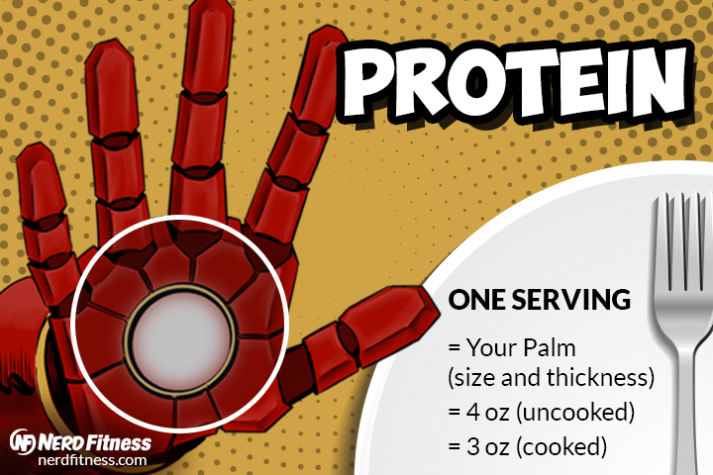
*The 4 oz serving is for an uncooked piece of meat. Cooking reduces about 25% of the weight, bringing it down to about 3 oz.
If you’re curious, here’s how much protein is in a serving of food:
- 4 oz (113 g) serving of chicken has around 30 g of protein.
- 4 oz (113 g) serving of salmon has 23 g of protein
- 4 oz (113 g) of steak has 28 g of protein.
While all of the Healthy Plate above is important, I want you to pay extra attention to your protein intake since we are trying to build muscle.
If you’re having trouble making your protein intake goals, check out our Guide on Protein Supplements for some tips and tricks to up your intake, including some awesome smoothie recipes.
This is the exact strategy I followed to lose 22 pounds and get to single-digit body fat percentages WHILE building muscle:
- Lift super heavy.
- Eat LOTS of protein.
- Reduce carb and fat intake.
If you are NOT losing weight, it means you are still eating too many calories. Keep your protein intake high, and reduce your fat and carbohydrate intake.
I cover this in greater detail in our “Why Can’t I Lose Weight?” guide.
Eventually, you’ll reach a status where there just isn’t enough fat on you to help with “Rebuild Muscle.” At this stage, you can no longer stay with a caloric deficit. You’ll need to flip to a slight “caloric surplus” to build more muscle.
Which means you’ll have to eat more.

Which brings us to our next point – how do we know if our body recomposition strategy is working? And is this the best strategy for me?
HOW TO TELL IF IT’S ALL WORKING (Continuing to Lose Fat While Gaining Muscle)

If you’re trying to improve something, it’s important to track it. This also holds true of body composition.
Most people do this by jumping on the scale. This can be “okay,” but it’s only going to tell part of the story.
If you’re building muscle while losing fat, the scale might not go down. [15]
Despite weighing the same, you could potentially have an improved physique.

That’s why in addition to jumping on the scale, I would also encourage you to take progress photos.
Take front and side photos in your mirror, wearing underwear or a bathing suit. Each week, take new photos, and record the number on the scale under the same scenario. Two forms of tracking here allow us to get the full picture.
The scale sometimes lies!
If you eat for a caloric deficit, strength train, and prioritize protein, see what happens.
You may find yourself losing some fat and gaining muscle.
If not, track each category:
- Are you really in a caloric deficit? Track your calories to find out.
- Are you lifting enough? Perform resistance training consistently and track your workouts to determine whether or not you’re progressing via increased weight or repetitions.
- Are you prioritizing protein in your meals? Track your macronutrient breakdown each time you eat.
Data can help tell the story.

…I was thinking of detailed notes.
But an android would be helpful too.
Oftentimes if you’re not seeing desired results, notes and record-keeping can help point us in the direction to make adjustments.
Test your assumptions if things don’t appear to be on track. Here’s our Guide on Tracking Fitness Progress for you to learn more.
IS BODY RECOMPOSITION THE RIGHT STRATEGY FOR ME?
It all boils down to this. As we’ve seen with the data and with real-world examples from our clients, body recomposition is indeed possible. But is it the right strategy for you? Here are some recommendations to keep in mind.
Body recomposition is a great strategy for you if:
- You are starting your fitness journey. It allows you to focus on a sustainable calorie deficit, lifting weights, and feeling good. You’re likely to see steady progress for 12-18 months without much need for deviation!
- You feel burned out on dieting. By adding in more calories and going for a moderate body recomposition strategy, you can reduce diet fatigue while still making steady progress.
- You want to maintain the maximum amount of muscle while you lose fat. Enough said.
- You enjoy it!
- You prefer an approach you can sustain for longer periods. Versus more intense fat-loss phases that you may need to cycle off of every 8-12 weeks.
Body recomposition may not be the right choice for you if:
- You want to lose the maximum realistic amount of body fat per week. From experience, we’ve seen that a lot of people who THINK they want body recomposition actually just want to lose a lot of body fat. Which is totally cool! We recommend starting with a fat loss program and likely a slightly higher caloric deficit. You can always come back to body recomposition later on.
- You need quick wins to stay motivated. Body recomposition, by definition, is a slower strategy than focusing on fat loss or muscle building exclusively, as you’re essentially dividing your attention between two goals. If you want faster results in one direction, we recommend narrowing your focus.
- You are really close to your goal body fat %. The closer you get to your goal, the harder it will be to build muscle and lose weight at the same time.
Can I Body Recomp forever?
No, you cannot lose body fat while gaining muscle forever.
When you’re first starting, focusing on body composition is a great strategy and can give you a lot of progress.
But with consistent workout and nutrition habits over many months and years, you may notice that your changes and progress slowing down or plateauing.
At this point for many, going into a more distinct muscle/weight gain phase for several weeks, followed by a fat/weight loss phase for several weeks will produce results faster than doing both at the same time.
Does that mean it’s the best course of action for everyone?
Not necessarily!
- For some, they enjoy the relative simplicity of body recomposition tactics and it’s less to mentally think about. They still feel great, look much different than when they started, and are completely content with how everything is going.
- For others, switching from weight gain/weight loss phases might be stressful and triggering, especially if they have a checkered history with their nutrition. So while distinct phases of gains and losses may work best in theory, they might not be ideal for everyone.
Choose what’s best for you!
And if you’re looking for a pro to help you navigate through all these questions and situations, check out Nerd Fitness Online Coaching! The team spends all day talking about these sorts of things. That and Super Smash Bros.
Alright, I think that about does it for this guide.
Did I miss anything? Do you have any tips and tricks when it comes to shedding body fat and building muscle?
Share it with us!
-Steve,
PS: Make sure you read the rest of the articles in our “How to Lose Weight 101” Series!
- The Beginner’s Guide to Healthy Eating
- Why Can’t I Lose Weight?
- How Many Calories Should I Eat? (Our TDEE Calorie Calculator)
- What’s the Perfect Diet for Me?
All photo sources are right here: Venting Off, Ekaterina Minaeva © 123RF.com, czgur © 123RF.com, morethanl8ve © 123RF.com, Константин Колосов © 123RF.com, Maxim Maksutov © 123RF.com, Julianna Funk © 123RF.com, jump
The post The Ultimate Guide to Losing Fat and Gaining Muscle (At the Exact Same Time) first appeared on Nerd Fitness.
]]>The post How to Get Rid of Man Boobs: Step-By-Step Plan for Reducing Moobs Quickly first appeared on Nerd Fitness.
]]>
“Can I get rid of my man boobs quickly and naturally?”
Awkward phrase? Sure.
But that’s not gonna get us to shy away from the topic here on Nerd Fitness.
We work on solutions to questions just like this with our Online Coaching Clients: awkward questions and challenging situations that are tough to talk about, but can be helped!
This is what we do, and we’re really good at it.
Today, let’s tackle the “moobs” situation head-on by covering all of the following in this MASSIVE guide:
- What are “man boobs?” (Gynecomastia vs Pseudogynecomastia)
- Can you get rid of “man boobs”?
- Can exercises target chest fat?
- The best workouts for reducing “man boobs” (Strength Training 101).
- The science of fat loss (Proper nutrition and “moobs”).
- What should I be eating to lose “moobs”?
- Does soy cause “man boobs?”
- Do I actually have gynecomastia?
- Can I boost my testosterone naturally to reduce gynecomastia?
- How to start reducing “man boobs” (Step-by-step action plan).
Okie dokie, let’s jump in!
What are “Man Boobs”?

Let’s chat about some medical definitions, because it’ll help us put “man boobs” in some proper context.
- Gynecomastia is defined as the benign growth of the male breast glandular tissue. The National Institute of Health states it’s usually caused by “increased estrogen activity, decreased testosterone activity, or the use of numerous medications.”[1]
- Pseudogynecomastia is when male breasts are enlarged by fat deposits, due to an increase in body fat which distributes itself on one’s body according to genetics.
Most men who struggle with “man boobs” or “moobs” are in this second category, and the “pseudo” means they don’t really have the condition “gynecomastia.”
There is no hormonal imbalance.
Instead, the body is just storing extra fat in the chest area.
I’ll mostly be talking about shedding body fat and building muscle to lose “moobs,” but I will also talk about gynecomastia and medical conditions later.
Next up!
Can You Get Rid of Man Boobs?
Why do some men store fat in their chest?
We all process and store calories differently in our bodies.
And how our body stores excess calories is a critical concept for our discussion on “man boobs.”
If you eat more calories than you burn, day after day, month after month, year after year, your body has to do something with all that extra energy.
If we’re sedentary, more often than not, the body will choose to store that energy as fat to be used for later.
Depending on our genetics, our body might choose to store that fat in our butt, gut, thighs, or chest.
Probably a combination of all those things.
And for some of us, a large portion of that body fat deposits itself in our chest area.
And thus, man boobs.
So, in order to start reversing the process, we need to have a two-pronged approach to tackling the “moobs” problem naturally and safely:
Exercise and nutrition.
Specifically, strength training and calorie restriction.
If you are somebody that wants EXACT instruction and a nutritional plan that is designed to help you reduce your man boobs, check out Nerd Fitness Coaching. We’ve helped people just like you do this the right way.
Can Exercises Target Chest Fat?

Fat and muscle are two different ‘systems’ in our body.
Fat sits on top of the muscle, like oil on water.
When we target a specific area for weight loss, like with a Thighmaster, all we’re really doing is exercising the muscle underneath the fat on our thighs.
And don’t get me wrong – this is GREAT (the muscle, not the Thighmaster).
And yup, any exercise will result in calories burned – which is crucial when it comes to fat loss.
However, we need to think of the other systems as well:
The fat resting on top.
So, the path to get rid of “man boobs” centers on three points:
- Eating a caloric deficit (consuming fewer calories than you burn) so that our body has to break down our fat stores (including the fat stored in our chest) for energy. You can calculate how many calories you should eat to start.
- Strength train so more calories are diverted to rebuilding our muscle mass rather than getting stored as fat.
- Strength train (again) to build up the muscle under the fat. Muscular pecs with a low body fat percentage look dramatically different than man boobs.
Here’s why: strength training preserves the muscles we have (and can help build pectoral muscles).
Our body also has to rebuild the muscle that breaks down while we exercise, so it uses any extra calories we have to do that rather than storing it as fat!
Think of it kind of like the Sorting Hat from Harry Potter (come on, this is Nerd Fitness after all).

When we strength train, our body will act like The Sorting Hat and divert calories coming into House “Rebuild Muscle” and away from House “Store As Fat.”
It’s a message we really strike home in our video for Body Recomposition:
For more, check out our guide on “Losing Fat and Gaining Muscle At the Same Time.”
With a strategy of slight caloric restriction combined with enough protein and heavy strength training, we’re decreasing the body fat on top of our muscle, while also building up that same muscle underneath.
This results in tighter skin, with less padding (fat), stretched over firmer muscles.
And boom – confidence-boosting pecs that would make King Leonidas proud!
Said another way, we’ll be coming at “man boobs” from the outside and inside.
The Best Workouts for Reducing “Man Boobs”: strength Training

If we’re currently sedentary, the best form of exercise to help build a confidence-boosting physique would be strength training.
In our opinion, strength is a foundational component of overall health.
We’ll get started in three areas:
- Build up oour pectoral muscles (chest muscles under your “man boobs.”)
- Same with broadening our shoulders.
- We can also improve our posture to make sure we stand tall and proud, puffing our chest out and pulling our shoulder blades back.
In order to accomplish each of these goals, we’re gonna focus on building up strength in our PUSH muscles and our PULL muscles.
Our first stop will be push-ups, a foundational exercise for developing upper body strength.
We show the correct way to do one right here:
I don’t care if you need to do them from your knees or doing an elevated push-up:
KNEE PUSH-UP

ELEVATED PUSH-UP

We all start somewhere, and the name of the game is progressive overload – getting stronger with each workout!
In addition to the push-up, let’s consider the following as the best 5 Advanced Chest Exercises.
These are the types of exercises we build into the workout programs for our Coaching Clients looking to reduce chest fat and build up muscle in that area:
#1) Bench press (barbell or dumbbell).

If one piece of equipment is visually associated with a fitness gym, it would be a bench press. If you’ve never used one before, check out our guide on using a bench press safely right here.
#2) Incline bench press.

We can also work on an incline bench press to develop a more rounded-pectoral muscle that targets your upper chest.
#3) Overhead presses.

Not only can our pectoral muscles help push forward, they also get worked out when we do an overhead press (though much less so than the bench press variations.)
Varying chest exercises is a good way to help attack all different sides and parts of our chest and build well-rounded pectorals.
Here’s a dumbbell variation if you can’t train with a barbell yet:

#4) Bodyweight Dips (ADVANCED)

Once we start to develop some serious strength, we can start to level up your advanced bodyweight training with bodyweight dips!
#5) Dumbbell Chest Fly (ADVANCED)
The dumbbell fly is another great exercise that targets the chest. This is one you want to make sure you do with good form. Lie on a bench like you are about to do a dumbbell bench press (but you’ll want to use MUCH lighter weights to start.) Keep your elbows slightly bent and your chest puffed up. Reach to the sides until you feel a great stretch RIGHT in the chest muscle, and then come back to the starting position.
As we cover in our “how to build your own workout” guide, make sure to do a push exercise in every workout to start building up pectoral muscles.
Again, start with push-ups.
Start doing them today.
Again, if you can’t do a regular push-up, a knee push-up is totally fine.
Just do them.
After you get cozy with push-ups, move onto the above advanced moves or follow some of the following workouts:
I asked the male members of the Nerd Fitness Rebellion about man boobs, and many have reported improving their appearance with these pectoral exercises.
Outside of improving man boobs, strength training will make every other aspect of your life better.
Bringing groceries in from the car, doing that thing that consenting adults do, and defending yourself against ninjas will all be much easier after strength training.
Now, I’d be remiss if I didn’t include two other exercises that can change your life:

These two basic barbell movements are the most ‘efficient’ exercises at building strength and burning fat.
They recruit your central nervous system and every muscle, joint, tendon, and bone in our body to get stronger.
In fact, if you could only do 4 exercises for the rest of your life, I would say:
Show me somebody who is super strong at those four movements, and I’ll show you somebody who has a great physique.
Seriously, don’t neglect those PULL muscles!
This exercise might seem counterintuitive: why work on your back muscles if we’re trying to build up the muscle in our pecs?
Balance and posture.
By building strength in our PULL muscles, we strengthen and tighten our back muscles. This will naturally cause us to pull our shoulder blades back and down into proper position, and give us a better posture.
If we ONLY do chest exercises, we’re more likely to get out of balance, which leads to contracted chest muscles, hunched shoulders, and poor posture.
Here are some options for building up our back muscles and improving our posture:
#1) Dumbbell Rows


#3) Pull-ups (here’s how to do proper pull-ups)
And if you can’t do a pull-up yet, here’s a great pull-up progression that will show you how to do assisted pull-ups to build up strength, like so:

Too long didn’t read: get strong, and your life will get better.
Build muscle in the right places, and it can help you reduce “man boob” problems.
Now, if you’re all:
“Steve this sounds awesome. I want to strength train, but damn man. I’m already self-conscious enough about my man boobs.
How the hell do I get enough confidence to go into a gym when I don’t know what I’m doing!”
Great question.
If you want expert guidance, form checks, and a custom build workout (and nutritional guidance) to help you transform your physique, we have a private, 1-on-1 coaching program that spurs nerds into action.
Also, you don’t even NEED a gym to train (it might sketchy thanks to the pandemic). Here’s exactly how to start working out from home.
Okay, we talked about exercise.
And I mentioned “nutrition” as a MAJOR component when it comes to weight and fat loss.
80-90% of “how to get rid of man boobs” will rest on how we answer the question: “What do I normally eat?”
The science of fat loss (Proper nutrition and “moobs”)

TOUGH LOVE ALERT:
I can almost guarantee that your man boobs are NOT a result of a slow metabolism or genetics (outside of how your body stores excess body fat).
It’s due to the fact that you have been consistently overeating, day in, and day out, for years.
Once you’re done being mad at me and defensive about this, you’ll realize this is great news!
Why? Because it’s fixable.
You are not broken.
You simply need to change how you deal with food.
To do that, we’re going to focus on sustainable changes.
After all, temporary changes create temporary results.
And we want to get rid of man boobs permanently.
So, in order for us to lose body fat, we need to expend more calories than our body consumes, consistently.
Let’s put some numbers to this: 3,500 calories equals roughly one pound of fat.
So if we do the math here:
- There are seven days in a week.
- If we want to lose one pound of body fat in a week (a worthy, sustainable goal for some), we need to create a caloric deficit of 500 calories a day.
- We can do this by consuming 500 fewer calories, burning 500 more calories, or a combination of the two.
Remember this: a daily 500-calorie deficit compared to how we normally eat to lose a pound a week.
(Note: in our coaching program, we’ve found clients have the most success targeting 0.5%-0.75% of their body weight per week as a fat loss goal. This is fast enough to see consistent results and stay motivated, while not SO restrictive that it’s completely unsustainable.)
What does 500 calories look like?
Here are two examples:
- The number of calories found in a Big Gulp of Mountain Dew.
- An estimate of the calories required to run five miles.
Hopefully, those two dots above made your head explode.
“Steve, you’re saying that in order for me to counteract just sipping on a Mountain Dew while owning noobs in Fortnite, I’d need to run 5 miles?
I haven’t run a mile since gym class. And that was 15 years ago.”
Yup.
Nutrition is 90% of the equation when it comes to weight loss.
NINETY. PERCENT.

Okay, I don’t actually know the exact percentage, but 90% is dramatic enough.
I hope to get you to realize that changing your nutrition is the most important thing you can do to reduce “man boobs.”
Sure, exercise is important.
However, when it comes to creating a caloric deficit, it’s much easier to decrease calories consumed vs. increase “calories burned.”
Put a different way: would you rather pour out that Mountain Dew, or run five miles?
Let’s tie together our discussion on “man boobs” with our philosophy on fitness: we’re eating too much, and our body is choosing to store these calories wherever it sees fit.
Unfortunately in this situation, it’s choosing to store them in our chest area.
We can’t change the past.
But we can change your future…and you won’t even need a wacky scientist.

This is why we’re gonna reverse the trend: eat a caloric deficit, consistently, until we reach our goal. Then learn how to eat AT our caloric needs to sustain it for the long run.
Over time, our body will respond by burning fat from certain areas, in a certain order (again, this is out of our control).
As our body fat percentage drops far enough, it should start to remove the body fat from your pectoral area.
We have two paths forward.
PATH ONE: Count calories. If you’ve never done this before and are interested in trying, we recommend recording every meal and morsel for 3-5 days to start. (We can use a food journal, a calorie-counting app like MyFitnessPal, etc.
It’ll teach you a lot about the food you eat, and yourself. From there, calorie counting can be a viable strategy for SOME to continue to monitor and dial in their caloric intake. For about 25% of our coaching clients, this is the process that works for them.
As for how many calories we SHOULD eat, see our Total Daily Energy Expenditure (TDEE) Calculator.
It works, but boy is it challenging.
PATH TWO: follow our “simple plate” approach from our Healthy Eating Guide. Learn portions sizes, and start making slightly better choices. Focus on getting enough protein and veggies and cut back on liquid calories. Over 60% of our coaching clients find this method to be more sustainable and successful for them in the long-run.
I know that overhauling one’s diet is easier said than done.
But it’s time to take a proactive approach to nutrition.
You’re reading this article because man boobs are a real problem for you – educate yourself on what you’re eating and work on cutting back on the calories!
And that’s what we’ll cover in the next section: what foods to eat that will help you reduce your calories without you being miserable.
What should I be eating to lose “moobs”?
The Nerd Fitness philosophy on what constitutes a ‘healthy food’ can be written like this:
“Foods I can eat frequently that give me enough fuel to get through the day AND don’t make me miserable.”.
I lay it all out in our Beginner’s Guide to Healthy Eating, but this generally equates to foods like:
- Protein like poultry, meat, low-fat dairy, and legumes.
- Fruits and vegetables.
- Healthy carbohydrates like rice and quinoa.
- Healthy fats like almonds and olive oil.
- Occasional full-fat cheese and dairy.
These are the types of foods that form the foundation of a well-balanced diet.
Do you know WHY these types of foods help with weight loss?
Because if we stick mostly to this list, we’ll likely create a caloric deficit naturally.
But why tho?
The fine folks at WiseGEEK did an awesome post where they took pictures of what 200 calories of a certain food look like.
200 calories of broccoli gets you enough broccoli to fill up an entire plate:

Or half a Snickers bar:

Yeah. And who eats half a Snickers and says “I’ll save the other half for later?”
Literally nobody.
If we want to create a caloric deficit consistently, focusing on foods that give you a ton of bang-for-your-buck from a nutrients vs calories standpoint is the answer.
Of course, I know a Snickers bar is way more delicious than broccoli – it was designed in a lab by scientists to be AMAZING!
And I’m not gonna tell you to never eat a Snickers ever again either.
Instead, we need to start being proactive about our food choices. If we’re gonna eat a Snickers, we better damn well be planning for that by reducing our calorie intake elsewhere.
And if the scale isn’t budging, and our man boobs aren’t getting smaller – we’re still eating too much!
Should we do the Mediterranean diet? Keto? Vegan?
Maybe!
They all follow the same premise: by changing the foods we eat, we’re more likely than not to eat a caloric deficit. Certain people respond better to certain diets than others.
I personally follow a mental model diet, summarized here:
- Minimize and plan for processed food – they’re designed for us to overeat them. Take a look again at that Snickers bar. Do you really think you’d only eat half of one to stick to 200 calories? Of course not.
- Eat veggies. Vegetables are nutrient-dense and light on calories. Because of all the fiber, they are also tough to overeat. Imagine eating all that broccoli. Are you going for seconds? Probably not. So eat your veggies to help keep you full. Here’s how to make vegetables taste good.
- Avoid liquid calories. Cut back dramatically on soda, juices, smoothies, and any beverage with calories. Even most coffee orders (with sugar, cream, etc.) have a ton of hidden calories. Stick to water, and unsweetened tea or black coffee. Here are our thoughts on diet soda.
- Prioritize protein. Our body uses protein as the building block of muscle rebuilding. Outside of repairing our body, protein will also work to keep us full and satiated: 400 calories of chicken will leave us wayyy more full than 400 calories worth of Gatorade.[3] If you prioritize protein on your plate, you’ll be doing a lot of the heavy lifting on proper nutrition. Some great sources of protein include chicken, eggs, beef, pork, fish, nuts, legumes, quinoa, and most dairy products. Check out our Guide to Protein to measure how much protein you need every day.
These four points will help you on your journey to create a caloric deficit.
I know this is much easier said than done. After all, everybody knows they should eat more vegetables, and yet 70% of the country is overweight.
Clearly, there’s more happening here than just “I need willpower and I need to try harder!”
If you’re struggling with portion control and challenges, jump fully into the NF community.
We cover human behavior and psychology to help you:
- Improve your environment.
- Fix your habit-building.
- Surround yourself with people that make you better (including our free private community).
We’ve helped thousands of people like you here at NF, and we really focus on nutrition.
As we said, it’s 90% of the battle!
It’s why we created our 10-level nutritional system. Each level gets a bit more challenging and healthier, but you can progress at your own speed to make your changes stick!
I’ll send you the 10-Level Guide when you sign up for our newsletter here.
Does Soy Cause Man Boobs?

You don’t have to search far on the internet for the advice “avoid soy because it causes man boobs.”
It’s repeated so much, it’s assumed to be fact.
Is it?
The definition of gynecomastia (medical condition of man boobs) mentions “increased estrogen activity” as a major cause.
So when people say stay clear of soy, they’re worried about its impact on hormones like testosterone and estrogen.
Why the concern?
It comes down to a compound found in soy called “isoflavones.” Isoflavones are a type of phytoestrogen, which acts a little like estrogen, the central female hormone.
“Phyto” is derived from Greek and means “plant.” “Estrogen” is estrogen. So phytoestrogen more or less means plant-derived estrogen.
The fear of isoflavone rests with our bodies using this plant-like estrogen as actual estrogen. A report from Frontiers in Neuroendocrinology found that this is potentially possible.[4]
I should now note, we are about to wade into a controversial subject.
We’ll be careful and rely on good old-fashioned science and studies for guidance.
However, sometimes science can point us in a couple of different and contradictory directions. When this happens, it’s important to acknowledge the uncertainty.
Compounds in soy may act like estrogen in the body. Does this apply to men though? And do they cause “man boobs?”
A 2005 study out of The Journal of Nutrition did find a relationship between soy intake and hormone levels in men.[5] However, they concluded these to be “minor.”
In 2010, Fertility and Sterility tackled the question on whether soy had “feminizing effects on men.”
They found it didn’t.[6]
Their report stated:
Neither isoflavone supplements nor isoflavone-rich soy affect total or free testosterone levels.
The journal concluded:
There is essentially no evidence from the nine identified clinical studies that isoflavone exposure affects circulating estrogen levels in men.
Case closed?

Probably, but I’d be remiss not to mention the following:
There is one documented case published in Endocrine Practice, where a man may have given himself gynecomastia by drinking three quarts of soy milk a day.[7]
His gynecomastia went away when he stopped. Granted, this is anecdotal evidence, which is far from proof.
However, it is interesting and worth noting to round out this discussion. And as mentioned earlier, the ability for phytoestrogen to act as actual estrogen does seem possible…
“Steve, Just tell me: Should I ditch soy to ditch my man boobs?”
Well, as with anything, quantity and context matters. Virginia Miller, an estrogen researcher at the Mayo Clinic, told a Vice journalist:[8]
The amount of phytoestrogens in various soy products varies by process method.
Dr. Miller didn’t think it was too problematic to eat soy, specifically mentioning that:
Eating tofu is probably OK.
Interestingly, Miller suggested that BPA found in plastic is more harmful to our endocrine (hormone) system than eating or drinking soy.[9]
Confusing stuff.
In general, the consensus seems to be that as long as you don’t binge soy products, the amount of phytoestrogens found in a normal diet is fine.
If you have the actual condition of gynecomastia, soy is unlikely to be the root cause.
As more and more research is being done on this subject, this answer could change.
My opinion: this is a tiny piece of the puzzle…
…not the whole picture.
If we’re overeating food every day, worrying about the soy we consume is missing the forest for the trees.
That’d be like…putting on a long sleeve shirt instead of a t-shirt for added protection, before driving 50 miles an hour into a brick wall.
Instead, maybe focus on wearing a seat belt, or better yet – not driving into the wall in the first place!
I swear that analogy made sense in my head before I typed it out.
Anyways – back to real specifics.
Here is the Nerd Fitness philosophy on soy: focus on total calories consumed and get that dialed in for consistent caloric deficit.
Only THEN, as our body fat starts to decrease, and we’re analyzing how our body responds to any and ALL types of food, see how our body responds to removing soy from our diet.
Want to have an expert guide you on this process? A fitness partner to help guide you on nutrition, including eliminating and then re-introducing certain foods? You can by checking out Nerd Fitness Coaching.
Do I actually have gynecomastia?
The only way to really know if you have gynecomastia is to go to a doctor.
They’ll be able to tell you (often with an ultrasound) if it’s a glandular breast enlargement or just fatty tissue.
They might also do some blood tests to check testosterone levels and female sex hormones like estrogen.
If you have an imbalance, gynecomastia could be a side effect. They’ll know for sure and can prescribe a treatment.
Also, they can verify that something very serious isn’t going on. In very rare cases, male breast enlargement can be a sign of cancer. Yes, men can get breast cancer.[10]
It should be noted: obesity itself is tied to increasing the development of real gynecomastia.
Excessive fat stimulates the body’s production of estrogen, spurring the growth of actual breast tissue.[11]
Said another way:
Pseudogynecomastia can turn into actual gynecomastia.
If you are diagnosed with gynecomastia, it’ll be between you and your doctor as to the next steps. I’ve seen men take one of three paths, as I’ve read anecdotes from our private support community for Nerd Fitness:
- Men who had elective surgery (liposuction in some instances and skin tucks) to remove the fat due to gynecomastia. They are thankful for no longer being self-conscious about their chest areas. This is not an option for everybody for various reasons.
- Others have worked hard to reduce their man boob size through exercise and nutrition.
- Some have elected to not treat gynecomastia, or are working to reduce the fat around their pecs through diet and exercise before deciding what to do next.
If you’re concerned with “man boobs,” weight management is the path of action we’d recommend, whether you’re facing either gynecomastia or pseudogynecomastia.
Reducing your body fat percentage can help keep your hormones in balance.
One important note here. Your unique situation is just that: unique.
I know many men who have treated pseudogynecomastia with diet and exercise, and I know others who are VERY thankful they had surgery to treat the symptom and are much happier as a result.
No judgment here. You do you, brother.
At this point, I bet you have an additional question: “Can hormone balance be affected in the opposite direction? By increasing testosterone?”
Is there a way to boost my testosterone naturally?

If you do suspect you have a hormonal imbalance, speak with your doctor. They can run tests and tell you exactly what is going on, why, and how to treat it.
I will not be digging into medically supervised testosterone therapy (which is above my pay grade, and between you and your doctor), but here’s our guidance on naturally boosting your testosterone levels:
#1) Strength training. I know. A few sections ago I devoted an entire area to strength training.
However, if you are looking for a natural way to boost testosterone, strength training would be a good way to go about it.
One 2017 study found, that although temporary, testosterone levels were shown to: “acutely rise immediately following an acute resistance exercise bout.”[12]
Because of the short-term increase, consistency is key with resistance training and testosterone levels. That’s likely why “regular exercise” has been linked with increased testosterone overal.l[13]
#2) Stress. Cortisol is a hormone that is promoted by stress and reduces free testosterone levels (in addition to signaling for your body to store fat).[14]
The more stressed out we are, the lower our testosterone will be. What’s a cure? Being mindful.
Meditation practices have been shown to help control cortisol levels.[15] Want to start a mindfulness practice? Scope out our Nerd’s Guide to Mindfulness to get going.
Do you know what else is connected with higher cortisol levels and increased stress? Lack of sleep! If this is you, shut off Netflix and get to bed sooner.
#3) Overtraining. There can be too much of a good thing. Studies have found that both professional basketball and soccer players drop their testosterone levels by the end of a season.[16]
Which makes sense.
Tons of activity in a short amount of time gives no time to repair and heal. The same phenomenon has been found in ultra-marathoners.[17][[17]]That study on ultra-marathoners is right here.[[17]. Make sure you get plenty of sleep and schedule rest days.
#4) Eat red meat. Red meat is a great source of the amino acid carnitine, which has been linked to improved fertility.[18] Plus, it’s a good source of zinc, which has also been shown to help regulate testosterone.[19]
#5) Your results may vary. My friend Brett over at Art of Manliness did a 90-day experiment in which he doubled his testosterone levels through diet and strength training.
To be honest with you, even if you don’t have low testosterone levels, you should strength train, be mindful, and prioritize rest.
And maybe even eat a little red meat.
And yes, I read that study that says red meat will kill you. I don’t agree with the fear-mongering.[20]
If you want help with strength training, nutrition, or even starting a mindfulness practice, check out Nerd Fitness Coaching! We help men (and women) level up their lives by providing actionable goals and accountability.
How to Start Reducing Man Boobs

So you have pseudogynecomastia.
And you’re interested in trying to do this the old-fashioned way before going down the route of surgery.
This would be my recommended path to everybody, though remember I’m not a doctor and I would recommend working with your doctor to put a plan in place together.
OUR NON-DOCTOR ADVICE FOR A DUDE TRYING TO GET RID OF MAN BOOBS NATURALLY:
- Take front and side photos without a shirt on today. This will help give you a frame of reference as you move forward with your changes. Pictures will round out your story.
- Consider a tape measure and take weekly chest measurements too. Just be consistent with how you take the measurements and look for overall trends! Here’s our Guide on Tracking Fitness Progress.
- Follow the above nutritional guidance and workout routine for the next month. Remember, I gave you four tips for healthy eating. If you requested our 10-Level Nutrition Guide, it’ll help make those suggestions permanent. Plus, I want you to start doing push-ups (on your knees is a great start). Do it immediately. It’ll help prep you for those Advanced Chest Exercises I talked to you about.
- If the scale is dropping, and your photos are showing “moob” improvement, keep it up! As I said earlier, consistency is the name of the game here at Nerd Fitness. “Slow and steady” beats “fast and quitting” every time.
- If you want to talk to a doctor to see if anything can or should be done about it, go for it! Medical advice is generally good advice. Bonus points if you find a doctor who strength-trains and seeks to treat through nutrition and exercise first!
I do want to stress, that many male members of the Nerd Fitness Rebellion have reported improving their “man boobs” through the strategies listed in this article.
We are dealt a certain hand from the genetic lottery: whether we gain muscle quickly or slowly, whether we lose our hair or not, and whether we store fat in our legs or in our chest.
We can get mad about it, or we can play the hand we are dealt.
Until somebody develops robot legs, I’m not growing any taller.
However, let’s not justify our internal excuses, or throw ourselves too big of a pity party.
What we do with our genetic fate, is completely up to us. And we have hundreds of thousands of people in the Nerd Fitness Rebellion who have overcome shitty genetics to transform themselves dramatically.
If you want 1-on-1 help to transform yourself, we got you!
We come in all shapes and sizes: you do you.

The goal of this post is educational. To teach us how our body stores fat, and what can or cannot be done about it.
It’s more than okay to love yourself and also want to improve your physique.
Body positivity and wanting to look better are not mutually exclusive.
We’re all works in progress, and that’s great.
If you want to use this post to spur you to change, like cleaning up your diet or lifting some weights, awesome!
I’m glad Nerd Fitness can help lead you into action:
- Reduce your body fat percentage through nutritional changes (which includes eating a caloric deficit).
- Strength train to increase the amount of muscle you have, increase the “calories burned” portion of the weight-loss equation, and increase your testosterone.
- Work with your doctor if you are reducing your body fat but not seeing any changes in your chest area – you might actually have a medical condition called gynecomastia.
Want help knowing exactly how to progress from here?
I have MULTIPLE options for you. Pick the path below that best aligns with your goals and timeline:
1) If you want step-by-step guidance on how to lose weight, eat better, and get stronger, check out our killer 1-on-1 coaching program:

2) Join the Rebellion! We need good people like you in our community, the Nerd Fitness Rebellion.
Sign in the box below and not only will you receive our free weight loss guide, but our step-by-step plan for starting a Strength Training practice:
I know it’s easier said than done to say “f*** the haters,” but seriously, f*** the haters.
Take your shirt off at the beach: you deserve to enjoy the sun and sea like everybody else.
We’re all a work in progress, and I hope this post helps you continue to work on yours!
-Steve
PS: No seriously, f*** the haters:

###
All photo sources can be found in this footnote right here [21]
The post How to Get Rid of Man Boobs: Step-By-Step Plan for Reducing Moobs Quickly first appeared on Nerd Fitness.
]]>The post The 5-Step Guide to Restarting Your Fitness Journey first appeared on Nerd Fitness.
]]>
Did you know today is National Respawn Day?
This is definitely true and not a holiday that I just made up.
Okay, I did make it up, and it doesn’t matter what day it is – you’ve decided you want to try again (that’s awesome!  .) And you want to find a way to make changes that stick this time.
Luckily, whether this is the first time you’ve had to respawn or the 50th, you’re in the right place.
I’m going to share the same step-by-step strategy we’ve used to help 15,000+ nerds restart their fitness journey in our Coaching Program, and we’re gonna have a tiny bit of fun along the way.
Here’s what we’ll cover:
- Why It’s Okay to Start Again
- Restarting Step 1: Forgive Yourself
- Restarting Step 2: What Went Wrong?
- Restarting Step 3: Change a Variable
- Restarting Step 4: Respawn
- Restarting Step 5: Supercharge Your Results
- Get Back in the Fight (Next Steps)
Why It’s Okay to Start Again

So you already bailed on a goal or habit or routine this year.
We all start with hopes and dreams for what we can accomplish, but then we encounter this ugly thing called “reality.” We find out that maybe we picked the wrong goal, or we tried to do too much, or life managed to get in the way.
This is amazing news!
As the saying goes, “Success is moving from failure to failure without a loss of enthusiasm.” So, congrats for already finding a strategy that doesn’t work for you right now.
Let’s get to work on fixing that!
First step’s first…
STEP 1: FORGIVE YOURSELF

When we stumble at a task or goal, that voice in our head will very quickly point out all the things we’ve done wrong or how we’ve screwed up.
We might call ourselves a nasty name, or berate ourselves for not having enough discipline.
There’s another way to think about this:
- You discovered a strategy or tactic that doesn’t work for you! For example, if you went Keto and bailed, great! That’s a diet that doesn’t work for you. I personally love carbs, so Keto sounds terrible to me too!
- Treat the voice in your head like a roommate. You just both happen to occupy the same brain. Just because our brain thinks something doesn’t mean it’s true! I like to imagine my thoughts came from Chaz, a weird roommate. He means well but he doesn’t always know what he’s talking about. Also, he has a ferret.
- It’s also possible the strategy or tactic is still USEFUL, just in a different context. For example, if you tried calorie counting, and it didn’t work, that doesn’t necessarily mean we have to throw out that tactic FOREVER. But we need to figure out why it wasn’t a good fit for us RIGHT NOW – so we can learn from it.
And you’re ready to try again.
This is amazing and should be celebrated.
As NF Coach Matt explains in the video below, “self-compassion” is really important when attempting to fulfill New Year’s resolutions:
STEP 2: ASK WHAT WENT WRONG?

Great! That’s information we can use, my scientist friend.
#1) You built an idealized goal for a romanticized view of life:
Life is chaos, and we all have a lot going on. When we expect to have a beautifully organized schedule, our kids won’t get sick, and work won’t run late…we’re setting ourselves up for failure.
And when we set our expectation at “perfect adherence to the plan,” one missed day can be enough to derail our progress completely.
Fortunately, as John Steinbeck wrote, “Now that you don’t have to be perfect, you can be good.” Perfection is a trap, so we’re instead going to focus on being pretty good, most of the time.
We need a plan that fits into the chaos that is life, and is not built for a perfectly clear schedule! Those don’t exist.
#2) You tried to change ALL the things:
- Your goal was 1,800 calories a day instead of your normal 3,000.
- You tried to run 7 days a week when you don’t exercise at all now.
- You said you were going to write 5,000 words a day but don’t write normally.
Instead of changing all the things completely or not changing anything, what if we changed a few things, a tiny bit?
We’re never going to get everything done, certainly not all at once. So like a video game, we need to stop trying to fight 10 level-100 dragons at the same time when we’re a wimpy level-1 wizard!
We need to pick ONE target, that’s our level, and then as we level up and get stronger, tackle bigger monsters.
So, let’s try to do less with our next experiment, okay? It’s better to laser-focus on building ONE new skill than it is to attempt to change so many things at once that we end up in the same place we started!
STEP 3: CHANGE A VARIABLE IN YOUR EXPERIMENT
For your next attempt consider adjusting one of the following:
Did you enjoy the exercise you attempted? If you discovered that you hate running, great! Never do that again. “Exercise sucks,” so I would pick something that sounds more fun.
Did you try to exercise 5 days a week for 60 minutes a day? What if you instead decided to go for a 5-minute walk every day to practice the habit first, and then increased the difficulty?
#2) Try a substitution rather than addition:
ADDING a brand new exercise routine into an already busy schedule can be really challenging. The same might be true with severely restricting your calories, which can be really uncomfortable and make you hangry and angry.
Let’s try this instead: Substitution! Here are three examples:
- Making healthy swaps with our diet: How you eat is 80-90% of the weight-loss equation, and you’re already eating every day. So focus on substituting a vegetable for fries once a week, or swapping sparkling water for soda. You can also keep a food journal and change up your breakfast twice a week.
- Temptation bundling: combine an exercise/activity you want to do with an activity we already love: Listening to a great audiobook, but only when we’re out for a walk or on the treadmill, or joining a friend on a bike ride (to a winery or pub!).
- Do ONE activity mindfully every day: meditation is amazing for developing the skill of being present and cultivating awareness, but it might be tough for us to set aside 20 minutes to sit alone with our thoughts. So why not practice being mindful during something you’re already doing! Practice mindfulness while brushing your teeth or washing the dishes in the sink. No extra time required, all of the benefits!
#3) Adjust your “win scenario”:
I get it. You were able to train in your home gym for the first few weeks of this year, going for at least an hour.
But THEN…work got busy. And you only had 30 minutes, which wasn’t enough time to get through your workout. So why not set the win scenario at “30 minutes,” or “15 minutes,” or “1 exercise”? Lower the bar!
This is not an on-off switch. It’s a dial that we can turn UP or turn DOWN based on how busy our life is that day:

We can stop asking, “Do I have time for my workout” and instead ask “What workout do I have time for?”
There’s nothing that says “a workout must be 60-minutes in a gym.”
A 5-minute walk with your kids. A 10-minute circuit workout between Zoom calls.
It all counts!
Feel free to turn the dial all the way down when life gets really busy, just don’t turn it off.
STEP 4: RESPAWN and try again


This next attempt might be the one that works for you too!
Keep trying differently, keep failing differently.
You can do this!
STEP 5: SUPERCHARGE YOUR RESULTS

For more strategies here, check out our guide Tracking Your Fitness Progress.
We have a free Nerd Fitness Facebook group with thousands of people ready and willing to support you!
As Coach Matt explains below, sometimes “outsourcing” help can be a real game-changer when trying to get in shape (or back in shape):
GET BACK IN THE FIGHT


For #5 (“Supercharge your results”), I have two perfect ways to help you respawn today:
Consider our Online Coaching program, and I also send out a free newsletter twice a week to help you stay motivated and entertained.
It’s the best newsletter in the galaxy, I promise you.
For the Rebellion!
PS: If you want more tips and tricks on how to stick to your goals this year, check out 5 Hacks to Effortlessly Build Healthy Habits in 2024.
###
Photo Citation: Oh My Goodness! Shut Me Down, The Iron Giant, “Hello, old friend. Is he ready for me?”, Happy Halloween!!, At the blacksmith’s (Part 2), Medieval Blacksmith
The post The 5-Step Guide to Restarting Your Fitness Journey first appeared on Nerd Fitness.
]]>The post How to Run Your Very First 5K (without getting injured!) first appeared on Nerd Fitness.
]]>
Looking to run your first 5K? You’ve come to the right place.
In today’s guide, we’ll cover common questions – and 5 mistakes – about running your first 5k, and avoiding all the mistakes most people make:
- Why are 5k Training Plans so popular?
- Analyzing popular 5k Training Plans
- What is the best 5k Training Plan?
- “Will I lose weight running a 5K?” (Mistake #1)
- “Do I even like running?” (Mistake #2)
- “Am I healthy enough to run a 5K?” (Mistake #3)
- How to start (5K Schedule and PDF)
- “How do I not hurt myself running a 5K?” (Mistake #4)
- 10 tips and tricks for running a 5K
- “What do I do after Running a 5K?” (Mistake #5)
- “What if I own a futon? Can I still do Couch to 5K?”
Why are 5k Training Plans so popular?

To make sure we’re all talking about the same thing, a “5K” is a race that’s 5 kilometers long (roughly 3.1 miles).
Running 5Ks exploded in popularity thanks to “Couch to 5K,” a free program that takes people from their couch to running a 5K race in 9 weeks.
This running program was invented by Josh Clark of CoolRunning WAY back in the day.
It has since been co-opted and copied by every running blog out there, so we’re going to be referring to a generic “5K Training” program when we talk about it.
(When people ask the question “How long does it take to complete Couch to 5K,” it really depends on which program they pick.
It might be 6 weeks, or 12 weeks, or 9 weeks. The original Couch to 5K plan created by Cooling Running took 9 weeks).
We have tons of clients who come to us wanting to complete their first 5k walk or run.
“Steve, I’m intrigued. Why are 5K and 5K training plans SO DANG POPULAR?”
#1) They’re simple and clear.
Print out a PDF or download an iPhone app and for the next 6-12 weeks (depending on which plan you pick) you simply do what it tells you:
Today, do this.
Tomorrow, do that.
Repeat.
We’re all busy. Most of us lead hectic lives. And programs that tell us EXACTLY what to do allow us to follow instructions without needing to figure it out ourselves.
Not that we nerds overanalyze things to the point of giving ourselves anxiety attacks…
#2) Many believe running = weight loss.
If you’re brand new to health and fitness, and you’re trying to lose weight, you’re most likely overwhelmed by what you should start with and how you should train.
Are you gonna go sign up for a gym membership, hire a trainer, and start doing squats and deadlifts?
As much as I would WISH that was the answer (it’s probably the fastest path to changing one’s physique), it’s often a bridge too far for many folks.
So a majority of newbies equate running with weight loss (which MIGHT be true, but MIGHT not, I’ll explain later), and decide to start with a walk or jog around the block.
And then they pick a goal like “Run a 5K” because…
#3) Running a 5K feels approachable.
Running a 5K feels like an obtainable goal, and thus picking a “5K training program” is the next logical step.
Most are free programs (or inexpensive apps) that feel very approachable.
Weight training programs like P90X and Insanity are designed to appeal to people who consider themselves hardcore (whatever the hell that means).
5k Training Plans appeal to people who are overwhelmed at the idea of doing P90X or Insanity or mustering up the courage to go to Crossfit.
5k plans lower the barrier to entry. They make you think “maybe I can actually do this…” which is the most important part of any fitness journey: starting.
#4) Everybody wants to “have run a 5K.”
If you’re new to health and fitness and working on setting a good obtainable goal, “run a 5K this year” is a great place to start.
- It’s a short enough distance that with some training you can pull it off, even if you have to walk some or all of it.
- There are 5K races every weekend, many of which raise money for charity or are themed in a fun way.
- It’s an amazing activity to do as a group with friends.
- Humans are wired for achievements, progress, and gratification – 5Ks are perfectly designed for that.
So in completing a 5K, you train and get to see yourself progress weekly, you get to finish a race feel a sense of accomplishment, and you go home with a medal you can hang on your wall reminding you of the proud moment.
Plus, it might get you in shape!
(Maybe…we’ll explore it in just a moment.)
This sense of progression is one of four key elements we’ve found in our 1-on-1 Online Coaching Program that helps people stick with a program long enough to see results.
Analyzing popular 5k Training Plans
Here are the two most popular types of 5K Training plans in a nutshell:
1) Interval Training
Many programs use a concept called interval training – moving at different speeds throughout a running session. For example, your running workout might consist of 30 seconds of jogging, followed by 2 minutes of walking, repeated 6 times.
Varying your pace this way does a few things:
- Helps push you outside your comfort zone. You’re able to push harder for short ‘sprints’ within an interval training workout, which allows you to work at a higher level of relative intensity.
- Keeps workouts short and sweet. Because we are operating at a higher intensity level, interval workouts tend to be shorter than their steady-state cardio counterparts.
- Teaches you what it feels like to run at different paces and speeds. Could you train at different paces and speeds using steady-state cardio? Sure. However, the variance in speeds with interval training tends to help beginners experience different pacing structures.
- Improves your general conditioning and endurance. Your heart and lungs have to adapt to the various levels of strenuous activity (and get stronger/healthier as a consequence.)
- Introduces a bit of novelty into your training – which can help you stick to it. When people first start a program, often the most important factor is sticking with it consistently to see results.
Over the weeks, 5K Programs slowly ramp up the amount of time you spend running and cut back the time you spend walking until you’re at the point where you can actually run a 5K without stopping. (At least, that’s the idea!)

However, there are limitations to a training program based solely on interval training:
- Interval training causes more fatigue. Because it’s done at bursts of higher intensity, interval training can cause more fatigue. This works great if you are short on time, but it’s important to know it’s a trade-off of being able to train MORE (which has its own benefits.)
- Preparing for race day. While you can absolutely use intervals at your 5k race, if you want to walk or run the race at a consistent pace, doing more training that mimics that exact pace is beneficial.
- Enjoyment. You may find you just don’t enjoy interval training as much as other forms of training. That’s a completely valid reason to do something else.
As a general rule of thumb, we’ve found interval 5k plans to be great for beginners, and for those short on time to train throughout the week.
As you get familiar with endurance training, we recommend including some longer runs in your training. Which conveniently leads us to our second type of 5k plan:
2) Steady-state Training
In a steady-state training plan, you’ll be given a specific time or distance to go out and walk or jog. An example would be “Jog for 20 minutes” or “Walk 1.5 miles.” Your goal is to maintain about the same pace for the duration of your workout that day.
Having a steady pace like this does a few things:
- Improves your general conditioning and endurance. Yup, just like interval training, steady-state training is great for general conditioning and endurance. (* This study showed steady-state and high-intensity interval training to be equally effective for endurance. https://www.ncbi.nlm.nih.gov/pmc/articles/PMC4657417/)
-
- Easier to track pace. Since you are running at a consistent pace for the duration of your training, it’s much easier to track your pace and see improvements in your speed over time.
- Scales to longer distances. Because you can train at a lower relative intensity than interval training, you are also able to train longer distances and times. As you get to a more intermediate/advanced level of training, adding more total time spent training is a key component of progressing further!
- Easier to stay in Heart Rate Zones. Heart rate training is another effective way to monitor your intensity and improve your endurance training. By maintaining your heart rate in a specific “zone”, you can target the appropriate intensity for your session. Because interval training is start/stop, it can be much harder to regulate your heart rate in the time given.
Steady-state 5k plans can be great for beginners who enjoy them more than interval training, and for intermediate and advanced trainees who need to work with longer distances or heart rate training to see further improvements.
What is the best 5k Training Plan?
The simple answer: the one you actually stick with!
I know, I know, that’s not the answer you are looking for. But don’t worry, we can do one better! Here are the exact criteria one of our coaches uses to evaluate programs for their clients:
- Is it a program you’ll actually do? The best training program in the world doesn’t matter if it doesn’t fit with your schedule, life, and preferences. The best program is one that you can do, consistently.
- Is the program specific to your starting point and goal? Too many programs are one-size-fits-all. We know that’s not how the best training programs work. Instead, they should take into account your starting point (training age, etc.) and your specific end goal (run a 5k in X minutes, walk your first 5k, etc.) and draw the clearest line from Point A to Point B possible.
- Are you able to recover from the training in time for the next session? This is probably the most overlooked part of a good training program. YOU NEED TO BE ABLE TO RECOVER BEFORE THE NEXT SESSION. If the training times and distances are too high, you’ll continue to be sore for your next session, which means you won’t be able to train to the best of your ability and can lead to overuse injuries down the road.
- Are you seeing steady, maintainable progress? On the other hand, the training program needs to challenge you ENOUGH that you see steady progress, week in and week out – without burning yourself out.
The truth is – there are tons of great programs out there that can work.
Couch to 5k apps, Run! Zombies!, and Hal Higdon all provide great places to start.
Looking for a program that incorporates all the things we’ve talked about so far? Check out our 5k Training Templates – completely FREE.
We’ve divided them into different levels so you can pick your exact starting point and goal Whether you want to walk your first 5k, run your first 5k, or improve your overall times, we’ve got you covered. Snag our templates by signing up for our newsletter in the box below.
Will I lose weight running a 5K?

“Steve that’s all fine and good. But what do you REALLY think about running 5Ks and Couch to 5K?”
Okay, you got me. I got thoughts. I also got jokes (they’re bad).
RANT INCOMING!

Will the Couch to 5K program help you run a 5k? YES! If you actually stick with it for the entirety of the training program.
Will the Couch to 5K program help you lose weight? MAYBE.
Is Couch to 5K a program that will get you healthy? MAYBE.
Will Couch to 5K make me sexy and look damn good in a bathing suit? MAYBE.
Here’s the truth about any 5K training program: It’s the same truth with popular programs like P90X or Insanity or any other structured workout program:
It totally works and will help you lose weight if you do two things:
- You actually complete the program, AND
- You address your diet.
MISTAKE #1: Couch to 5K won’t help you lose weight if you do two things:
- You complete the program, BUT
- You don’t address your diet.
As sexy as it is to think that just going for a run will help you lose weight, the data doesn’t back it up. In fact, as Time Magazine rightly pointed out years ago and got yelled at for telling the truth, exercise alone won’t make you lose weight.
As we say here at Nerd Fitness, weight loss isn’t magic, it’s math + behavior change.
If you go for a mile run and then stuff your face with extra calories “because you earned it,” you’re going to gain weight.
It’s not because you have a slow metabolism. It’s because you’re consuming too many calories.
This is Common Mistake #1: not addressing your nutrition if you’re running for weight loss!
If this were a movie, nutrition would be Tom Cruise in Mission: Impossible and exercise is the funny sidekick who helps Tom. Let’s be real here, Tom is doing all of the heavy lifting to make that movie what it is.

5k Training Programs help people run a 5K. And by doing so, improves their cardiovascular capacity and health.
That’s it!
(Of course, building cardiovascular health is pretty awesome)
A 5K training program is NOT designed to help you lose weight or build muscle. It’s a temporary program that lasts a certain number of weeks until you run your 5K.
For Couch to 5K to be successful long term, and for it to help you lose weight, it needs to be the catalyst for building a consistent long-term habit of exercise and changing how you think about food.
Remember: you never get to be “done”, so you need to enjoy the journey and look forward to exercising daily.
You also need to train the right way to build the type of body you want! And eat the right way.
That’s priority numero uno.
Nutrition is a really challenging, complex, controversial topic (Keto? Paleo? Ah!), which is why we make it stupidly simple for smart, good looking, modest people like yourself.
In addition to our online coaching program that guides you on making healthier food choices, we also created a free 10-level NF Nutrition blueprint you can hang on your fridge next to your Couch to 5K PDF.
Print it out, hang it on your fridge, and follow the instructions to level up! You can get yours free when you sign up in the box below:
Now that we have the “will I lose weight?” stuff out of the way, I have two BIG questions to ask you:
Do you like running?
Are you healthy enough to run?
Do I Even Like Running?

Bodybuilder Ronnie Coleman said it best:
“Everybody wanna be a bodybuilder, don’t nobody wanna lift no heavy ass weight.”
In other words: “Everybody wants to be in shape, but nobody wants to put the work in to actually GET in shape and look great.”
Yep, getting in shape is tough; if it were easy we’d all look like Captain America and Wonder Woman.
This brings me back to the most crucial question of this entire 5K process:
Do you LIKE running?
The world is split into three groups:
- People that like running and want to run.
- People that don’t like running but eventually learn to love it.
- People that don’t like running and will never like running.
Here’s that Ronnie Coleman quote, slightly adapted: “Everybody wants to have run a 5K, but many people don’t actually enjoy running.”
Running a 5K is a great achievement and a worthwhile fun goal, but it’s only one way of thousands to “get in shape.”
Many people feel like Andy Dwyer in Parks and Rec when they go running.

Some people love that feeling of pushing beyond the limits, and that’s awesome!
But for everybody else, they make Mistake #2: they force themselves to run even though they don’t like it!
Before you start Couch to 5K, think of it as a science experiment:
“I hypothesize that training for a 5K will be good for me! I’ll enjoy the process, enjoy how I feel after a run, enjoy running a 5k, and/or enjoy the achievement of having run a 5k.”
That’s all this is: an experiment to see if running is the type of exercise you want to continue doing consistently for the next few years.
If 2 weeks into Couch to 5K you’re miserable and hate it: fantastic!
You just discovered that you hate running and are now free to NEVER RUN EVER AGAIN FOREVER.
It means your science experiment produced a result that you can now use to inform future exercise decisions.
It doesn’t make you a failure.
It just means you found a type of exercise that doesn’t work for you.
If you discover you LOVE running and how it makes you feel: fantastic! You can now make running part of your regular exercise routine. You’ve found something you can do for the rest of your life.
If you are running to prove something to yourself, because a friend is doing it, because you’re raising money for charity, or anything else: fantastic! Do Couch to 5K and then decide if this is the strategy that you enjoy and want to stick with permanently.
Don’t make Mistake #2: If you’re ONLY doing this to lose weight and it’s making you miserable, quit. Don’t run. Ever.
Instead, pick an exercise you actually enjoy. Not because the exercise is going to help you lose weight – because doing an exercise you love is a constant reminder of “I’m making choices that support my goals, and thus I should probably eat to support that!”
If weight loss above all else is your goal, start with our “Beginner’s Guide to Healthy Eating.” I can promise that if you read those strategies and start to implement them in your life, you’ll see results without ever having to set foot on a treadmill.
Phew! Okay, that covers “do you actually LIKE running?”
There’s another massive question you should be asking yourself before you start…
Am I healthy enough to Run a 5K?

Just because you WANT to run doesn’t mean you SHOULD necessarily start running just yet.
It could be a fast track to injury, disappointment, and misery!
Those are literally three of my least favorite things. The fourth being mosquitos.
Back to your health: are you physically ready to run?
If you’re at or close to your goal weight, then starting a running program is a good idea.
Read the section “How to not get injured running a 5K” and get started.
If you are obese or very overweight, WALKING a 5K is a great goal for the immediate future.
However, I think Mistake #3 would be running a 5K before properly preparing your body for it! In fact, running prematurely might cause damage to your joints and ligaments and cause you to backslide a whole bunch.
WHAT I WOULD DO INSTEAD: Focus on healthy eating, build the habit of daily walks (or our walking a 5k template), and follow a beginner strength-building routine like the Beginner Bodyweight Circuit.
This will build you a solid foundation of strength, core strength, and endurance.
Here’s why you should focus on strength and nutrition before pounding the pavement with hours of running:
- As you begin to drop weight, the strain on your joints, organs, bones, etc. will start to decrease.
- As you strength train, the ligaments that hold your body together will become stronger and more adequately prepared for the rigors of running.
- As you refine your running form to minimize resistance and jarring shocks throughout your body, your body will learn to become more efficient.
- When you start to approach your goal weight, you can start to increase your speed from power walking to jogging – with the correct running technique (see below) – and stay healthy.
“STEVE, I was all excited to run a 5k, and now you have me demoralized. I’m overweight but I still want to run!”
Great! I don’t want to keep you from exercising, I want to help you build momentum and make you antifragile.
You’re an adult! If running is what you want to do, go for it!
Just read the section below on proper running technique!
I would still advise you focus your efforts on strength training, hiking, long walks on the beach…low low-impact activities that strengthen rather than deteriorate your body.
You do you, boo.
How to Start (5k schedule and pdf)

“Steve I’m in. I read all of that jazz above and I am ready to get started. Whether I’m walking or running, I want to train for a 5K!”
Here’s the walking 5k Nerd Fitness official template as well. You can grab all of our templates for free, from walking to running a 5k, when you sign up for our newsletter.
The goal is to do each week’s workout listed 3x/week.

What I would do next after downloading the program? Do the first day of training!
I would also recommend finding a race that’s 2-3 months from now, and sign up for it even if you’re not ready.
Recruit a friend or two to join you in training and the race!
Doing these things creates immediate motivation and accountability.
It’s the strategy that Jaime from Nerd Fitness used to get herself in shape: signing up for races in the future that she wasn’t quite ready for yet.
She also strength-trained and dramatically overhauled her nutrition, but she used races as great motivational events to stay on target!

HOW TO FIND A 5K IN YOUR TOWN: Let me google that for you. Type “5K + [your town]”, and I bet there’s a 5k every weekend for the rest of the year coming up. The Couch to 5K app also lists local races for you.
Here’s how you can get started:
- Pick a race that looks fun that raises money for a good cause
- Recruit a friend or two
- Go for your first day of running!
It’s gonna suck, and you’re going to be fine. You’ll get better!
This is exactly what I did years ago when I dressed up like a Caveman with 20 of my friends and raised thousands of dollars for kids with cancer to go to summer camp!
How do I not hurt myself running a 5k?
If you don’t learn how to run correctly, you’re doomed to develop an overuse injury and that’s going to negate the whole reason you started running in the first place!
This is Mistake #4: Crappy running form!
When you run, you’re putting hundreds of pounds of pressure on your joints and ligaments with each bounding step down the road.
This is then repeated thousands of times over the course of training and a race.
No wonder nearly every runner has stories of injuries they’ve had to deal with. It can be a brutal activity that can wreak havoc even with good running mechanics.
With poor running mechanics, the results are compounded.
And not the GOOD kind of “compounded” like compound interest like you learned in 2nd grade with the story about starting with 1 penny a day and doubling it every day for 30 days.
The BAD kind of “compounded” like plantar fasciitis and stress fractures and sore IT bands and torn ligaments and crazy soreness all the time.
We don’t want that.
I’m going to get super granular into proper running technique in this section, so if you already have perfect running form, you can skip this section. But I’d still read it.
Yeah, you should probably read it.
Here are the “5 Steps to Not Sucking at Running a 5K,” thanks to my friend Jason Fitzgerald of Strength Running:
1) Lean From Your Ankles

Lean from your ankles, and keep a straight line from your ankle, through your butt, and up to your head.
If you’re standing still with this slight forward lean, you should feel like you’re about to fall forward.
When you start running, gravity will help keep you progressing forward. A proper lean from the ankles keeps your body in alignment and loads your muscles properly and efficiently.
2) Increase Your Cadence
Cadence is your stride rate, or the number of steps you take per minute. It will probably seem weird at first, but you’re putting less stress on your legs with shorter foot strikes.
Your cadence should be at least 170-190 steps per minute when you’re running at an easy, conversational pace. It will probably increase once you start running faster—that’s normal.
“Steve, what the hell do I do with “170-190 steps per minute?”
Great question. Go to Spotify and look for 170-190BPM playlists, like these which I found here:
Not on Spotify? Cool. (But like, why?) To get a cadence, try running to Outkast’s “Hey Ya” and time your strides to match the beat. That’s the cadence you’re looking for:
Research has shown[2] that increasing your cadence and taking more steps (around 180 per minute) provides many of the same benefits of barefoot running: less impact shock that goes up your legs, improved running economy (or your efficiency, which means you’ll run faster with less effort!), and a reduced chance of injury.
You’ll feel like you’re taking way more steps than normal – that means you probably had poor form before and now you’re fixing it!
If your legs get to the point where they’re going this fast, let me know:

3) Foot Strike at the Right Time
When your foot comes down and makes contact with the ground, it should be underneath your body, not in front of it.

Combined with a quick cadence and a slight forward lean from your ankles, you’ll be distributing impact shock evenly—and efficiently.
This aspect of running form is often skipped over by beginning runners.
Instead of focusing on where the foot is landing in relation to the rest of the body, they focus too much on running on their forefoot. If you don’t first land in the right place, a midfoot or forefoot strike will only do more damage.
As you’re running, a good mental cue is to think that you’re just “putting your foot down” in a straight line underneath your body.
There’s no reaching or stretching your leg out in front of you. Practicing this mental cue will have your leg touching down almost exactly underneath your center of mass, distributing your weight evenly and safely.
4) Land on Your Mid-Foot
While not as important as landing underneath your center of mass, becoming a mid-foot striker has a host of benefits.

It can help you avoid a lot of injuries by absorbing impact shock and preventing a severe heel-striking running stride.
Heel-striking can’t be entirely blamed for injuries and labeled “bad.”
Even elite athletes heel strike when they run races! It’s not entirely bad— especially if you’re putting weight down on your foot just after you heel strike, instead of directly on the heel.[3]
What you should focus on is having a higher cadence, landing underneath your body, and not aggressively heel striking.
Try to land with your foot flat on the ground, instead of with your toes angled upwards.[4]
5) Symmetrical Arm Swing
Nobody wants to look at you running if you’re flailing your arms wildly all over the place like Elaine dancing from Seinfeld.

An ideal arm swing has your arm bent at about 90 degrees and a front-to-back swing (not side-to-side).

Imagine a pretend line that goes down your mid-line or center of your body. When you run, your hands should not cross over this imaginary line.
Cup your hands loosely together (no clenched fists!) and if you want to use your arms for momentum, pump your elbows, not your hands.
Once you incorporate these changes into your running form, you’ll feel a lot more comfortable and your injury risk is going to plummet.
For extra credit, learn to run softly and quietly. Foot stomping isn’t allowed and gets increasingly more difficult as you approach 180 steps per minute.
A few other things you want to keep in mind:
- Keep a tall back, chest up. No slouching.
- Look 30-50 meters in front of you – not head down looking at your toes.
Both are easy cues to keep an athletic posture and good running form.
Go back through and read this section a few more times. We know it’s a LOT to think about while running, but it is incredibly important. If you get a chance, have somebody film you running, and then watch your tape back to see how you’re doing.
10 Tips and Tricks for Training for Your 5K
Although the average 5k Training Plan covers specifically how you should be training, it still leaves out quite a few important things (like technique, which I covered above!).
Once you’ve picked your 5K training program, here’s how to get yourself to ACTUALLY follow through on your training!
#1) Recruit an accountability partner. Have somebody that trains with you (or at least somebody you tell about your training), so that each day you can check in with each other.

Wanna be diabolical?
Give somebody else $100 of your money. And tell them you’ll check in with them after your training every day – if you don’t do your run, they’ll donate $50 of that money to a political cause you HATE.
While you’re building the habit of running, you need to make the pain of skipping your run greater than the pain of doing the run.
Do this enough times until you build up enough momentum and get hooked on that runners high so that you actually look forward to training.
#2) Warm-up before, stretch after. Don’t do static stretches before your runs. It’s not doing what you think it is[5]. Instead, you’re going to warm up your muscles through active movement.
- Do a dynamic warm-up before you run. Continue this by going for a light jog, high knees, and warming up your muscles through movement.
- Do the following cool-down stretching routine after you run. Stretching after for the win!
#3) Make it the first thing you do each day. Build the habit of doing your run first thing in the morning when life hasn’t had a chance to get in the way.
Sleep in your running clothes.
Put your alarm clock/phone across the room. Put your running shoes by the door. By hacking your Batcave, you’ll minimize the steps between you and the new habit you’re trying to build.
#4) Strength training makes running easier. Doing 1-2 sessions of strength training per week (on days you’re not running) will help you burn fat, build muscle, and stay injury-free.
Follow our Beginner Bodyweight Routine, no equipment required!
#5) Don’t worry about your shoes when you start. Wear whatever shoes you have so that you can just get started building the habit immediately. If you START to love running, read our article on proper footwear and get yourself some better kicks.
The same is true for “running clothes.” Don’t let this be a barrier to entry.
Start running first and make sure you like it before you go spending any hard-earned cash on stuff you’re not gonna use.
Oh, and as Coach Jim mentions in the video above, DON’T RUN IN BRAND NEW SHOES!
Trust us on this one.
#6) Sign up for your race as far in advance as possible. Use 20 seconds of courage if you need to, but commit to the race.
If you don’t sign up, you’re going to be much more likely to back out when life gets busy.
But if you pay for it ahead of time, and get other people to run with you, you’re going to be using positive peer pressure to follow through on your commitments.
#7) Your race time doesn’t matter! Who cares if you’re the last person to finish? Like the Rock taught us, it doesn’t matter.

What’s important is that you finish something that you started. That’s a huge accomplishment in itself.
#8) Start a running club or join one at work – the more people you surround yourself with that are doing the things you want to do, the better. Hang out with runners that are faster than you.
You’re the average of the 5 people you associate most with, so you might as well start associating with faster, healthy runners.
#9) Don’t have an in-person running community? That’s cool! Join our private Facebook group – the Nerd Fitness Rebellion – and you can find other Nerds who are on a similar path to you!
#10) Hire a coach. Outside of having a group of friends or co-workers keeping you accountable, a coach who routinely checks in with you and your progress can be a godsend. We’ve helped tons of people build the habit of running!
What Do I do After running a 5k?

You made it through the training, and you ran/walked your first 5K! I’m so proud of you.
Gold star.
A+.
So after successfully completing your first 5K, you may be wondering what you should do next. To run again or not…
Many new runners absolutely love the atmosphere at a race; the number pick-up, pre-race motivational speech, cheering crowds, and crossing that finish line.

Oh, and the post-race beer and meal is the best food and drink you’ve ever tasted.
So after the excitement settles down, you need to ask what you want to do next.
Your three options:
- Run Faster: Sign up for another 5K, keep training, and try to beat your previous race time.
- Run longer: Maybe you want to run a longer race like a 5 miler, or a 10k, or go slay a bigger dragon, like half-marathons or marathons.
- Pick a different activity: Keep the momentum going with your next goal/challenge!
Notice there wasn’t a 4th option, which is the option that usually everybody picks:
“Go back to sitting on the couch”
That’s Mistake #5: not having a plan to CONTINUE exercising after Couch to 5K!
As we say at Nerd Fitness: “Temporary changes create temporary results.”
You have to do SOMETHING next, otherwise all that hard work and training will have been for naught!
Check out these other sweet running resources:
- Beginner’s Guide to Running: Covering everything you need to start a running practice, including technique, proper footwear, and a training schedule.
- NF Guide to Footwear: What shoes you should be wearing while training!
- Run Faster from the 5K to the Marathon: How to Be Your Own Best Coach.
- Strength Running: A site by my friend Jason Fitzgerald.
To recap our guide on the Couch the 5K plan, these are the 5 Mistakes to avoid:
- Running a 5K might be a good way to lose weight. It is entirely dependent on your nutrition. The same is true of literally ANY workout program. (Mistake #1: Not changing your nutrition)
- Couch to 5K may or may not be a great program for you. It depends on how much you enjoy running, and what you are hoping to get out of the program. (Mistake #2: not actually enjoying running)
- Make sure you are fit enough to endure the rigors of running! If you’re severely overweight, let’s get you in shape FIRST before we put stress on your knees and joints for thousands of running steps. (Mistake #3: Running before you’re ready)
- Make sure your running technique is solid. It’ll save you years of pain and injury. (Mistake #4: Running with improper form)
- Once you finish the race, decide if you want to keep running or if you are going to pick a different activity. (Mistake #5: Not having another goal after completing your 5K)
And our two bonus tips:
- Recruit a friend or find a way to stay accountable so you actually do the race!
- Who cares about your race time! Just completing the race should be your goal.
Okay, it’s your turn to get out there and get moving! I hope this guide helped give you a head start and can’t wait to here about your journey.
-Steve
###
photo credit: mripp Fun run, 632imagine © 123RF.com,Four Bricks Tall Morning run with the Fitbit and Laughing Buddha, clement127 Halloween is coming!!, Flash, and Banquet, Andreas Just a Lego Minifig, Reiterlied Wandering in the North,
The post How to Run Your Very First 5K (without getting injured!) first appeared on Nerd Fitness.
]]>