The post How Temptation Bundling Can Help Build Healthier Habits first appeared on Nerd Fitness.
]]>
“How did I just watch 10 episodes of Bridgerton, I have stuff to do!”
We’ve all been there. There are the things we know we SHOULD do, the things we NEED to do, and the things that we WANT to do.
More often than not, the WANT wins out over the NEED and SHOULD.
It’s like trying to win a tug-of-war against a tractor pulling in the opposite direction. It’s why we struggle to get to the gym after a long day of work. It’s why we opt for Taco Bell instead of taking the time to cook a healthy meal.
Today, I’m going to give you a quick life hack that can help you level up your life and get things done that need to get done, while still doing some fun stuff!
What is Temptation Bundling?

I bet you’ve said the following: “Before I can watch TV, I need to exercise.”
And yet, TV ends up winning over exercise most of the time, especially if it’s after a long miserable day at work.
So, instead of “if I do this, then I get this” What if we combined the two into one epic activity?
That idea is called “temptation bundling,” a term coined by Wharton Professor Katy Milkman: ultimately, you combine something that needs to be done with something you want to do.
She describes the idea in a paper entitled: “Holding The Hunger Games Hostage at the Gym: An Evaluation of Temptation Bundling.” [1] The goal is to get us to do things we need to do by combining them with things we want to do, removing the “either/or” temptation and getting us to ACTUALLY do stuff:
Participants were randomly assigned to a full treatment condition with gym-only access to tempting audio novels, an intermediate treatment involving encouragement to restrict audiobook enjoyment to the gym, or a control condition.
Initially, full and intermediate treatment participants visited the gym 51% and 29% more frequently.
Long story short: the people in the study who were told they could listen to addictive audio books only while working out visited the gym 51% more frequently than those who were just told they should exercise more.
Here’s some Nerd Fitness examples:
In love with The Bear? (Season 2’s “Forks” is my favorite half hour of TV ever). Don’t say, “I can only watch The Bear after exercising.” Change your phrasing, and try this instead: “I can only watch The Bear WHILE exercising.” Bring your iPad or Laptop to the gym, and only watch particular shows while you are on a treadmill, walking, or using the elliptical.
Maybe you can only listen to Serial or The Rewatchables while walking, doing a particular work task, or even completing a chore at home like cleaning or laundry. An hour episode while walking could result in you racking up 3+ miles on your walk to Mordor!
Afraid to try cooking a new healthy meal? You can ONLY listen to a podcast or music in your house while you are cooking. BLAST it at top volume while having fun making a mess trying to cook.
Now, although this study teaches us that bundling a healthy life-improvement activity with one you enjoy can help you make a change, the boost can oftentimes be temporary.
The study went on to say that the “allure” of the audiobook + gym combo wore off after a few months, thus furthering the suggestion that the best chance for long term success is to truly “enjoy the journey.”
Long story short: this can a great strategy to get started, and a great way to identify types of exercise or strategies that work for you, long term results might require leveled up strategies!
But that’s fine – we’re going to be using it to build long term habits.
Try the temptation bundle challenge

If you can implement it properly, temptation bundling can both increase your time spent doing a healthy activity while also helping you limit the unhealthy one.
Now, you might be saying, “Steve, doesn’t this make the fun activity less enjoyable and the exercise/health portion less efficient?”
Possibly, but that’s not the point! Sure, I would love it if you went to the gym, completed a kick-ass workout, ate a healthy meal, and then got 8 hours of sleep.
However, the best workout plan is the one you actually complete. This is infinitely better than the perfect workout plan that makes you say “meh, I’ll start tomorrow.”
So what do we do? We use temptation bundling to get us started, and then use drive to keep us going. When we build interest ih the activity itself, we shift our focus from “I’m enduring this workout” to “I can’t wait to see how much better I am this week.” The change can become permanent.
Your turn: what’s one activity that you love to do, and one that you know you should do more of? And how are you going to implement this strategy TODAY to your daily routine?
Here are some other rapid fire examples:
- Try walking outside (or a cardio machine) – that’s now the only time you’re allowed to listen to your favorite podcast/audiobook.
- Try pairing chores like ironing, doing laundry, or cleaning dishes while watching your favorite tv shows or a new movie you’ve been waiting for.
- Download your favorite shows on your iPad and watch them while getting your steps in at the gym.
Your turn!
What’s one temptation bundle you are going to combine and start TODAY?
-Steve
###
Photo sources: Visiting Friends, A good Sunday to you, Rain doesn’t stop a photographer
The post How Temptation Bundling Can Help Build Healthier Habits first appeared on Nerd Fitness.
]]>The post The Beginner Bodyweight Workout: 20-Minute Routine To Do At Home or Anywhere! first appeared on Nerd Fitness.
]]>Well, as your fitness Yoda, I’m going to share with you a great bodyweight workout routine that you can do ANYWHERE: In your living room, at a park, or in a galaxy far, far away…
These are the types of workouts we build for our busy Online Coaching Clients, and I’m pumped to share them with you today!
Let’s dig into the different parts of this workout and get to the action:
- Can You Build Muscle Mass With Bodyweight Exercises?
- Beginner Bodyweight Workout Video (and Tracking Sheet).
- Should I Warm Up Before the Workout?
- How Often Should I Do the Beginner Bodyweight Workout?
- 17 Best Bodyweight Exercises for Beginners
- Is Bodyweight Training Effective for Weight Loss?
- What’s Next After the Beginner Bodyweight Workout?
Make sure you also download the Beginner Bodyweight Workout PDF so you can track your progress and level up at home.
I’ll send it on over when you join the Nerd Fitness Rebellion in the box below:
Let’s jump right in!
Can You Build Muscle Mass With Bodyweight Exercises?
You want to know:
Can you build muscle mass with bodyweight exercises?
Yes! Bodyweight exercises can build muscle mass, as long as you do what’s called “progressive overload.” This means consistently pushing your muscles to get stronger by:
- Increasing reps.
- Decreasing your rest periods.
- Performing more difficult variations of exercises.
- Increasing your time under tension (by going slower).
Just ask our friend Jimmy here, who got in great shape using bodyweight exercises in his apartment:

You just need to make sure you have the right program to follow.
And if you’re getting started, the Beginner Bodyweight Workout is a great place to begin.
Let’s go through a basic home workout today that can be completed anywhere: in your house, out at a park, in your basement, in a box, with a fox, on the moon, wherever!
Beginner Body Weight Workout Videos & exercises
This is the Beginner Bodyweight Workout (3 Circuits):
- 20 Bodyweight squats.
- 10 Push-ups.
- 10 Walking lunges (each leg).
- 10 Dumbbell rows (use a milk jug or other weight).
- 15 Second Plank.
- 30 Jumping jacks
We turned this bodyweight workout into a fun infographic because that’s how we roll around here:

Jump to the “Best Bodyweight Exercises” section for a full breakdown of each movement.
In a circuit routine, you’ll do each exercise in succession without a break in between (if you’re able).
- Once you’ve finished all exercises in the circuit, do it again.
- If you’re still able after the 2nd run-through, go for a third.
Because all of these exercises come one after another, you’re bound to get tired – and that’s okay!
It’s better to stop and take a break than to do an exercise incorrectly.
Should I Warm Up Before The Workout?
Before you start, it can be helpful to do a Dynamic Warm-Up – “warming up” simply means preparing your muscles to move, and getting your heart rate elevated.
This doesn’t need to be overly complicated!
A couple of minutes jogging, marching in place, jumping rope, pedaling on a stationary bike, punching and kicking, going for a brisk walk, and/or twisting and swinging your arms and legs to get them moving!
You could also do an easier variation of each exercise in your workout for one round, slow and controlled, to prep your body for the harder workout to come.
For example, if you’re doing knee push-ups in your workout, you could do a warm-up round by utilizing chest-high elevated push-ups to warm up all the muscles and joints involved in that movement.
Here’s a warm-up you can try:
After you’ve completed your workout at home, feel free to cool down and stretch.
How Often Should I Do the Beginner Bodyweight Workout?
Do this routine 2-4 times a week, while taking 48 hours off between workouts.
You don’t build muscle when you’re exercising, you build muscle when you’re resting, so try not to do a strength training routine (of the same muscle groups) two days in a row.
I like to follow a training pattern of:
- Strength training on one day (like this workout).
- Going for a walk, hike, doing yoga the next day.
- Back to strength training.
- Back to interval training or rest!
Alternatively, you can pick one of these fun exercises to do on your off days instead!
Okay, let’s talk a bit more in depth about each of the exercises in this workout!
The 17 Best Bodyweight Exercises For Beginners

As laid out above in our Beginner Bodyweight Workout video, there are some key movements you can work on to help you get started strength training!
Here’s how to do every bodyweight exercise covered today, as well as alternatives for each. Pick the right level for you!
#1) WALL PUSH-UP

#2) ELEVATED PUSH-UP

#3) KNEE PUSH-UP

#4) PUSH-UP

We have a whole article on how to do a proper push-up, but we also cover it extensively in this 5-minute video:
#5) ASSISTED BODYWEIGHT SQUAT

#6) BODYWEIGHT SQUAT

If you want even more instruction, here’s how to do a proper bodyweight squat:
#7) BODYWEIGHT GOOD MORNINGS

Great if lunges bother your knees.
#8) SUPPORTED LUNGES

#9) REVERSE LUNGES

#10) FORWARD LUNGES

Here’s how to properly perform lunges.
#11) ONE ARM ROW

Use a milk jug, suitcase, or actual dumbbell.
#12) DOORWAY ROW

A useful variation if you don’t have anything laying around to use for rows. Do the pictured movement, but using a doorframe instead! (Make sure you don’t pinch your fingers.)
#13) KNEE PLANK

#14) PLANK

#15) SIDE PLANK

#16) WALKING JACKS

Use this variation if you too much impact bothers your knees.
#17) JUMPING JACKS

If you are looking for even MORE bodyweight exercises you can use in your workouts, make sure to check out our mega-resource:
“The 42 Best Bodyweight Exercises You Can Do Anywhere.“
Is Bodyweight Training Effective for Weight Loss?
The question of the day is:
Is bodyweight training effective for weight loss?
Possibly! Bodyweight training can be great for fat loss, as long as you have your nutrition dialed in.
If you don’t…then no, it won’t be your magic bullet.
That’s because a good workout and the wrong dietary strategy won’t help you lose weight.
This means if you don’t ALSO fix your relationship with food, then all the exercise you do won’t help you get in shape.
It’ll just make you frustrated…
So if you are trying to lose weight, then you need to fix your nutrition first and foremost. If you do strength training while eating in a caloric deficit, you retain the muscle you have while burning the fat on top of those muscles…creating the “toned” or muscular look many are after.
Remember, when it comes to fitness, eating for your goals is key!
You have two options here to dial in your nutrition:
#1) Track your food by counting calories – you can calculate your daily caloric needs here.
#2) Look into proper portion sizes, like with our balanced plate strategy:

We’ve actually developed our own 10-level nutrition system and mindset blueprint in Nerd Fitness Prime, but let me break this down into some basics:
- Slow down and eat mindfully whenever possible
- Be aware of liquid calories, and minimize if you are struggling to cut calories elsewhere.
- Put vegetables and fruit on your plate!
- Know your fats and carbs – these are the foods we can overeat without realizing it.
- Make sure you get enough protein each day (meat, chicken, fish) – this helps with rebuilding muscles and things like that.
The raw honest truth: how you eat will be responsible for at least 80% of your success or failure.
If you’re doing bodyweight workouts because you’re interested in losing weight, know that training is only 10-20% of the puzzle!
After the Beginner Bodyweight Workout: Next Steps!
Do this Beginner Bodyweight Workout for the next 4-6 weeks and focus on getting better.
If doing just one circuit of the workout was really challenging, no big deal!
Write down how you did, and try to do just 1 more rep or exercise next time through.
The whole point is “do a bit more than last time.”
As a reminder, you can grab our beginner bodyweight tracking sheet, which includes a brand-new variation perfect for people who need to prioritize low-impact movements to start.
—
I’d love to hear how this workout went for you and how else we can help!
If you’re looking for more workout routines to follow, I got you covered:
- Beginner Dumbbell Workout: all you need is 1 or 2 dumbbells to take your training to the next level.
- Beginner Strength Training Workouts: start with bodyweight training and work up to barbell training!
- Advanced Bodyweight Workout Circuit: warning – this will kick your ass

- 6 Levels of Gym Workouts: Never wonder what to do in the gym again! Follow these 6 levels of workouts to go from Newbie to Gym Hero!
- 42 Bodyweight Exercises You Can Do Anywhere: Who needs a gym? Simply pick the exercises from each category and build your own workout!
This is what we’ve dedicated our lives to, and you’re now part of a killer community.
Welcome to the Nerd Fitness Rebellion!
You can do this, we got your back!
-Steve
###
INFOGRAPHIC SOURCES: superhero costume, male graphic, female graphic, various graphics, icon, milk jug, robot, comic background.
The post The Beginner Bodyweight Workout: 20-Minute Routine To Do At Home or Anywhere! first appeared on Nerd Fitness.
]]>The post The Ultimate Skinny Guy’s Guide to Bulking Up Fast: How to Bulk like the Hulk first appeared on Nerd Fitness.
]]>
Want to go from a skinny guy to building muscle quickly? I got you.
I’ve spent my entire life trying to pack on muscle, and after years and years of trial and error, I finally cracked the code.
Today, I share that code with you! Up, up, down down, left, right…
Wait, wrong code.
This is a topic that is near and dear to me because I’ve spent my life devoted to this stuff:

These are the exact tactics I’ve used and the same strategies we use with our Online Coaching Clients.
This free guide is gonna get you started off on the right foot!
Here are the 4 parts we’ll cover in this ultimate guide:
#1) INTRO:
#2) NUTRITION:
- The most important thing for putting on muscle (your diet).
- What foods should I eat to bulk up?
- What supplements should I take to bulk up and build muscle?
#3) STRENGTH TRAINING:
- How to grow bigger muscles (get stronger).
- Skinny Guy Workout Plans for bulking up.
- Can bodyweight training help you bulk up?
- I am skinny fat: should I gain weight or lose weight first?
#4) RECOVERY, TIPS AND TRICKS, NEXT STEP:
- Proper sleep and rest for putting on muscle.
- FAQ for skinny guys trying to bulk up.
- More resources for skinny guys looking to bulk up.
We also have nutrition guides, shopping lists, and workouts you can download for FREE when you sign up for our newsletter.
Alright, let’s get to it!
How I Bulked up After Years of Struggling as a Skinny Guy

Growing up, I was always the scrawny, skinny weak kid.
There was a reason I dressed up like Superman every other day for the first six years of my life:
Superman was strong, big, and powerful…and I wasn’t.
To this day, it’s still a big challenge for me to gain weight or build muscle.
When I was cut from the high school basketball team (for being bad at basketball, mostly), I decided I needed to get bigger and stronger, so I signed up for a gym membership to get big and strong.
Within five minutes, I had almost killed myself when loading up way too much weight for a set of bench presses.
Fortunately, I survived and thus began my love affair with strength training.
I spent the next six years training in a gym, reading every muscle and fitness magazine I could find, drinking protein shakes religiously…and had about 3 pounds of muscle gain to show for it.
I just assumed “I’m one of those people who can’t gain weight.”
It turns out, I was doing it all wrong.

After graduating college, I moved to California, signed up for a gym membership, and received a few free personal trainer sessions.
Although I thought I had known it all (I had been training for 6 years in a gym! I read the muscle mags! I was in good shape already!), I still took the free sessions for the hell of it.
I’m so glad I did!
The trainer drastically simplified my workout and DOUBLED the amount of food I was eating.
I thought he was crazy at first, but I stuck with it.
In 30 days, I had put on 18 pounds (pictured below), increased the strength for ALL of my lifts, and felt more confident than I ever had before in my life.
That’s when the lightbulb went off in my head: turns out I had been telling myself a lie.

Thus began a radical redefinition of how I thought the human body worked, how muscle was built, and where I needed to put my priorities.
Since then, I’ve spent over 15 years learning everything I can about how muscle is built.
A few years back, I took an epic 35,000-mile trip around the world, and despite not having access to a gym for 6 months, I managed to pack on even more muscle and get myself in great shape without once picking up a weight (pictured below):

Again, my world was turned upside down.
I learned that gyms are not a requirement for building muscle and getting stronger, though a great gym workout can certainly speed up the process.
And after a few more years of up and down challenges, I had finally – jokingly – changed from Steve Rogers to Captain America (there’s a story behind this):
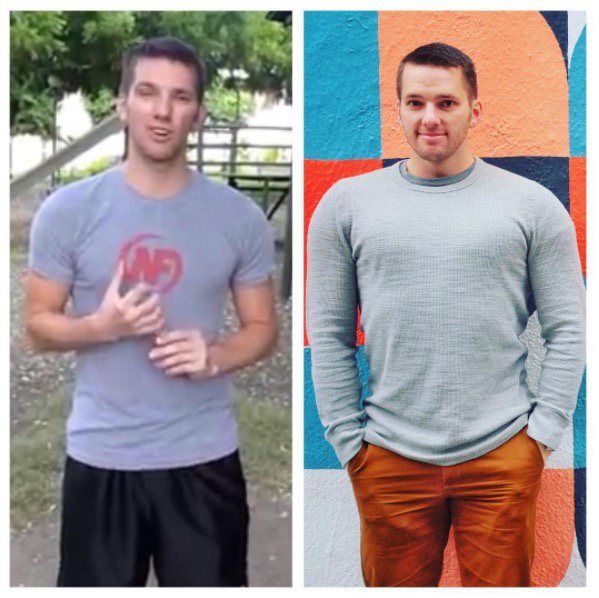
I’m still not the biggest guy in the world, nor will I ever be. I’m okay with that!
I’ve learned that anyone can pack on muscle, even skinny nerds like me.
If you’re skinny and want to get bigger, you’ll be fighting genetics the whole way, but do not let that deter you.
Today’s article outlines everything I’ve learned over the past 15+ years of mistakes, successes, failures, and adventures.
The Most Important Thing for Putting on Muscle: Eat More Food.

As they say, muscle isn’t made in the gym, but in the kitchen:
If you want to bulk up, you’d be better off working out twice a week for 30 minutes and eating enough calories/protein, than working out 6 days a week and not eating enough.
I learned this the hard way.
I spent four years of college working out five days a week for 90 minutes a day trying to get bigger.
I drank protein shakes like I thought I was supposed to. I got a little stronger but never bigger.
Why?
BECAUSE I DIDN’T EAT ENOUGH CALORIES.

When I get emails from people who lament the fact that they can’t gain weight, I always first ask about the person’s diet.
More often than not, that person thinks they are eating enough, but are definitely not.
Here’s the truth:
If you are not getting bigger, you are not eating enough.
Your body can burn 2000+ calories every day just existing (and then factor in exercise and, gulp, cardio – I’ll get to that in a minute), and you need to overload your system with calories in order for it to have enough fuel for the muscle-building process.
Want to know how many calories you burn every day just existing?
Plug your stats into our TDEE (Total daily energy expenditure) calculator:
Nerd Fitness Total Daily Energy Expenditure Calculator
Basal Metabolic Rate (BMR)
0
Your BMR is an estimate of the total calories burned a day, while in a state of rest.
TDEE
0
Your TDEE is an estimate of the total calories burned during a single day, when exercise is factored in.
Note: we have used The Mifflin-St Jeor Equation to create this calculator! [1]
For every person, the number of required calories for bulking up daily is different. You need to factor in your age, your height, your current weight, how much you move and fidget throughout the day, and how much weight you want to gain:
- For some people, it might be 2,000 calories a day.
- For others, it might be 3,000 calories a day.
- For others, it might be 4,000 calories a day.
While calorie counting isn’t required to put on mass, I think for a newbie starting out tracking calories for a few days is a great place to begin. It gives you a snapshot of your current eating patterns and helps you avoid a lot of heartache later on. No one wants to spend months trying to gain muscle only to realize they vastly overestimated how much they were eating!
(Of course, this doesn’t mean you need to track calories forever. In our coaching program, we use a combination of calorie tracking and a “Balanced Plate” approach to find what works best for each client.)
So, track your calories using something like MyFitnessPal over a few days and get an average.
I bet you’ll discover you’re eating significantly less than you thought you were.
Once you’ve learned how many calories your body burns daily…
Eat MORE than that!

How much more, you may ask? Time to do a little math.
Step 1: Calculate your TDEE (total daily energy expenditure.)
Step 2: Calculate how many additional calories you need to eat to gain weight.
- We recommend you aim to gain 0.25-0.5% of your body weight per week.
- If you weigh 150lbs, that would be 0/3-0.75 lbs per week
- Multiply that increase in weight by 3500 calories (3500 calories = 1 pound)
- In the above example, you would need to eat an extra 200-400 calories per day.
Step 3: Track your progress for 2-3 weeks and reassess.
- Spend the next two weeks eating those additional calories and see how your weight adjusts and how you look in progress photos!
- If you are not getting bigger, add 250 additional calories per day and repeat the process.
Some people will bulk up much faster by overeating more calories than this, but we don’t recommend it. Your body has a limit to how much muscle it can naturally build each week.
Everybody’s results will vary (thanks, genetics!):
- Under optimal conditions, some say you can expect to gain 1 pound (.5 kg) of muscle per week.
- My results have shown that 2 lbs (1kg) per month is more realistic.
- A 2016 study[2]revealed that strength training produced a 2.2 lb increase (1kg) increase in lean mass in 8 weeks.
When you exceed your muscle-building capacity, those extra calories are stored as body fat, not as muscle – which isn’t necessarily a bad thing. There will likely always be SOME fat put on while you bulk – it won’t be 100% muscle even for people like professional bodybuilders with great genetics.
Here are things to consider if you overeat WHILE strength training: extra glycogen, some fat, and water stored in your body can be a good thing for your confidence and get you headed down the right path.
So, don’t listen to the sites or programs that say “gain 40 pounds of muscle in two months!”
It’s going to be a slow, long process.
Yes, it is possible to have incredible transformations in a short amount of time, like when I gained 18 pounds (8.1kg) in 30 days
This was due to strength training, overeating, protein, and extra water weight (from supplementing with creatine):

My advice: Rather than massive weight gain over a month, you’d be much better off gaining .5-1.5 lbs. (.25-.75 kg) a week, every week, for several months at a time…and keeping the weight on!
Now, I know this isn’t easy.
There’s nothing worse than spending 6+ months in a gym and doing what you think you SHOULD be doing, only to step on the scale and realize that you haven’t made any progress!
If you’re somebody who’s worried about wasting time, or you want to have an expert guide your nutrition based on your current situation, consider checking out our Online Training Program!
What Food Should I Eat to Bulk Up?

Let’s go through how you should be prioritizing your nutrition, nutrient by nutrient:
- Protein: rebuilds muscle after you break it down.
- Carbohydrates: provide your muscles with fuel and your body with energy
- Fat: helps your bodily functions and can also be burned as fuel in the absence of carbs.
Let’s look at each of these individually:
PRIORITY #1: PROTEIN
Protein can come from any number of sources, including:
- Meat (steak, bison, pork).
- Fowl (chicken, turkey, duck).
- Eggs![3]
- Cheese and dairy.
- Fish and shellfish (salmon, tuna, shrimp).
- Legumes (black beans, chickpeas).
- Other vegetarian protein sources here.
As we cover in our “How much Protein do I need?”, claims for the amount of protein needed vary wildly from source to source (and athlete to athlete).
Here is our recommendation for protein consumption:
If you’re of healthy weight, active, and wish to build muscle, aim for 0.8g/lb (1.6g/kg). [16]
If you get all of your protein from plant-based sources, you may want to aim slightly higher at around 1.0g/lb (2.2g/kg). This covers for plant-based sources that don’t have as complete an amino acid profile as meat and dairy.
If you want to keep it simple, target ~1 gram of protein per pound of body weight (2.2 grams per kg).
If you’re curious, this is what a portion of protein looks like from our healthy eating article:
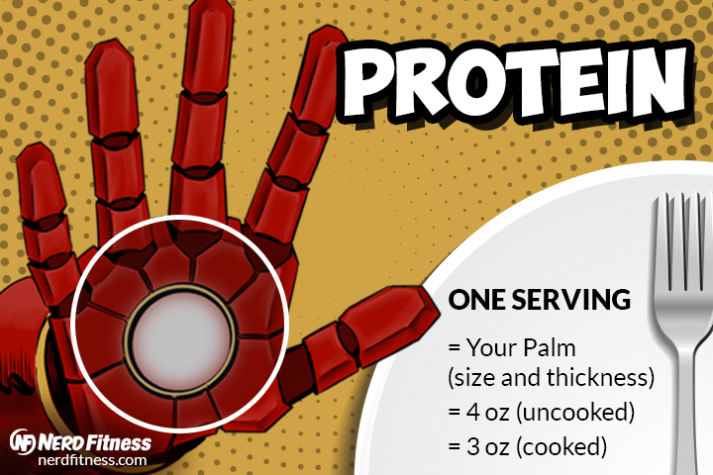
Also, here’s how much protein is in a serving of food:
- 4 oz (113 g) of chicken has around 30 g of protein.
- 4 oz (113 g) of salmon has 23 g of protein
- 4 oz (113 g) of steak has 28 g of protein.
Want to get more protein? Consider protein shakes, like so:

PRIORITY #2: CARBS
After protein, to get bigger, you need to eat enough calories, and those calories should come from sources composed of carbs and/or fats.
Making sure your muscle’s glycogen stores (which primarily comes from consuming carbohydrates) is full also helps prevent the breakdown of protein into energy (i.e. breaking down muscle tissue for energy!) That’s a pretty big deal when we are trying to bulk up!
Here are foods full of carbohydrates you can prioritize for bulking up:
- Rice
- Quinoa
- Oats
- Legumes and lentils
- Sweet potatoes
- Yams
- Regular potatoes
- Whole grain pasta
- Whole grain bread
To help you get better at eyeballing serving sizes:
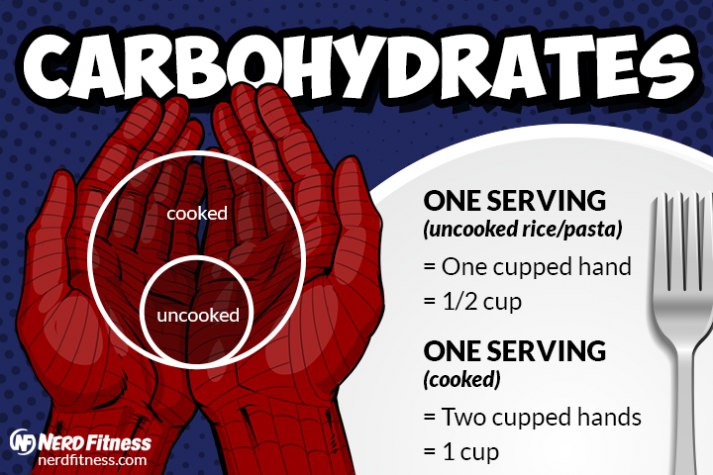
1 serving of a starchy carbohydrate is 1 cupped hand (uncooked), or your two hands forming a cup (cooked).
Here are some images to help you learn proper portion sizes (thanks to SafeFood):

In addition to consuming carbohydrates from these sources, there are tons of other great options like fruit, starchy tubers like potatoes or yams, and more.
PRIORITY #3: FAT!
Fat is a macronutrient that can help you reach your goals in the right quantity. It’s higher in calories, so a little bit can go a long way. Especially if you struggle to eat enough calories, adding more fat to your diet can help you increase your calories without feeling too full.
Healthy fat can be found in foods like:
- Avocado
- Almonds
- Walnuts
- Macadamia nuts
- Olive oil
- Almond butter
- Peanut butter
What about saturated fat? Is that OK to eat when I’m bulking up? In moderation, saturated fats can absolutely be a part of your diet! [4]. We recommend keeping saturated fats to 10-20% of your total fat intake.
Saturated fats can come from things like:
- Whole milk
- Full-fat dairy
- Coconut oil
- Grass-fed butter
- Fatty cuts of meat
- Lard
To help you gauge: a serving size of fat is roughly the size of your thumb!
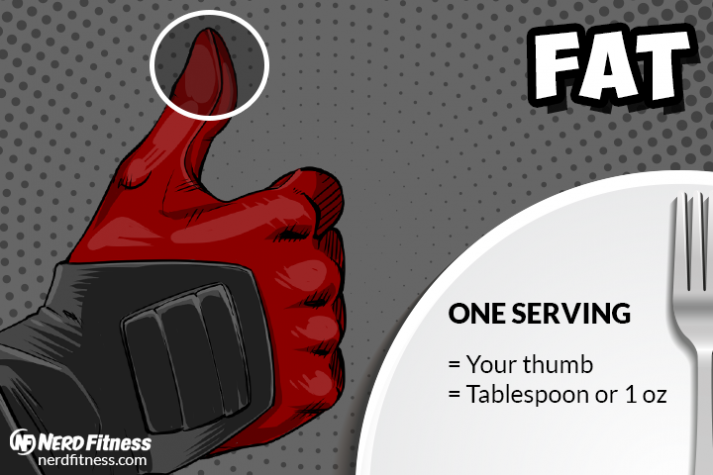
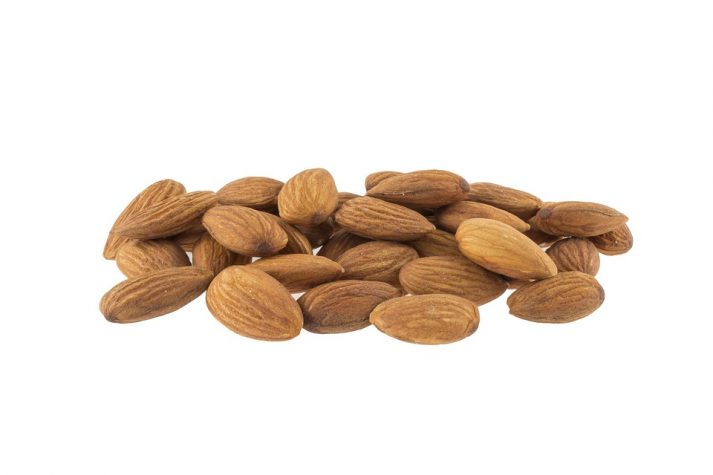
For reference, this is a single serving of almonds (162 calories):
THIS is a serving of olive oil (119 calories):
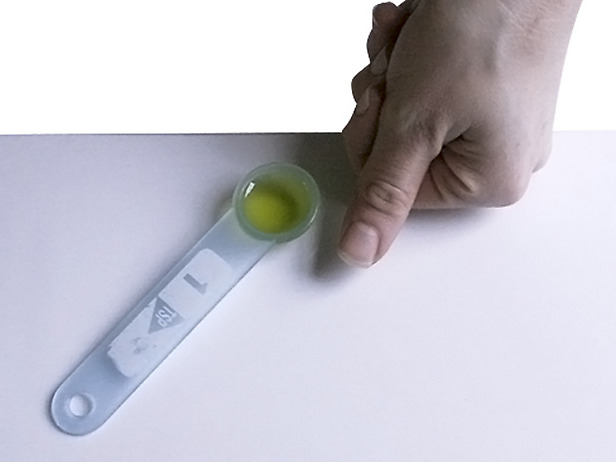
As you can see, you can eat an extra 500 calories of “healthy fats” by eating lots of “heart-healthy” fats like nuts or adding more olive oil to your meals.
PRIORITY #4: VEGETABLES!
Last but not least, fruit and vegetables.
If you start to eat a lot more food, your “indoor plumbing” is going to really benefit from eating some high-fiber veggies with each meal:
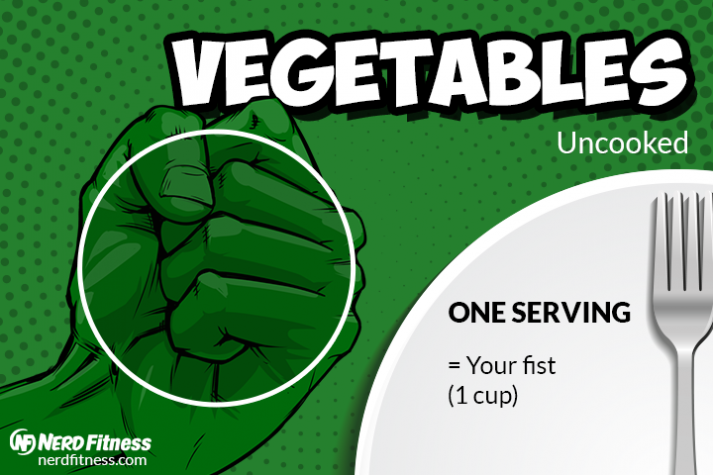
A serving of veggies is about the size of your fist.
Here’s a quick, non-complete list of veggies that can fill your plate:
- Broccoli
- Broccolini
- Cauliflower
- Spinach
- Kale
- Spaghetti squash
- Brussels sprouts
- Zucchini
- Cucumber
- Carrots
- Onion
- Asparagus
BRINGING IT ALL TOGETHER:

This plate and serving size stuff above is just to help you get started thinking about healthy food differently and in proper portion sizes.
To recap:
HERE’S HOW TO EAT TO BULK UP:
- Calculate your (Total daily energy expenditure) and add enough calories to increase 0.25-0.5% of your body weight per week.
- Consume 0.8-1g per pound (1.6-2.2g per kg) of body weight in protein every day.
- Consume the rest of your calories from foods composed of carbs and fats.
- Eat vegetables to keep up your fiber and micronutrient content for your general health.
- If you are not gaining weight, add more carbs and/or fats to your meal.
It really does come down to the following:
If you are not gaining weight fast enough, you are not eating enough. Increase your portions of carbohydrates and fats!
Whenever we work with coaching clients who struggle to bulk up, this is the area we target: adding more carbs and fats to each meal.
What Supplements Should I take to Bulk up? How to eat more calories.

If you are struggling to consume enough food every day, then here are some tips to help you reach your caloric goals to bulk up:
“WHAT SUPPLEMENTS SHOULD I TAKE TO BULK UP FAST?”
Most supplements are garbage.

HOWEVER, if you are interested in bulking quickly, there are two I would recommend:
- Protein Powder. A great solution for getting extra protein and calories in your diet and building muscle.[5] As we point out in our article on protein and protein shakes, mix and match your own ingredients and see how many calories you can get into a smoothie without breaking your blender.
- Creatine supplement. It helps your muscles retain more water, and have more energy and power to push your workouts hard (which will be another key component of bulking up, adding muscle!) [6], and has been shown to increase the hormone IGF-1, which is needed for muscle growth[7].
Outside of these two supplements, you really don’t need to prioritize supplementation, despite what the muscle magazines tell you!

I’ll leave you with a couple more suggestions on how to bulk up in this section:
#1) Liquid calories are your friend. Liquid calories can give us lots of calories without ‘filling us up,’ which is an easier way to consume enough calories every day without feeling overly full.
I personally get a huge chunk of my calories every day from making my own ‘Powerbomb Shake – from our Protein Guide:
- Water: 16 oz.
- Quaker Oats: 3 servings (120g)
- Frozen spinach: 1.5 servings (120g)
- Frozen mixed berries: 1.5 servings (120g)
- Protein powder: 2 scoops of Optimum Nutrition Vanilla Whey
And here is the macronutrient breakdown:
- Calories: 815 cal
- Protein: 70g
- Carbs: 107g
- Fats: 12g
If you need even more calories consider adding whole milk, coconut milk, or almond milk instead of water.
I like to buy Frozen berries and Frozen Spinach from Trader Joes, but you can buy in any grocery store!
You can also add a shot of olive oil to add calories/fats to a shake in the quest for MOAR MUSCLE!
#2) Keep your protein intake to the lower end of the 0.8-1g/lb range.
Wait, Steve, are you actually telling me to eat LESS protein? In this case, yes! If you’re struggling to get enough calories in, I recommend you keep protein at the optimal range of 0.8g/lb of body weight, and not any higher.
You’ve already maximized muscle synthesis, so any additional protein is just going to fill you up more (since protein is the most satiating macronutrient.)
#3) Use food palatability to your advantage.
Highly palatable foods (like those containing lots of flavor, carbs, and fats) are less filling and tend to make you want to eat more of them. This is essentially the opposite advice of someone on a fat loss diet, but can be helpful if you struggle to get enough calories to bulk!
#4) Continue to slowly increase your portion sizes or add more meals throughout the day
If you’re someone who’s struggled to put on weight your whole life, a lot of that could be because you just don’t feel all that good when you try to eat more food!
There’s really no way around the fact that we’re going to have to increase the amount of food you eat, even if it’s not always the most comfortable.
If you are cooking rice, each week try adding in an extra quarter cup when you cook it.
You may have to eat at times when you don’t feel all that hungry.
This is not enjoyable. You can try to increase the number of times you eat throughout the day to help combat this a bit.
However, just like it’s necessary to force your muscles outside of your comfort zone to get bigger, you need to force your stomach outside of its comfort zone until it adapts to accepting more calories.
How to Grow Bigger Muscles: Get Stronger

When you strength train, your muscles are broken down and then get rebuilt stronger to adapt to the stress you have applied to it.
So every time you pick up a slightly heavier weight, you are increasing the challenge and forcing your muscles to adapt and get more resilient.
Specifically, what I’m trying to say is:
If you want to get bigger, focus on getting stronger.

As long as you are continually increasing the weights or increasing the sets and reps you are lifting, your muscles will continually adapt to get stronger.
This is called “progressive overload” and it. is. everything.
NF Coach Jim walks you through the ins and outs of progressive overload in this video:
If you want to dive in more, check out our guide “What is Progressive Overload?“
Follow a progressive overload strategy and eat enough calories, and you will get bigger.
Let’s dive into more specifics with programming and exercises so you can maximize your muscle growth potential:
VOLUME
Volume refers to the total number of sets and reps you challenge your muscles with each week.
For most people, we recommend starting with 10-20 working sets per muscle group per week. Getting more volume (more sets of exercises) per week resulted in more mass compared to less volume (fewer sets of exercises), in this study[9]
That might look like:
- 6 sets for your quads on Tuesday, and then another 6 sets on Friday
- 4 sets for your chest on Monday, Wednesday, and Friday
- Or 3 sets for your back on Tuesday, Thursday, Saturday, and Sunday
How you break it up will really depend on your schedule (which we’ll get to in a minute.)
What about repetitions per set? While recent studies show that any rep range from 5-30 reps per set stimulates an equal amount of muscle growth as long as the set was brought close to failure, practically, we’ve found that most of our clients do really well in the 6-15 rep range, with 2-3 working sets per exercise. [17]
INTENSITY
Remember when we talked about progressive overload? That comes into play right here.
You want to come within 1-3 reps of failure for your working sets. That means you pick a weight and do enough reps that you can only do 1 to 3 more before you can no longer perform the exercise with proper technique. [10][11]
Don’t risk an injury by trying to lift too much weight too soon, but make sure you regularly test whether you can lift a few more pounds in your lifts.
TEMPO
Maintaining tension in the muscle for longer helps stimulate muscle growth. Controlling an exercise’s eccentric phase (the lengthening portion) also helps reduce injury risk. (Though strength training is one of the safest sports in the world.)
Our recommended tempo for your lifts is this:
- 2-4 seconds slow and controlled as you lower the weight
- A brief pause in the bottom position
- Athletically move the weight back up (no need to go slower than normal here)
- Repeat
SCHEDULE
You want to train each major muscle group at least 2x/week. You can divide this up in several ways:
- 2-4 full body workouts per week – hitting major muscle groups in each session
- 2-3 upper body days, combined with 2-3 lower body days each week
- 2 days each of a “push” focus, a “pull” focus, and a lower body focus each week
For most people, we recommend starting with a full-body program. It’s more efficient (only 2-4 days per week instead of 5-6), and your body doesn’t NEED more workouts at this point to grow plenty of muscle.
As you progress, you can experiment with upper/lower and push/pull/lower splits if they work for your schedule and you hit a plateau in your training – though before adding more days, we recommend you double-check that your volume, intensity, and tempo are all dialed in first.
You can use movements like these in your full-body workouts:
- Squats
- Deadlifts
- Overhead Presses
- Bench presses
- Body rows
- Dips (assisted)
- Push-ups
- Pull-ups (assisted)
If you can focus on getting stronger with the above exercises and eat enough calories, you will also get bigger in all the right places.

Just. Keep. Eating. And. Lifting.
Skinny Guy Workout Plans for Bulking Up

As we cover in our “How to build muscle” article, here’s a sample routine you can follow NOW to start bulking up.
After you do your dynamic warm-up, do the following workout:
MONDAY BULK-UP WORKOUT:
- Squats: 3 sets of 6 to 8 reps
- Bench press: 3 sets of 8 to 10 reps
- Wide Grip Pull-Ups: 3 sets of 8 to 10 reps
- Dumbbell Lateral Raises: 3 sets of 10 to 12 reps
WEDNESDAY BULK-UP WORKOUT:
- Deadlift: 3 sets of 6 to 8 reps
- Dumbbell Incline Bench Press: 3 sets of 12 to 15 reps
- Inverted Bodyweight Rows: 3 sets of 10 to 12 reps
- Cable Tricep Pushdowns: 3 sets of 12 to 15 reps
FRIDAY BULK-UP WORKOUT:
- Front Squats: 3 sets of 6 to 8 reps
- Dips: 3 sets of 8 to 10 reps
- Pull-Ups: 3 sets of 6 to 8 reps
- Dumbbell Bicep Curls: 3 sets of 12 to 15 reps
Get stronger, and the rest will take care of itself.

NERD FITNESS RECOMMENDATION: Feel free to pick WHATEVER workout program you want from wherever. If you don’t want to follow the workout above, consider these sources:
- Beginner Dumbbell Workout
- 5 Beginner Strength Training Routines you can follow.
- Follow our 6-level gym workout routine.
- You can build your own workout routine.
- You can follow any workout from any muscle magazine.
If you’re curious, here are some commonly accepted strategies based on your goals for how many sets and reps you should do:
- Strength and power: 1-5 reps
- Strength and some size: 5-8 reps[8]
- Size and some strength: 8-12 reps
- Muscular endurance: 12+ reps
As we pointed out above, as long as you get close to failure, recent research shows that anything between 5-30 reps is about equal for muscle growth. So don’t worry too much about which path is best.
Nutrition plays the most important role in bulking up, and any strength training plan will help you get bigger.
What this means: Don’t overthink it.
- Pick up heavy stuff for 2-3 sets of 6-15 reps. Pick up a weight that is heavy enough that you could only complete 1-3 more reps with good technique.
- And then do a little bit more next time.
What’s important is that you pick a plan and follow through with it while focusing on eating enough.
After a few months, you can reevaluate and then adjust based on how your body has changed. [18]
And as we showed, feel free mix in bicep curls or tricep extensions or calf raises at the END of your workouts.
Focus on the big lifts first and get stronger with them.
How much weight should you lift? For every one of the barbell movements above, it’s okay to start with just the bar, and then add weight in 5 lb (2.2kg) increments each week.
It’s important to get the form right and get your body used to the movement for when you start to lift heavy weights.
How long should you wait between sets? Again, don’t overthink it.

Waiting 60-90 seconds puts more of an emphasis on muscular size and endurance (as you’re resting for a shorter period). Waiting 2-3 minutes allows you lift heavier weight, and thus can make you stronger.
..but don’t overthink it. Do the next set when you’re ready.
A piece of advice from 8-time Mr. Olympia, Lee Haney: “stimulate, don’t annihilate.”
Don’t destroy yourself for the sake of destroying yourself; stopping one or two reps short of maximum effort can save you from overtraining and potential injury – remember that muscles are built in the kitchen!
Can Bodyweight Training Help Me Bulk Up?

Yes, you can get bigger and stronger by doing exclusively bodyweight exercises.
Take a look at any Olympic gymnast: he is jacked, with giant muscles, all built with bodyweight exercises:

It all depends on the same rules we laid out above.
Can you target the muscle groups you are trying to grow with exercises that create a high amount of tension and take you close to failure after doing 6-15 reps?
If your answer is “yes”, then that bodyweight exercise is a great option for you! In fact, things like inverted rows, chin-ups, pull-ups, dips, push-ups, lunges, etc. are all fantastic exercises to help you put on muscle.
However, some people may find it difficult to get that right level of “challenge” with certain bodyweight movements.
Maybe you have a hard time finding upper body or bicep movements that feel good without using weights.
Maybe you can do countertop push-ups for more than 15 reps, but when you try to progress to a harder variation you don’t have any surface in your house that quite works so you feel stuck.
And that’s the crux of the issue:
Like with weight training above, you need to increase the difficulty in order to challenge your muscles to adapt.
Because it’s often more challenging to add a few pounds to a bodyweight exercise to make it tougher – compared to putting a weight on a bar, you need to increase the difficulty of the bodyweight movement itself.
You may need to experiment with higher rep ranges (15-30 reps) to push your muscles closer to failure.
- If you can do 4 sets of 15 push-ups, consider making them harder to progress. Do 4 sets of 15 push-ups with your feet on a bench.

- Bodyweight squats too easy? Work your way up to pistol squats (one-legged squats).

4 sets of 12 pull-ups not a challenge anymore? Great. Make them tougher. Try a different grip or weighted pull-ups.

I highly recommend that beginners take a serious look at strength training with free weights; it’s much easier to record one’s progress, easy to add more difficulty (just add more weight!), and very structured.
You can ALSO mix in bodyweight training! Really, it’s just about finding the group of exercises that works best for you, regardless of whether their bodyweight, barbell, dumbbell, machine, or anything else!
What it really comes down to is this: no matter what you have access to (a gym, barbell, dumbbells, or just a pull-up bar), you can find a way to build strength and muscle if you follow a plan and eat enough calories.
If you’re trying to bulk with just bodyweight, it might be worth enlisting the help of a coach to help you scale your bodyweight exercises correctly and in the proper sequence!
I am Skinny Fat: Should I gain or lose weight first?

If you are skinny fat (you have skinny arms and legs but have a gut), there are three paths available to you:
- Bulk up and build muscle, then lean out.
- Lean out, then build muscle.
- Build muscle and lean out at the same time.
We all want Door #3, right?
Here is how to accomplish both goals at the same:
- Heavy strength training…
- While following a healthy diet and slight calorie restriction…
- To decrease your body fat percentage.
If you follow a program with the right calories and strength training, you can both lose weight AND build muscle at the same time.

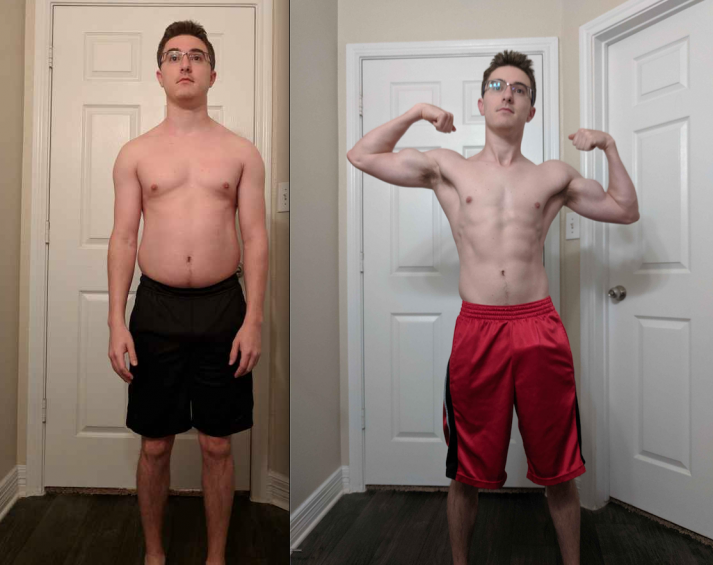
It’s how we helped NF Coaching Client Jimmy (these photos are 5 months apart):
NF Coach Matt recommends the following strategy, as long as you also know there are tradeoffs!
Get strong and eat a SLIGHT caloric deficit while consuming enough protein every day.
Get yourself down to roughly 15% body fat (~25% for women), and then start to increase the size.
By slimming down first, while building muscle, you don’t have to worry about buying BIGGER clothes first, only to then need smaller clothes once you start cutting the fat.
Then, once you decide to eat more and get bigger, if you notice your body fat percentage start to creep up, you can simply adjust until your body fat gets back in the acceptable range. Then keep building!
What about those tradeoffs Coach Matt mentioned?
Anytime you focus on two different goals at once (losing weight AND building muscle), neither of those will be done optimally. You can build muscle more quickly if you focus on that as your main goal, eat more calories, and continue to challenge yourself in your workouts. You can also lose weight faster if you go into a slightly larger caloric deficit than recommended above.
Balancing these two goals isn’t necessarily a bad thing. You’ll be able to get plenty strong and lean out a bit without having to manage bigger changes in your diet, which can be easier to sustain.
If you get stuck in the future, focus on one thing at a time.
To recap, here’s what to do if you are skinny-fat:
- Eat a caloric deficit while heavy strength training to build muscle while leaning out.
- Prioritize protein intake: 0.8g per pound (1.6g per kg) of body weight.
- Get strong as hell with compound lifts and a moderate rep range (this will build muscle even in a deficit).
Once you reach a certain body fat percentage you’re happy with, then you can increase your caloric intake to build more size.
Proper Sleep and Rest for Building Muscle

Last but not least, the other important piece to this Triforce of muscle building:
Strength training, eating enough, and RECOVERY.
Your body builds and rebuilds its muscles during RECOVERY.
Our muscles generally need 48 hours or so to recover from their previous workout, so I do not recommend you do any serious strength training of the same muscle group on back-to-back days . [20]
Feel free to do dynamic warm-ups or fun exercises as active recovery on off days, but I tend to take my off days OFF.
I might go for a walk (to Mordor!), but that’s about it.
A word about cardio: if you are serious about getting bigger and stronger, lots of long-distance cardio will work against you.
It’s something Coach Jim brings up in the video “7 things I learned adding on 50 lbs of muscle”:
As Coach Matt says, when you do a ton of long-distance cardio, it’s hard to eat enough calories to grow bigger. You’re also training for efficiency rather than size, which stimulates a different type of adaptation in your muscles.

If you love to run/bike, that’s cool, as long as you know it’s slowing (or halting) your progress.
So, cut back on the running or cut it out completely.
Try mixing insprints and interval training, or even just upping your step count, if you want to keep the cardio up without having to do all of the crazy distances. You can always add it back in once you accomplish your weight gain goals.
A few words on SLEEP: You need more of it when you are building muscle.
It’s that simple.

Don’t be surprised if after a heavy deadlift day you find yourself wanting to sleep for 10 hours.
It might mean less TV or less video games.
Again, if you are serious about getting bigger and stronger, don’t neglect sleep.
FAQ for Skinny Guys Trying to Bulk Up

QUESTION #1: “But I just want to get toned, I don’t want to get too bulky.”
That’s not a question, but I hear it all the time. Do NOT worry about getting too bulky. I’ve been trying to get “too bulky” my entire life – it takes years of concerted effort to pull that off.
I’m gonna guess you have 30+ pounds to gain before you’d ever even be considered “bulky.”
That means that if you struggle with weight gain, getting to the point where you are TOO bulky would actually be a good problem to solve.

As you start to put on weight if you ever find yourself getting a tiny bit too chubby, simply eat less at that point!
So, when in doubt, always err on the side of too many calories than not enough. If you’re not sure if you should eat or not, etc.
QUESTION #2: “But I don’t want to do that stuff, so I’m gonna do _____ instead.”
Hey, go for it. Give it a month, and see how your body reacts. If you’re getting bigger, stronger, and healthier, keep doing it.

If not, come back to this article and apply the lessons here!
QUESTION #3: “I’m a vegetarian/vegan, can I bulk up?”
Absolutely. You just need to make sure you’re getting enough calories and enough protein in your system to promote muscle growth.
In order to optimize muscle protein synthesis, plant-based eaters may actually need MORE grams of protein per day (~1.0g/lb of body weight).
Beans and nuts have lots of protein; if you’re vegetarian you can still use dairy to your advantage (whey protein, whole milk, cheese, etc.).
If you’re vegan, then it’s slightly more of a challenge to get enough protein, but it can be done!
Check out our plant-based protein suggestions.
QUESTION #4: “Should I do ___ reps and sets or _____ reps and sets?“
Either plan will get you there. As long as you have your diet dialed in, either will work.
What’s important is that you pick a plan, you progress, you keep track of your results, and you consistently progressively increase the load that you are moving (be it your body’s weight or an actual weight).
QUESTION #5: “I want to get bigger and faster and have more endurance and flexibility ALL at the same time, can I do that?”
I hate to say it, but building endurance and getting bigger simultaneously is brutally difficult.

As I point out in “How to build any physique,” compare a marathon runner’s body with that of a sprinter or gymnast. Put the running on hold for a while, and focus on getting bigger: you’ll get there faster.
That being said, low-intensity cardio like 20 minutes of bike riding, walking, etc. isn’t likely to dent your gains all that much and can be good for heart health and enjoyment all around.
When you decide to mix longer distance endurance training back in, keep your calorie consumption high, and don’t forget to keep strength training!
QUESTION #6: “Do I need to eat every three hours?”
Nope, you don’t have to:
- The TOTAL number of calories you consume over the course of a day is more important than the timing of the meals.[14]
- The same is true with protein intake: studies show it doesn’t matter WHEN you eat your protein. HOW MUCH you consume in a day is more important.[15]
But eating more frequently might help…
If you struggle to get enough calories in your system, spacing out your meals might help you feel less full, or give you more opportunities to reach your calorie goal for the day.
QUESTION #7: “But what about this other article? And this other thing I read? Which workout is the best workout?“
Don’t overwhelm yourself. Keep it simple. Get stronger, eat more food, sleep. Break this down into simple steps and goals that aren’t scary, and get started.
The best advice I can give you is to start and make adjustments along the way.
Track your progress, track your calories, and track your workouts.
If you are getting bigger and stronger, keep it up!
I know this stuff can be overwhelming, as I struggled with this stuff for YEARS before getting results.
It’s why after I started Nerd Fitness, I eventually launched a coaching program: to help people skip the years of mistakes I made!
More Resources for Skinny Guys Looking to Bulk Up

This is a monster of an article, and your head probably hurts at this point.
If I can narrow it down to three main points:
- Get stronger by picking up heavy stuff or doing more challenging bodyweight movements.
- Get bigger by eating enough.
- Recover faster by sleeping enough and giving your muscles days off to rebuild.

If you made it this far, and you want more specific instruction and guidance, we have a few options for you:
1) If you are somebody who wants to follow a tailor-made program that’s designed around their life and goals, check out our popular 1-on-1 Online Coaching Program.
You’ll work with our certified NF instructors who will get to know you better than you know yourself, check your form, and program your workouts and nutrition for you.

2) Download our free Bulk Up Guide, which you can get when you sign up in the box below:
May you achieve ALL THE GAINZ!
-Steve
PS: Make sure you check out the rest of our Bulk Up guides:
- How to build muscle quickly
- How fast can I build muscle?
- 9 Mistakes People Make Trying to Get Bigger
- 13 Tips for Guaranteed Weight Gain.
###
photo source: Not Happy, Marina Pissarova © 123RF.com, magone © 123RF.com, Ekaterina Minaeva © 123RF.com, Morning run with the Fitbit, Inna Vlasova © 123RF.com, Viktor Hladchenko © 123RF.com; Olga Yastremska © 123RF.com; famveldman © 123RF.com; 167/366, LEGO bench
The post The Ultimate Skinny Guy’s Guide to Bulking Up Fast: How to Bulk like the Hulk first appeared on Nerd Fitness.
]]>The post How To Use 20 Seconds of Courage To Do Hard Things first appeared on Nerd Fitness.
]]>
20 seconds.
Today I’m going to issue you a challenge, and it will only require 20 seconds.
It could change your life.
I know 20 seconds doesn’t seem like a lot of time., but I’ve come to learn that when it comes to getting healthy, taking risks, and living a life worth living, 20 seconds is often more than enough to change one’s path.
What began as a fun mental strategy to overcome fear has since become a rallying cry for our community here at Nerd Fitness.
And today, I’m gonna help you do that thing that scares the crap out of you.
The Discovery of 20 Seconds of Courage
As I explain in the video above, today’s concept comes from an obscure Matt Damon movie: We Bought a Zoo.
In it, Matt Damon meets his wife by mustering up strength for a mere 20 seconds of courage to talk to her, despite being a complete nervous wreck before and after.
Had he never taken those 20 seconds to step outside of his comfort zone, he never would have met the love of his life.
One decision changed everything:
What does 20 seconds of courage have to do with leveling up our lives?
We Can Do Things Differently
As we think about our lives and how much we think we might be stuck on a certain path…
There are two realizations that might help us break free:
REALIZATION #1: Our lives are made up of a never ending series of decisions that actually take very little time:
- Walking through a door.
- Picking a seat on the train.
- Signing up for a class.
- Starting an uncomfortable conversation.
- Filling out a form.
Of course, there’s lot of internal thought, plenty of inertia, and years of ingrained behavior that happen before an action is taken…but the action itself is often a split second.
This means that no matter what decisions we’ve made up until now, we still have infinite paths available to us moving forward.
As Alan Watts points out:
You are under no obligation to be the same person you were 5 minutes ago.
I’m reminded of this amazing graphic from my friend Tim Urban at Wait But Why:

Each decision creates a new branching path in our history. We can’t change the past, but we can decide to make act differently moving forward and change our fate.
REALIZATION #2: Humans (especially us nerds) tend to be risk averse, comfortable, and wary of doing things that scare us.
This isn’t surprising or unusual: we’re hardwired to trust our gut and be cautious of things that raise our anxiety. The decision to avoid certain things is what kept us alive during our cave-dwelling days.
In other words, a cautious cavewoman 120,000 years ago listened to that instinct, avoided the scary noise coming out of the brush, and lived long enough to pass along her cautious genes to you today.

These days, we’re still wired to avoid things that scare us – not animals in the brush, but rather conversations with strangers, activities that might embarrass us, and events that are anxiety-inducing.
If we are going to get the things we actually want out of life, it’s going to require us to overcome that fear mechanism to make a decision that is counter to 120,000+ years of DNA-sequencing.
Which ain’t easy.
But boy it can be life changing at best, or a lesson learned at worst:
As author Brandon Sanderson points out[1]:
“I can do hard things. Doing hard things has intrinsic value, and they will make me a better person, even if I end up failing.”
Why 20 Seconds of Courage works
By using 20 seconds to do something you normally would have avoided, or saying YES when you normally say NO, three amazing things happen:
- If it doesn’t work out, you learn a lesson and become more resilient. You quickly learn the world didn’t end, and you are more likely to try new things in the future because failure wasn’t that bad! And you can develop some crucial self-compassion.
- If it DOES work out, your life is now better as a result of your targeted bravery. A relationship, a new job, a new hobby, lifelong friend, are often results of a single decision made by somebody. This is you taking action rather than waiting for fate to intervene.
- You NEVER have to wonder “what if?” when thinking about what could have been had you done that thing!

How 20 Seconds of Courage Can Change Your Life.

“Courage is being scared to death, but saddling up anyway.” – John Wayne, clearly a fan of 20 Seconds of Courage.
Here’s how to implement 20 Seconds of Courage into your life:
- Identify the thing you terrified of.
- Put ALL of your focus into a single specific action that will take less than 20 seconds but will result in you attempting the thing you’re scared of.
- Work yourself up into a frenzy if you need to. Give yourself a pep talk in the mirror. Recruit a buddy if you have to.
Get scared to hell before.
Pee your pants (preferably after).
Just focus on the 20 seconds required for you to start or complete the action that is needed for you to change your path.
And then, welp… you’ve already started, and the hard part is done, might as well keep going:
- Afraid of the free weight section at your gym? Turn on Berserker mode. Give yourself 20 seconds and walk into the section before you realize how scared you are. After your 20 second are up, you can go back to being afraid, but you’re already IN the free weight section, maybe even with a weight in hand. Might as well do the workout now, right? Who cares about the people around you – they’re too busy being self-conscious anyway.
- Don’t think you can start your workout? Too tired? Put on a great freaking pump up song, jump around, psyche yourself up, and just GET started. Don’t worry about what happens in the 20 seconds after you get started. JUST focus on those 20 seconds that are needed to get you out of bed or out the door.
- Afraid to sign up for a class? Afraid to try something new? No problem, be afraid. Sign up in those 20 seconds and make your commitment before you have a chance to back out. All of a sudden, you’re signed up and have to follow through!
- Are you typically a push over? Do you never stand up for yourself at work? Beast mode. At the next meeting, take 20 seconds to really stand up for yourself and present YOUR opinions. Work up the courage to begin the conversation with your boss about getting that raise you deserve. Once you’re in the office and the conversation has begun, you might as well keep going.
- See that cute person at the coffee shop? Normally you say NOTHING, and then go home and wish you had? Give yourself 20 seconds of courage. Be scared shitless before and scared shitless after, but give yourself 20 seconds of courage: “Hey, I need to get back to my friend/work, but I saw you from across the room and wanted to come introduce myself. Can I buy you a cup of coffee sometime?” At the very least, give them a drive-by compliment. You’ll never have to wonder “what if…”
Lao Tzu once said, “A journey of a thousand miles begins with a single step.”
A life where you actually might get what you want and deserve begins with 20 seconds of courage.
Make the step. Approach that person.
Sign up for that club/class/speaking engagement.
Have that uncomfortable conversation you’ve been avoiding.
Finally be honest with yourself and confront the monsters in Pandora’s Box.
It’s how Jaime, after 3 decades of struggle, managed to change her life. It started with 20 seconds of courage and a single decision:

I’ve used 20 seconds of courage dozens of time in my life too.
Sometimes with health or fitness, sometimes with relationships, and other times with my own life level up quests, which I discuss in my book, Level Up Your Life.
“Steve this is great. But I’m still cautious and Matt Damon is cool and all, but give me nerdy stories I can learn from regarding 20 seconds of courage!”
Fine! Here are my favorite examples of 20 seconds of courage:
- Super Mario Bros: Star Power makes Mario invincible for a short amount of time. He’s normal before and after, but in those few seconds he can cover some serious ground and wipe out a LOT of Koopas.
- Transformers: Some transformers had the ability to transform from a robot into an animal form, just for a time. This was referred to as “Beast Mode!”
- Ancient Viking lore: Berserkers were Norse warriors who worked themselves into a rage before battle, and fought in a nearly uncontrollable, trance-like fury.
- Lord Urthstripe in the Redwall Series: A badger lord who goes into “bloodwrath” mode to vanquish his foes.
- Will Ferrell in Old School: He puts together less than 20 seconds of pure genius in his debate with James Carville. Sure, afterwards he has no recollection of his answer (and before he was probably freaking out), but this 20 seconds saved his fraternity:
The 20 seconds Of Courage Challenge!

Today, I’m issuing a 20 Seconds of Courage Challenge.
You have 7 Days to use 20 Seconds of Courage to do something you’re scared of.
Everybody is fighting their own demons and chasing their own dragons (not a euphemism),
- Leading an army of Transformers against the Decepticons.
- Saying yes to something you’d normally say no to.
- Eating a new vegetable that you’d normally avoid.
- Going to that part of the gym that you’re afraid of.
- Establishing boundaries with your family.
- Having an uncomfortable conversation.
- Taking more initiative at work.
- Doing a new workout/exercise.
- Talking to a complete stranger.
- Signing up for a new class.
- Standing up for yourself.
- Buying a Zoo.
Change can happen in an instant, and your life’s path can change as a result of any single decision you make.
I think this quote paints that picture better than most:
“Easy choice, hard life. Hard choice, easy life.”
Fortune favors the bold, and doing sh** that scares us is often the only way to actually get what we want out of life.
So here’s how to not let that fear keep you prisoner: 20 Seconds of Courage!
Here’s how to participate:
- Pick something you want to do but have been too scared to attempt.
- Freak the F out before you do the thing.
- Muster up 20 seconds of courage and take that one action.
- Pee your pants after (optional).
Just 20 seconds!
-Steve
###
photos: berserker, fire poi, beast mode,
The post How To Use 20 Seconds of Courage To Do Hard Things first appeared on Nerd Fitness.
]]>The post How to Build Muscle Fast (Training, Diet, and Workouts) first appeared on Nerd Fitness.
]]>
Want to build muscle like this guy?
(Leopard print unitard optional but encouraged)
In this guide, we’ll provide step-by-step instructions that will help you start building muscle immediately. Like, today.
We’ll explore:
- How do you build muscle?
- What’s a sample routine for muscle training?
- How many sets and reps should I do?
- Muscle training weightlifting tips.
- How many calories to eat to build muscle? (and which supplements)
- Will I get too bulky lifting weights?
- Can you lose weight and gain muscle at the same time?
- Rest days for building muscle and strength.
That may seem like a lot of topics to cover. DON’T PANIC!
If you want to build muscle, get bigger, and become stronger, it comes down to three things done consistently:
I realize doing those three things is much easier said than done. Doing hard stuff consistently for months and years requires a great strategy!
In fact, we even helped our friend Ali Abdaal put together a video on exactly how important these three things are.
If you want some help implementing these strategies in your own life, we provide a free bodyweight routine, and a comprehensive gym training routine to get you started with strength training in our free guide, Strength Training 101: Everything You Need to Know. Grab your guide when you sign up in the box below:
How Do You Build Muscle and Strength?

If you are going to build strength and muscle, you need to lift heavy things to force your muscles to rebuild themselves stronger.
But what the heck does ‘heavy’ mean in this context? I’m so glad you asked!
Muscle-building is optimized when performing strength-training exercises in the 5 to 30 rep range (bodyweight or weightlifting), working to within 1 to 3 reps of failure while maintaining good technique.
(i.e. You could do 1 or 2 or 3 more repetitions of the exercise using a specific weight, but not more.) Usually, you’ll repeat this effort for multiple sets targeting multiple muscles in a workout.
That’s what I mean by ‘lift heavy’: you picked the right amount of weight to challenge yourself for the desired number of reps. By forcing your muscles to really tax themselves by picking up heavy things, you are participating in the Holy Grail of muscle building: progressive overload!
Progressive overload: forcing your muscles to rebuild themselves stronger by increasing the challenge they face with each workout. Examples include: lifting heavier weight, doing more reps, frequency, etc.
For example, from one week to the next, progressive overload would look like:
- Week 1 Barbell Squat: 4 sets of 6 reps at 150 lbs.
- Week 2 Barbell Squat: 4 sets of 6 reps at 155 lbs.
If you do that, you’ve gotten stronger! Then, repeat next week. Consume enough calories and protein, and you’ll gain muscle mass too.
“Got it, Steve. I need to pick up heavy things. Can we talk about which exercises I should do to build muscle?”
Great question, you good-looking person. I’ll cover specific exercises in the following section, but let’s start with a broader point:
Free weights, machines, and bodyweight exercises are ALL good options as long as you can adhere to the guidelines we laid out above. [4]
While you can grow muscle using any type of strength-training exercise, having access to a gym with free weights and weight machines makes leveling up your muscle-building game all the easier.
Check out our Beginner’s Guide to the Gym for everything you need to know and getting started in a gym with sample workouts.
So let’s start building muscle!
We’ll want a routine with compound exercises that train multiple muscle groups at once. They’re efficient and they can create solid growth and stimulation.[5]
To create our full-body routine, each workout will make sure it has a big compound leg exercise, push exercise, and pull exercise:
- Leg Exercises (Quad Dominant or Hip Dominant): Squats, Deadlifts, or Lunges
- Push Exercises: Bench Press, Deficit Pushups, or Dips
- Pull Exercises: Inverted Rows, Pull-Ups/Chin Ups, or Dumbbell Rows
Learn these few exercises, get really good at them, and your entire body will get stronger and bigger. Focus each week on adding more weight to each exercise.[8]
Bottom line: if you want to get bigger muscles, you need to challenge them regularly with exercises that bring the muscle close to failure (1 to 3 reps). To start, we recommend picking big, compound movements that work multiple muscles at a time.
“Steve, what about isolation exercises like bicep curls, tricep extensions, calf raises, etc.?”
Absolutely add these in whenever you want to, though we recommend starting with the workout we laid out above FIRST and getting consistent with that. Muscle-building isn’t just about picking the right exercises and the right weights, it’s about building the habit of working out!
If you try to do ALL THE THINGS at the very beginning, you’re increasing the risk that you won’t be able to make the habit stick.
Start with compound exercises that give you the biggest bang for your buck, THEN sprinkle in isolation exercises that target your specific areas of need. [6]
“What about machines versus free weights? I’ve heard free weights are better…”
Not true! If a machine exercise feels safer, is more easily accessible to you, and targets the same muscles – go for it. The important thing is that you are challenging your muscles to get stronger, that’s it. [7]
What’s a Sample Routine for Building Muscle?

Using the principles I’ve laid out in my “how to build a workout routine” article, here’s a beginner three-day routine:
- Monday: Squats, Benchpress, Wide Grip Pull-Ups
- Wednesday: Deadlift, Overhead Press, Inverted Rows
- Friday: Weighted Lunges, Weighted Dips, Weighted Chin-Ups
Each day has a leg exercise, push exercise, and a pull exercise.
Besides having rest and recovery days in between MWF, adequate rest intervals have been established in the workout itself!
By following the leg exercise, push exercise, and a pull exercise routine you will maximize rest in-between each exercise, therefore, limiting muscular fatigue and allowing you to perform each strength training exercise to its fullest extent.[9]
Now, this is just a basic, 3-day, Full-Body workout routine. We have a whole guide on how to build your own workout, but there are infinite ways to build a strength training routine.
4-Day Push-Pull split[32]:
- Monday: Push exercises
- Wednesday: Pull exercises
- Friday: Push exercises
- Saturday: Pull exercises
4-Day Upper Lower Split:
- Monday: Lower Body
- Wednesday: Upper Body
- Friday: Lower Body
- Saturday: Upper Body
Bodybuilders often prefer to follow a 5-day “each day gets one body part” workout. While this is a popular split, we recommend hitting each muscle group 2x/week for more efficient gains.
- Monday: Legs (quad dominant)
- Tuesday: Chest
- Wednesday: Back
- Thursday: Legs (hip dominant)
- Friday: Arms
Yes, there’s even a 6-day split! (We muscle-building nerds can come up with endless ways of organizing our training.
- Monday: Legs
- Tuesday: Upper Body Push
- Wenesday: Upper Body Pull
- Thursday: Legs
- Friday: Upper Body Push
- Saturday: Upper Body Pull
- Sunday: Rest
Each routine has positives and negatives, is dependent on how often you can work out, and is based on your preference! As long as your muscles are being forced to rebuild themselves stronger, and are able to recover before you work them out again, it’s the right workout for you.
While it’s possible to build out the perfect routine on your own, many of our Rebels end up spending hours and hours building something custom – only to realize it isn’t what they need (or isn’t effective) weeks and months later for their goals.
For people who want to avoid that altogether, we built the solution – our uber-popular 1-on-1 coaching program pairs you with your own Nerd Fitness Coach who will get to know you, your goals, and your lifestyle, and handcraft a workout plan that’s specific to your body, your schedule, and your life.
Click the image below to schedule a call with our team to see if we’re a good fit for each other!

How Many Sets and Reps Should I Do?
We have a MASSIVE guide on the exact number of sets and reps (it’s where the video above comes from), but you can follow the basics here.
- For beginners, we recommend starting in the 5 – 15 reps range to increase both size and strength. (If you want to focus on more strength than size, stick to the lower end of that range.)
- As you get more advanced, you may find that it’s beneficial to do up to 30 reps of an exercise. (Though 90% of your work will still be in that 5 – 15 rep range.) The biggest drawback to higher rep ranges like this is it can be hard to target specifically that “1 to 3 reps before failure” when the rep count is so high. [10] [11]
The good news is that no matter which path you take (pure strength, size, or a mix of both), as long as you are adding weight each week – and eating enough – you WILL be getting stronger.[12]
ANY path will work, provided you are progressively overloading your muscles with an increased challenge!
Coach Jim explains it all for you right here:
Progressive overload involves exerting slightly more effort than last time (lift a heavier weight or do 1 more rep) consistently.
Your muscles will have to adapt and rebuild themselves to get stronger. So in order to see improvements, your training must gradually and constantly increase.
We just have to make sure we get the right pace!
According to Mike Rebold, PHD, a professor from from Hiram College:
Keep in mind that if the overload increases too quickly, poor technique and injury may result. And if the overload progresses too slowly, improvements will be minimal or non-existent.
Slowly but gradually increasing your challenge could look like:
- If you do 5 sets of 5 squats at 140 pounds this week, aim for 5 sets of 5 of 145 pounds next week.
- Or if you’re doing 3 sets of 10 at 100 pounds, then next week try for 3 sets of 12 at 100 pounds.
Get stronger, which is 20% of the puzzle. The other 80% is nutrition (which I cover later)!
As I said before, if you want even more info, you can head to our article “Determining the Correct Number of Reps and Sets” for a deep dive into the subject.
7 Muscle Building and Weight-Lifting Tips

#1) Warm-up before exercising – don’t walk into a gym, slap 45-pound plates on the bar, and then start your routine.
Get your heart rate up and muscles warm first by doing a dynamic warm-up of jumping jacks, lunges, bodyweight squats, hip raises, push-ups, leg swings, jumps, etc, for a couple of minutes.
After that, always start with doing a set or two of lifting a much lighter weight than your planned heavy sets, gradually increasing your weight each warm up set until you are ready to start your workout proper. [13] Only then should you start adding weight for some warm-up sets before moving into your work sets.
#2) Have a focused form – if you’re doing a bodyweight squat incorrectly, you might develop bad habits.
However, if you do a barbell squat incorrectly with 405 pounds on your shoulders, you could do some serious damage. If you’re just starting out, check your ego at the door: start with a VERY light weight and make sure you are doing the exercise properly.
There is NO SHAME in starting with just the bar. You can always add more weight next week if this week is too easy.
#3) Stimulate, don’t annihilate – I try to always have one more rep left when I finish a set.
While it can be helpful to occasionally go to failure in order to gauge how many “reps in the tank” you have left, this isn’t something we would do all the time.
Your muscles get built while resting, not in the gym, so don’t worry about destroying them completely each day you step in the gym – it’s not worth it.[14]
#4) Adjust your rest time accordingly – some muscles take longer to recover than others. For example, your quads may need more rest time before they feel ready to do another set, while your shoulders may only take half the time.
You know you are ready to start the next set when:
- You’re not so out of breath that it’s limiting your ability to perform the lift
- You’re muscles are recovered enough to do at least 5 high quality repetitions (the bottom end of the 5 to 30 target rep range for muscle building)
- You’re supporting muscles aren’t a limiting factor (for example, your biceps aren’t the muscle that is limiting your ability to do a back exercise)
For most people, this is going to be 30-90 seconds between warm-up sets and 2-3 minutes between working sets.
Just be consistent between sets and when doing the same workout between weeks to track your progress.[15]
Bottom line: The most important thing is to rest long enough that you can give near the same level of effort as you did in the previous set.
For more, learn all about sets and rep ranges.
#5) Don’t overdo it – More does not mean better in weightlifting. You don’t need to spend two hours in the gym, you don’t need to do 15 different kinds of chest exercises.
My routines last no longer than 45 minutes, I only do three or four sets (after warm-up sets) for each exercise, and it’s enough to stimulate muscle growth. I only need to add more if my growth plateaus or stops, and before I do that I make sure my intensity, diet, and recovery are dialed in FIRST. [16]
Three workouts a week is a great place for most to start – we’ve had clients build muscle on anywhere from 2 days a week to 4 days a week using a full-body routine like this! You need to give your muscles time to regrow bigger – remember muscles are made in the kitchen![17]
Less is often more – just make your routines really intense and exhausting.[18]
#6) Write down everything – Keep a training journal, and write down exactly how many sets and reps you did for every exercise.
That way, you can compare how you did this time with how you did last time. You’ll know how much more you need to lift this week to make sure you’re stronger than last week.
#7) Follow a routine, have a plan and stick with it for months and months. We are training our muscles to get stronger and stronger, so you’ll get the best results if you can fall in love with the boring process of doing the same workout – but lifting heavier weight for months and years. [19]
I’ve been doing squats, pull-ups, deadlifts, and presses once a week, every week for 24 years. The sets, reps, and weights have changed, but the workout is largely the same. I don’t need to be entertained by the workout, I’m excited about, “how much weight can I lift?!”
How Many Calories Should I Eat To Gain Muscle (and Which Supplements)

If you’re skinny and trying to bulk up, this will be 90% of the battle.
If you’ve been lifting weights for a while “but can’t seem to gain weight,” then you are not eating enough. To gain weight, you’re going to need to seek a calorie surplus (i.e., hypercaloric diet). This usually consuming an additional 250-500 kcal/day or 10-20% above your typical diet. [20]
I thought I was one of those people who just could never gain weight, even after training hard for 6 years…and then I learned it was all diet, started eating 3500+ calories a day (lots more liquid calories, rice, bread, oats, and potatoes!), and I put on 18 pounds in 30 days.

After 6 years of exercising without putting on any weight, it was great to see so much progress in such a short period of time.
I’ve since changed my strategies and have become more calculated in my approach. It’s how I (jokingly) went from Steve Rogers to Captain America.
So, as a former super skinny nerd who finally realized “it’s the calories, dummy,” here’s the 3-step process for nutrition when it comes to building muscle:
PART #1: Eat More – To gain weight, you’re going to need to seek a calorie surplus (i.e., hypercaloric diet). This can be achieved by consuming an additional 250-500 kcal/day or 10-20% above your typical diet.
You can get an estimate of how much you need to eat to just MAINTAIN your weight in our free calculator here.
I’m not clairvoyant (yet), so I’m not sure how you’re currently eating. But if you’re looking to add more calories, there are 3 key places to look:
- Adding more carbs: rice, bread, pasta, oatmeal, cereal, potatoes, and any other calorically dense food!
- Adding more fats: avocado, olive oil, nuts, seeds, cheeses, nut butters.
- Drinking more liquid calories: protein shakes (covered below), juice, milk, weight-gain shakes, etc.
Besides just seeking a calorie surplus, it can also be beneficial to pay attention to your macronutrient ratio (e.g., carbohydrates, fats, and protein).
For more specific information on what foods to eat and how to structure your diet for bulking, check out our ‘Bulk like the Hulk’ guide!
PART #2: Eat enough protein – With all the hard training you’re doing, you want to not only gain weight but make sure your body has the resources to turn as much of that weight as possible into muscle.
That’s why we put together this handy protein calculator for you – so you can maximize your gains! For most people, targeting between 0.7-1.0g/lb of bodyweight gets you in the optimal muscle-building range.
In our Protein 101 Guide, we discuss sources of protein and provide simple ways to incorporate more into your diet. If you’re not used to eating a lot of protein, that can be a struggle!
“Which Supplements Should I Take to Build Muscle Quickly?”
As we lay out in our Nerd Fitness Supplement Guide, most supplements are a waste of money and completely unnecessary for building muscle.
However, there are two supplements that CAN BE helpful in building muscle quickly:
- Protein Shakes: If you are struggling to hit your protein and calorie intake goals for the day, adding in a high-calorie protein shake can be a game-changer.[23]
- Creatine Supplements: Creatine helps your muscles retain water and can improve your performance, allowing you to push harder, for longer, in the gym.[24]
Are you vegan and trying to build muscle? Read our full article on how to go plant-based properly![25]
Bottom line: If you don’t see any change, then you need to eat more.
- Yes, it will feel excessive.
- Yes, you will feel full all the time.
- Yes, it’s a pain in the ass and expensive.
But if you really want to be bigger, then you are going to need to really dedicate yourself in the kitchen.
Unless you’re a genetic mutant, it’s incredibly tough to build muscle and strength without overloading your system with calories and nutrients.
Just keep eating.
Won’t All of This Eating Make Me Fat? I Don’t Want to Get Bulky.

I have amazing news: as somebody who has been trying to get “too bulky” for 20 years, it’s unbelievably difficult for a naturally skinny person to suddenly get too bulky.
Yes, you will put on SOME fat along with the muscle you’re building if you’re running a calorie surplus.
This is why picking the right amount of calories per day is important:
- If you can build muscle at 3,000 calories, but you’re eating 4,000 calories, you’ll put on a pound or two of fat per week along with your muscle.
- However, if you need to eat 3,000 calories to build muscle and you’re only eating 2,500, you won’t see any changes.
Everybody is different, so you need to experiment and find out what works best for you.[27]
Once you get to your desired weight (actually, aim for about 10-15 pounds heavier than your goal weight), you can scale back the calories, increase your step count, and keep lifting heavy – the muscle will remain, the fat will disappear, and you’ll be left with the body you want.
I’m not skinny, I need to LOSE weight – what’s different for me?
As Coach Matt explains above, you can actually build muscle and lose body fat at the same time.
You just have to be careful about how you do it.
We cover the subject in depth in the post, “Can You Lose Fat and Gain Muscle at the Same Time?”:
If you are eating enough protein, and have decent fat stores to pull from for energy needs, you can build muscle even while in a caloric deficit.
As long as you are resting (next section) and strength training (previous section), you can shed body fat while still putting on muscle.
Now, this only works if you have plenty of fat stores to pull from. Once you start to lean out a little, you’ll likely have to increase your calories to start putting on more muscle.

I recently added some strength (and muscle) while losing 22 pounds in 6 months.
Just remember, you can build muscle while losing weight if you:[28]
- Sustain a caloric deficit
- Lift heavy
- Prioritize protein
- Rest
Let’s talk about that last one for a bit.
Rest Days for Building Muscle and Strength
As Coach Jim mentions in the video above, if you’re skinny and trying to bulk up and build muscle, avoid cardio like the plague (also avoid the plague).
Why?
Take a look at the best marathon runners in the world, and compare their physique to somebody like Usain Bolt, the best sprinter in the world – tons of muscle, power, and a body to envy.

There’s nothing wrong with EITHER body – we’re all awesome and are special and blah blah blah.
But you’re reading an article about how to build muscle fast, right? So focus all of your effort on building muscle![29]
You want all the calories you’re consuming to go towards “building muscle,” and not “fuel my run.”

I will admit that I’m biased against chronic cardio, but mostly because it bores me!
You can be far more effective when you focus on getting stronger and only do ‘cardio’ on things you enjoy – after all, your success will largely depend on your nutrition, NOT your cardio!
If you’re lifting heavy, and eating enough, make sure you’re also getting enough sleep! 5-6 hours a night isn’t going to cut it – you need to get at least 8-9 hours of sleep per night for optimal muscle-building. Take naps too if you have the opportunity.
Sleep needs to become a priority, because while we’re asleep, growth hormone, a hormone responsible for regulating muscle growth is released.[30]
If you’re a big guy/girl trying to slim down, a little extra cardio might speed up your fat loss but if you’re not eating correctly, it might result in losing some of the muscle you already have.
Don’t worry about going for 10-mile runs on your off days – do 20-30 minutes of intervals or go run hill sprints in your park. The weight will come off more slowly, but you’ll be losing predominantly fat, not fat AND muscle.
Once you hit your goal weight and the target amount of muscle mass, I’d recommend adding back in some cardio for your overall conditioning and cardiovascular health.
If you love going for long runs and aren’t going to give that up, I’m not gonna stop you. Just know that the long hours of cardio will severely inhibit your progress on building strength and size.[31]
Get Started Building Muscle Today

This is a basic overview to get ya started. It really boils down to a few major things:
- Lift heavy
- Eat lots of good food
- Rest
Simple to understand, tough to implement.
Trust me, I know – I’ve been battling this for the past decade.
If you made it this far, and you want more specific instruction, here’s how Nerd Fitness can help!
If you are somebody that wants to follow a tailor-made program designed to build muscle and grow strong, check out our popular 1-on-1 Online Coaching Program.
You’ll work with our certified NF instructors who will get to know you better than you know yourself, check your form, and program your workouts and nutrition for you.
-Steve
PS: Be sure to check out the rest of our Strength Training 101 series:
- Strength Training 101
- Strength Training 101: Equipment
- Strength Training 101: Finding the Right Gym
- Strength Training 101: Where do I start?
- Strength Training 101: How much weight should I be lifting?
- Strength Training 101: Inverted Rows
- Strength Training 101: How to Squat Properly
- Strength Training 101: The Overhead Press
- Strength Training 101: The Deadlift
###
All Photo Sources are found right here.[32]
The post How to Build Muscle Fast (Training, Diet, and Workouts) first appeared on Nerd Fitness.
]]>The post Intermittent Fasting Guide: Myths, Facts, & Strategies first appeared on Nerd Fitness.
]]>
“…Tony the Tiger tells us that breakfast is the most important meal of the day! It’s grrrrrreat!”
This adage about breakfast has become commonplace that it’s readily and unquestionably accepted as fact.
Well then, what’s with the growing popularity of Intermittent Fasting and SKIPPING breakfast?
(Tony just audibly gasped.)
In this Ultimate Guide to Intermitting Fasting, I’ll teach you everything about the science of fasting and what results you can expect:
- What is Intermittent Fasting?
- How does Intermittent Fasting work?
- Should I eat 6 small meals a day?
- Should I try Intermittent Fasting? (6 Things to Consider)
- What are the negative effects of Intermittent Fasting?
- Can I build muscle and gain weight while Intermittent Fasting?
- Should I do Intermittent Fasting and the Keto Diet?
- Does Intermittent Fasting have different effects on men and women?
- Top 5 questions about Intermittent Fasting.
- 5 tips and tricks for fasting.
- Intermittent Fasting: next steps.
- Download our Intermittent Fasting Plan.
Let’s dig in!
What is Intermittent Fasting?

Intermittent fasting is not a diet, but rather a dieting pattern:
Intermittent Fasting: making a conscious decision to skip certain meals, or avoid consuming food for a specific time period.
Let’s talk about why it’s become so popular: because it can work incredibly well for weight maintenance!
When you skip meals or only eat during certain hours, you’re more likely to eat fewer calories overall, which can result in a lower number on the scale!
(We dive deeper into the science on this in the next section.)
Let’s now talk about some popular Intermittent Fasting Strategies:
#1) INTERMITTENT FASTING 16/8 PLAN
What it is: Fasting for 16 hours and then eating within a specific 8-hour window. For example, only eating from noon-8 PM, essentially skipping breakfast.
Some people only eat in a 6-hour window, or even a 4-hour window. This is the “feasting” and “fasting” parts of your days and the most common form of Intermittent Fasting. It’s also my preferred method (5 years running).
Two examples: The top means you are skipping breakfast, the bottom means you are skipping dinner each day:
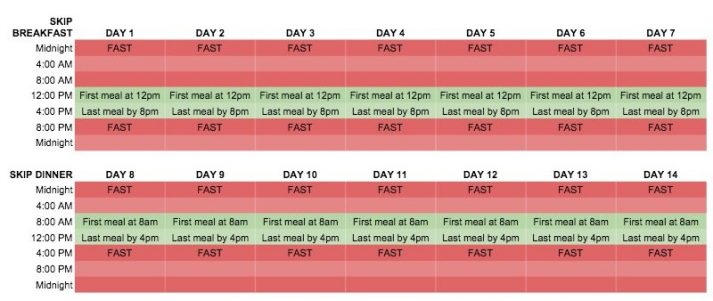
Adjust this window to make it work for your life:
- If you start eating at: 7AM, stop eating and start fasting at 3pm.
- If you start eating at: 11AM, stop eating and start fasting at 7pm.
- If you start eating at: 2PM, stop eating and start fasting at 10pm.
- If you start eating at: 6PM, stop eating and start fasting at 2AM.
#2) INTERMITTENT FASTING 24-HOUR PLAN
With this plan, you eat your normal 3 meals per day, and then occasionally pick a day to skip breakfast and lunch the next day.
Eat on a normal schedule (finishing dinner at 8PM) and then don’t eat until 8PM the following day.
If you can only do an 18 hour fast, or a 20 hour fast, or a 22 hour fast – that’s okay! Adjust with different time frames and see how your body responds.
Two examples: skipping breakfast and lunch one day of the week, and then another where you skip lunch and dinner one day, two days in a week.

These are just two popular strategies, though there are many variations of both that you can modify for yourself:
- Some people eat in a 4-hour window, others do 6 or 8.
- Some people do 20-hour fasts or 24-hour fasts.
- Another strategy is to eat only one meal a day (OMAD).
You’ll need to experiment, adjust to work for your lifestyle and goals, and see how your body responds. If there’s one thing we’ve learned after Coaching over 15,000 1-on-1 clients: there is no “one-size-fits-all” approach to exercise and nutrition that works for everyone, all of the time.
Let’s first get into the science here behind Intermittent Fasting and if you should consider it!
How Does Intermittent Fasting Work?

Now, you might be thinking: “okay, so by skipping a meal, I will eat less than I normally eat on average (2 meals instead of 3), and thus I will lose weight, right?”
All things being equal, yes.
By cutting out an entire meal each day, you are consuming fewer calories per week – even if your two meals per day are slightly bigger than before. Overall, you’re still consuming fewer calories per day.

In this example, you’re eating LARGER lunches and dinners than you normally do, but by skipping breakfast you’ll consume 500 less calories per day.
And thus, weight loss!
However, that doesn’t mean this works 100% of the time, for everyone. By understanding the underlying mechanism of weight loss (i.e. calorie deficit), we can better understand how our dieting strategy is affecting our behavior. Then we know if this strategy will work for us or not.
In the case of intermittent fasting, by condensing the eating window, many people feel more full and naturally eat less (like in the example above.)
However, it’s also totally possible for somebody to be so hungry as a result of fasting that they overconsume calories during that same period, which would result in weight gain instead of weight loss.
If you were reliant on the idea that “Intermittent Fasting works for weight loss” – full stop – you could be easily discouraged if it didn’t work.
You might think: “Is my metabolism broken?” But because we know that intermittent fasting is one dieting strategy that CAN work for weight loss if it helps you stick to a caloric deficit more easily, you’re empowered to decide if this is a good fit for you. Eureka!
This is highlighted in a recent JAMA study[2] in which both calorie-restricted dieters and intermittent fasters lost similar amounts of weight over a year period.
You might be thinking: “Ok, ok, I get it. Caloric deficit. But what about the timing of meals – can’t that also influence how your body reacts?”
Yes, your body operates differently when “feasting” compared to when “fasting”. But it’s important to understand how this fits into the big picture.
When you eat a meal, your body spends a few hours processing that food, burning what it can from what you just consumed.
Because it has all of this readily available, easy-to-burn energy (thanks to the food you ate), your body will choose to use that as energy rather than the fat you have stored.
During the “fasted state” (the hours in which your body is not consuming or digesting any food) your body doesn’t have a recently consumed meal to use as energy.
Thus, it is more likely to pull from the fat stored in your body as it’s the only energy source readily available.
However, when we compare the differences in energy used from body fat over an entire day, that’s entirely dependent on the total calories consumed. So while your body is more likely to pull energy from a recent meal, and will rely on fat stores once that energy runs out, if you eat the same amount of calories throughout the day, the result is the same amount of energy pulled from fat. It all balances out in the end.
The same goes for working out in a “fasted” state.
Without a ready supply of glucose and glycogen to pull from (which has been depleted throughout your fasted state, and hasn’t yet been replenished with a pre-workout meal), your body is forced to adapt and pull from a source of energy that it does have available: the fat stored in your cells.
While many of us get excited about the idea of being in a “fat-burning mode”, the same principle holds. If we burn an equal amount of calories, whether fasted or not, the result is less total energy stored in our fat cells at the end of the day. (There’s even an argument for athletes whose sports require glycogen to be readily available to meet their energy demands – making sure these stores are never depleted is important so an athlete doesn’t ‘bonk’ in the middle of their competition.)
Hopefully, you can see how easy it is to take a true fact of our biology (we burn more fat from fat stores when in a fasted state) and extrapolate it to seem more than it is. The same goes for six meals a day!
The truth is, there isn’t a magic pill or solution that’s going to overcome the basics. The best reason to do Intermittent Fasting is because you like it and it fits within your lifestyle.
TL/DR: Fasting can help promote weight loss and muscle building when done properly ~ though it isn’t the ONLY method that works.
Should I Eat 6 Small Meals a Day?

There are a few main reasons why diet books recommend six small meals:
1) When you eat a meal, your body does have to burn extra calories [9] just to process that meal. So, the theory is that if you eat all day long with small meals, your body is constantly burning extra calories and your metabolism is firing at optimal capacity, right? Well, that’s not true.
Whether you eat 2000 calories spread out throughout the day, or 2000 calories in a small window, your body will burn the same number of calories processing the food [10].
So, the whole “keep your metabolism firing at optimum capacity by always eating” sounds good in principle, but reality tells a different story.
2) When you eat smaller meals, you might be less likely to overeat during your regular meals. I can definitely see some truth here, especially for people who struggle with portion control or don’t know how much food they should be eating.
However, once you educate yourself and take control of your eating, some might find that eating six times a day is very prohibitive and requires a lot of effort. I know I do.
Also, because you’re eating six small meals, I’d argue that you probably never feel “full,” and you might be MORE likely to eat extra calories during each snack.
This is why personal preference is so important when picking a diet strategy that works for you.
Although grounded in seemingly logical principles, the “six meals a day” doesn’t work for the reason you think it would (#1), and may feel prohibitive to prepare and eat 6 times a day (#2). Other people may find that 6 meals a day fits them perfectly. If you find what works for you, that rules!
If we think back to caveman days, we’d have been in serious trouble as a species if we had to eat every three hours. Do you think Joe Caveman pulled out his pocket sundial six times a day to consume his equally portioned meals?
Hell no! He ate when he could, endured and dealt with long periods of NOT eating (no refrigeration or food storage) and his body adapted to still function optimally enough to still go out and catch new food.
A recent study (written about in the NYT, highlighted by LeanGains) has done a great job of challenging the “six-meals-a-day” technique for weight loss [11]:
There were [no statistical] differences between the low- and high- [meal frequency] groups for adiposity indices, appetite measurements or gut peptides (peptide YY and ghrelin) either before or after the intervention. We conclude that increasing meal frequency does not promote greater body weight loss under the conditions described in the present study.
That’s why we made this:

Should I Try intermittent fasting? (4 Big Benefits)

Now that we’re through a lot of the science stuff, let’s get into the reality of the situation: why should you consider Intermittent Fasting?
#1) Because it can work for your goals. Although we know that not all calories are created equal, caloric restriction plays a central role in weight loss.
When you fast, you are potentially making it easier to restrict your total caloric intake over the course of the week, which can lead to consistent weight loss and maintenance.
#2) Because it simplifies your day. Rather than having to prepare, pack, eat, and time your meals every 2-3 hours, you simply skip a meal or two and only worry about eating food in your eating window.
It’s one less decision you have to make every day.
It could allow you to enjoy bigger portioned meals (thus making your tastebuds and stomach satiated) and STILL eat fewer calories on average.
It’s a point that Coach Matt makes in this video on intermittent fasting:
#3) It requires less time (and potentially less money). Rather than having to prepare or purchase three to six meals a day, you only need to prepare two meals.
Instead of stopping what you’re doing six times a day to eat, you simply only have to stop to eat twice. Rather than having to do the dishes six times, you only have to do them twice.
Rather than having to purchase six meals a day, you only need to purchase two.
#4) Plus, Wolverine does it:
If adamantium-clawed superheroes do Intermittent Fasting, it can probably work for you too, if you can make it work for your particular lifestyle and situation!
What Are the Negative Effects of intermittent fasting?

It’s important to understand Intermittent Fasting is NOT a cure-all panacea.
Let’s talk about some of the potential drawbacks of Intermittent Fasting:
#1) If you skip breakfast, you might be so hungry from this that you OVEREAT your other meals, which can lead to weight gain. The important thing here is that with an intermittent fasting plan, you’re eating fewer calories than normal because you’re skipping a meal every day (if your goal is weight loss.)
In other words, don’t delude yourself into thinking that if you skip breakfast and then eat 4,000 calories of candy bars for lunch and dinner that you will lose weight.
This is simply a math and behavior strategy for giving yourself fewer chances to overeat and put your body into a caloric surplus.
(If you struggle with portion control, figure out your calorie goals and track your calorie intake in your meals to make sure you’re not overeating.)
#2) Skipping meals can result in feelings of lethargy, hunger, and “hangriness”!
If you eat breakfast every morning, your body expects to wake up and eat food.
Once you retrain your body to NOT expect food all day every day (or first thing in the morning), it’s possible that these side effects become less of an issue. In addition, ghrelin (a hormone that makes you hungry [13]), is actually lowest in the mornings and decreases after a few hours of not eating.
#3) Intermittent Fasting can be more complex for people who have issues with blood sugar regulation, suffer from hypoglycemia, have diabetes, etc. If you fit into this category, check with your doctor or dietitian before adjusting your eating schedule.
#4) Intermittent Fasting can affect women differently: there’s a whole section dedicated to that here.
Can I Build Muscle and Gain Weight While Intermittent Fasting? (Pros and Cons)

It is possible to build muscle and strength while Intermittent Fasting, though it’s not inherently superior to building muscle and strength while following a traditional eating pattern.
(We have our big “how to build muscle” guide, in addition to a whole “Strength 101” series – and I’d recommend you read those if you’re looking for a place to start strength training.)
Personally, I did intermittent fasting from 2015 to 2020 while building muscle and strength:
Let’s talk first about the nutritional strategy first, and then we’ll get into the exercise portion.
Here’s how I built muscle while simultaneously fasting: In order to gain weight and build muscle, I had to be in a caloric surplus.
And because I was not eating for 16 hours, that meant I was cramming 3000 nutritious calories into an 8 hour window, which often left me feeling bloated and overly full.
- 11 AM Work out with heavy strength training in a fasted state.
- 12 PM Immediately consume 1/2 of my calories for the day (a regular whole-food meal, followed by a calorie-dense homemade protein shake).
- 7 PM Consume the second portion of my calories for the day in a big dinner.
- 8 PM – 12 PM the next day: Fast for 16 hours.
After following this strategy for a number of years, I gave up fasting in 2019, and instead consumed my calories throughout the day.
Here’s a different strategy for Fasted Muscle Building: my friend Nate Green packed on a crazy amount of muscle while fasting for a full 24 hours on Sundays. [15]
Let’s now talk about strength training!
If you want to build muscle while fasting, you need to work out. Specifically, by lifting heavy, so here are a few workout options!
#1) “Build Your Own Workout Routine” and get your hands dirty. Our guide will walk you through building a full-body exercise program in 10 simple steps.
#2) Follow our Strength Building Guide and start training today. You’ll want to do lots of heavy compounds lifts:
How to tie it all together: pick up heavy things, eat enough protein, and consume enough calories, and you’ll build muscle and strength.
Should You Do Intermittent Fasting and the Keto Diet?

We have a crazy extensive guide on the Keto Diet in case you’re not familiar with it, so here it is in a nutshell:
By only eating fat and protein, your body must adapt to run on fat for fuel instead of carbohydrates. In the absence of carbs/glucose, your body converts fats to ketones and uses them for fuel.
This process is called “ketosis,” and there are two ways for a body to enter ketosis:
- Eating in a way that induces ketosis (very low carb, high fat).
- Fasting…Hey, that’s what you’re reading about right now!
We actually have an amazing success story here on Nerd Fitness, Larry, who followed our strategies, went Keto and start intermittent fasting. He ended up losing weight, getting stronger, AND overcame the challenges of rheumatoid arthritis (click on the image for his story)!

Why Keto and Fasting can work: eating Keto can be really challenging. And every time you eat, it’s an opportunity to do it wrong and accidentally eat foods that knock you out of ketosis.
You’re also tempted to overeat.
So, by skipping a meal, you’re eliminating one meal, one decision, one chance to screw up.
Note: if you’re thinking “Steve, am I losing weight because I’m skipping 1/3rd of my meals for the day, AND eliminating an entire macronutrient?”, then you’d be right.
Both Keto and IF have secondary effects that could also be factoring in – physiological benefits which I explain in both articles.
Your value may vary!
You need to decide what works for you.
You probably won’t become “keto-adapted” (your body running on ketones) just skipping breakfast every day – your body will still have enough glucose stored from your carb-focused meals for lunch and dinner the day before.
In order to use fasting to enter ketosis, the fast needs to be long enough to deplete your carb/glucose stores, or you need to severely restrict carbohydrates from your meals in addition to IF in order to enter ketosis.
MORAL OF THE STORY: Experiment and try different strategies that will work for you.
By skipping a meal or minimizing carbohydrate intake, you’re more likely than not to lose weight:
- You can do intermittent fasting without eating a Keto Diet and lose weight.
- You can do a Keto Diet without intermittent Fasting and lose weight.
- You can combine them and lose weight.
- You can do neither and lose weight.
Sticking with Keto is BRUTALLY difficult, and probably not the right diet for 98% of the planet. Those people would be better off following our “Start Eating Healthy” guide with small changes.
Does Intermittent Fasting Have Different Effects on Men and Women?

The quick answer is: “yes, Intermittent Fasting can affect men and women differently.”
Anecdotally, we have many women in our online coaching program that swear by Intermittent Fasting, while others have had adverse effects.
Let’s dig into the science and studies.
A recent PubMed summary concluded that “fasting can be prescribed as a safe medical intervention as well as a lifestyle regimen which can improve women’s health in many folds [18].
Now, in that extract, many of the studies cited are focused on specifically calorie restriction (and not just fasting), and they also say that “future studies should address this gap by designing medically supervised fasting techniques to extract better evidence.”
Digging into the PubMed Archives brought me to the following conclusions [19]:
One small study (with 8 men and 8 women, all non-obese) resulted in the following: “Glucose response to a meal was slightly impaired in women after 3 weeks of treatment, but insulin response was unchanged. Men had no change in glucose response and a significant reduction in insulin response.”[20]
Another small study (8 women) studied the effects on their menstrual cycles after a 72-hour fast – which is significantly longer than any fast recommended in this article: “in spite of profound metabolic changes, a 72-hour fast during the follicular phase does not affect the menstrual cycle of normal cycling women.” [21].
Yet another study tracked 11 women with 72-hour fasts (again, longer than we’d recommend) and it found that “Fasting in women elicited expected metabolic responses – included increased cortisol (a stress hormone) – and apparently advanced the central circadian clock (which can throw off sleeping patterns). [22]
Those studies above, in working with small sample sizes, and different types of fasting than recommended here, would lead me to believe that fasting affects men and women differently, and that many of the weight loss benefits associated with intermittent fasting (that affect insulin and glucose responses) work positively for men and negatively for women.
There are also a series of articles[23] out there that dig into the potential reproductive health issues, stress challenges, induction of early-menopause [24] associated with fasting (and calorie restriction) for women.
Precision Nutrition – a great resource – recommends not attempting Intermittent Fasting as a woman if:
- you’re pregnant
- you have a history of disordered eating
- you are chronically stressed
- you don’t sleep well
- you’re new to diet and exercise
The challenge associated with all of this is that there aren’t enough long-term studies, with large enough sample sizes, specifically targeting female humans, with relation to the different types of Intermittent Fasting.
It does appear that men and women will have different experiences with intermittent fasting; we’re all unique snowflakes (yep, especially you), and your body will be affected by intermittent fasting differently than the person next to you.
There is enough evidence as cited in the articles and studies above that would give me pause to recommend Intermittent Fasting for women, especially if you are considering getting pregnant in the near term.
If you are looking to attempt fasting for weight loss reasons, my research has shown me that Intermittent Fasting could be less effective for women than men with regards to weight loss, and thus you would be wise to keep your efforts elsewhere:
- Focusing on the total calories and quality of your food (here’s how to eat better).
- Start exercising regularly!
- Make sure you are getting enough sleep.
Now, if you’ve read the above warnings, you are still curious about Intermittent Fasting, and you want to give it a try as a female, that is your choice!
You know your body best.
So, get blood work done, speak with your doctor and get a check-up.
Give intermittent fasting a shot, track your results, and see how your body/blood work changes as a result of Intermittent Fasting and decide if it’s right for you.
Your mileage may vary, so speak with a doctor or find a doctor versed in intermittent fasting plans and treat it like an experiment on yourself!
Top 5 Questions about Intermittent Fasting
1) “Won’t I get really hungry if I start skipping meals?”
As explained above, this can be a result of the habits you have built for your body. If you are constantly eating or always eat the same time of day, your body can actually learn to prepare itself for food by beginning the process of insulin production and preparation for food.
After a brief adjustment period, your body can adapt to the fact that it’s only eating a few times a day. The more overweight you are, and the more often you eat, the more of an initial struggle this might be.
Remember, your body’s physical and cognitive abilities most likely won’t be diminished as a result of short-term fasting.[25]
2) “Where will I get my energy for my workouts? Won’t I be exhausted and not be able to complete my workouts if fasting?”
This was a major concern of mine as well, but the research shows this might not be the case: “Training with limited carbohydrate availability can stimulate adaptations in muscle cells to facilitate energy production via fat oxidation.”[26]
In other words, when you train in a fasted state, your body can get better at burning fat for energy when there are no carbs to pull from!
The caveat to this is that pulling energy from fat oxidation is a slower process than breaking down carbohydrates. If your workout is super intense (high-intensity interval training, MMA, even bodybuilding) – you’ll likely benefit from having more readily available energy to fuel your workouts for better performance.
3) “I like the idea of fasted training, but I work a regular 9-5 or a night shift and can’t train at 11AM as you do. What am I supposed to do?”
Depending on your training schedule, lifestyle, and goals, go back to the portion above where I talk about the 16/8 protocol and simply adjust your hours of fasting and feasting.
LeanGains digs into various options here, but here is really what you need to know:
- Don’t overthink this. If you can’t train until 5pm, that’s okay. Consume a small meal for lunch, or shift your Intermittent Fasting window to eat all of your meals in the 8 hours post-workout. Better to do that than abandon it as a lost cause and have 0% compliance.
- If you are an elite athlete, speak with a coach or nutritionist about your specific concerns and expectations. Otherwise, make intermittent fasting work for you Consider trying the 24-hour protocol below instead of the 16/8 protocol.
- If you train later in the day (say, 7pm) but break your fast before training (aka Lunch), make it a smaller meal focused around fats and protein – which should be a solid goal even if you aren’t Intermittent Fasting! Try to time your carb and big meal consumption to happen AFTER your workout.
- If you exercise BEFORE work, but then don’t eat until lunchtime: consider a protein supplement immediately after your workout, or simply wait until lunch to start eating. See how your body responds and adjust accordingly.
Do what you can, and don’t psyche yourself out! Get started and adjust along the way.
4) Will Intermittent Fasting cause muscle loss?
Good news: Our bodies are quite adept at preserving muscle even when fasting [27], and it turns out that protein absorption by our body can take place over many many many hours.
Not only that, but you can even burn fat AND build muscle at the same time if you have the right system in place!
Protein consumed in a shorter period of time has no difference on the body compared to protein spread throughout the day.
5) How much should I eat while intermittent fasting?
Simple: Eat for your goals! You do know how many calories you should eat every day, right?
If your goal is weight loss, you still need to consume fewer calories than you burn every day to lose weight, full stop. If your goal is bulking up, you’ll need to consume more calories than you burn every day. Intermittent Fasting isn’t a cure-all, it’s a PART of the puzzle.
To start, begin intermittent fasting and eat your normal-sized meals and track your weight and performance. If you are losing weight and happy with the progress, keep doing what you’re doing! If you are NOT losing weight, you could be eating too much. It’s a message I really strike home in our guide “Why Can’t I Lose Weight?”
That’s why you should track your calories for a week, and then target a 10% reduction in calories and continue. Here’s a calculator for you to determine the amount of calories you need daily.
6 Tips and Tricks about Fasting

#1) Don’t freak out! Stop wondering: “can I fast 15 hours instead of 16?” or “what if I eat an apple during my fasted period, will that ruin everything?” Relax. Your body is a complex piece of machinery and learns to adapt. Everything is not as cut and dry as you think.
If you want to eat breakfast one day but not another, that’s okay. If you are going for optimal aesthetic or athletic performance, I can see the need to be more rigid in your discipline, but otherwise…freaking chill out and don’t stress over minutiae!
Don’t let perfect be the enemy of good when it comes to your intermittent fasting plan. It’s just one tool in your toolkit.
#2) Listen to your body during your strength training workouts. If you get lightheaded, make sure you are consuming enough water.
If you notice a significant drop in performance, make sure you are eating enough calories (especially fats and protein) during your feasting window.
And if you feel severely “off,” pause your workout. Give yourself permission to EASE into intermittent fasting and fasted workouts. This is especially true if you are an endurance athlete.
#3) Stay busy. If you are just sitting around thinking about how hungry you are, you’ll be more likely to struggle with this. For that reason, I time my fasting periods for maximum efficiency and minimal discomfort:
- My first few hours of fasting come after consuming a MONSTER dinner, where the last thing I want to think about is eating.
- When I’m sleeping: 8 of my 16 hours are occupied by sleeping. Tough to feel hungry when I’m dreaming about becoming a Jedi.
- When I’m busy: After waking up, 12 hours of my fasting is already done. I spend three hours doing my best work (while drinking a cup of black coffee), and then comes my final hour of fasting: training.
#4) Zero-calorie beverages are okay. I drink green tea in the morning for my caffeine kick while writing. If you want to drink water, black coffee, or tea during your fasted period, that’s okay. Remember, don’t overthink it – keep things simple! Although be aware that Dr. Rhonda Patrick over at FoundMyFitness believes that a fast should stop at the first consumption of anything other than water, so experiment yourself and see how your body responds.
If you want to put milk in your coffee, or drink diet soda occasionally while fasting, I’m not going to stop you. Remember, we’re going for consistency and habit-building here – if milk or cream in your coffee makes life worth living, don’t deprive yourself.
There are MUCH bigger fish to fry with regards to getting healthy than a few calories here and there during a fast.
80% adherence that you stick with for a year is better than 100% adherence that you abandon after a month because it was too restrictive.
If you’re trying to get to a minimum bodyfat percentage, you’ll need to be more strict with overall calories – until then, however, do what allows you to stay compliant!
#5) Track your results, listen to your body:
- Concerned about losing muscle mass? Keep track of your strength training routines and see if you are getting stronger.
- Buy a cheap set of body fat calipers and keep track of your body fat composition.
- Track your calories, and see how your body changes when eating the same amount of food, but condensed into a certain window.
#6) Don’t expect miracles. Yes, Intermittent Fasting can potentially help you lose weight, increase insulin sensitivity and growth hormone secretion (all good things), but it is only ONE factor in hundreds that will determine your body composition and overall health. Don’t expect to drop to 8% body fat and get ripped just by skipping breakfast.
You need to focus on building healthy habits, eating better foods, and getting stronger.
This is just one tool that can contribute to your success.
Getting Started with Intermittent Fasting: Next Steps

Intermittent fasting can potentially have some very positive benefits for somebody trying to lose weight or gain lean body mass.
Men and women will tend to have different results, just like each individual person will have different results. The ONLY way to find out is through a conversation with your doctor and self-experimentation.
There are multiple ways to “do” an Intermittent Fasting Plan:
- Fast and feast regularly: Fast for a certain number of hours, then consume all calories within a certain number of hours.
- Eat normally, then fast 1-2x a week: Consume your normal meals every day, then pick one or two days a week where you fast for 24 hours. Eat your last meal Sunday night, and then don’t eat again until dinner the following day.
- Fast occasionally: probably the easiest method for the person who wants to do the least amount of work. Simply skip a meal whenever it’s convenient. On the road? Skip breakfast. Busy day at work? Skip lunch. Eat poorly all day Saturday? Make your first meal of the day dinner on Sunday.
After that, get started! Take photos, step on the scale, and track your progress for the next month.
See how your body responds.
See how your physique changes. See how your workouts change.
And then decide if it’s something you want to keep doing!
4 years later, I have no plans on going back to eating breakfast. Sorry General Mills and Dr. Kellogg!
Thanks for reading, and I hope we gave you ALL the information you wanted about Intermittent Fasting, it’s underlying mechanisms for success, and reasons it may (or may not) work for you!
-Steve
PS: Before you take off, grab our Intermittent Fasting Worksheet to help you start your fasting practice:
PPS: Make sure you check out the rest of our guides on losing weight:
- The 5 Rules of Weight Loss
- How to Start Eating Healthy (Without Being Miserable)
- 9 Strategies for Losing Weight Quickly
###
Photo Source:[29]
The post Intermittent Fasting Guide: Myths, Facts, & Strategies first appeared on Nerd Fitness.
]]>The post 5 Best Strength Training Workout Routines For Beginners (Home & Gym) first appeared on Nerd Fitness.
]]>
Want to get strong like these LEGO lifters but don’t how to start?
In this Beginner’s Guide to Strength Training (part of our Strength 101 series), you’ll have both the confidence to start getting strong with resistance training AND a plan to follow.
These are the exact strategies we use with our Online Coaching Clients to help them start strength training, and I’m excited to cover everything you need.
We’ll be digging into the following:
- How do I start strength training or resistance training?
- What are some examples of strength training?
- Which strength training program is right for me?
- 5 best strength training workouts for beginners.
- How much weight should I lift?
- The 9 best strength training exercises.
- How to know you’re doing an exercise properly (form checks)
- Strength training for weight loss.
- “Just TELL ME what strength program I should do.”
By the way, we’ve combined this article along with the rest of our strength articles into a “Strength Training 101: Everything You Need to Know” guide.
Grab it free when you join the Rebellion by putting your email in the box below.
How Do I Start Strength Training?

Welcome to the first day of the rest of your life.
You’ll look back years from now and thank “Past You” for starting strength training today.
And I promise, you WILL start strength training today.
After all, strength training or resistance training doesn’t need to be scary or overcomplicated!
Strength training really comes down to two things:
#1) Movement of any weight against “resistance”(including your body weight) – Doing ANY exercise that pushes your muscles outside of their comfort zone, forcing them to rebuild stronger to prepare for the next challenge.
#2) Progressive overload: doing slightly more than last time (lift heavier weight or do 1 more rep) consistently. Your muscles will break down slightly during your workout, and then rebuild themselves as you rest and recover to be stronger and able to handle more the next time.{1}}[[1]]Powers SK, Howley ET. (2011). Exercise physiology: Theory and application to fitness and performance. New York: McGraw-Hill Humanities/Social Sciences/Languages.[[1]]
Coach Jim explains the ins and outs of progressive overload in this video:
That’s all there is to it: do some resistance training and attempt to make it more and more challenging, and you’ll grow stronger.[2]
- This means if you do ONE push-up off of a countertop right now, technically you’ve done a strength training workout.
- It also means if you then do TWO countertop push-ups tomorrow, then you are officially following a strength training routine.
In other words…

Now, it’s SCIENCE TIME!
While learning the strength training exercises, you are allowing for proper communication to develop between your neuromuscular systems.

More efficient communication between your neuromuscular systems will result in something known as “proper motor unit recruitment.”
You may be asking yourself: what is a motor unit?
That’s okay because I was asking myself this same question.
A motor unit is a single motor neuron and the muscle fibers it innervates.
You can think of two different types of motor units:[3]
- We all have small motor units, meaning that a single motor neuron innervates relatively few muscle fibers, and these smaller motor units are good for precise and detailed movements (e.g., moving your fingers).
- We all also have large motor units, meaning that a single motor neuron innervates hundreds of muscle fibers, and these larger motor units are good for generating a lot of force (e.g., getting larger muscle groups like the quads to generate a lot of force to help in sprinting).
When you start strength training, you really are helping your muscles communicate better together.[4]
How cool is that?
Now, there are many different “strength training” and “resistance training” paths.
Like a “skill tree” in a video game (with branching paths and progressions), you can progress up one path, and mix and match movements from others depending on the situation.
These paths depend on your goals and what equipment you have available to you.
What Are Some Examples of Strength Training?

Let’s chat about a few different types of strength training.
#1) BODYWEIGHT TRAINING
Bodyweight training is simply doing an exercise in which your own body is the “weight” you are “lifting.” For example, you might do a squat, a push-up, or an inverted row. These are all bodyweight strength training exercises.
This is the place where we start many of our 1-on-1 clients on their strength training journey.
Why? Two big reasons:
A) You always have your body with you (unless you are a ghost, in which case, this is awkward). This means you can work out ANYWHERE with bodyweight training:
- Our Beginner Bodyweight Workout Routine in your living room.
- Our Hotel Workout in a hotel (obvi).
- Our Park Workout in a…well, you get the point.
B) Using your body for resistance training is the most “human” thing ever! By learning to push and pull and hang and squat and lunge, you are doing what your body is literally designed to do.
And by building strength, you’re making yourself antifragile and less injury-prone.
For many of our clients, bodyweight exercises are right in that sweet spot of being challenging while lowering the barrier to entry to get started.
Bodyweight training isn’t as easy to ‘scale’ the difficulty as some of the other strength training methods (“put more weight on barbell”), but you can get REALLY strong with just bodyweight training.
For example, you can start with knee push-ups, then go to regular push-ups, then elevated push-ups, then even up to things like handstands and handstand push-ups.
You just have to know HOW and WHEN to scale up (we can help there too).
#2) DUMBBELL TRAINING

Dumbbells are a great first step into the world of weight training and strength training:
- Most gyms will have dumbbells, even if it’s a basic gym in your apartment complex.
- An adjustable set of dumbbells doesn’t take up a lot of room, which means you can have a pair at home without a large footprint.
- Dumbbells make it easy to add difficulty to a bodyweight movement: holding dumbbells while doing lunges, for example.
- Dumbbell exercises can be less intimidating than barbell training for some, and are a step towards barbell training.
- Dumbbells have an added stabilization challenge,[4] and will point out muscle imbalances pretty easily (“oh my right arm is stronger than my left arm.”).
- Dumbbells allow for single-arm and single-leg exercises to be performed. This can allow you to strengthen any muscle imbalances and can come in handy, especially after an injury.
- You can scale easily. Once the 10-pound weights become too easy, pick up the 15-pound ones!
#3) KETTLEBELL TRAINING

A kettlebell is essentially a cannonball with a handle on it. They come in any weight imaginable, don’t take up a lot of room, and can be used in dozens of ways for a great compact workout.
Our 20-minute kettlebell workout has 8 simple exercises you can do with just one weight.
Although there are “adjustable kettlebells,” you’ll most likely be working with a single kettlebell, and then adjusting your movements for “progressive overload” (making the workout slightly more difficult each time).
If you are a member of a gym, they’ll probably have multiple kettlebells that you can use to level up.
#4) BARBELL TRAINING
Regardless of sex or gender age, if your goal is to get strong quickly, use 20 seconds of courage and get comfortable training with a barbell (I’ll help you, I promise):
- “Progressive overload” is easy – you simply add weights to either side of the bar, allowing you to progressively lift more and more weight each week.
- It’s much easier to go heavy safely – especially for lower body movements like the squat and the deadlift.
The biggest downside to barbell training is that to train at home, you need to have purchased a squat rack, a barbell, a bench, and enough weights for your house or garage (which can be an expensive investment, especially when starting out!).
If you want to try it before you buy it, you definitely will need to join a gym.
#5) MACHINE TRAINING
Although they’ve gotten a bad rap in previous years, machines are another excellent entry point into strength training! These are going to be one of the most common options at gym franchises like Planet Fitness or Anytime Fitness, and usually come with instructions on the side for how to set up and perform the exercise. They have the benefit of being able to add weight quickly to scale, and usually require less stability to perform. (I.e. you’re not trying to balance and coordinate the movement at the same time as lifting it as much.)
While we still encourage our clients to do free-weights to build stability, when you’re first getting started having the extra guidance from a machine can be helpful!
WHICH RESISTANCE TRAINING PATH IS RIGHT FOR YOU?
Not sure which path to pick? You’re not alone – this stuff can be overwhelming. The truth is that you’ll probably mix and match a variety of these different options as you go. However, if you’re unsure, we recommend starting with bodyweight exercises. Then you can add in one dumbbell or machine movement at a time to introduce more variety and options for yourself!
Want to take the thinking off of your plate and have a program designed with your specific needs and equipment in mind? Check out our 1-on-1 Coaching Program. We get to know you and your goals, check your form via video, and make adjustments based on your progress!
Which Strength Training Program is Right for Me?

So, what’s the best workout program to start as a beginner?
Realistically, it’s the one that you will ACTUALLY do.
We have a saying that we love around here: “Start where you are. Use what you have. Do what you can.”
Barbell training might be optimal in terms of building pure strength quickly, but if you don’t see yourself getting to the gym regularly – or you’re too self-conscious to enter the free weight section (for now) – no problem!
Start with bodyweight training.[5]
Conversely, bodyweight training might seem convenient and easy to start now, but if you can’t motivate yourself to work out at home, you might be better off joining a gym.[6]
So let’s get you a workout program!
As we cover in our “How to Find the Perfect Workout Plan (for you)”: MOST beginners will be best served by following a “full-body” or “total body” routine, 2 to 3 times per week, with a day of rest in between each workout.[7]
This full-body workout will have 4-5 big compound movements.
A compound movement is an exercise that recruits LOTS of muscles simultaneously and forces your body to work in unison. These compound exercises are considered multi-joint exercises meaning that they involve more than a single muscle group.[8]
An example would be the barbell squat, which recruits every muscle in your core, butt, and legs to work together to lift the weight.

This is WAY more efficient – and effective at building pure strength – than doing 5 different isolated leg exercises.[9]
Why do 5 exercises when 1 exercise will get you better results in 20% of the time?
In order to balance our full-body workouts, we want to make sure we pick exercises that spread the work out across the entire body. One helpful way to do this is to think of exercises as fitting into one of three different ‘buckets’:
- Push Exercises – these are exercises that generally work the front of your upper body. Things like push-ups, bench press, and overhead press all fit in this category.
- Pull Exercises – these are exercises that generally work the back of your upper body. This includes rows, pull-downs, and chin-ups.
- Lower Exercises – these are exercises that work your legs. Squats, deadlifts and lunges are some of the biggest bang for your buck exercises here.
By balancing your workouts across all three of these buckets, you get a well-rounded full-body strength program!
I can already tell what you’re next question will be: but how many sets and reps of each of these exercises should I do as a beginner?
As we explain in our “How Many Sets and Reps” guide:
- Reps in the 1-5 range build super dense muscle and strength.
- Reps in the 6-12 range build equal amounts of muscular power, strength, and size.
- Reps in the 12+ range primarily build muscular endurance and size and also cardiovascular health.[10]
If you want more, Coach Jim breaks down different set and rep ranges in this video:
Many beginner strength programs will encourage you to keep things simple, doing just 5 sets of 5 reps for each exercise.
Personally, I encourage people to aim for a weight that they can lift for 8-10 reps. This gives you a chance to really work on your form and lift safely!
The max lifts will come later, my friend. You gotta learn to walk before you can run!
To recap, our recommendations as you get started are:
- Pick a type of strength training that you have access to and are excited to try (body weight, barbell, etc.)
- Perform 2-3 full body workouts per week, with at least 1 day of rest in between each
- Pick 4-5 compound exercises that work multiple muscles at once for each workout
- Perform 8-10 moderately challenging reps of each exercise for 1-3 sets
If your main goal is general fitness and fat loss, doing these exercises in a circuit training workout will likely help you reach your goals (make sure you see our section below for “strength training for weight loss”).[11]
If your main goal is to get stronger and/or put on muscle, following a more traditional, pure-strength-style gym workout is going to get you there faster.
TRUTH BOMB: ANY strength training workout will help you reach nearly any goal provided you do two things:
- Eat correctly for your goals too. How you eat will account for 80-90% of your success or failure when it comes to weight loss or bulking up.[12]
- Increase the difficulty of your workouts. This is that “progressive overload” stuff we were talking about earlier. Doing 1 more bodyweight squat, lifting 5 more pounds, or completing your circuit 10 seconds faster than the last workout. By forcing your body to constantly adapt, your muscles will never get complacent and have to keep burning extra calories and rebuilding themselves stronger.
The 5 Best Beginner Strength Training Programs

“Alright Steve, are there any ‘out of the box’ beginner workout programs I can start following now?”
Yup! Let me share with you some of our suggestions:
Here are 5 resistance training workouts you can follow TODAY. Pick the level that you feel most comfortable with, and then level up when you feel ready:
#1) BEGINNER BODYWEIGHT WORKOUT:
Our Beginner Bodyweight Workout has a variety of rep ranges to promote endurance, strength, and cardiovascular health. We’ve added new progressions and even created a handy tracking sheet for free if you sign up for our newsletter.
Complete one set of each exercise and then move directly to the next exercise:
- 10 assisted bodyweight squats
- 10 elevated push-ups
- 10 dumbbells rows (using a gallon milk jug)
- 15 to 30-second knee plank
- 10 bodyweight good mornings
- 20 walking jacks
- Repeat for 2 rounds
Once that feels easy and you want to level up, try this sequence:
- 20 bodyweight squats
- 10 push-ups
- 20 walking lunges
- 10 dumbbell rows (using a gallon milk jug)
- 15-second plank
- 30 Jumping Jacks
- Repeat for 3 rounds
Want to stick with bodyweight training? When you’re ready to level up, check out our advanced bodyweight training circuit.[13]
Otherwise, you can move on to weight training when you feel comfortable!
#2A) BEGINNER NERD FITNESS DUMBBELL WORKOUT
If you are just getting started with dumbbells and you’re looking for a beginner workout program to follow, this is an example of a workout that includes dumbbells with your bodyweight training:
- 10 goblet squats
- 10 push-ups
- 10 dumbbell rows per side
I knew you’d ask, so here is a Goblet Squat video explanation:
And here is our video on how to do dumbbell rows:
#2B) BEGINNER NERD FITNESS KETTLEBELL WORKOUT
Our Beginner Kettlebell Routine is a workout you do anywhere you have room to swing a kettlebell.
So, probably not in a phone booth or a closet or a bathroom stall. But other than that, pretty much anywhere else.
Complete 3 Kettlebell Workout Circuits:
- 8 Halos (each side)
- 10 Goblet Squats
- 8 Overhead Presses (each side)
- 15 Kettlebell Swings
- 8 Bent Over Rows (each side)
- 6 Front Rack Reverse Lunge (per side)
#3) BARBELL TRAINING: 2-DAY WORKOUT SPLIT
As we cover in our “How to Train in a Gym” guide (where we take you from “lost sheep” to “barbell badass”), this routine is a much more focused weight training, strength-building workout that gets your feet wet with barbell training. Click on ANY exercise to learn how to do it properly.
NF BEGINNER BARBELL STRENGTH WORKOUT: DAY A
Do 3 rounds of:
- 10 barbell squats
- 10 push-ups
- 10 bodyweight rows
NF BEGINNER BARBELL STRENGTH WORKOUT: DAY B
Do 3 rounds of:
Alternate between these 2-4x per week and there’s your program!
WHAT ARE SOME OTHER POPULAR STRENGTH TRAINING PROGRAMS?
#1) “Starting Strength” is considered the gold standard beginner barbell weight training program by many. We highly recommend you pick up the actual book if you are serious about barbell training – it’s one of the most important training books you can ever read.
#2) Strong Lifts 5X5: A solid workout program that starts you out very slow, with just the barbell, and helps you master form before you get too heavy. It also keeps things VERY easy with “do 5×5.” Strong Lifts has been around for a long time and is a solid program.
#3) Jim Wendler’s 5/3/1: This program allows you a little more freedom to do exercises that you enjoy, or work on personal weaknesses, because you choose some of the assistance work.
Note: You can modify any of the barbell training programs to be done with dumbbells, if that’s what you have at home!
Lastly, you can always write your own workout plan!
We do have our own 1-on-1 Online Coaching Program where you’ll work with a coach who will build a strength training workout program for your body type and goals, check your form on each exercise via video, and even help you plan out your nutrition too.
How Much Weight Should I lift?

We have a FULL resource on how to determine your starting weight for lifting, but I’ll give you the gist here.
The simple-to-learn but tough-to-implement answer: lift enough so that you can get through the set, but not too much that you have NO fuel left in the tank at the end.
And then, try to lift sliiiightly more than last time.
Here are two common questions on strength training:
#1) How much weight should I start with?
- If you are using dumbbells or a kettlebell, always err on the side of “too light” versus “too heavy.” You want to learn the movement correctly and build correct form.
- If you are training with a barbell, ALWAYS start with JUST the bar, no matter the exercise (By the way, a standard barbell weighs 45 pounds).
#2) How fast should I add weight to the bar?
Here’s what we teach all of our coaching clients: add the minimum amount of weight each week you can, even if you THINK you can lift more. It’s better to finish a workout full of momentum and say “I can do more!” than defeated and saying “That was too much, crapola.”
Think of it this way, even if you are adding just 5 pounds per week to the bar, within a year you would be lifting 300+ pounds!
The National Strength and Conditioning Association (NSCA) recommends a similar approach:[14]
- For less trained people (i.e., beginners), it is recommended that for upper body exercises you increase the load by 2 – 5 pounds and by 5 – 10 pounds for lower body exercises.
- For more trained people (i.e., advanced), it is recommended that for upper body exercises you increase the load by 5 – 10 pounds or more and by 10 – 15 pounds or more for lower body exercises.
So go SLOW. Even slower than the NSCA recommends if needed.
I even bought little half-pound weights and increased many of my lifts by just 1 pound per week. It’s a big part of how I transformed (jokingly) from Steve Rogers to Captain America.
The 9 Best Strength Training Exercises to Learn

If you’re new to all this “strength training” stuff, hopping into a program and going from zero to sixty might be a recipe for failure.
Instead, be patient, and take the time to learn these movements first.
I’m going to share with you the 9 best strength training exercises that every beginner should master (scroll down for full video and explanations!):
- 1. Push-up: uses every push muscle in your body (chest, shoulders, triceps)
- 2. Bodyweight squat: uses every muscle in the lower body (quads, hamstrings, glutes, core)
- 3. Bodyweight row: works every “pull” muscle and helps prepare you for a pull-up!
- 4. Pull-up or chin-up: the best “pull” exercise in history! Everybody should have a goal to get their first pull-up.
- 5. Bodyweight dip: advanced “push” movement that targets your push muscles (chest, shoulders, triceps) in a different way than push-ups.
- 6. Barbell squat: the best bang for your buck on muscle building. recruits nearly every push muscle in your whole body, and a great core workout.
- 7. Barbell deadlift: the favorite exercise of every coach at Nerd Fitness. Uses every “pull,” leg, and core muscle in your body.
- 8. Barbell benchpress: as basic and powerful as they come. Uses every “push” movement in your upper body and can get you strong as heck!
- 9. Barbell press: press the bar above your head! Targets shoulders and triceps more than the chest.
All of the exercises listed above are considered functional (closed-chain) exercises. That means they relate to our everyday movements and can be used to predict our success in sports, recreational and occupational activities, and activities of daily living.[15]
When attempting all of these above-listed exercises, aim to master the movement and perform the exercise through its entire range of motion (ROM).
Why?
Because it will decrease your risk for injury, activate all of the appropriate muscle groups, and result in greater muscle hypertrophy.[16]
Let’s go over these now.
Click on any of these exercises to get a FULL explanation of the movement, step-by-step:
1) The Push-Up: The best exercise you could ever do for yourself when it comes to using your bodyweight for push muscles (your chest, shoulders, and triceps):
2) The Bodyweight Squat: This exercise serves a dual purpose: it is the foundation for building strength AND helps build proper mobility. If you are going to ever do barbell squats, you need to work on hitting proper depth with a bodyweight squat first!
3) The Inverted Bodyweight Row: Until you can get your first pull-up or chin-up, these exercises are GREAT to start building your pull-muscle strength: your back, biceps, and forearms.
4) The Pull-Up and Chin-Up: Once you can support your bodyweight above the bar, the world becomes your playground. No strength training routine should be without pull-up or chin-up work! (Click here if you can’t do a pull-up or chin-up yet?)
5) The Bodyweight Dip: As you start to get stronger with push-ups and need to find a way to increase the challenge, consider doing dips – warning: these are very advanced, but incredible strength-building exercises.
And now we’re into the best weight training exercises:
6) The Barbell Squat: Probably the best exercise when it comes to building strength and muscle throughout your whole body. It also burns crazy calories and makes life better. This is a MUST:
7) The Barbell Deadlift: Maybe the best exercise of all time. Actually no, it IS the best exercise of all time. It’s certainly the most primal: “pick the weight up off the ground. Done.”
This is a very technical lift, so make sure you read our article on how to do it with proper form:
8) The Barbell Press: Press a barbell above your head. This recruits all of the muscles in your chest, shoulders, and arms in order for you to lift the weight over your head.
As a bonus, you need to really flex and brace your core, which gets those muscles working too.
9) The Barbell Bench Press. Lie on a bench, and lower a barbell until it almost touches your chest. Pause, and press it back up towards the sky. Repeat! And get strong.
NOTE: All exercises were explained according to the guidelines that have been established by the NSCA.[17]
Your mission, should you choose to accept it: commit to trying ONE of these movements in the next week. Use 20 seconds of courage, recruit a friend who has lifted or trained before, and try your best.
How to Know You’re Doing a Strength Training Movement Properly (Form Checks)

Always start out with just your body’s weight and make sure your movement is correct!
- If it’s a barbell movement, use a broomstick (or PVC Pipe).
- If it’s a dumbbell movement, use two sections of PVC or something else that is light and small to simulate a dumbbell.
When it comes to movements like squats, deadlifts, pull-ups, bench presses, your form is crucial. Develop good habits with lightweight and you will save yourself months of frustration later and will protect you from injury.[18]
If you’re struggling with certain elements of a movement, don’t get frustrated! Remember, proper communication between your neuromuscular systems needs to develop.
Things will start to improve.[19]
How do you know if your movement is correct?
Do regular video form checks! Record yourself and watch the video.
Alternatively, an expert reviewing your specific movement can be invaluable.
If you’re looking for someone who can do video form checks, provide feedback, and adjust your workouts based on your progress, you can check out our 1-on-1 Online Personal Training!
I’ve had an online coach for years and it’s changed my life.
You could also get expert guidance in person: Look around at your local strength and conditioning gyms and see if you could hire a coach (here’s how to find a good personal trainer) for one or two sessions just to go over the basic movements.
If you can’t do either of those two options, no big deal! Videotape yourself and compare it to the videos here in the articles. You can also post your video to our private Facebook community and let other friendly nerds help you out.
When I started, I really liked practicing all of the movements at home because I could watch a video online at the same time as I was watching myself do it in a mirror. Studies have found this can actually help![20]
Strength Training for Weight Loss

So you’re looking to lose weight, and tired of hours of cardio (me too).
And you’re wondering if strength training for weight loss – by following one of the workouts in this guide is a viable solution.
Yes, Strength training will help you lose weight IF you do two key things for effective weight loss:
- Calorie restriction: eating fewer calories than you burn every day[21]
- Strength training with progressive overload (picking up heavier stuff)
As we point out in our “Cardio vs Intervals vs Weight Training” article, strength training is the MOST efficient method for weight loss.
Not only that, but you can find study after study after study that shows you the benefits of strength training for weight management when combined with “calorie restriction.”[22]
As we cover in our “Why Can’t I Lose Weight?” article, here’s why eating a caloric deficit and strength training is SO magical when combined:
When you strength train – by picking up something heavy – your muscles are “broken down” during the exercise itself, and then they rebuild themselves stronger over the next 24-48 hours.
Guess what happens during those 24-48 hours?
Your body will divert as many calories consumed as necessary to “Rebuild Muscle!”[23]
It also diverts additional calories to “Burn as Fuel” to handle this increased “muscle rebuilding” activity.
This means two amazing things:
- Your metabolism is revved up for this time period, burning more calories than normal.
- Rebuilding muscle is a calorie-taxing activity!
Not only that, but when you eat a caloric deficit, your body doesn’t have enough calories to fuel all the day’s activities. In these instances, your body will pull from your stored fat to make sure all the work still gets done.
This is the trifecta of physical transformation victory:
- You get stronger and keep the muscle you have.
- You burn through the fat you’re trying to get rid of.
- You’re decreasing your body fat percent and keeping your muscle = look good naked.
In other words, strength training + eating right is the BEST path for weight loss out there! And yes, in certain situations, you can actually lose weight AND build muscle at the same time.
Coach Matt explains how to gain muscle WHILE losing fat in this video:
So how do you put this into practice? Pick one of the strength workouts in this article. Calculate your daily caloric needs. Learn about healthy eating. And start.
In other words…
Pick up something heavy, and eat a vegetable.
“Just Tell Me What Strength Training Program to Follow!”

Okay! Unless you are collecting underpants, you should now have a workout program you want to try out!
“Steve, this is a lot, can you just TELL me what to do?”
Okay fine.
Here are the steps again for you:
STEP #1: PICK YOUR WORKOUT PATH:
A) If YOU ARE TRAINING AT HOME. Pick one of these 3 based on what equipment you have:
- Beginner Bodyweight Workout (no equipment)
- Kettlebell Beginner Workout
- Dumbbell Division Workout (Level 3 of Gym Guide)
B) IF YOU ARE TRAINING IN A GYM: Amazing! I love gyms.
Read our “How to train in a gym” guide and go from Level 1 to Level 6 over the next month. Gym closed? Here’s how to build a home gym.
STEP #2: TRY A NEW EXERCISE: In addition to following a workout program, I’m gonna push outside of your comfort zone – that’s where real growth happens.
Learn ONE new movement this week.
Pick one of the exercises below and try it out!
- How to squat
- How to deadlift
- How to bench press
- How to do the overhead press
- How to do a pull-up
- How to do a push-up
- How to do an inverted row
Here are 42 bodyweight exercises you can do too.
STEP #3) HIRE A YODA: If you are somebody who just wants to be told exactly what to, how to train for your goals, and are good at following directions, consider hiring a coach.
I’ve been working with an online coach since 2014 and it has changed my life – and I do this stuff for a living!
- Read our guide on “Is a personal trainer worth it?”
- Consider the NF Online Coaching Program!
No matter what you do today:
Don’t be afraid of doing anything wrong – truth be told, the majority of the people in the gym don’t have any idea what they are doing, and are just as nervous as you are!
Muster up your 20 seconds of courage if you need to, and let me know in the comments how it goes!
What questions do you have about getting started?
So, what’s the biggest thing holding you back from starting strength training?
-Steve
PS – Check out the rest of the articles in our STRENGTH TRAINING 101 series:
- Strength Training 101
- Strength Training 101: Finding the Right Gym
- Strength Training 101: How Much Weight Should I Be Lifting?
- Strength Training 101: How to Build Muscle Quickly
- Strength Training 101: How to Squat Properly
- Strength Training 101: How to Deadlift
- Strength Training 101: How to Bench Press
- Strength Training 101: How to Do a Pull-Up
- Strength Training 101: How to Do a Bodyweight Row
- Strength Training 101: How to Do a Dip
- Strength Training 101: How to Overhead Press
photo source: LEGO bench pres, tonobalaguer © 123RF.com, Stormtroopers lifting, Chris Christian:Strongman, W_Minshull: Stormtroopers in Gym, Lego Lifting, Rainstorm, Kristina Alexanderson: Teddy Love,
The post 5 Best Strength Training Workout Routines For Beginners (Home & Gym) first appeared on Nerd Fitness.
]]>The post Advanced Bodyweight Workout Circuit: A Full Body Routine You Can Do At Home first appeared on Nerd Fitness.
]]>
Want to get strong but hate the gym?
No problem!
With today’s Advanced Bodyweight Routine, you can burn fat, build muscle, and get a great workout in! All with no gym membership required!
It’s the kind of workout we build through our online coaching program. If you’re in a hurry, sign up for our free weekly newsletter and we’ll send you PDFs of our “Work Out at Home” guides!
If you’re ready, click the sections below to get right into the action:
- Advanced Bodyweight Workout Video
- 21 Best Advanced Bodyweight Exercises
- How to scale your bodyweight workout
- What’s next after the Advanced Bodyweight Workout?
Alright, let’s do this thang.
The Advanced Bodyweight Workout
This is the Advanced Bodyweight Workout (Do 3 Circuits):
- 10 One-Legged Squats – each side
- 20 Bodyweight Squats
- 20 Walking Lunges (10 each leg)
- 20 Jump Step-Ups (10 each leg)
- 10 Pull-Ups (or inverted bodyweight rows using your kitchen table)
- 10 Dips – Bar Stools
- 10 Chin-Ups (or inverted bodyweight rows with an underhand grip)
- 10 Push-Ups
- 30 Second Plank
See our section below on advanced bodyweight exercises to see how to do each of these movements!
I do use a door-frame pull-up bar in the video, but you can do table bodyweight rows (see the video below) if you can’t do a pull-up yet or if you don’t have a pull-up bar!
Another option is to do dowel rows, as we outline in The 5 Best Pull-up Alternatives:

Lastly: this workout will have you sweating like a pig and leave you sore all over the next day.
If you’re just moving beyond the Beginner Bodyweight Workout for the first time, this workout might seem ridiculously difficult, which is fine.
The goal will be to go through as many circuits as you can without breaking form.
“WHAT IS A ‘CIRCUIT’?”
As Coach Lauren describes in the video above, in a circuit routine you’ll do each exercise in succession without a break in between (if you’re able).
- Once you’ve finished all exercises in the circuit, do it again.
- If you’re still able after the 2nd run-through, go for a 3rd.
- Because all of these exercises come one after another, you’re bound to get tired – that’s okay!
Our goal is to give you a full-body workout that leaves you panting.
“HOW LONG SHOULD A BODYWEIGHT WORKOUT LAST?”
Go at your own pace, but the above 3 circuits and your warm-up and cool-down will take you about 25-30 minutes.
And speaking of warming up and cooling down…
Before you start, do a WARM-UP:
Don’t forget to warm up. You can run in place, jump rope, do a few push-ups, pedal on a stationary bike, jog up and down your stairs, etc. Since we are doing advanced movements here, the warm-up becomes even more critical.
Also, if you want to stretch and cool down after your workout, here’s a routine you can run through:
If you are following this bodyweight workout plan because you’re trying to get in great shape without needing a gym, download our free guide: Strength Training 101: Everything You Need to Know. It’ll provide an exact plan to follow for growing strong.
The 21 Best Advanced Bodyweight Exercises

Let’s go through each movement in the Advanced Bodyweight Workout Circuit, so we can ensure you’re doing each move correctly!
1) BODYWEIGHT SQUAT
If you want even more instruction, here’s how to do a proper bodyweight squat:
2) ASSISTED ONE LEGGED SQUAT

3) ONE-LEGGED SQUAT (PISTOL SQUAT)
Here’s our video How to Master the One-Legged Squat:
4) WALKING LUNGE

5) JUMP STEP-UPS

6) ASSISTED PULL-UPS (WITH BAND)

A resistance band is a great tool to help build strength for proper pull-ups. It’s part of our arsenal for getting your first pull-up.
You can get different types of exercise bands with different levels of strength, or a variety pack for easy progression.
Put your foot in the exercise band and pull yourself up.
Here’s a video on How to Tie the Resistance Band for Your Pull-up:
7) NEGATIVE PULL-UPS

If you don’t have a resistance band, you can do negative pull-ups instead. Jump and hold yourself above the bar, and then slowly, under control, lower yourself to the ‘starting position’ of a pull-up. Then repeat!
This is a great way to build up enough strength to eventually get your first pull-up.
8) PULL-UP

We have a full guide on proper pull-up form so you can hone your technique.
9) CHIN-UPS

Much like a pull-up, but with your palms facing toward you.
Here’s a video going over the proper pull-up and chin-up form:
If you can’t do pull-ups or chin-ups, you have another option…
10) INVERTED BODYWEIGHT ROW (OVERHAND)

An inverted bodyweight row can be a great “pull” exercise if you can’t do a pull-up yet, or if you don’t have a proper pull-up bar nearby. Because a good sturdy table can be used for inverted rows:
11) INVERTED BODYWEIGHT ROW (UNDERHAND)

12) ASSISTED BODYWEIGHT DIPS

With a resistance band, you can start performing assisted dips. A great exercise while you build up strength for normal dips.
13) BODYWEIGHT DIPS

14) KNEE PUSH-UP
15) ELEVATED PUSH-UP
16) REGULAR PUSH-UP
We have a whole article on how to do a proper push-up, but we also cover it extensively in this 5-minute video:
17) DECLINE PUSH-UPS
18) KNEE PLANK

19) PLANK

20) SIDE PLANK
21) JUMPING JACKS
If you are looking for even MORE bodyweight exercises you can use in your workouts, make sure to check out our mega-resource:
“The 42 Best Bodyweight Exercises You Can Do Anywhere.“
How to Scale Your Bodyweight Routine

As I said earlier, this whole routine is scalable based on your ability. For example, here is a sample routine for somebody who has conquered the Beginner Bodyweight Workout but can’t do the full routine above:
- 10 Bodyweight Squats
- 10 Walking Lunges
- 15 Jump Ups
- 3 Assisted Pull-Ups (or 6 inverted bodyweight rows – overhand grip on table)
- 8 Dips (or 10 decline push-ups if these are too tough)
- 3 Assisted Chin-Ups (or 6 inverted bodyweight rows – underhand grip on table)
- 10 Push-Ups
- 30 Second Plank
- 30 Jumping Jacks
“WHAT IF THE ADVANCED BODYWEIGHT WORKOUT IS TOO EASY FOR ME?”
Hm, well then, can you do 4 circuits instead of 3? Or have you tried a circuit that would make you worthy of a Spartan?

Whatever your fitness level, find a way to push yourself a little harder, get better, be faster, and grow stronger.
We cover this extensively in our guide, Tracking Your Fitness Progress.
Keep track of:
- Your exact routine
- How long it took you
- Which exercises wore you out
- Exactly how many reps you did
Then make sure you do more next time!
“HOW OFTEN SHOULD I DO THE ADVANCED BODYWEIGHT WORKOUT?”
Do this routine 2-3 times a week, but never on consecutive days. It’s a message we really strike home in our guide, “How Often Should I Work Out?”
You don’t build muscle when you’re exercising, you build muscle when you’re resting, so try not to do a strength training routine (of the same muscle groups) two days in a row.
I like to follow a training pattern of:
- Strength training on one day (like this workout).
- 20 minutes of interval training on the next day.
- Back to strength training.
- Back to interval training or rest!
Alternatively, pick one of these fun exercises to do on your off days instead!

If you’re still uneasy about this advanced workout, start with our Beginner Bodyweight Workout instead. You can download a worksheet to get started when you sign up for our free weekly newsletter:
After the Advanced Bodyweight Workout: Next Steps!

This should help you get started with a really powerful bodyweight training routine. But we hear frequently that people want MORE instruction, MORE guidance, and MORE workouts.
If that’s you, we have MULTIPLE options to take the next step. Pick the option below that best aligns with your goals and timeline:
1) If you want step-by-step guidance, a custom bodyweight training program that levels up as you get stronger, and a coach to keep you accountable, check out our killer 1-on-1 coaching program:
2) If you want a daily prompt for doing workouts at home, check out NF Journey. Our fun habit-building app helps you exercise more frequently, eat healthier, and level up your life (literally).
Try your free trial right here:


3) Enlist in the Rebellion! We need good people like you in our community, the Nerd Fitness Rebellion.
Sign up in the box below to enlist and get our guide, Strength Training 101: Everything You Need to Know. It’ll help you start incorporating these advanced bodyweight moves into your training.
4) Level Up Your Workout! If you’re looking for more workout routines to follow, I got you covered:
- How to Get Started with Gymnastic Rings: learn to train with gymnastic rings so you can eventually do epic moves like a Muscle-up!
- How to Do Your First Handstand: now we’re talking! Learn the different progressions that will eventually have you getting your first freestanding handstand!
- Beginner Strength Training Workouts: start with bodyweight training and work up to barbell training!
- 15 Circuit Training Routines: if you enjoyed today’s advanced circuit, I’ve got many others for you to try out!
- 6 Levels of Gym Workouts: never wonder what to do in the gym again! Follow these 6 levels of workouts to go from Newbie to Gym Hero!
I’d love to hear how this workout was for you.
Leave a comment below with your results or any questions you have on advanced bodyweight training and how else we can help.
For the Rebellion!
-Steve
PS: Where do you go after you’ve crushed the Advanced Bodyweight Workout? Well, have you ever heard of the PLP Progression? There’s really no limit on how challenging that can get.
Good luck!
###
All photo sources can be found right here: [1]
The post Advanced Bodyweight Workout Circuit: A Full Body Routine You Can Do At Home first appeared on Nerd Fitness.
]]>The post The Beginner’s Guide to Parkour (How to Become a Ninja) first appeared on Nerd Fitness.
]]>
Today we’re going to take you step-by-step (and jump-by-jump) through beginner parkour training.
We’ll teach you everything you need to know (yep, even that).
A ninja costume is optional, but having fun is mandatory!
(That’s one of the cheesiest things I’ve ever typed. Sorry!)
While parkour can seem very advanced, we actually use it as a tool in our Online Coaching Program when we program workouts. Yes, you can start exercising with some basic parkour movements if being glued on a treadmill seems like death.
Here’s what we’ll cover today:
- What is parkour?
- What’s the difference between freerunning and parkour?
- Am I too old or big for parkour? (You’re not)
- Beginner training for parkour (Ninja 101)
- 4 Parkour techniques for beginners
- 6 Advanced parkour moves.
- Additional parkour resources (Next steps)
After you’re done with today’s lesson, all you’ll need is a killer soundtrack and somebody following you around with a camera to create your own epic parkour montage.
Just please don’t be like Michael, Dwight, and Andy:
What Is Parkour?

Parkour is natural, effective movement. That’s it.
Which is why we love it here at Nerd Fitness. After all, we encourage the following:
- Train naturally: Parkour is a stellar poster child for natural movement training. We encourage bodyweight training here at NF, and that’s what parkour is built around!
- Train with conviction and intelligence: Parkour’s emphasis on awareness of your environment and circumstances, as well as performance under pressure, requires as much of these qualities as you can muster, then challenges you to dig deep down and find even more.
- Train for fun: the playful and spontaneous nature of parkour encourages creativity in a way that I can only liken to improvisational jazz and dancing.
In French, the term passement is used for overcoming any obstacle. You pass or traverse a barrier in whatever way suits you and the moment; there’s no one prescribed method for anything.

Parkour is a lens of efficiency applied to every aspect of your movement through life. At its broadest definition, it implies a low-impact and considerate attitude towards bosses, co-workers, family, friends, driving, consumer purchases, and the environment (natural or manmade).
What is the least amount of effort and stuff you need in order to live the most meaningful and happy life you can make for yourself?
As with the Nerd Fitness Rebellion, it is an exuberant and responsible celebration of life.
The Difference Between Parkour and Freerunning
You’ll often hear the terms “parkour” and “freerunning” used interchangeably.
However, there are some differences worth highlighting.
- Parkour is about efficient movement through your environment, using jumps, swings, and vaults.
- Freerunning is much more about the theatrics, and you’ll find more cool-looking acrobatic movements.

It’s not that flips, tricks, aerial acrobatics, etc, are banned from parkour. These movements can be used to traverse certain obstacles more rapidly or aggressively, but their use in parkour is ultimately dictated by need.
Will your zombie pursuers be deterred by a double front tuck flip as you clear a 14′ gap?
Or do you just need to leap and roll the gap?
Or again, maybe a quadrupedal crawl across that fallen log bridge might be best.
Success is a must, and looking cool comes from success.
People who have never done parkour (or any other high-risk physical activity) tend to see only the sensational end results on YouTube, and not the obsessive levels of meticulous and conservative training that underpin the visible final product.
Safety is huge, but ultimately a part of “effective.” The speed and airborne moves you may have seen can be a part of parkour, but are far from necessary.
Am I too old or big for Parkour? Do I have to be in shape for Parkour?
Anyone can figure out a way to traverse an obstacle.
Case in point, Emily, one of our coaching clients, started her fitness journey by training with parkour.

Emily recounts pitching the idea to her coach:
“It felt silly at first. I’m still overweight.
How could I even think about running and jumping and all that?
I braced for laughter and some gentle turn down, but Coach Matt being Coach Matt…he just got EXCITED!”
Coach Matt was thrilled Emily wanted to do some Parkour training (since he practices it himself), so he started by programing the fundamentals (more on this below).
That’s all it took to begin Emily’s Parkour obsession.
Today, Emily heads to her local park at night (like a true ninja) and practices her runs, climbs, and jumps:

So badass.
Parkour is just a mindset to find your own best way through each particular situation and moment.
From one week to the next, you could be looking at the same obstacle. But by developing a traceur’s eye (a traceur is somebody who practices parkour, by the way), you’ll begin to see different ways over or around it, depending on conditions.
Plus, as a beginner, you won’t begin by doing anything sketchy.
Emily shares, “Nobody starts by jumping scary gaps between buildings. Plenty of people in the PK community NEVER do anything even remotely dangerous.”
Even if you don’t level up to anything that’ll go viral, parkour is still a practice worth undertaking.
How Parkour Can Help You Improve Your Life

Anything we do in life can be as easy or hard as we care to make it.
Parkour just makes us realize it upfront:
- Taking five or ten seconds to set and prepare for a standing jump can be easy.
- Carefully climbing over a four-foot wall can be easy.
But when preparation time is taken away, the pressure to perform makes the same task much harder. Any traverse or passement rapidly becomes challenging when you have to do it at a dead sprint.
The hardest and most beautiful thing about parkour and other challenging activities is that they unequivocally call shenanigans on us when no one else will.
When you stand on top of a 6-foot wall and look down at the concrete or grass below, you can say whatever you like:
- “It’s easy!”
- “Man, that looks scary!”

But that knot in the pit of your stomach will tell you what you really feel. Your mind will know whether you trained a hundred jumps and landings this past week, or whether you slacked off and played Xbox for three hours daily.
- If you trained up on your shorter jumps and landings, the knot will be smaller or not there at all.
- If you didn’t, the knot will be so large it’ll threaten to choke you with fear.
Good parkour is fairly easy.
Impressive, fast, and aggressive parkour is hard.
If you want to perform YouTube or District B13 (pictured below) movie-quality parkour, your typical time per passement goes from five seconds to half a second, which is a tenfold increase in difficulty.
Your methods, movements, and relative safety considerations must all adapt when your time changes.
Got it? Good!
Let’s move onto some basic training on how to get started.
Beginner Training For Parkour (Ninja 101)

If you’ve done any of our circuit workouts or bodyweight training, you’ve already begun to prepare for parkour.
Do not take my advice here as a requirement set in stone. Instead, learn your body, and you will be able to learn parkour.
Activities like yoga, lacrosse, boxing, swimming, and running (and so on) will keep your body in peak physical condition and ready for anything. I like to think of it as becoming antifragile.
Let’s start with some moves to help you build up some strength.
The Parkour Workout for Beginners:
#1) Bodyweight Squats: 10 reps
#2) Push-ups: 10 reps

#3) Leg lifts: 10 reps (each leg)
#4) Pull-ups: 10 reps
If you can’t do a pull-up, no problem. Start with bodyweight rows:
Here’s how to get your first pull-up if you’re interested.
Do two sets of this list, every other day. If some or all of this list is too hard, reduce your reps per set for the hard exercise(s) until you can do two sets.
It’s also OK to start with knee push-ups or assisted bodyweight squats – you can find easier versions of all these moves at The 42 Best Bodyweight Exercises.
The important thing is to do more next week than you can this week.
Here’s how to progress:
- Each week, add 1-2 reps to each exercise (2×12, 2×14, 2×15, etc.)
- After doubling the reps for each exercise (2×20), add another full set to your workout (3×20; you may have to temporarily reduce reps on that final set back down to 10 or less).
- When you can do 4×20, perform each rep a little faster, more explosively, to get in a more plyometric and aerobic workout.
“Plyometric” are exercises where muscles exert maximum force, in short intervals of time. Think “explosive” here, which is critical for parkour.
To make these moves more “plyometric,” you can swap regular push-ups for the explosive kind:

Your squats can become jump squats:
That will help you develop the power you need to overcome obstacles.
Bodyweight exercises may seem really easy, but they provide a base level of strength for more advanced parkout maneuvers.
Want some more help starting with bodyweight training?
Download our free worksheet for the Beginner Bodyweight Workout, for training that can be done in the comfort of your home or a park today! Get it free when you sign up in the box below:
4 Moves for Beginner Parkour: Jumps, Landings, Vaults, and Muscle-ups
Now it’s time to learn some parkour moves.
Let’s start with our jumps.
First, practice your jump squat:

Then, you can work on a broad jump:

Then, we’ll want you to train jumping upward, with box jumps:

After you become comfortable with basic jumps, it’s time to leap over some obstacles.
We’ll start with stairs.
Find some stairs or outdoor steps, and practice jumping with your whole body. Jump from the ground up to one step, then two, then three, etc.
You should be relaxed, well-balanced with a relatively upright posture, and land softly on your toes 10 times in a row before you add another step to your jumps the next session or week:
- 1-2 steps are fairly easy
- 3-4 is a moderate challenge
- 5-6 is difficult
- 7 steps or more probably isn’t happening.
Here’s a great video highlighting some beginner parkour stair exercises:
Stairs aren’t the only obstacle you’re going to need to overcome with parkour.
Any beginner traceur will be comfortable doing four moves to navigate their environment:
- Landing
- Two-Handed Vault
- The Muscle-Up
- A Precision Jump
Let’s go over each of these beginner parkour moves now.
These videos are all courtesy of American Parkour.
Beginner Parkour Move #1: Landing Properly
Beginner Parkour Move #2: Two-Handed Vault
Beginner Parkour Move #3: The Muscle-Up
Beginner Parkour Move #4: Precision Jump
How to do More Difficult Parkour Moves
Here’s a great video showcasing solid parkour skills without being too flashy:
Brilliant. This is what parkour should look like.
No flips, no huge gap-clearing launches into empty space, just a lot of little things that add up to efficient zombie-fleeing movement…after all, you never know when that zombie apocalypse may strike
Before you jump into a sequence like this, make sure you’re comfortable with the basics, like the muscle-up:

You should be able to do our 4 beginner moves (Landing, Two-Handed Vault, Muscle-Up, and Precision Jump) over and over again.
Hundreds of reps of full-body exercises will help strengthen all your minor stabilizers and oblique muscles that you don’t think about.
All it takes is one weak muscle getting pulled to ruin your day. For you to stay safe and minimize the damage and injury from stumbles and falls, you need to be as fit as you can afford to be (in terms of time and willingness).
You will be the best judge of doing only what is within your ability.
If you want to flip and vault off monkey bars, be prepared to spend many hours at a gymnastics gym.
Want to Kong Vault over a picnic table or other object?

Then be prepared for thousands of clapping push-ups. This trains not only the strength but the reflexes to use those muscle motions in the 0.1 second when you trip on a wall or rail in mid-air and come tumbling down.
Reports of bone breaks, sprains, and concussions are not uncommon with parkour. However, they are almost always because someone got a little overconfident and pushed beyond their current training and ability. Respected traceurs may not be flashy, could they can also report not breaking any bones in their years of training.
I’ll take that win every single day.
Before we bring up some advanced techniques, you should be able to regularly perform these exercises with ease:
- Jump up at least 24” and grab an overhead rail or ledge for a casual pull-up.
- Jump and tuck your knees to land gently on a bench or a picnic table.
- Broad jump 4-6’ with good balance on landing.
- A set of plyometric push-ups.
Did you get that down no problem? Awesome…now let’s do some fun stuff.
Advanced Parkour Training Techniques
Shoulder rolls are your absolute top face-saver and pain-preventer. Choosing to do them well isn’t important. Falling and rolling when completely surprised and off-balance is what’s important.
Tuck your head and hands in, relax your body, arc your arms and one shoulder forward in a hula hoop shape around your head, and roll your butt over your head.
To do the parkour roll:
Here’s the rest of the APK parkour tutorial channel, with videos covering these foundation parkour movements (listed in approximate order of increasing difficulty and greatest to least utility):
Advanced Parkour Move #1: Wall Run
Advanced Parkour Move #2: Cat Leap
Advanced Parkour Move #3: Cat Balance
Advanced Parkour Move #4: Monkey Vault
Advanced Parkour Move #5: Kong Vault
Advanced Parkour Move #6: Tic-Tac
Want some more?
Work through Demon Drills’ category of videos.
Try everything once slowly. Skip anything that’s too challenging, and come back to it in a week or so.
Parkour is a highly personal form of self-expression and choice, and it demands a fine sense of body awareness. Your body can only be as strong as its weakest muscle when it comes to parkour, so make sure you are well balanced.
More Parkour Resources and Motivation

Ready to get started? Good, now watch a few more videos for motivation and inspiration:
After that, head outside, start practicing your movements and look for other traceurs in your area. A simple google search for “parkour” or “free-running” plus your town name will generally turn up a group that practices in your area.
That should help you get started.
If you want to continue your journey with Nerd Fitness, I’ve got three options for you:
Option #1) If you’re reading this because you know you need to exercise, but don’t want to get bored in a gym, I hear ya. My own personal torture is being stuck on a treadmill! If you’re trying to lose weight and want somebody to guide you through the entire journey, who will ALSO never make you do any exercises you hate, consider checking out our popular 1-on-1 Coaching Program.

2) If you want a daily prompt for doing workouts at the gym (or at home), check out NF Journey. Our fun habit-building app helps you exercise more frequently, eat healthier, and level up your life (literally).
Try your free trial right here:
Option #3) Become part of the Rebellion! We need good people like you in our community, the Nerd Fitness Rebellion.
As I pointed out earlier- if you’re just getting started with parkour, I would make sure you begin with bodyweight training! If you sign up for our newsletter, I’ll send you a worksheet for our Beginner Bodyweight Workout that you can follow at home:
Okay, enough reading, go start practicing!
Viva la Rebellion!
-Steve
PS: If you’re looking for more creative ways to move your body, check out 40 Ways to Exercise Without Realizing It!
###
photo 1, photo 2, photo 3, photo 4, photo 5
The post The Beginner’s Guide to Parkour (How to Become a Ninja) first appeared on Nerd Fitness.
]]>The post How to Deadlift Safely With Proper Form: Step-by-Step first appeared on Nerd Fitness.
]]>
Deadlift day is my favorite day of the week.
After reading This Ultimate Guide to Deadlifts – a part of our Strength 101 series – it’ll be yours too!
Click any link below or scroll down to read the whole guide:
- What are the benefits of the deadlift?
- What is proper deadlift form? How to deadlift safely (with videos)
- Setting the bar down (Should I drop the bar on a deadlift?)
- Proper deadlift grip, straps, and other equipment.
- 7 common mistakes when deadlifting.
- What are the different types of deadlifts?
- Frequently Asked Questions on the deadlift (including starting weight).
Teaching people how to deadlift and get comfortable with barbell training is one of my favorite things about our 1-on-1 online coaching program.
We do video form checks via our coaching app, we’ll build a program that fits your schedule, and even help you get your nutrition dialed in too.
If that sounds like something you’d be interested in…
Oh, and if you like this guide, we have an entire Strength 101 Guide that you can download free when you join the Rebellion (our free community).
I’ll send you the ebook when you sign up in the box below!
Let’s do this.
What Are the Benefits of the Deadlift?

The deadlift is a true full-body movement.
While most people would consider it a “back” exercise, others will argue that it’s a “leg” exercise.
In my book, it’s an everything exercise.
And who am I?
I’m Staci Ardison. I love the Legend of Zelda.
This is me deadlifting 455 lbs (206 kg) at a bodyweight of 150 lbs (68 kg):

Back in 2011, I could barely lift a pink dumbbell.
But then I fell in love with heavy barbell training and the deadlift changed my life:

I’m now a regular powerlifting competitor and a Senior Coach for the NF coaching program, where I help people like you hit their strength training goals.
I’ve written this guide on Deadlifts because it’s the exercise that will change your life too.
So why is the deadlift so great?
Well, when you deadlift you use every single muscle in your body:
- Your arms, forearms, and hands hold onto the barbell and make sure the bar stays in the right position and stays stable throughout the lift.
- Your shoulders and traps hold the weight and hold it stable.
- Your back and core help keep your entire body tight and stable to help keep your spine secure.
- Your posterior chain[1] and legs to act as a lever and lift the weight.
Whenever anyone asks me where I got my shoulders/abs/etc, I answer the same: deadlifts.

Why do a million crunches when I can just do deadlifts instead?
Way more fun! Plus, deadlifting is actually more effective at building a strong core.
On top of that, the deadlift is a basic human movement. Other than the squat, there might not be another movement that is more “functional.”
From the grocery store, to moving a piece of furniture, to picking your child up off the floor – you are deadlifting.
As you build solid form deadlifting in the gym, your form for picking things up in real life will also improve.
This means you’ll be less likely to injure yourself now and later down the line (not only because you are stronger, but because your body knows how to properly handle the weight).
And this goes further than just picking up objects – how you move while shoveling snow, doing yard work, and doing other basic everyday life tasks will all dramatically improve from deadlifting.
Don’t be that guy/gal with back problems from lifting that random object!
Oh, and by the way, the effectiveness of the deadlift isn’t limited to an age or gender – even grandma thinks they’re cool.

The deadlift is awesome – perhaps the purest measure of strength: either you can pick the weight off of the ground, or you can’t.
What Is Proper Deadlift Form? How to Deadlift Safely

When doing a deadlift you’ll be lifting a dead weight off the ground (hence the name, duh).
The deadlift can actually be taught in one sentence:
“Bend your knees and bend over with a flat back to pick up a loaded barbell off the ground.”
It looks like this (this is Team NF’s Steve pulling 420 pounds):
Of course, this sentence doesn’t do the awesomeness of this exercise justice.
Here’s how to do a conventional barbell deadlift:
- Step up to and under a barbell with your feet angled slightly outward, at hip-width apart.
- Bend over and grip the barbell with both hands at shoulder width.
- Bend your knees until the bar almost touches your shins.
- With a neutral spine, flex your butt and brace your stomach.
- Pick the bar up off the ground (It helps to think “press DOWN into the floor with your feet through your heels”).
- Continue pressing down with your legs until the barbell passes your knees, then thrust your hips forward until you are standing up.
- Reverse your movement until the bar returns to its starting place on the ground.
- High five yourself for you doing a deadlift.
(Don’t worry I’ll get more in-depth below.)
Oh, what’s that?
You want even MORE detail on each of those steps!? Sure.
PHASE ONE: The Deadlift Setup.
*NOTE: Always warm up properly, and start with just the bar, even for deadlifts!

- Load the bar and secure the plates with collars. If you are just starting out with the movement, begin with 5-10 lb plates, using boxes or blocks to elevate the bar to about where it would be with 45 lb plates attached (if your gym has training plates that are this size, even better!). You may also be able to use your gym’s power rack for this.

- Step up to the bar as if you are about to JUMP. Naturally, your feet should end up about hip width (8-12 inches) apart, and your feet slightly angled outwards (5-10 degrees).
- Look down – the bar should be over the middle of your feet. If you’re wearing laced shoes, the bar would be approximately over the tied part of your shoelaces.

PHASE TWO: Preparing to lift the bar!
Here are the next steps to take before lifting the bar off the ground (I’ll petition Websters to add the word “deadliftoff” to the dictionary):
- Without moving the bar, or your hips, bend over and grab the bar. Your legs should still be straight at this point. Your grip width will be slightly outside of your legs, but not so close they touch. For now, a simple double overhand grip (both palms facing behind you) will work. We will discuss options in grip in more detail later!
- Now that you’re holding onto the bar (but not moving it), move your hips down. While you do this, your shins will come forward until they touch the bar Stop moving your hips down when your shins touch the bar.
- Press your chest out and flex your pecs like you’re King Kong getting ready to bang on your chest for intimidation. As you do this, your back should flatten, and your spine should go into a neutral spine position.
This is the final starting position of the deadlift: everything is tight and in position and you’re ready to pull.
To Recap we DON’T want your back to round or hyperextend.

If you’re just starting out, getting into a neutral spine might feel like you’ve gone too far (hyperextended), so don’t be afraid to ask a friend for help or to record yourself so you can see what you’re doing.
We also do form checks with our 1-on-1 coaching clients for stuff just like this.
PHASE THREE: Deadlifting with proper form (THE DEADLIFTOFF!)

If your setup looks and feels good, you’re ready to lift.
Here is the Conventional Deadlift, as demonstrated by me (Staci) and Jim from the NF Coaching Program:
Here are those steps in written form.
Inhale and fill up space deep in your stomach (like a deep belly breath), and while keeping your entire back, butt, and core tight with your chest puffed out, drive down through your heels and the bar should lift off the ground:
- All of your weight should be on your heels and midfoot. You should be able to wiggle your toes the entire time (though that is not a part of deadlifting!). Imagine you are pushing the earth world away from the bar with your heels rather than pulling the bar up.
- During the movement, your entire body should move upwards at the same speed. This means that your butt should not rise faster than your chest, or vice versa. You may have heard of the term “stripper deadlift” – this is when your butt rises first before your chest.
- Your arms should stay straight the entire time. They are just there to hold onto the bar – they are not bending or pulling at all. Your legs and core are doing all the work!
- The bar should stay in contact with your body the entire time – you will literally be dragging it up your thighs. This is why you see many powerlifters with chalk or baby powder covering their legs (and why they typically wear socks that cover their shins, to prevent cuts and scrapes). Do not let it come forward. If you were to draw a line that follows the bar’s path from the floor to lockout, it should be a straight, vertical line.
- As you are pulling, you should be squeezing your glutes like you’re pinching a penny between your…well, you know. Once the bar passes your knees, think of getting your hips under the bar by squeezing your glutes. So while you’re pulling with your arms, you’re pushing through the floor with your feet, pushing your butt under the bar.
- At the top of the movement, you should be standing tall and proud with your chest open, like if you were King Kong getting ready to pound his chest.
- At the top, do not hyperextend and lean back. You want to keep your spine neutral and everything tight.

I realize that’s a lot to take in, and that’s okay! You’ve read this far and I’m proud of you.
Many people are so afraid of the deadlift and avoid it at all costs because they’re afraid of splitting themselves in half or getting injured in another way.
That’s why we not only created this awesome guide on deadlifts, but also a way to review technique and proper movement so you have the confidence you’re doing it correctly.
If you want an expert to check your deadlift form and help build a workout program specific to your goals, check out our 1-on-1 Online Coaching Program. Our coaching app lets you record and send a video of your movement directly to your coach who will provide specific feedback:
Setting the Bar Down (Should I drop the bar on a Deadlift?)

Okay! You got the weight off the ground and finished the movement. But now what!?
Your body should descend all at the same time, just as it ascended during the deadlift, only in reverse!
Unlock your hips and slowly move your hips backward until the bar lowers past your knees, then bend your knees and slowly lower the bar to set it down (make sure you unlock them at the same time.
Don’t unlock your knees first, as it will cause a lot of awkward movement, and possibly your lower back to round).
I REPEAT: DO NOT DO THIS:

Don’t lose tightness until you let go of the bar.
This is extremely important – a large amount of deadlift injuries come from people getting super excited about making a lift, losing tightness, and then putting the bar down wrong.
You want this to be a quick movement – lowering the deadlift slow will take a lot out of you and leave you sore for days.
Should you drop the bar during the deadlift?
The eccentric part of the deadlift (lowering it) is actually riskier than the concentric (picking it up) part of the deadlift.
Many coaches will advocate dropping your deadlift (especially with advanced athletes where they can’t afford to sacrifice performance later in the week).
In our opinion, especially if you’re training in a commercial gym, I would recommend putting the bar down (especially if you want to compete in powerlifting competitions – the lift does not count if you drop it).
So, practice putting the bar down properly. It’s just as important as practicing picking it up.
By the way, we have a massive Strength 101 Guide that you can download free when you join the Rebellion (our free community).
Get the guide when you sign up in the box below!
Proper Deadlift Grip, Straps, and other Equipment

Grip strength is a huge part of the deadlift. If you can’t hold on to the bar, you can’t lift it!
Here’s how to improve your grip strength quickly.
There are two main grips when it comes to the deadlift.
#1) Double overhand grip. Your palms are both facing towards your body. This is the safest grip, and the best grip for beginners to start with.

#2) Mixed Grip: One hand grabs the bar with an overhand grip, and another hand grabs the bar with an underhand grip.

The mixed grip has many disadvantages:
- It places uneven stress on your shoulders
- It can aggravate problems in the biceps on the side in which your palm is facing outwards
- It’s easier for your lift to be uneven as you’re literally gripping the bar it with uneven hands.
So why do a mixed grip?
You can physically lift more. The bar wants to roll out of your hands, so by using a mixed grip you are more likely to not have your grip fail you on a heavy lift.
As you start to lift more than your grip can handle, you can consider doing a mixed grip for your heaviest lifts, but be sure to use the double-overhand throughout your warm-up sets. Consider doing grip strength work as well.
#3) Hook grip: This grip is where you put your thumbs under your fingers.

This type of grip is preferable to the mixed grip due to the fact that it doesn’t introduce any imbalances. However, it does have one major disadvantage:
It hurts like hell!
From personal experience, you get used to it and your thumbs can manage, but prepare for pain when you learn to do the hook grip!
No matter what grip you use, you’re probably going to want to invest in some chalk! It’s absolutely optional and initially won’t be incredibly useful.
However, after you start to put some weight on the bar, chalk will be enormously helpful for hanging on to the bar (I use this kind of lifting chalk). I certainly find this to be a better, smarter, and safer option than either straps or gloves.
Speaking of which…
Here are some common questions on deadlift equipment:
#1) “Should I use straps while doing deadlifts?”
Ehhh, probably not. Straps can help you lift more than your hands can hold with an overhand grip, but relying on straps could cause your grip strength to be undeveloped down the road.
You’re better off developing your grip strength alongside your deadlifts.
Short answer: consider using straps strategically when doing high-volume deadlifts, but don’t rely on regularly them for max lifts: improve your grip strength.
Instead, chalk, stronger grip strength, and a hook grip for max lifts is your friend!
#2) “Should I wear gloves while doing a deadlift, Staci?”
Nope.
Gloves actually create space between your hands and the bar, and it reduces your grip security, increases the diameter of the bar, and makes the bar harder to hold on to.
This means the gloves are doing the exact OPPOSITE of what you think they’re doing.
Use chalk instead, my friend.
I don’t recommend using gloves unless you have an injury like a ripped callus.
Speaking of ripped calluses, or if you’re worried about getting rough hands from deadlifting – make sure to take care of your hands and they are less likely to happen!
#3) “Do I need to use a lifting belt?”
When starting out, you don’t have to worry about using a belt.
However, as you get to really heavy weights, it may be something to look into.
Belts need to be worn correctly in order to be effective.
#4) “What kind of shoes should I wear to deadlift?”
GREAT question. I don’t care what kind of shoes they are, as long as they are flat.
You really have four options for deadlifting shoes:
- FLAT SHOES: Chucks work great. I personally prefer to deadlift in either socks or zero drop minimalist shoes. Do NOT wear clunky athletic shoes with thick heels or shoes with pockets of air bubbles in the heels.
- DEADLIFTING SHOES: Getting a bit fancy here, but if you are competing or just want shoes you can deadlift in, consider deadlifting shoes.
- GO BAREFOOT: If you don’t want to invest in new shoes, deadlift barefoot. Just don’t go walking around the gym in socks – you might get kicked out or have a weight roll across your feet!
- SLIPPERS: No, not fuzzy Snoopy ones. Look into deadlift slippers – they’re just fancy socks approved for competition.
Still here, eh? Amazing!
We want to be part of a community that helps you reach your goals. Whether you want to deadlift for the first time, or you’re trying to hit the 1,000 club, our Nerdy Coaches want to help.
Let us take care of everything so all you have to worry about is following the instructions and picking up the weight!
7 Common Faults and Mistakes while Deadlifting

DON’T DO THESE THINGS:
#1) Rounded Back – not keeping your spine in neutral the entire time. Letting your lower back round at all is a huge no no. [2]

#2) Looking up (with your neck) – Along with keeping a neutral spine, hyper extending your neck to look up is also something we want to stay away from.

#3) Hyperextending at the end of the movement – The spine should still be in neutral even at the top. Hyper extending at the top is actually not something we actually strive for or need to do.

#4) Treating the deadlift like a squat with the bar in your hands. You are not starting in a squat position and standing up – it is a different movement.

#5) Letting the bar come forward – The bar needs to stay over your midline and be dragged up your body the entire lift – any movement forward of your midline should be avoided.

#6) Butt rises faster than your chest (also known as the “stripper deadlift”) – your chest should lead the movement, and your entire body should move upward at the same pace.

#7) Bending your arms – your arms should stay straight. Don’t bend your elbows to try to get the bar up faster.

NOT SURE YOUR FORM IS RIGHT? I hear you – Personally, I deadlifted with bad form for years and I didn’t even realize it.
It wasn’t until I enlisted the help of an online coach who checked my form via video and helped me with the right “mental cues” to get me to start deadlifting correctly.
If you want somebody to check your form – AND build the workout for you – consider our 1-on-1 online coaching program with form check:
What Are the Different Types of Deadlifts?

So far we’ve addressed the conventional/traditional barbell deadlift.
There are MANY different variations of deadlifts, and you can use whichever one floats your boat (if you have a boat to float, that is).
Here are 8 different deadlift variations:
1) Conventional Deadlift – Your hands are just outside your feet, standing at about hip-width apart. Our article has been highlighting this form of deadlift.
2) Sumo Deadlift – Your hands are inside your feet with a wider stance.

3) Hex or Trap Bar Bar Deadlifts – Use a specialty bar made just for deadlifting which changes the biomechanics.

4) Snatch Grip Deadlift – Your hands will use a wide grip like in the Snatch.

5) Romanian Deadlift: Think of this as the top half of a conventional deadlift (imagine you’re a “drinking bird” bending over at the waist).

6) Deficit Deadlift: This movement increases the range of motion of your deadlift, since your feet are elevated compared to the bar.

7) Rack Pulls: Conversely, this decreases your range of motion with the deadlift, since the bar is raised higher.

8) Dumbbell Deadlift Variations: For either accessory work, or if you don’t have access to a barbell and weights.

This guide covered primarily the conventional deadlift, because it’s a great variation for beginners and an exercise you can do every week for the rest of your life.
Once you get comfy with it though, move onto others. Need more tips for strength training moves?
I would highly recommend you do 3 things:
- Pick up Starting Strength: the bible of barbell training.
- Hire a trainer to help you do the movement correctly!
- Consider working with an online coach for your workout and nutritional guidance.
Oh and don’t forget to grab our Strength Training 101: Everything You Need to Know when you sign up in the box below:
Frequently Asked Questions on the Deadlift

#1) “What do I do if I can’t get into the proper starting position?”
While you are getting the mobility to get into the correct starting position, you can put the bar on blocks to raise it up a few inches to help you get in the right position.
Each workout, start with the bar a little lower, until it is just on the floor.

#2) “What weight do I start deadlifting with?”
Always start with just the bar. Then progress as described in our Strength Training 101 article “How Much Weight Should I Be Lifting?”
Each week, your goal should be to lift SLIGHTLY more than last week.
That’s it. By going SLOWLY, you’re giving all of your muscles, joints, tendons, your grip, and your central nervous system a chance to level up together.
So start small. Lift more each week.
#3) “Should I do ‘touch and go’ or ‘dead stop’ if I’m doing a set of multiple reps?”
A dead stop means letting the weight settle completely on the ground before doing the next rep, while “touch and go” reps means you’re essentially bouncing the weight at the bottom of the movement and going RIGHT into the next rep.
Touch and go reps are thus easier:
- The stretch reflex where your body quickly rubber bands in the other direction.
- Locomotion: the bar is already in motion, so it’s simply easier to lift something that is already moving than it is to lift something that is completely stopped.
- Bounce: If you are at a gym that has rubber bumper plates, these plates actually will bounce a little when they hit the floor – helping you lift the weight.
HOWEVER, while “touch and go” reps are easier, they are also more dangerous. It’s easier to mess up your form if you aren’t resetting every rep and easier to get fatigued.
It is also in the eccentric (lowering) part of the “touch and go” deadlifts that most people get hurt. This is one of the most technically demanding, important lifts out there and should be treated with respect.
For that reason, resetting between every rep is preferred for general strength programs. This allows you to reset, get your form right, and get your breathing right on every rep.
Yes, If you are doing a CrossFit WOD, you might be doing touch and go for time. Awesome. You do you, boo.
#4) “Okay, I get it. Deadlifts are great! How often should I deadlift?”
I love your enthusiasm and I would never ask you to curb it, but there are some things we need to take into consideration when adding deadlifts into our program.
(Here’s how you can build your own workout routine, by the way.)
Heavy deadlifts are extremely taxing on the central nervous system.
This means your body needs more time to recover. In fact, it’s so taxing that some coaches recommend taking the deadlift out completely for their more advanced, sport-specific athletes.
Most good strength programs only deadlift once a week – and it’s lighter volume than with your squats.
Both Starting Strength and StrongLifts only include ONE set of 5 deadlifts. Meanwhile, they program 5 sets of 5 for squats.
In our Coaching Program, we add deadlifts into each person’s workout on a case-by-case basis.
Generally, it’s once per week, and we’d love to help build a program for you that has you deadlifting 400+ pounds in no time!*
*Okay it’ll definitely take longer than “no time,” but it might happen sooner than you think!
Get Out There and Deadlift: Next Steps
 I am so excited for you to start deadlifting, because it’s the ultimate physical AND mental exercise.
For people looking for the next step, we’ve built 3 options that might float your boat:
1) If you are somebody that wants to follow a tailor-made program designed around their life and goals, check out our popular 1-on-1 Online Coaching Program.
You’ll work with our certified NF instructors who will get to know you better than you know yourself, check your form, and program your workouts and nutrition for you.

2) If you want a snazzy app to teach you exactly how to start crushing deadlifts (using things you might have around the house), check out NF Journey. Our fun habit-building app helps you exercise more frequently, eat healthier, and level up your life (literally).
Try your free trial right here:
3) Download our free Strength 101 Guide, which you can get when you sign up in the box below:
So, as Mark Rippetoe, Starting Strength author said:
“The deadlift also serves as a way to train the mind to do things that are hard.”
If you can pick up hundreds of pounds off the ground, what else can you accomplish?
I have a big question for you:
- Are you going to start deadlifting TODAY?
- If it not today, how about TOMORROW?
Note: these are the only two acceptable answers
If you have more questions about how to fit deadlifts into your workout, please leave them in the comments below.
Big or small, what questions do you have on the deadlift?
-Staci
PS: Here are our other free articles in the Strength 101 series:
- Strength Training 101: How to Get Strong
- Strength Training 101: Beginner Strength Training Routines
- Strength Training 101: Finding the Right Gym
- Strength Training 101: How much weight should I be lifting?
- Strength Training 101: Building Muscle Quickly
- Strength Training 101: Inverted Rows
- Strength Training 101: How to Squat Properly
- Strength Training 101: The Overhead Press
###
photo/media source:[3]
The post How to Deadlift Safely With Proper Form: Step-by-Step first appeared on Nerd Fitness.
]]>