The post How to Use Primal Movement to Rebel Against Captivity first appeared on Nerd Fitness.
]]>
This is a guest post from Camp NF instructor Jonathan Mead.
I’m no historian or anthropologist, but I don’t think it takes a rocket scientist to see that over time, we’ve come to move less and less thanks to amazing advances in technology.
Simply put, our bodies are capable of amazing things, but we no longer NEED to do these things in order to survive. How did this happen, and how has it changed us as a species?
- First, the agricultural revolution allowed people to specialize and outsource movement to farmers (the birth of the division of labor).
- Then, there was the industrial revolution, which allowed for even less movement with the advent of machines to do much of the work for us.
- Finally, the technological revolution made movement practically obsolete. A meal, book, even a date on OKCupid is just a click away. Hell, you can now order pizza by sending an emoji.
Although it’s not our fault we don’t HAVE to move much anymore, it IS our responsibility to address it. Our lives simply don’t require it any more – the Empire (boo!) took over and changed the way we live by removing ANY physical requirement from existence.
Unfortunately, this sets us up for disaster when we do try to move more often: when we go from sitting for 10-12 hours a day to trying to train martial arts or Parkour, playing kickball or even picking up groceries, it’s no wonder injuries are commonplace.
If you’re looking to improve your physical well-being, remain injury-free, and set yourself up to succeed with whatever form of fun activity you choose to get your heart racing, it’s time to start moving like we are genetically designed to move.
Let’s take a look how to master our body’s controls, and rebel against captivity.
Anti-fragility is your natural, primal state

Believe it or not, you grow stronger when you expose your body to chaos. The problem is, modern zoo living life has made everything very predictable, and much too comfortable.
This isn’t a surprise if you’ve ever seen the movie Madagascar: take an animal raised in temperature-controlled captivity, and compare them to an animal raised in the wild: which one do you think is better prepared to handle life in the jungle?
In Steve’s article on Becoming Antifragile, he talks about how some things grow stronger through unpredictability, breakdown and stress. It’s no surprise that our man-made habitat – traveling from couch to car to computer desk each day – has allowed our bodies to break down. Like in WALL-E, modern life has removed the “survival of the fittest” aspect from the human race, and thus we no longer to take care of ourselves physically to get food or shelter.
We need to reintroduce this element into our lives as much possible if we’re going to level up our bodies.
Think for a moment about how your joints and ligaments would develop:
- Option one: walking in an air conditioned gym on a treadmill at precisely 3.5 miles per hour.
- Option two: traversing a trail covered with rocks, dirt, mud and branches in your way. You might need to hop from rock to rock on all fours, crawl under a branch, and jump over the mud.
Because of the natural variability of terrain and your tasks for the day, your joints are going to be moved in many different ways, in many different angles. You’re forced to respond to the elements and constantly adapt.
Take away the unpredictability of life — like sitting in a chair all day, or never lifting anything heavier than 3 lbs — and you create weakness and vulnerability that can result in problems when you face any real world scenario that requires even a base level of physical fitness.
Disaster!
It sounds counterintuitive, but our bodies crave unpredictability and continuous stressors. Too much of the same pattern in our temperature-controlled, artificially lit, smoothed-edges lives, and we become increasingly vulnerable to injury and breakdown.
In fact, there has been a recent study that showed an increased chance of children developing peanut allergies when they are kept away from peanuts beginning at birth. This is why playing in the mud as a kid can actually be really beneficial for your body’s immune system development.
So get started, get uncomfortable, and start pushing your body outside of its “safe” zone. Get comfortable with being uncomfortable. Antifragility is the goal!
So, how do we fix this mess and start moving better?

Good question! The most important thing is to start exploring your body…no, not like that!
That’s next week’s article (kidding).
What I mean is research the way your body moves. Be curious!
Of course, it’s easy for me to say that, but a bit tougher to explain. You see, most of us have gotten so far away from this way of living, that we need a framework to get us back on track. If you’re somebody who struggles with lower back pain, despite all of modern life’s creature comforts, make sure you start implementing the below movements. Don’t set yourself up to suffer through inaction!
Here are two movements you can start with RIGHT NOW that every human should master:
Here’s the gist of the video:
- Squat DEEP! Believe it or not, an “ass to grass” squat is the natural human resting position, and it results in less lower back pain among indigenous people despite a lack of access to things like chairs. For people who don’t live in a civilized modern society, this is how they rest! So, how do you do it? Arrange your feet shoulder width apart and begin lowering yourself down, leading with your tailbone as if you’re feeling for a chair behind you. Keep lower until your thighs are touching your calves. Make sure your heels stay on the ground. Try to hold this position for as long as you can, even if it’s just for a few seconds, gradually working up to being able to hold for several minutes. Try it while watching TV, playing video games, or reading. Just do it (Desk jockeys – be sure to avoid hunching forward!).
- Hang out. Did you know that our shoulders are meant for us to hang? We evolved to be able to “hang out” on branches (just look at the way kids naturally hang and swing on the playground). It’s actually critical for the health of our spine and shoulders. If you can, mount a pullup bar in your doorway and spend 10-30 seconds hanging each time you go through. If your hands aren’t strong enough, use a bit of assistance by putting your feet on a chair.
Creating the habit of all-day movement

As you’ve probably guessed by now, the real benefit comes when we start to implement old-school movement throughout our modern lives. Our paleolithic ancestors were constantly moving and dealing with mother nature throwing chaos at them. They simply had no other choice but to continually move and adapt.
As Anthony Mychal points out, we send our bodies conflicting information all day long if we don’t actively work on it: if you stretch for 10 seconds (“Hey body! Being mobile and flexible is important!”), the other 86,390 seconds we’re saying “Hey body! Stretching isn’t important! In fact, sitting is!”
So, how can you make natural movement a lifestyle or a continual fixture in your day?
The key isn’t to pledge to move more and sit less, but to change your environment and your habits so that these changes become a natural part of your life, and we start to tip the scales back in favor of “move! squat! hang!”
Here are a few tips to get you started:
- Consider a standing desk. As this viral infographic proved, sitting is correlated with higher mortality rates. Most of us work on the computer these days, which creates a whole host of issues. One of the best ways to combat this is to create a standing desk. This can be accomplished with something as simple as a couple of boxes to put your monitor on (how I started out) or by investing in an adjustable height desk. (This is not to say to stand ALL day, which might have its own problems. The idea is that you’re moving more).
- Put a medicine ball and tennis ball under your desk. The medicine ball can be used to stretch your calves by placing your toes and the ball of your foot on the ball. And the tennis ball can be used to massage and stimulate your feet.
- Consider a cobblestone mat for your house. The more you vary the terrain you walk on, the more you stimulate your feet and create healthy unpredictability.
- Squat while you eat. This is a habit I recently started. I try to squat while I eat as much as possible. This definitely helps you if you have a low coffee table to eat at, similar to a low, Japanese-style dining table where you sit cross-legged. It’s how humans used to eat before the advent of chairs. Squatting also helps massage the internal organs and builds healthier, stronger knees.
- Put a pullup bar in your doorway, and hang every time you go through the door. Hanging and brachiating is a natural human pattern and our shoulder joints are designed for brachiation. Why hang? Hanging and swinging creates healthier shoulders. Aim for 30 seconds of passive hanging every time you go through your door.
These are just a few habits you can start implementing to incorporate more primal movement into your daily life.
where do I start?

The unsexy part of leveling up – especially with something like fundamental, foundational movement – is going back to the basics. By drilling these patterns into our day, our bodies adapt and thus build a solid foundation of awesome.
Remember, the second Rule of the Rebellion is that you’re in “for life.”
In other words, it’s not about diets, or short-term fixes. It’s about creating a new lifestyle.
To get back to your natural health you need to create a lifestyle of movement. One way to do this is to start with a habit.
To make it dead simple, I’ve created a 30-Day Squat Challenge. The absolute simplest, most basic place to start is with the squat. When you join the challenge (bring a nerdy friend for support!), you’ll get a quickstart guide to squatting. It covers the basics of form and increasing your flexibility in the squat. You’ll also get daily tips and inspiration.
The challenge is simple: For a total of 10 minutes a day, squat. You don’t need to do it all in one sitting squatting. It can and should be spread throughout the day.
Do it every day for 30 days to create the habit.
Here are some ideas to level up your squats:
- Squat while you’re waiting for the bus.
- Squat while you poop (seriously, there are a lot of benefits to this).
- Squat while you work on your laptop (use a 14-18″ box).
- Squat while you’re waiting in line (takes a bit more courage).
- Squat through your whole meal.
- Give away your couch and squat while watching television.
I challenge you to level up your natural strength:
Click here to take the 30-Day Squat Challenge.
My question for you: Where is your favorite unconventional place to drop into a squat? Share in the comments below.
-Jonathan
PS: Jonathan is one of our instructors at Camp Nerd Fitness this September!
###
photo source: Jordan Colley Visuals: bunny squat, pepe pont: dog jumping, imamon: toy caveman, m01229: museum caveman, David Boyle: Super Caveman
The post How to Use Primal Movement to Rebel Against Captivity first appeared on Nerd Fitness.
]]>The post Becoming Wolverine: How to Recover Faster and Never Get Hurt Again first appeared on Nerd Fitness.
]]>
This is a guest post from my good friend Jason Fitzgerald over at StrengthRunning.com.
As a kid, I used to debate really important questions, like: Which X-Men superhero would I be?
And over and over again, I always came back to Wolverine. The claws! The mutant healing factor! The adamantium skeleton!
I loved Wolverine because his mutant power is one that we can improve ourselves: his enhanced recovery.
While we can’t fuse our bones with a virtually indestructible metal alloy that makes us practically invincible, we can improve our own healing factor so we can work out more without getting hurt.
For many of us, overuse injuries stop us in our tracks. Whether it’s that weird pain in our back when lifting or a burn in our Achilles while running, injuries are an unfortunate reality for Rebels who are leveling up their lives.
Unfortunately, this isn’t a rare occurrence. Some reports place the annual injury rate for runners at over 50%, and over 40% for triathletes. As a coach, this is unacceptable to me.
So what should we do? Stop exercising because we’re afraid of getting hurt? There’s no fun in that.
Instead, you can change how you exercise to lower your injury risk – so you can keep running, jumping, lifting, throwing, and playing.
Wolverine has unparalleled regenerative capabilities – and so can you.
But first…
What Exactly Are Overuse Injuries?

Overuse injuries are what happens when we fall victim to the “3 Too’s” – too much (exercise), too soon (before you’re ready), too fast (at too high of an intensity).
Whether that’s running, Ultimate Frisbee, or golf, overuse injuries can happen if you go all in without letting your body recover in between exercise sessions.
Now, instead of calling it an overuse injury, let’s call it a “repetitive stress injury.” Doing something over and over again causes stress – which isn’t necessarily a bad thing – but if we do it too much without enough rest, we could get hurt.
Not all injuries are repetitive stress injuries, though. If Magneto uses his power to extract the iron from your body, that’s not an overuse injury. That’s an acute injury and you need to get to a hospital right now.
Here are some of the most common repetitive stress injuries and the type of athlete they usually afflict:
- Tennis Elbow (tennis players, weight lifters, those with jobs that have repetitive motions like carpenters, plumbers, or butchers)
- Patellar (knee) Tendinitis (weight lifters, basketball players, anyone who jumps a lot)
- IT Band Syndrome (cyclists, hikers, and runners)
- Achilles Tendinopathy (runners and hikers)
- Plantar Fasciitis (runners, hikers, and those who spend a lot of time on their feet)
You might be asking yourself – do injuries only happen to endurance specialists? The answer is nope!
Overuse injuries are common among any type of athlete, not just those who prefer endurance sports like running, cycling, or swimming. In fact, they’re the most common injury among weightlifters, too!
Since these types of injuries are repetitive, those of us who specialize in a single sport are more at risk. I train for marathons and I’m more likely to get an overuse injury than someone who just runs casually a few times a week.
Staci trains for weightlifting competitions so she’s more likely to get a repetitive stress injury than a Rebel who only does bodyweight workouts twice a week.
Even X-Men can be at a higher risk for repetitive stress injuries. If Gambit keeps throwing playing cards all day, he could develop tennis elbow. Nightcrawler’s prehensile tail could get tendinitis if he spent hours crawling and swinging in battle with the Brotherhood of Mutants.
Now that we know what repetitive stress injuries are, how do you actually avoid them?
Recovery 101

There are specific ways you can adjust your exercise routine (like doing neutral grip chin ups in the PLP program, for example) to help prevent injuries. However, none of them would work if you didn’t allow yourself time to recover in between workouts!
Without recovery, you can’t adapt to your workout and get stronger or faster. After all, it’s in the recovery period that your muscles rebuild faster and stronger – not the workout itself.
I’m a nerd and love graphs so here’s how this adaptation principle works (for strength training, replace “race” with “next workout”):
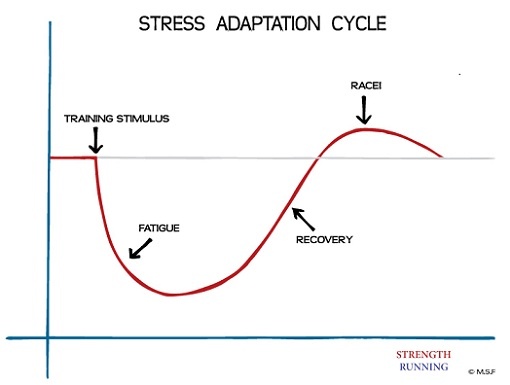
See how important recovery is?
If you follow every workout with a night of hard drinking and only four hours of sleep, you’re never going to see any progress.
While it would be awesome to have Wolverine’s healing factor, it’s best to listen to my college coach’s advice: “you can’t burn the candle at both ends.”
So how exactly do you get the maximum amount of recovery in between workouts? Just three easy payments of $29.95 for RecoverPRO-X2 JAKKD!
There are no shortcuts to recovery, performance, or getting in shape. If you’re paying out the nose for wacky supplements, you should stop that. Seriously.
There are three aspects of recovery that have the biggest impact on how you feel day to day, so here we go.
1) SLEEP! Getting enough sleep is hands down, absolutely, positively the most important thing you can do to recover in between your workouts. Sleeping as much as you need helps your muscles repair the damage that you inflicted during the workout (this “tear down, then rebuild even stronger” is what fuels the adaptation process and helps you get stronger and faster).
Not getting enough sleep has a huge number of negative physical side effects, like decreased muscle mass, poor recovery, lower testosterone and human growth hormone levels (important for women, too!), and a lot more. That’s bad news bears.
If you’re exercising a lot, you might need more than usual. Experiment with what works best for you, and check out the Nerd Fitness Guide to Sleep.
Diet Matters! Eat a conventional diet of fried food, simple sugar, and virtually no vegetables, and your body won’t be getting the basic building blocks it needs for that rebuilding process. Imagine trying to build a house without any wood? Just imagine it! I feel like I’m taking crazy pills!
If you exercise a lot, especially if you run, you’ll need more carbohydates. But that doesn’t mean you can gorge on Oreos and sugary sports drinks.
Instead, use the paleo diet principles and add nutrient-dense carbohydrates like sweet potatoes, fruit, wild rice or quinoa.
The RIGHT Training. Recovery is only going to happen if your workout is appropriate for you. New to weight lifting? You shouldn’t start out with six max effort deadlifts. Just started running? Probably not a good idea to sign up for a marathon in three weeks.
Your workouts should always build on themselves. You start at a level that’s appropriate for you and gradually over time your workouts get harder and harder. This is exactly how fellow Rebels see enormous success – they follow good training that progresses over time. It’s tempting to get excited and do too much too soon, but resist the urge.
Once you’re sleeping enough, eating right, and training appropriately, it’s time to learn smart injury prevention strategies that you can use within your workouts.
These are the same strategies Professor X uses with his team. Trust me, I called him to verify.
4 ways to actually prevent injuries

Repetitive stress injuries happen for a lot of reasons, but the most common are because of poor form, no progression, lack of strength, and no variety. And usually because of a combination of all four!
If you improve each one, your injury risk will plummet. While you won’t be as indestructible as Wolverine, you won’t get hurt nearly as much as the non-Rebel who doesn’t plan his workouts well.
1) Proper form is critical if you’re a weight lifter, cyclist, runner, or any athlete in between. The wrong movement repeated hundreds (or even thousands) of times is a serious injury in the making.
- Lift weights? Learn how to properly do a squat, pull up, and every other exercise you do in the gym.
- If you ride bikes, get a professional bike fitting.
- Are you a runner? Learn how to not suck at running.
As a running coach, I see problems with running form all the time. And it transcends to other sports too. In the weight room I see people doing technical lifts with horrible form. Helloooo back injury!
Exercising correctly is admittedly the least sexy topic ever (almost ahead of taxes), but it’s foundational. It’s basic. It helps you do whatever exercise you love – running, lifting, Parkour – without problems. And hopefully, without injuries.
2) Progression is moving through every exercise at a level that’s appropriate for you.
Start at Level 1. Then level up to Level 2 when you’re ready. That’s progression at its finest. It’s one of the really effective ways I was able to go from chronically injured to healthy.
Improve your training gradually, consistently, and incrementally. It’s the smartest (and most often IGNORED) training principle that will help you stay healthy. It’s why Steve started with just 10 push ups on his first day of PLP training. It’s why you don’t start with a 20 mile run, but rather going for a walk.
And my suggestion is to always err on the side of doing too little than too much. I’d much rather you be 5% under-trained than hurt and unable to exercise at all.
3) Get strong! Like, really strong. Strength helps prevent injuries no matter what activity or sport you enjoy.
- Parkour athletes won’t fatigue as quickly and will have the strength to avoid any clumsy falls or muscle strains.
- Runners who lift weights are less likely to suffer an overuse injury.
If you haven’t started with strength exercises yet, yesterday is the best time. But today is fine, too! Always use good form while doing strength work and start with manageable workouts like bodyweight exercises.
That’s right, form and progression, again! All of these principles are related – once you implement them into every one of your workouts you’ll be far less likely to get injured.
4) Variety is the spice of life and it should be a big part of your exercise program, too. As a coach, I see runners making this running mistake all the time by doing the same distance, at the same pace, in the same shoes on the treadmill every day.
You might be making the same mistake as a weight lifter, doing the same exact workout in the gym every single week. No wonder you’re not improving!
Every subtle change you implement is a different stress that’s applied to your body. Exercises like squats have almost countless variations that help you gain strength and work your body in different ways.
Since repetitive stress injuries are by definition repetitive, variety is a way to reduce that repetition. Here’s a good example for the Rebels who like running: let’s say your knee hurts after a 5 mile run on a hilly route on the roads.
The next time you go running, wear a different pair of running shoes (to slightly alter your running form) on a flat 3 miler on a softer surface like a dirt path. That’s a totally different type of run than your hilly 5 miler on the roads.
You can do the same with any type of workout: vary the stress, reduce the repetition.
These strategies are so effective at injury prevention that I use them with my runners to help them stay healthy long-term (and myself, too – I’ve only been hurt once in the last five years!). It’s a much better approach than bad injury advice like “stretch more!” and “run intervals so you feel like you’re dying!”
Ouch.
What injuries do you struggle with?

Let’s exercise a little smarter, recover a little better, and improve our healing factor just like my favorite X-Men: Wolverine.
With injury rates as high as they are, I’m sure you have a story about an injury you’ve experienced while leveling up your life.
Let us know in the comments so we can learn from each other.
And if you have any questions, leave them below and I’ll do my best to reply to each one!
-Jason
PS from Steve: We actually started planning this post months ago, and then my friend Brett from Art of Manliness ran a post about recovery and wolverine too. It seems like great nerds think alike! While this is merely a coincidence, both articles compliment each other nicely! 
Jason Fitzgerald is a 2:39 marathoner and USA Track & Field certified running coach. Get more running advice at Strength Running – or sign up for two free presentationson injury prevention, mistakes we make, and how you can stay healthy like Wolverine!
###
photo source: JD Hancock: Ill-gotten, Andrew Becraft: Medic Sigfig, momo: wolverine hug, Nathan Rupert: wolverine, Nicolo Paternoster: Tightrope
The post Becoming Wolverine: How to Recover Faster and Never Get Hurt Again first appeared on Nerd Fitness.
]]>The post How to Level Up Your Wardrobe: A Primer on First Impressions first appeared on Nerd Fitness.
]]>
Today’s post might be one of the more important articles we’ve ever posted on Nerd Fitness. Last week’s article on body image was incredibly well received, and today we’re going to take a look at the stuff we wear OVER our bodies, something I ignored for far too long but didn’t know where to find help. A few years back, I met Barron of EffortlessGent.com through the blogosphere and we have become good friends since then.
Last fall I decided it was time to level up other parts of my life and stop dressing like a mismatched college kid. So I emailed Barron: “Here’s a small budget. Can you help me not dress like an idiot?” He helped me pick out a few key items, and almost overnight, I was transformed…into a sharply dressed idiot!
Because I had started taking pride in my appearance, I felt better about myself and thus exuded more confidence. I immediately noticed a change in how I was treated: from the stranger at the airport counter, to the cashier at the grocery store, to the cute girl at the coffee shop. Seriously, I couldn’t believe how my clothing changed how I felt about myself and how others perceived me.
At a conference this past summer, with lots of friends who only see me once a year, I couldn’t go more than five minutes without getting complimented on my appearance. My physique honestly hadn’t changed much – it was just that I finally started wearing the right kind of clothes for my body type!
I figure I can’t be the only one who is clueless, but didn’t know where to turn or how to get started. I can help you level up your life; Barron is going to help you level up your armor.
Note: this article is mostly beneficial for the guys in the audience, though quite a bit will be applicable to ladies as well. Sometimes we’ll have articles that are more beneficial for guys (like this one), while others we have published (like this and this) will be more helpful to women. We’ll end up doing a similar article helping out ladies soon!
Take it away Barron.
Your body is a complicated tool, an intricate system. The moment you are mindful of its well-being, changes start to occur.
If you’ve committed to improving your body, whether you’re already a modern-day Leonidas or simply a work in progress, today I invite you to also level up the way you present yourself.
After all, why work hard leveling up everything else in your system, only to neglect the very last and easiest upgrade: your clothes.
Think of it this way: In every role-playing game you spend time leveling up, gaining skills, spells, and new attacks to defeat your enemies. But you also have to suit up with armor, either for protection, to enhance your overall strength, or to simply strike fear into the hearts of your enemies.
Today we’re going to learn how to treat your clothing the same way!
Suit up let your clothes enhance your already awesome self, helping you put your best foot forward in completing the quest at hand.
Why you should level up your wardrobe

You’re in full control.
In your life, there are many circumstances that may be out of your control, but the way you present yourself is not. Even if you aren’t at your ideal bodyweight or you’d still like to lose a few inches from your waist, you can still pick out something to wear that will make you look and feel great RIGHT NOW. We’ll go over exactly how to do that in a little bit.
Self-confidence reflects as much inward as it does outward.
If you’re not confident and self-assured inside, you certainly won’t seem it on the outside. Same goes for if you’re uncomfortable (or in some cases, too comfortable) with what you wear in your day to day life. If you’re schlubby and unkempt, there’s a good chance that lack of care is reflecting what’s going on inside.
When Steve asked me to help level up his look in preparation for his upcoming talks, he was already an engaging speaker with plenty of experiences to share.
He knew looking the part could only help him. The better his armor, the more confident he’d feel in his task to nail the talk.
Steve learned, by visually asserting himself by appearing put together and polished, he immediately sent unspoken signals to people. As a result he received an unprecedented number of compliments on how good he looked and how confident and strong his message was.
It’s crazy, but true. The way you present yourself drastically affects how people perceive you and the things you have to say.
Whether you like it or not, you’re judged by your appearance.
Your face and your clothing are the first things people see. You may be dedicated to your health, eating clean and regularly setting that squat PR. But at the end of the day, the clothes you wear, your superhero attire, will be what people see first.
You may be thinking, “I don’t care what people think,” and that’s fine. Just keep in mind that first impressions are powerful. The way you present yourself says a lot about you, as well as how YOU feel about those who come in contact with you.
You’re here, you’re a Nerd Fitness reader. You DO care!
It’s not too late to upgrade your armor

I went to Catholic school as a kid, and even though we wore uniforms most of the time, I always remember caring about my personal style. My friends and I enjoyed “free dress days” when we could come to school in our regular clothing and express our individuality.
If there’s one thing us nerds have in common, it’s standing out from the crowd.
…though maybe we just wanted to show off our cool new T-shirts we bought with our allowance money. If your transformative years happened in the early- to mid-90s, you must remember these prints.
Growing up, I established pretty terrible eating habits, which only became worse as I got older. Eventually, my never-ending appetite caught up with me, and in my third year of college, I topped off at 241 lbs. Funny enough, despite my size, I always received compliments about how I dressed. From time to time, I was even asked for advice by my close guy friends, which eventually inspired my now four-year-old site, Effortless Gent.
Around my senior year in college, something clicked, and I realized I needed to change. Over the next two years I lost over 80 lbs. I look at old pictures from just a few years back, and I hardly even recognize that guy.
But the one thing that has stayed constant was my interest in dressing well, even through the highs and lows of my transformation. I always saw it as a way to express myself, even though I felt totally insecure and out of control when it came to my health and fitness.
What is the point of all this endless rambling and back story, you may wonder?
For one, it’s never too late to upgrade your armor and have it work for you, not against you. It’s never too late to start caring about your appearance and how you present yourself.
And two, despite your background, situation, or size, a little effort with your presentation can help you get the reactions, confidence, and respect you deserve.
Misconceptions for not caring
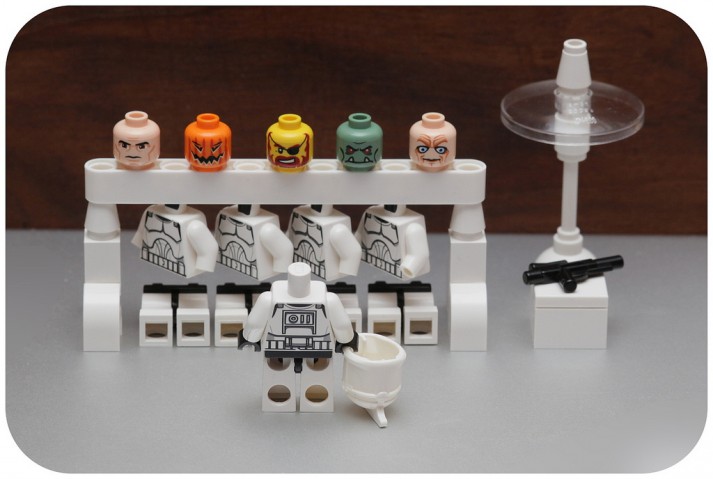
Your armor may be a simple surface-level addition, but what it stands for is much more than that.
It’s how you choose to represent yourself…a display of your pride and your self-esteem.
It says you care enough to make a good first impression, that you’re knowledgeable, well put-together, confident and self-assertive.
Steve’s anecdote shows us that your look can create self-esteem, not just project it. Dressing well gives you a certain presence that sloppy dress does not.
Just try it out once, and observe the reactions you receive from others. Don’t be surprised if you get a bunch of positive comments, or more than a few lingering glances from others. Keep in mind that dressing well doesn’t always equate to dressing up. It’s all about dressing well relative to your everyday lifestyle and situation.
Here are a few common excuses I hear and why they’re totally unfounded:
“I don’t know where to start!”
Similar to creating new habits for change in both your diet and exercise, start small. Choose one thing, work at it, and soon enough, it will just be your normal outfit, routine, or way of life. The simpler the change, the easier it is to keep.
This may mean improving just one aspect of your presentation. For example, focus on one great work outfit, and not your whole freakin’ closet (which can be overwhelming, I know).
“It’s too hard and I don’t know what I’m doing.”
If you follow the Lean Wardrobe philosophy, you’ll realize it’s not as difficult as you think. It’s all about owning a few simple basics—items that are all interchangeable—which minimizes the need to think. Easy peasy!
“I live by myself / play video games in a basement all day / work in a cubicle, no one cares what I look like.”
Studies suggest that your presentation affects how others perceive you as much as how you perceive yourself. Crazy, right? Start to dress differently and begin to feel differently as well. And in turn, people will start perceiving and treating you differently.
I work from home and I know for a fact my day is much more productive and focused when I put on something work-appropriate, instead of shuffling around in the shorts and T-shirt I wore to bed the night before.
“I don’t want to appear vain / shallow / self-absorbed.”
Is building muscle vain? What about losing 100 lbs? How about deadlifting two times your body weight? How shallow is that? Leveling up your life is about becoming the best version of you, whether it’s about your style, self-esteem, max deadlift, or LOTR knowledge.
Four big takeaways

Every person’s situation is different, so instead of giving you absolute “You should…” statements, I’ll leave you with a few thoughts and big takeaways apply to both males and females and are totally actionable right this second.
Understand how clothes should fit.
Fit is of utmost importance when it comes to your clothing. If you’ve never given it a second thought beyond how comfortable or uncomfortable a certain article of clothing is, there’s a good chance your clothes are either WAY too big or WAY too tight on your body.
The importance of fit in dressing well is akin to the importance of form when weightlifting. You must master fit for your specific body type before you can begin to replace your whole wardrobe. Just like you must perfect your form before increasing the weight on the barbell.
Recognize your body’s proportions and let your clothing create illusion.
Think of clothing as a tool to re-draw your body’s lines, thus creating these illusions I speak of. You’re basically Criss Angel-ing your body! But, you know, in a more useful and less freakish way.
When clothes fit you properly, they seem to re-draw lines and help you look in proportion and balanced… and everyone wants to look balanced, right?
Here are some examples:
- If you’re a big guy, your first inclination may be to purchase a size XXL when you’re actually an L, thinking the extra room hides your size. In actuality, massive clothing just makes you look bigger. Trust me, I’ve made the same mistake before, when I was 80 lbs heavier. Buy your size if you don’t want to look larger than you are.
- If you have long legs and a short torso, you can appear more proportioned and hide that imbalance by wearing pants that rest below your waist, closer to your hips.
- Ladies, if you have a wider midsection or are more pear-shaped (narrower in your torso, wider in your hips), you can balance this by wearing clothing that accentuates your natural waist—the slimmest part of your torso—with the rest of the garment flowing away from your body.If you’re shorter, try V-neck dresses and tops. This visually elongates you, making you appear taller. For a shorter, pear-shaped body: add visual interest to the waist, wear a long neckline to elongate, and find a garment that flows from your hips, like this.
- If you’re very tall and/or skinny, break up your height by utilizing things that cut you in pieces, visually of course. That means a substantial leather belt for your pants (you’re tucking in your shirt, right?), and cuffs in your jeans. You can also wear bolder prints (like your favorite plaid shirt), but avoid bold vertical stripes, because that will just accentuate your height.
- If you’re built smaller, shorter, or more petite than most, it would help to avoid patterns and lines that break up your height. Smaller scale patterns and textures also help. If you’re shopping for a suit, it’s a good idea to find a shorter jacket with a lower button positioning, which will aid in your efforts to appear more proportioned, and thus taller.Consider the size of your accessories. Stick with smaller watches and rings, skinnier ties, etc., which may look miniature on a guy that’s 6’5″, but perfectly proportioned for someone who’s 5’6″.
See what I mean? View clothing as yet another tool in your arsenal when looking to put your best foot forward.
Use color to your advantage.

The colors you choose to wear make a big difference in how you look overall. It’s different for everyone because we all have different skin tones, but here are two tips:
1.) Don’t wash yourself out. Clothes in solid colors that are close to your own skin tone aren’t a good idea. It makes you appear pale and washed out, like you’re wearing a flesh-colored skin suit. Just check out the difference a bit of color makes to the guy in the T-shirt above. Same guy, three different T-shirts.
2.) Focus on contrast. Contrast is key. Contrast between your clothes and your skin tone. Contrast between your top and your bottom. Contrast is more visually appealing, generally speaking. Wearing clothes too close in tone to one another (as in, green pants with a green shirt and green shoes) doesn’t look very good unless done right. And I don’t have to explain why contrast between your clothing and your skin tone is a good thing. Just take a look at T-shirt guy one more time, and compare first two photos to the third.
Keep that wardrobe lean!
Just like Steve advocates for a basic workout plan with big compound movements, I advocate a Lean Wardrobe because it’s the easiest way to stay organized and look great with minimal effort and money. By definition, a Lean Wardrobe is the minimum number of items you need to create a flexible, well-rounded wardrobe that suits your daily life. For Steve, we picked up a nicer pair (but still inexpensive) pair of jeans, well-fitting shirts (slim fitting J-Crew shirts are his new go-to), two ties, and a pair of nice dress shoes.
The whole point is to assemble a collection of items that work well with each other. You do this by choosing classic items in simple colors.
Key words: Simple. Classic. Clothing that won’t make you cringe when you see photos of yourself in twenty years.
Man to man, just tell me what to wear!

[Steve’s note: I asked Barron to include this section for any guys like me, in need of SPECIFIC instruction. I honestly felt clueless and wanted Barron to just tell me what to buy. If that sounds like you, you’re welcome!]
Some rebels may thrive off general, overarching principles, enjoying the journey of experimentation and coming to your own conclusions…while others may want specific items to place in your inventory.
For the gentlemen, here’s the perfect starter kit. Add to this three-piece set at your own risk, and do so wisely, and after the appropriate amount of research so you’re not wasting time or money. Even if you just stick with these three things, you’ll be better off than 95% of your peers.
The Bare Minimum: Three-Piece Starter Kit:
1) One pair of straight-leg dark blue denim
Make sure this is dark dark blue, like midnight. Almost black. You want this to look raw and unwashed. No fake distressing, no embellishments, no studs, no cutesy patterns on your butt pockets.
Why dark blue? This style of denim is perfect for all situations. You can wear it with a T-shirt to your buddy’s house or on a date with a dress shirt.
Why straight-leg? There are plenty of variations, as far as fit is concerned. A simple straight-leg pair is classic and will never go out of style. You may need to try different styles if you’re huskier / skinnier than the average guy, but just go with what is most comfortable.
Here’s some further reading on the right denim.
2) One white and/or light blue casual shirt
A simple, casual, white or light blue shirt will look great anywhere you go. Wear it with your dark denim and you can’t go wrong. That could be your go-to “more dressy than normal” uniform.
Make sure you find one that fits your body well. “Slim” is the key word (yes, even if you’re a bigger dude). Too big and billowy and you risk looking as out of place as Seinfeld in his unforgettable Puffy Pirate Shirt.
Here’s some further reading on the right casual shirt.
3) A decent pair of brown leather “dress” shoes
I put the word “dress” in quotes because if you’re not used to them, you may think they’re strictly for “dressing up.” But trust me, they can (and should) also be worn casually. Again, I’m giving you extremely versatile options, so you don’t have to spend too much time thinking, buying stuff, or worrying about how to put it all together.
Get the right pair and you can wear them with your denim, khakis, even that oddly-fitting suit your mom bought you in middle school (I’m advising against this, but technically, you could).
Why brown? The dark brown leather color looks great with the things I mentioned above. It’s dressy enough for that important meeting your boss is making you attend, while at the same time, casual enough to be worn with the dark denim you picked up.
Why leather? It all comes down to utility, and using things in the environment for which they were made. Sneakers, Vibrams, and flip flops, for example, were all made with a certain purpose in mind. Wear them when you’re performing the activity they were meant for. For regular, everyday situations, wear a decent pair of leather shoes.
Here’s some further reading on the right pair of brown shoes.
Think of these three things as bare essential gear in any game: the basic armor and weapon that you need to get started. Just pick up these three things and you can get right into battle. Don’t worry about getting other accessories until you have these basics.
Keep it simple and get started

You care about leveling up your life, cleaning up your eating habits, and becoming more fit through exercise, otherwise you wouldn’t be reading Nerd Fitness. If you take the time to improve these aspects of your life, care enough to take that one final step to present yourself in the best possible light.
If you improve your self-presentation, the way people perceive you and the way you perceive yourself will change dramatically.
Just know the basics. There are a few style “rules” you’ll need to understand when you’re starting from the very beginning, but once you get the hang of those, it’s pretty much a free-for-all. Personal style is just that, personal, and you can interpret that to mean whatever you’d like.
When I first decided to do something about my ballooning waistline, I changed what I ate and I hopped on an elliptical machine. I didn’t know anything about macros, eating paleo, or strength training. All I knew was that I had to do something.
Treat your journey to style self-improvement the same way. Learn one thing, act upon it, master it, and move on from there.
Create simple daily habits that support these improvements, and let them become natural to you. Accept that it won’t be easy, but it will be worth it, and just do your best.
If you have questions, need advice, or simply a word or two of encouragement, I invite you to reach out directly or hop on over to the Effortless Gent community, where you’ll find a bunch of guys who can either lend a hand, or are on the same path as you.
What sort of questions do you have? Have you changed how you dressed and noticed a change in how people treat you?
-Barron
Barron Cuadro runs Effortless Gent, a site dedicated to helping guys figure out their personal style and what looks best on them. For those you like me (in need of some serious help), check out his Guide to Dressing Like a Grownup.
###
photo source: skin tone comparison, iron man, shirt wardrobe, lego wardrobe, bond, colorful wardrobe, marvel
The post How to Level Up Your Wardrobe: A Primer on First Impressions first appeared on Nerd Fitness.
]]>The post How to get started with Handstands first appeared on Nerd Fitness.
]]>
This is a guest post from Chris Salvato.
What went through your mind the last time you saw someone perform a great handstand? If you’re like most of the people I’ve worked with, then you probably thought:
“Wow, what control!”
“What a display of strength and finesse.”
“That looks really cool.”
Unfortunately, when you see a handstand you probably also think “I could never do that in a million years!”
“I’m scared of falling on my back.”
“I’m not strong enough.”
“I’m too overweight, too old, and too weak.”
So, what if I said that you could achieve a handstand in a much shorter time period than you think? Would you tell me that is was impossible? That you couldn’t possibly do it? Might our conversation go like this?
Luke: I can’t believe it!
Yoda: That is why you fail.
Once you start believing that you can perform your first handstand, its amazing how quickly progress comes. I routinely get beginners and intermediates to their first freestanding handstand within 60 days.
That’s two months to reach a goal they once thought impossible.
NOTE: Nerd Fitness now has an updated resource on how to finally get your first handstand.
Strong you need not be

Most Padawans think that the handstand is a feat of strength.
We can draw from Master Yoda’s wisdom again; our Jedi Master was more capable than even the biggest and strongest of the Sith Lords.
“Size matters not. Look at me. Judge me by my size, do you?” – Yoda
The handstand does not require great strength or big muscles. You will need a base level of strength, however; you need to be able to hold yourself upside-down, with your weight supported fully on your hands and shoulders. Don’t worry, though! This level of strength is actually a lot easier to build than most people think, so long as you train the handstand frequently.
Whether you are collecting a senior citizen’s discounts or are trying to lose weight, I have learned that this foundation can be built within a month or two. (Note: If you are more than 50 lbs overweight, I recommend tackling your weight loss goals first.)
Once you have your foundation in place, the handstand changes. It’s no longer strength training – it becomes skill training because you MUST train subtle movements and techniques that only improve through repetition.
Skill training is usually not very taxing and your improvement is directly related to how much you train (unlike a feat of strength, which is usually very taxing and requires rest and recovery).
Training handstands is actually more similar to learning to play the piano than it is to lifting weights or getting your first pull up.
So, practicing handstands just once a week isn’t ideal. Even three times a week isn’t ideal. Because of the nature of skill training, practicing at least a little bit, every day (say, 5 minutes per day) will produce the best results.
A habit you must build

Luke was able to drop everything and fly to the Dagobah system to focus solely on his Jedi training….but you probably don’t have the time for that. You need to build a habit that slips right into your daily routine.
The first and most important step is consciously deciding that this is something that you really want. Write it down on a piece of paper: “I will do a freestanding 15-second handstand.” Slap that paper on your wall or on your fridge so that you can see it all the time…then freakin’ do it.
“Do or Do Not. There is no try.”
Now that you have officially made this one of your goals, it’s time to kick start your commitment and challenge yourself. More specifically, challenge yourself to work on the handstand for 5-minutes every day, for 28 days.
When you commit to doing something for 28 days, you build a habit — something that becomes part of your daily routine. But what exactly do you do every day?
Just 5-minutes of handstand practice. That’s it. If you want to do more, that’s fine, but it’s not necessary. How much of a pain could it be to put 5 minutes aside for your handstands, anyway? Most of us take longer bathroom breaks…
Once you have established a 5-minute habit, it effortlessly grows into a more frequent practice, which translates into faster learning.
We all know of at least one young musician, who is inseparable from his instrument. It always starts with a small, consistent regimen and grows from there.
Or make it a hard hat challenge: buy a calendar and red sharpie and get to work!
Fear you must conquer

“Fear is the path to the Dark Side. Fear leads to anger. Anger leads to hate. Hate leads to suffering.”
When it comes to handstands, most instructors and tutorials sweep fear under the rug. This is strange, considering over 90% of the people I have worked with have succumbed to the Dark Side of fear. People avoid handstands because the fear of falling has held them back from handstand training…for years!
Fear conquering needs to be built into your handstand training.
Even if you get into consistent handstand practice, you still need to get over the fear of falling over yourself and ending up in a great big heap on the floor. Like every good Jedi, you need to learn to mitigate and eliminate your fears.
You can’t ignore fear. After all, Luke left Yoda before conquering his fears – before learning everything that needed to be learned. He left his training early…and where did that leave him? He lost a hand, and nearly fell to his doom!
Don’t be reckless like Luke!
Fear is the reason Luke almost died in Cloud City.
Fear is the reason you haven’t tried to train the handstand before.
Fear is the reason you won’t step away from this article and try kicking up into a handstand.
If you want to perform a handstand, you need to acknowledge this fear and overcome it.
There is no other way.
Getting over handstand fear

The good news is that getting over fear is actually a lot simpler than you think. I have even helped a retiree with vertigo-induced nausea conquer the fear of falling over in less than two months, resulting in one of the best beginner’s handstands I have ever seen (Lyle is pictured above!).
The key is to systematically and gradually introduce yourself to the handstand, to being upside down, and to relying on your hands to support you.
To do this, you need to break the fear down into its simplest parts: fear of being upside down and fear of falling over.
Without a solid strategy, many people let these fears hold them back for years without making progress.
Fear of Being Upside Down

Afraid that your arms will give out? Don’t want to face plant? Or do you just panic when inverted?!
You are suffering from a general fear of being upside down — but there is hope.
This fear is what keeps most people away from the handstand all together. But that’s crazy! Overcoming this fear is simple and completely risk free if you follow a systematic fear-annihilating progression.
Later, we’ll go through a progression that starts with normal planks on the floor. How can this be scary? Your hands and feet are firmly on the ground. Nothing too new.
As you move forward in the progression, you put your feet on the wall, and walk your hands a little closer. Then a little closer. Then closer still. Eventually you will find yourself 12 inches from the wall and, *ta-da* you are holding a wall handstand with almost no risk of falling over.

You are gradually loading your hands and shoulders with more of your bodyweight…so you get stronger and reduce fear! No Jedi Mind Tricks necessary. Sounds like a win/win to me!
Fear of Falling Over

Scared to kick up and fall flat on your back? Think you will kick up too powerfully and slingshot your back right into the ground? Maybe you are scared of actually holding the handstand, then freaking out, losing control, and crashing, sprawled out, crying on the floor?
But think, would this fear exist if you fell onto a fluffy mat? Or a soft pit of foam? What if there was no possibility of being in pain after falling over? What if there was literally no risk?
The answer is simple: we need to remove the possibility of you falling over yourself.
You need to learn to save yourself from a failed handstand. You need to learn to bail safely, without relying on the Force or good old-fashioned luck. Once you do that, the fear disappears completely.
I know this sounds too good to be true. I know it sounds too simple. But it’s true, and it’s simple.
I have seen hundreds of people conquer both of these fears in less than 28 days.
You’re about to learn how.
The handstand you must train

OK, so you are ready to start working on the handstand! You know you need to be committed, and conquer fear.
So how do we get started?!
If you have been working on the handstand in the past, then you have your head full of random tips and tidbits. You may be thinking about head position, body line, hollow body position, or a million other things.
But you must unlearn what you have learned, young Padawan.
The path to the handstand is remarkably simple, and it starts by forgetting all of those other tips and focusing on the small subset of skills and techniques that produce results. After rigorous testing, and thousands of students, there are only a few steps that you need to take to hit your first handstand.
Level 1 – 60-Second Wall Plank

Start by going into a plank pose with your feet on the floor near the wall. Place your hands directly under your shoulders, and your feet firmly on the ground.
If you can hold this for 60-seconds (5-8 long breaths), then move your hands a little closer to the wall by walking them backwards, and your feet up the wall. Bring your hands together, lock your elbows and push your shoulders towards the ground.
Work on holding this position for 60-seconds.
Repeat this over time, walking closer and closer with each attempt – even if it’s just one centimeter at a time.
By approaching the first step in this way, you start in a safe position, and gradually increase your exposure to the fear while building strength. This constant exposure reduces the fear.
Also, by starting with a simple posture, you start leveling up immediately. Every time you get closer and break new personal bests, you level up your “Handstand” ability even further.
Level 2 – 60-Second Wall Handstand

As you get closer to the wall, your plank starts to transform. As your hips get higher over your head, it turns into a wall handstand instead of a wall plank. You should never feel like you are at risk of falling over (if you do, walk your hands a little further from the wall until you feel safe again).
The magic number is 12 inches – that’s the distance your hands should be from the wall. You can measure this by leaving a ruler on the ground just before you start to walk up. You don’t want to get closer than 12 inches at this stage, because then you risk falling over yourself before you’re ready – but any farther and you’d be in a plank.
You should aim to hold this position for at least 60-seconds before moving on.
If this took some work for you, then your success will hit you like a slap in the face. One day, you will turn around and say, “Hey! I am doing a handstand against the wall! And I’m not scared!”
But the best part of this challenge is that it’s very similar to the real handstand…and you won’t have any fear. How could you? It’s nearly impossible to fall over in this position.
And, even better, this position prepares you to learn the bail, which is the most important part of the process.
Level 3 – Pirouette Bail
Control. Control. You must learn control. – Yoda
Since we don’t have the Force to keep us from falling over, we need to heed more advice from Yoda, and learn some freakin’ control!
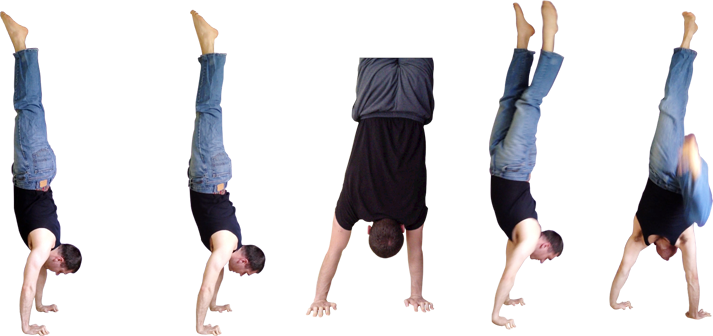
To gain control of your fear, you need to learn the best bailing technique around – the pirouette bail.
The bail, like the handstand, is a skill. You can practice bailing frequently, without fear, since you can set up a safe environment to learn bailing against the wall.
After in your best wall handstand, shift your weight to one arm (the planted arm), allowing the other arm to move. Finally, drive one leg into the wall (the one that’s on the same side as the planted arm), and lean the opposite leg forward. Gravity pulls you around, and lets you lower your feet to the floor safely. Looking for more?
Check out more about the pirouette bail here.
Learning this bail will help you take control of your fear of falling over. As you gain control, the negativity that flows through you will disappear. And you won’t even need to use the Force, like that cheater, Luke Skywalker.
Level 4 – Kickup and Freestanding Control

With bailing now a learned skill, you can start learning freestanding handstand balance. The easiest way to do this is to walk up into your best handstand, and then tap your feet away from the wall gently, trying to hold that balance as long as you can.
When you have mastered near-the-wall balance, it’s time to start kicking up. Instead of walking up the wall (shown in level 2), you will kick up the opposite way, like a real handstand, by swinging one leg way over your head. You’re not jumping, but rather placing hands on the ground and swinging one leg REALLY high over you.
Keep your arms straight and shoulders pushed towards your ears so that you don’t “crumple” to the ground. Kicking up near the wall will help you learn how much power you need to kick up properly, so your goal is to kick up without touching the wall (but it’s there to fall forward on, if you need it!).
As you get better and better, you will start to find your balance; you will see that small adjustments to your grip and body position will have a massive effect.
Eventually, you will build more confidence in your near-the-wall kickups than Han Solo has on the Kessel Run. That’s when you take all the lessons you learned, and move away from the wall completely.
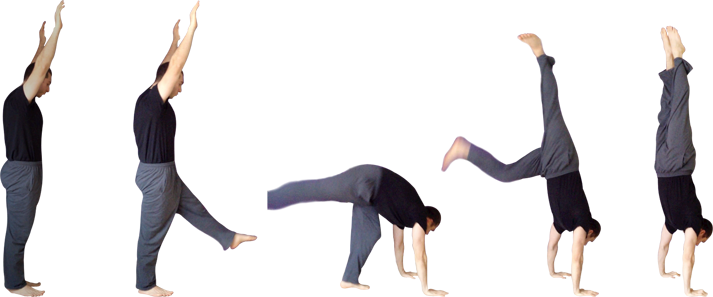
By the time you get to this stage, you can practice kicking up anywhere without any fear. Take that, fear!
The elimination of fear will have completely liberated you. Then, it’s just a matter of practicing kick ups and freestanding balance as much as possible…but no less than 5-minutes a day, every day.
But what if you kick up too hard? What if you start to fall head over heels? Well, then you just pirouette bail out to safety. If you get to this point, you won’t even feel this fear anymore. Sounds simple? That’s because it is.
If you follow this system, you can likely start working on pirouette bails within a month – you’ll be conquering your fears faster than a Jedi Knight.
start, you must
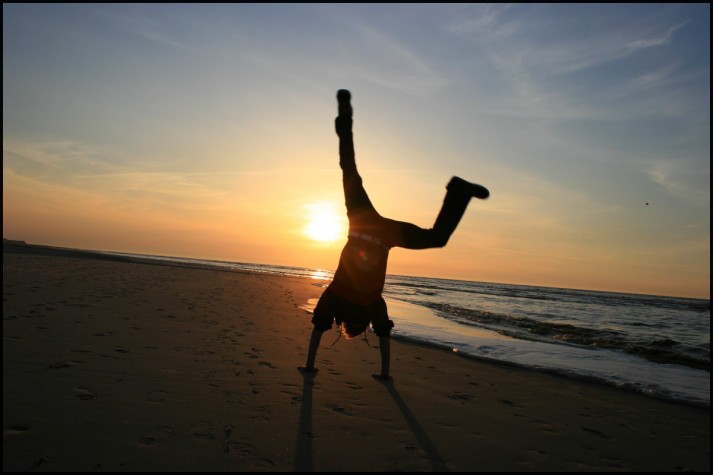
Embrace handstands right now, while you are motivated and inspired. You have an empty wall in your house, office or gym (or, you can clear one out). Go to that empty wall now and do a quick 5-minute session of wall planks by walking up the wall and seeing how far you can get without fear.
I’ll give you 5 minutes. Go do it. It’s just 5 minutes. Pretend it’s a bathroom break.
Even if you can “only” do a standard plank on the floor, this is an AWESOME first step.
“If you end your training now, if you choose the quick and easy path as Vader did, you will become an agent of evil” – Yoda
Well, maybe not an agent of evil, but you will kick yourself…Now, take the 28-Day Handstand Challenge (free resources!) to keep the habit going. Follow the progression, and practice every day. You will make huge progress!
Now just go out and train!
Have you ever tried working on the handstand?
What held you back in the past? Was it fear?
What do you need to know to get started today?
-Chris
###
photo source: figurines, yoda, dagobah, vader, r2d2, plushes, rapping, fear of falling,wall planks, wall handstand, pirouette, kickups, kickup beach
The post How to get started with Handstands first appeared on Nerd Fitness.
]]>The post The Amazing Spider-Man Workout Plan first appeared on Nerd Fitness.
]]>
This is a guest post from Khaled Allen.
Imagine that you are Spider-Man.
You’re reading Nerd Fitness, so I’m guessing this isn’t too much of a challenge.
What’s the first thing you would do with your new powers? Probably something like webslinging around your city, scaling the side of a building, and hanging upside down just for the hell of it, right?
You’re not alone: after all, it’s these scenes in the Spider-Man movies that are always the most exhilarating.
We want to BE Spider-Man in those moments, playfully exploring new powers, free of danger and full of creativity. Essentially, it’s like a kid on Christmas morning.
Wouldn’t it be great if workouts could feel like that (and not something that you have to suffer through)?
Spider-Man’s big appeal is that he’s playful. He seems to genuinely enjoy climbing walls, swinging from skyscrapers, and popping flips around the bad guys. He even cracks jokes in the middle of fights. Spider-Man is having fun, and this playfulness characterizes the way he moves, fights, and trains.
I’m here to tell you that you can use play to explore your abilities in ways more creative and empowering than the limited, controlled movements of a standard workout. It’s okay to act like a kid, and it can be incredibly beneficial!
Let’s learn how.
Benefits of Play

Play workouts (or playouts) have a number of benefits over traditional workouts.
- First and most importantly, a playout isn’t about building muscle, losing weight, or perfecting a routine – A playout is about figuring out the best way to interact with the environment in order to meet your goals. It shifts your focus from internal to external. It is about solving problems and having fun. Watch any video of Ido Portal (a real life Spider-Man?) and you’ll want to go outside and roll around.
- A playout integrates multiple movement patterns to overcome an obstacle – For example, Spider-Man’s web swing requires accurate aim, powerful jumping, swinging, and climbing. Excelling at these skills individually wouldn’t help, since Spider-Man needs to transition between them seamlessly to make the move work. In the gym you might train pullups and dips separately, but if you need to climb a tree, you’ll use both in sequence, as well as weird variations of each that blur the lines. This is the basis of Parkour.
- Playouts involve more exploration and improvisation than traditional workouts. There is no ‘right’ way to do anything when you’re playing. There are only more and less efficient ways. Which you choose will depend on your skill and level of fitness. If a regular workout is like building a model with instructions, playouts can be thought of as using a giant box of LEGOs: there will be many ways to build the same object, and your model’s complexity depends on how comfortable you are with the blocks.
Designing Your Perfect Playout

Having a good playout requires that we think differently about exercise. Remember, rule #9 of the Rebellion: We Question Everything.
http://www.youtube.com/watch?v=_KHy1BYjaP0
1. Find a play area
In his latest cinematic adventure, Peter Parker goes to a shipyard to play with his skateboard, but he co-opts the ramp and chains in the dry dock to start practicing his spidey swings. Nothing he interacts with in that scene was meant to be used for spidey training, but he thinks outside the box and finds his own challenges, seeing how far he can push his abilities.
The first step to a successful playout is to identify a problem you’d like to solve. This requires that you learn how to see situations creatively. The more varied the environment, the better, but you can get pretty creative with just a park bench if you know how to view it. Good places to start include:
- Playgrounds
- Parks with benches, rocks, and fences
- Skate parks
- Sculpture gardens
- The wilderness


2. Explore your options
Once Peter started playing with the shipyard chains, he spent some time figuring out different ways to interact with them. He climbed them but found that swinging worked better, and later discovered that he could swing from one to the other.
Once you have your problem, discover different with ways to interact with it. Start with the obvious, but don’t stop there. This is where you can get creative, be silly and try things that may not work.
Make an effort to try movements that are unusual or novel, or even unnecessarily elaborate
For example, dealing with a park bench, you could:
- Crawl over or under it (break it down further: bear crawl, military crawl, shrimp, crab walk)
- Jump over it
- Jump on top and down
- Dive and roll over
- Vault it
- Move it
- Simply go around it
- Climb the overhanging tree and swing over
You don’t have to be as acrobatic as these guys (must watch!), but every little bit counts!
3. Groove the individual movements
Spend 5-10 minutes with each element in your play area and work on your form.
Good form here means the move starts to feel more natural and less effortful.
Focus on efficiency and comfort, and figure out what feels best for you.
If you get bored, move on to another element. The goal is to maintain a high level of mental and emotional engagement, so you learn faster and stay alert, thus avoiding sloppiness and injury.
4. Start building movement combos
Once you have experimented with different ways to approach each segment of your play area, start putting them together and moving through the environment.
Start with two obstacles and one transition and go slowly, focusing on smoothness of execution. This can be as simple as crawling across a field to a bench, transitioning to your feet, and jumping onto the bench.
Once you have drilled that a few times, it will feel more natural and you’ll hesitate less. At this point, you can start adding additional pieces to the front or back of your combo.
- Try jumping off the bench
- Then add a roll to the landing
- Then try to smoothly transition to a sprint after the roll
If there are objects around, make them part of the game; do a relay with rocks or logs, carrying them through your course.
As you start to get a feel for the pattern, it will go faster naturally, so don’t rush. Conditioning will come after sufficient skill and strength for safety.
5. Check for mistakes
The first time the (soon to be) Amazing Spider-Man used his webslinger to make an escape, he ended up swinging right into a bus. Ow. Clearly, he needed to spend some time refining that move.
Here are some things to look out for that can alert you to the need to go back and refine your form:
- If you keep banging one spot of your body every time you do a move, make adjustments: check your posture, be sure you are staying tight, or slow it down or find a simpler variation.
- If a movement is generally jarring or jerks you around, refine your movement pattern until it feels smoother. Again, change the speed of the movement or try a variation. Look out for this on landings especially. Jarring is also an indicator of fatigue and might be a sign that it is time to wrap up your play session.
- If you find it difficult to maintain balance or stick your landings when you rush into an element of a playout, slow down on that segment and spend some more time drilling precision and balance. Fatigue also affects these abilities.
6. Make it social
No matter how much he practiced on his own, Spider-Man could never really develop the skill necessary to save New York until he went out and tested his powers with villains.
While I don’t suggest you go out and try to break up muggings, having a partner to challenge and encourage you can make a huge difference in your training, and play lends itself very well to social workouts.
There are some things you can do with a partner that you simply can’t do alone.
The options are endless, but here are some ideas to get you started:
- Toss sticks back and forth while running or balancing
- Have them throw (light) stuff at you while you go through your course
- Carry each other through the course
- Race each other
- Create cooperative rules: try running through the course with the rule that a move cannot be used more than once by either person
Make a game out of it. This is play, after all.
Tips and Tricks

The first time you to playout, it may be stilted and awkward.
It’s very hard to think outside the box we’ve become accustomed to. Most people stop playing long before they become adults; the wild, free creativity of youth gives way to organized sports as early as elementary school. You’ll probably get funny looks. That’s great. Embrace the weird!
Luckily, we can take some pointers from Peter Parker and inject the same sense of joyful exuberance Spider-Man brings to everything he does:
- Always warm up. Just because it’s play doesn’t mean it’s not intense, and varied movements can take you by surprise. You can warm up with low-intensity play, like crawling, low walking, and balancing.
- Give yourself plenty of time. Play is creative and suffers under pressure, just like any other creative endeavor. If you feel even a little rushed, you will default to movements you are familiar with in an attempt to get through the challenge as quickly as possible.
- Repetition will help you see more options. You will actually get more creative with successive iterations. Let a problem stew for a few days, and revisit the same play area more than once, so that you can elaborate upon your previous movements.
- Don’t try to get a workout. If you approach play with the intention of conditioning, you may unconsciously restrict yourself to movements you associate with traditional workouts. Don’t worry so much about whether a movement is good exercise or if you know the ‘right’ way to deal with something.
Everyday spidey play

When you’re training to be a superhero, there are no off days.
Spider-Man knew this, but he also genuinely had fun with his powers, like doing his homework hanging upside down in his room.
In the same way, you can use the mindset of playfulness to add some extra movement and practice into your everyday life, and more movement is always a good thing. With a bit of creativity, you don’t even have to go out of your way.
- Walking down the street, try balancing on curbs or precision jumps between paving tiles.
- While waiting for a bus, practice single-leg balancing.
- Use squats to get stuff out of your refrigerator.
- Jump and down stairs, challenging yourself to cover more steps.
The more options you can see, the more freedom you have. Fighting crime is serious business, but even superheroes should get to enjoy their powers every now and then…without worrying about the fate of the world.
So try adding a playout or two to your weekly routine in between strength training or running.
Where do you plan to try your first playout?
Khaled teaches MovNat in Boulder, CO, and writes about living with integrity, embodying
###
photo source: spider-man job, mosiac, kids, jungle gym
The post The Amazing Spider-Man Workout Plan first appeared on Nerd Fitness.
]]>The post How Game of Thrones Can Make You A Better Cook first appeared on Nerd Fitness.
]]>
This is a guest post from my friend Darrin over at TheGuyCanCook.com. I asked Darrin to write a guest post on getting started with cooking, and he asked if he could draw inspiration from Game of Thrones. My response was, “duh.” Whether you’ve only seen the show or you’ve read the books, there’s much to learn from the people of Westeros. Haven’t seen or read them? Shame on you! Go check out this awesome story, then come back. Take it away Darrin!
“Winter is coming.”
The motto of House Stark – and it’s really more of a warning – sets the tone for everyone in a Game of Thrones. The epic series, A Song of Ice and Fire, focuses on the struggle for power between the great families of the seven kingdoms.
But mysterious forces threaten the entire world as well, and the daughter of an overthrown king plots her return from exile…and she’s bringing dragons with her.
This legend is much like what you will experience when you start to learn how to cook healthy food for yourself:
- Like the war between the royal families, it can feel like a brutal struggle for power.
- You will face what feels like other worldly forces that will try to hold you back from what you want.
- But, if you take action, you can rise up from the ashes and win the throne for yourself.
Allow me to explain…
Slay Your Fear

“The man who fears losing has already lost. Fear cuts deeper than swords.”
-Arya Stark
In Game of Thrones, many characters face their fears over and over again. As a result, they change. They get better. They live more epic lives.
And you want your life to be an epic story, right?
Most people don’t cook because of one thing: they are scared of it:
- We are afraid of spending money on kitchen gear we don’t know how to use.
- We are afraid of trying new foods.
- We are afraid of ruining a meal.
We are terrified of trying something new and failing.
Where cooking was once an essential skill that was passed on from generation to generation, the success of the prepackaged food industry means that expertise in food preparation is now as rare as knowing how to wield a sword.
Fear is a good thing. It is a sign that you are getting out of your comfort zone and trying something new.
And it is only by trying new things that you will truly develop and get what you want in life.
You may be afraid of learning how to cook, but you’ll never be able to learn and grow while it is holding you back. And the “failures” you have along the way will only help to increase the speed that you learn to cook.
Here’s a step-by-step method to conquering any fear:
- Acknowledge that you are feeling fear.
- Ask yourself if that fear is holding you back from something you want.
- If the answer is yes, use your 20 seconds of courage and roll the dice.
If you are dedicated to learning a new skill, you will conquer your fear only when you decide to confront it head-on. It will never go away on its own.
If Sam Tarly can kill a White Walker, then you can certainly suck it up and cook a meal!
Eat Like a Medieval Warrior

“The eight soon-to-be brothers feasted on rack of lamb baked in a crust of garlic and herbs, garnished with sprigs of mint, and surrounded by mashed yellow turnips swimming in butter… There were salads of spinach and chickpeas and turnip greens, and afterward bowls of iced blueberries and sweet cream.”
In the novels, food plays a starring role.
From great feasts to humble breakfasts, every meal is described in rich detail.
So we can see that the warriors of the Seven Kingdoms eat a lot of plants and animals, but no ultra-processed foods. Believe it or not, there weren’t many vending machines in King’s Landing.
Although Game of Thrones is set in a fictional world, it is based on historical human civilizations, and the characters eat the same foods humans did 800 years ago.
Up until recently, eating unhealthy was impossible. Healthy food was literally the only stuff that was available!
But these days, our food system has moved away from fields and farms and to factories and laboratories. We are now getting a massive amount of our energy from things like sugar, white flour, and seed oils, things our Medieval ancestors wouldn’t have had the opportunity to consume.
While the debate rages on over what specific diet is ideal for everyone, one fact remains: switching from heavily-processed “food products” to fresh REAL FOOD is the most important change you can make with the way you eat.
Here’s a quick Real Food primer:
- Vegetables and protein should make up a big portion of your diet.
- Fruit, eggs, nuts, and seeds are all solid sidekicks.
- Grains, beans, and dairy are optional, but you might want to experiment to see if a Paleo-type diet without them works best for you.
- Natural herbs, spices, sauces, and even sweeteners are best used in moderation, enhancing your food rather than taking over.
- Signs that your food isn’t Real Food include: it makes bold health claims (seriously!), it contains unrecognizable ingredients, and it contains a dozen ingredients or more. Eat at your own risk!
Now, if you’re going to eat like a Medieval warrior…you’re gonna need to learn how to cook a few good meals.
Be the Sword and the Fire

“Night gathers, and now my watch begins. It shall not end until my death. I shall take no wife, hold no lands, father no children. I shall wear no crowns and win no glory. I shall live and die at my post. I am the sword in the darkness. I am the watcher on the walls. I am the fire that burns against the cold, the light that brings the dawn, the horn that wakes the sleepers, the shield that guards the realms of men. I pledge my life and honor to the Night’s Watch, for this night and all the nights to come.”
-Oath of the Night’s Watch
The Night’s Watch is the society of men whose job is to defend a massive wall protecting all seven kingdoms from northern invaders.
Learning how to cook means becoming two things, both of which can be found in the oath of the Night’s Watch:
- The Sword in the Darkness – knowing how to cut up meat, vegetables, and other fresh food (without losing a finger)
- The Fire That Burns Against the Cold – knowing how to heat ingredients up until they are edible (and tasty!)
That’s it.
For all of the fear surrounding learning how to cook healthy food, it boils down to just these two basic skills.
To be the sword in the darkness, you must learn these five basic knife skills:
- Peeling–Removing the outer layer of a vegetable (carrots, potatoes).
- Slicing–Creating thin pieces of veggies (celery, carrots, onions, peppers).
- Dicing–Creating large cubes or squares (onions, peppers, potatoes).t
- Chopping–Roughly cutting (broccoli, cauliflower, cabbage).
- Mincing–Like chopping, but ending up with smaller pieces (garlic).
To be the fire that burns in the darkness, you must learn how to use heat in the four basic cooking methods:
- Roasting–Heating food slowly in a closed environment.
- Frying–Heating food quickly in an open environment.
- Boiling–Heating food in boiling liquid.
- Steaming–Heating food in the steam of boiling liquid.
Once you have learned the five knife skills and the four heating skills, you can literally cook up a tasty and healthy meal no matter what ingredients you have on hand.
The best way to learn these skills is by learning how to cook your favorite meals from scratch.
I’m a big believer in learning things slowly as you need them. Choose JUST ONE healthy meal that you could eat over and over again. Google the directions, buy the necessary ingredients, and then make it as often as you can. Learn from your mistakes. Get better. Get faster.
Then learn how to make another meal.
Master your knife and cooking skills by making the kinds of foods you like to eat anyway.
Here are some examples of good meals for beginners to learn:
- Pot roast with mashed potatoes
- Roast chicken with roots and tubers
- Grilled steak and veggies
- Chili
- Chicken and rice soup
- Salmon and asparagus
- Beans and rice
- Barbecued ribs, baked beans, and cole slaw
- Epic Salads
- Scrambled eggs, bacon, and home fries
Start with one thing – just learn that one thing!
Play the Game of Thrones to Win

“When you play the game of thrones, you win or you die. There is no middle ground.”
-Cersei Lannister
In Westeros, many people are warring over who is to be king. And this is to say nothing of the forces growing both north and across the seas to strike against the Seven Kingdoms.
Ultimately, everyone is fighting so that they can rule themselves, rather than serving someone else.
This skill something you must work hard to win and constantly be on guard to keep. It means you have earned the right to live the life you want, on your own terms.
Most of the food you find in a box, a bag, or a can is garbage, and the manufacturers are battling for the prize of getting you hooked on stuff that will make you unhealthy and out of shape (while making them rich).
When you play the game of thrones, play it to win.
Put yourself and your health first. Not the bottom line of food and supplement companies.
Commit to learning how to cook healthy food.
Do it despite your fears. Learn how to prepare and cook meals from scratch. Eventually it will become second nature. And instead of opting for a microwave dinner or going through the drive thru, it will be easier to just reheat some leftover pot roast or quickly whip up some baked chicken and asparagus.
Over time, you will notice that you start looking better, feeling better, and living better.
And all this without the pain of trying to starve yourself, the agony of tracking calories, or the horror of a diet of protein shakes, egg white omelettes, and unseasoned oatmeal.
Winter is coming…
Darrin Carlson is runs TheGuyCanCook.com where he teaches normal people like you and me to stop being afraid of the kitchen. Check out his Kitchen Hacking Manifesto for more tips.
###
Today’s Rebel Hero: Bronwyn who has gone from overweight and unhappy to powerlifting supermom in a matter of months:
From Bronwyn: “I went in my third powerlifting competition yesterday, at PTC Brisbane, and got 2nd place trophy. That’s two trophies now for my shiny new collection! (The other was the deadlift comp.) Who would’ve thought I’d ever get trophies for a sports competition of any kind? I was always the short asthmatic who got picked last for any given sports team in school.
Attached are some photos of my 110kg deadlift, and here’s me with my shiny new trophy. All in my NF t-shirt! Shiggles from NF forum took the photos, and CruellaT’Kill from the forum also went in the competition, her first one ever, and she had a blast!
You know what I like? My trophy photo. Take a close look. There’s muscles!
Congrats Bronwyn!!
Want to be the next Rebel Hero? Take a photo of you doing something epic in your Nerd Fitness gear and send it to [email protected] so we can feature you on the site!
Photo: winterfell map, Arya Stark, Jon Snow, Flame, Kings Landing, Tyrion
The post How Game of Thrones Can Make You A Better Cook first appeared on Nerd Fitness.
]]>The post Nerdy and Different: What X-Men Taught Me About Life first appeared on Nerd Fitness.
]]> This is a guest post from Amy Clover, a good friend who has an amazing story to tell, and is about to start a fantastic adventure.
“Will it be used for the greater good? Or will it be used for personal or for destructive ends? Now this is a question we must all ask ourselves. Why? Because we are mutants.” -Professor X, X-Men: The Last Stand
I’m a massive X-Men fan.
I’ve always identified with the fact that they were born different.
I’m guessing a lot of us on Nerd Fitness don’t fit the average mold either:
- Growing up, I was the Teenage Mutant Ninja Turtle girl, not the Barbie girl.
- My favorite movie when I was little? The Last Action Hero.
- My first word was “Meat.”
You can’t make this stuff up.
Chances are, you may have felt this way at some point too: awkward, different, weird.
That’s okay. I’m here to teach you how to mutate into a confident, self-assured superhero.
Let’s learn how to transform, and how you too can rise like Phoenix from the ashes (er… lake).
The misfit mutant

All X-Men went through a rough patch when they first discovered their mutations. In elementary school, I was deemed a loner. I would contently sit on the sidelines of the playground by myself listening to my pink walkman (the “Back to the Future” soundtrack if you must know…).
Every mutant discovers they’re different and doesn’t really know how to handle it at first, right?
- Do you go to work or school and feel like you’re just not meant to be there?
- Are you struggling with anxiety or another diagnosis that’s holding your life back?
- Do you have trouble fitting in, trying to downplay yourself so you won’t stick out?
How do you react? Me? I started believing what they were saying about me: I must be weird because I didn’t make the effort to be like everyone else.
I started prioritizing “fitting in.” I just wanted to be normal so that everyone would like me, or at least so I would feel less singled-out…less different. A few years later, it became clear why I took everything harder than most kids: I was diagnosed with clinical depression and Obsessive Compulsive Disorder (OCD).
In high school I finally found my voice, and I wanted everyone to hear it. But like so many X-Men at this age, it wasn’t necessarily the right voice: I became Dark Phoenix [cue dramatic music], lashing out at anyone and everyone because I didn’t want to be the only one hurting.
No one was off limits: teachers, students, friends, family, no one.
I started associating myself with the evil mutants and lost control; my Dark Phoenix usurped my whole life. I went down fast in a fiery ball of mutant fury. The worst part was that I thought I had no choice but to let these aspects control me.
I hit rock bottom, almost taking my own life.
But things changed…I realized that I couldn’t live the rest of my life without mutating.
I had to rise from the ashes. I had to fight.
Let’s learn how I broke the cycle and improved my life, and how you can too.
Mutate yourself and change your life

Are you stuck in the same old cycle, whether it’s a dead-end job, struggling to get healthy, or issues with anxiety/depression/whatever?
You are faced with a choice: You can give in and give up, or you can rise and become more powerful than ever.
Change is a difficult process.
Fortunately for you, every change I made came from the steps below.
Here’s the secret formula to positive transformation:
Train like (a) Beast

Harnessing your super powers can be tough when you’ve just discovered how powerful you truly are. It’s scary when you don’t know exactly what to do with all that energy.
You need a means to control your ability. That’s where training comes in.
BEAST MODE: ON!
While working toward a goal, physical or otherwise, physical training hones your focus like nothing else. Working out enables success in every other aspect of your life.
When everything else is going wrong, exercise. It will begin your transformation:
- It reduces stress: a hard workout will get all that angsty, villainy energy out of your system so that you can use your powers for good.
- It makes you feel awesome: increasing confidence and making the tough process of mutation elsewhere easier.
- It will help you enforce new habits: they become second nature; studies show that exercise helps build brain cells!
I re-discovered fitness and I started feeling stronger, physically and emotionally. I was amazed when I started feeling more powerful so quickly.
Flip that Beast switch again and get moving!
Remember, every mutant is different, just as every BODY is different. Yours may prefer a different kind of workout than your fellow mutants.
I recommend playing around with different forms of exercise:
- Lift some weights.
- Go on a run.
- Try a 10-minute bodyweight circuit.
- Do some yoga.
- Parkour it up.
- Dance in your cubicle. Try Tai Chi. Do a handstand.
Whatever you want to do, just get moving to hone your focus and become more powerful than you ever imagined possible. As Steve says, “Catch The Disease.”
Lighten up your inner Phoenix

One of the most crucial steps to my own mutation was the choice I made to embrace the positive and sucker-punch the negative out of my life.
When you’re focusing on becoming a more positive mutant, you can’t let the villainous thoughts take over your mind. Instead, we have to reframe your brain a little.
Do you sometimes:
- Think you’re not good enough?
- Tell yourself how ugly/fat/stupid/etc you are?
- Stop yourself from trying before you even start?
Become aware of those thoughts as you have them. Replace these thoughts with helpful ones instead, thoughts that encourage you to keep mutating toward good, not evil.
Here are some ways to lighten up common villainous phrases:
“I’m not good enough to _____.”
“If they can do it, I can, too.”
“I am so fat.”
“I am taking action to mutate myself into a healthy person, and I am freaking proud!”
“Why bother? I’ll just fail anyway.”
“I’d rather try and fail, then risk never trying anything at all.”
At the beginning, you might feel silly replacing negative thoughts with positive ones like this, but I swear it works. I was the epitome of Dark Phoenix, to the point where I thought I was no different than her.
When I realized I had the choice to harness my real Phoenix, my whole life changed. I became a good guy.
Find your Professor X

You know how Steve talks about finding your Yoda? Well this was one of the most pivotal actions I took to rise from the ashes.
Finding someone who gets what you’re going through, and can support and encourage you is invaluable.
Mutation is hard. Having Professor X on your side can be the difference between failure and success.
So how do you determine who will be your Professor X? Your Professor X should be someone you trust, who has been through or understands what you’re going through right now.
- A doctor, therapist, teacher, trainer, or other expert who has coached people to overcome the issues you’re facing. These people usually have experience, knowledge, and expertise in the field you’re dealing with.
- A close friend or family member who has always had your back, with whom you feel you could talk to about anything and everything. This person should be positive and offer advice to take steps forward rather than back.
My Professor X is Dr. Pam – she’s my unbiased, professional resource I go to to just talk things out. She has helped me put everything in perspective when I’ve felt confused or lost. I always know I can count on her, and that’s how you should feel about whomever you choose to be your Professor X.
Beware of villains

One of my first steps in recovery was deciding to cut the people out of my life who didn’t add to my happiness or left me feeling drained.
It’s not worth it to spend time with people who “Rogue” the life force out of you. You want a team of people who will stand by and support you, have your back when you need it, and encourage you to be your strongest, happiest self. These are your X-Men, your A-Team.
Be sure to watch out for these types of villains you need to cut :
Magneto: The most common of villains, Magneto is one big energy magnet. Constant complainers and Negative Nancies, these villains don’t necessarily mean to drain you, and aren’t even the worst of the villains out there. You have the power to let them affect you or let them bounce right off of you. Create a forcefield if you can’t take them out of your life completely.
Mystique: Watch out: this shape-shifter can seem like a friend, but he or she does not intend to support or encourage you; they want to take you down. If you are constantly getting flaked on, put on the backburner, or treated badly, it doesn’t matter if this “friend” says they truly value your friendship. Actions speak louder than words, fellow mutants. Save yourself from falling victim to this tricky villain: trust your instincts.
Blob: You almost start to feel like you can’t mutate past where you are right now because Blob is so stuck in negative space. Blob is known for being immovable. You don’t want someone who holds you back in their negative state just to have the extra company. Don’t hold yourself back for Blob! Encourage them to evolve along with you, and if they insist on staying behind, you may need to move on without them.
Are going through your list and finding that it’s full of mostly villains? Don’t fret! Check out the NF message boards: They’re full of insanely supportive people and many of them will be trying to mutate in the same way you are! Here’s how you can set up your own support team.
Finally Phoenix

If you take away one thing from this post today, let it be this:
You can evolve!
- If you want to lose weight, make the choice.
- If you want to get happy, make the choice.
- If you want to get out of your dead-end job, make the choice.
We all have quirks we struggle with, but by positive taking action, you can create an epic life.
That fear that you feel? That resistance? That’s your brain resisting evolution. It’s freaking scary going into unknown territory, I know.
Fight for it. I did, and I evolved way past anything I thought was possible.
Reading Nerd Fitness, you’ve already made the first choice to fill your life with empowering messages. Now you just have to take action to do them. In the comments below, share how you want to mutate, and one action you can take this week to start the evolution!
Then go do it!
You have all the power in the world to be the mutant you’ve always wanted to be, no matter what your situation is. All you have to do is choose.
Questions or concerns? Leave me a comment here. I’ll get back to as many comments as I can personally!
-Amy
###
Amy Clover is the resident nerd at Strong Inside Out, a blog empowering you through fitness and positive action to overcome life’s obstacles.
photo source: xmen, wolverine, magnito, prof x, mutation, phoenix, handstand, atlas
The post Nerdy and Different: What X-Men Taught Me About Life first appeared on Nerd Fitness.
]]>The post How to Be Awesome at Approaching People first appeared on Nerd Fitness.
]]> Today, you’re going to get a lesson in social interactions from my personal relationship/dating yoda, and one of my favorite people on the planet, Lindsay Miller.
I met my friend Lindsay my freshman year of college and I have been going to her for advice when it comes to life, love, friends and dating ever since. She’s so good at this whole human relationship/social life thing that she actually started her own TV show at Vanderbilt called SexRx, in which she helped college students sort out their love lives.
The show was so popular that even though Lindsay graduated and left Nashville years ago, SexRx is still a Vanderbilt TV staple and airs episodes weekly.
I asked Lindsay to put together an article today about leveling up your social life, a topic we can certainly look at more closely here at Nerd Fitness. Considering one of the most popular articles of all time on the site is “5 Ways to Instantly Appear More Confident,” I’m guessing we have a lot of Rebels who could benefit from a primer on social interaction!
Don’t worry, we’re not talking about any shallow “Pickup Artist” seduction techniques. Instead, we’re going learn to casually approach and talk to people! Regardless of whether you’re married, single, or in a committed relationship, there are tons of lessons you can take away from today’s post.
How to level up your social skills

Hi, I’m Lindsay, and I think being comfortable talking to people is an important skill. Why?
-
For starters, there are lots of them. Seriously, people are everywhere these days. Sometimes they want to talk to you, and it’s rude to run away screaming.
-
They may be able to help you with things.
For these and many other reasons, I think we can all agree that if we had to choose between being awesome at approaching people and being horrible, we’d like to be awesome.
Today you’re going to learn how.
This is the first in a series of articles over the next few months about being awesome in your interactions with other people, whether they’re coworkers, strangers on the street, or that girl/guy you’ve had a crush on for weeks. You’ve already been hard at work leveling up your life by improving your diet and physical fitness.
Now you’re going to put it all together and level up your social skills.
From awkward to awesome


I speak to you now as a super-confident manslayer, from humble (and nerdy) beginnings.
My social peak was probably at age four, when my freestyle interpretive dance to Paula Abdul’s “Cold Hearted” brought an entire wedding party to a hushed standstill. From there I entered something of a crushingly awkward period (ages seven to seventeen) where most of my social interaction was comprised of looking in longingly from the outside. That lasted until I figured out that I wasn’t all that shabby looking if I stood up straight and hosed some of the dirt off. I’ve never looked back since.
From then until now, I’ve made it my mission to help people find their voice and connect with others.
Steve is to deadlifts what I am to first dates.
My goal is to help you do in ten minutes what it took me ten years to accomplish, because nobody should be stuck on the outside looking in.
Alright! Let’s get awesome.
Whether you’re extremely shy about approaching new people or you’re already at ease, this is a skill you can never practice enough. Like everything else Rebels do, today we’ll have multiple levels of tasks (three), in order to get you more comfortable talking to people:
- The Inception
- The Drive-By Compliment
- The Question Mark
Level 1: The Inception

This level is all about the thoughts you want to implant in people’s heads.
Metaphorically speaking, of course.
Just like all your other self-improvement goals, the more specific you can be about what you’re hoping to achieve, the better. Take the time to give your goals some bones, some structure—it’ll make it that much more satisfying when you achieve them.
Who are you interested in approaching? A potential boss? A potential date? Someone at a party who could be a cool new friend? The more you flex your social muscles, the more comfortable you’ll be across all dimensions. Considering this beforehand is important to note the ways you might want to tailor your approach to different audiences.
What sort of impression do you hope to make on this person? What do you wish he or she would say about you afterward?
Think about the people who have made a great impression on you recently—what was it about them that made you say that?
This exercise is useful because it helps focus your attention on the little, specific things that make such a big difference (like remembering people’s names, smiling, and maintaining eye contact…ideally of the non-creepy variety).
What are you most confident in already? When people compliment you, what do they tend to say? This exercise is great because as you try to stretch yourself socially, and you find yourself in positions that might give you a butterfly or two, it’s great to call upon your existing strengths for little boosts of confidence.
For example, if people have complimented your laugh, you could remind yourself that: “I’m a happy person. People notice that and enjoy being around me because that feeling is contagious.”
Or if you’re good at video games, you could think, “I can handle a lot of information at once and think on my feet, and people will appreciate that I can make decisions quickly and confidently, and have fun doing it.”
Look at that! You’re done with Level 1 already. Let’s keep it up.
Level 2: The Drive-By Compliment

This is pretty much my favorite thing in the entire universe. It’s extremely high payoff with zero risk, which, according to my business school classes, is technically supposed to be impossible. You ready?
What’s the biggest concern that you have in approaching other people? Being blown off? Being seen as a bother? Making a fool of yourself? As someone who has been blown off, seen as a bother, and made a fool of countless times, I’m not going to tell you that it never happens, or that it shouldn’t get to you. I’m just going to give you the antidote.
Say something nice to someone. Anyone. As many different people as you can.
Seriously. Strangers. Old, young, male, female, alone, in groups, whatever. I want you to be a compliment sprinkler, watering the lawn of the people around you with drops of good vibes. Or something. Here are some sample sprinkles:
- Cool boots!
- What an awesome dog!
- You have a great smile.
- Those jeans are cool.
- Neat shirt!
- You’re so lovely!
- You have a great laugh.
- I like your Trapper Keeper.
- You look so nice today!
- You look so happy!
You make eye contact (this is important!), say one of these things (really say it, don’t just whisper it conspiratorially as you sprint past them), and then… you vanish. That’s it.
Let me take you through a brief tour of why this is so amazing. First, and most crucially, you cannot be shut down, because you’re not putting anything out that could be shut down. Secondly, you’re not asking for anything, nor are you even asking anything at all, so there’s no risk of being blown off—no question left awkwardly hanging in mid-air (you know, like this). And finally, the people on the receiving end of these drive-by compliments will be caught off guard in the most pleasant way. They’ll either respond with a genuine “thank you!” or, even better, stand there somewhat stunned and dazzled that such an incredible thing has just happened.
You have just become the kind and mysterious stranger who went out of his or her way to make someone else’s day a bit brighter.
How awesome is that?
The reason I generally recommend being an equal opportunity complimenter (age, gender, etc.) is because it helps demystify the act of talking to strangers as much as possible. This helps separate the fear of “approaching any member of the human race” from a more specific concern like “asking for that cute person’s phone number” (stay tuned for future articles, hint hint).
For what it’s worth, I have found that women above the age of fifty or so are particularly adept at receiving compliments from all walks of life, so feel free to start with them. Just beware—you may get your cheeks pinched.
Once you see how positive of a response you can get from the average person on the street, you’ll start to neutralize the nervousness that comes from approaching strangers. Perhaps a person won’t let you vanish after you say your piece and will try to continue the conversation—which means they’re technically approaching you!
If you’re anything like me, you’ll be super nervous the first time you try this, but will be shooting off compliments like it’s your job within approximately fifteen seconds.
Two levels down, one to go!
Level 3: The Question Mark

Now that you’ve mastered the art of blowing people’s minds with your spontaneous sprinklings of sweetness, it’s time to up the ante a little.
In Level 2, we proved that approaching people didn’t have to mean putting yourself out there or making a fool of yourself. But after all these compliments you’ve generously bestowed upon the world around you, you might be tired of not hearing anything in return. Enter The Question Mark, the perfect complement to a compliment:
- Cool boots! Are they new?
- What an awesome dog! What’s its name?
- Those jeans are cool. Are they new? (Originality is overrated!)
- Neat shirt! Where’s it from?
- You’re so lovely! You having a good day?
- I like your Trapper Keeper. Can I have it? Seriously, give it to me.*
*This one is a joke. But if you try it and it works, please let me know immediately. Also, you’re my hero.
This perky punctuation mark is the linguistic equivalent of putting your hand out for a high five—you’re leaving a little something out there, and you hope that your partner doesn’t leave you hanging, but if they do, it’s not the end of the world. Frankly, if a person is too cool to tell you his or her dog’s name, the only appropriate response is to steal the pooch and run. And then you have a dog—win!
The Social Life Game!

Alright, get to it! How many points can you rack up in a week? (Compliment = 1, Question Mark = 2)
- 0-1 points (hopeless): Booger from Revenge of the Nerds – The girl from The Ring
- 2-5 points (trying, but yikes): My name a Borat! – Allison from the Breakfast Club
- 6-10 points (will talk to anybody): George Costanza – Leslie Knope
- 11-15 points (social butterfly): The Fonz. EHH! – Princess Leia
- 16+ points (always says the right thing): James Bond – Lara Croft
The great things about these exercises is they’re not just good practice—they’re also great opportunities for feedback and reflection.
- What worked? What didn’t?
- Was there a style that came more naturally to you? (Sweet, sarcastic, flirty, chummy?)
- How does this match up against your goals from The Inception?
- Were there certain people who responded better than others? How do you think the person you were thinking of in Level 1 would respond?
Overall, were you surprised by how positive the response was? Did it give you other ideas for ways to challenge yourself?
And finally, now that you have these beefed-up social skills, what else do you want to do with them?
I look forward to hearing your stories!
– Lindsay
Check out part 2, the 4 Step Plan to Not Suck at Talking to People.
###
PS – Check out Lindsay on Twitter @RellimYasdnil or send questions/comments at [email protected].
photo source: coffee chat, train conversation, sitting chat, u rock, inception, feet, lego men
The post How to Be Awesome at Approaching People first appeared on Nerd Fitness.
]]>